About the archive
Getting at it
Preservation without access is a warehouse. Everything below exists to make a nineteenth-century broadsheet as reachable as a web page.
Full text across the whole corpus
The scans are machine-transcribed and indexed, so a surname or a vessel can be searched across the newspapers, the books and the captured websites at once — with fuzzy matching, because the text is OCR. What the search covers lists the four collections and their extent.
Maps drawn from the archive's own data
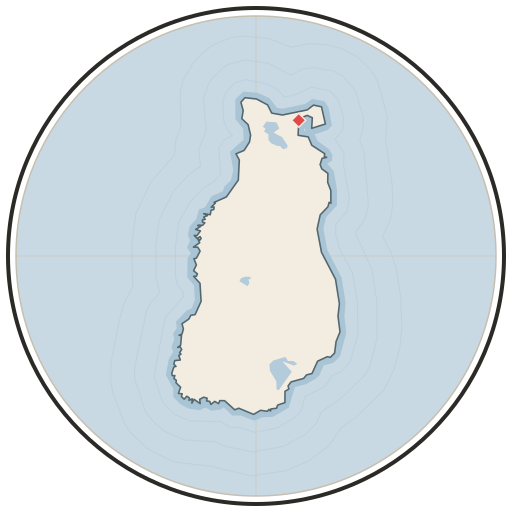
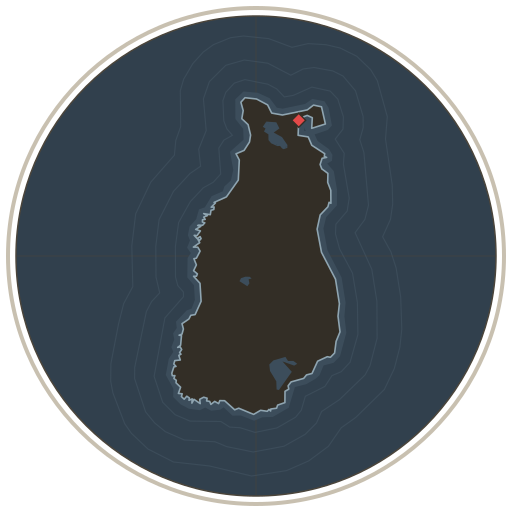
The plates are generated from open data held here, in one cartographic system, and are free to download at print resolution. Every place article carries a locator drawn the same way.
A timeline and an almanac
The same events, read two ways: along a scrubbable axis, and by the day of the year they fall on. Both are built from the articles' own dates, and neither invents precision the source does not have.
Kin diagrams and life strips
A person's family and the span of their life, drawn from the structured frontmatter rather than described in prose, so the shape of a household is visible at a glance.
6,373 media objects have their own citable page — 186 nautical charts, 5,869 catalogue photographs, 70 field recordings, 78 maps — with IIIF tiles where the sheet is large enough to reward it, so a chart can be read at the scale it was engraved at.
Structured data
Every entity has a stable URI under
/id/; the knowledge base compiles to RDF with a SKOS concept scheme; pages carry schema.org JSON-LD. Machines and search engines can read the holdings without scraping the prose.
Media counts are computed at build time from the media manifest. What may be downloaded and on what terms is set out under rights and reuse.