- Born
- 1826
- Died
- 1906-09-15
- Eras
- Irish eraModern era
- Concepts
- maritimereligioncommunityheritage
- Media
- Beaver Island History Map, 1978 revision
Summary
Capt. Henry Bundy (1826–1906) was a Great Lakes mariner who conducted an evangelistic mission from a succession of gospel ships known in sources as both Good Tidings and Glad Tidings. His Beaver Island work is not merely a later local tradition: the September 13, 1883 Christian Cynosure summarized Bundy’s own report that he had begun a promising Sunday school in one island village and ministered in another.1
That contemporary report does not name the villages and does not mention the June 10, 1882 casualty marked on the 1978 Historical Map. The exact incident behind the map’s dagger remains unresolved.
Vessels and spelling
The 1883 Christian Cynosure calls Bundy’s gospel ship Good Tidings. A contemporary July 1883 report in the Manistique Pioneer, quoted by the Schoolcraft County Historical Society, calls the new vessel Glad Tidings; Walter Havighurst’s 1945 account uses the latter spelling for the succession of four mission vessels. Both spellings therefore have historical support and should be searchable rather than “correcting” one away.
The Pioneer report says Bundy sold in fall 1882 the craft on which he and his family had sailed for six years, then built a larger vessel during the winter. That chronology does not exclude a grounding, swamping, or recoverable sinking earlier in 1882, but it makes an unrecovered total loss unlikely.
Beaver Island casualty tradition
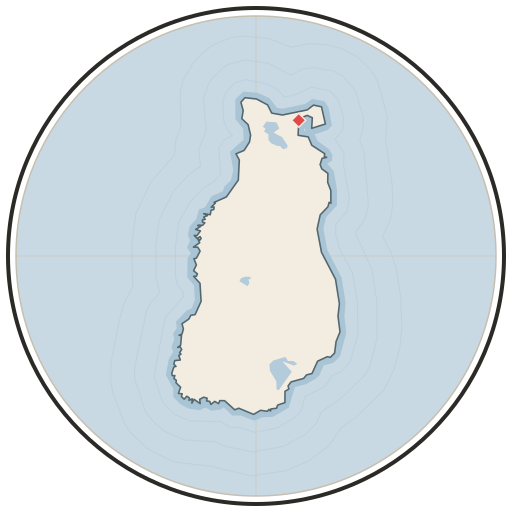
The 1978 map places “Captain Bundy’s Gospel Ship GOOD TIDINGS” off the northwest shore and follows it with a dagger and June 10, 1882. A later Beaver Island Historical Society lighthouse narrative says Harrison “Tip” Miller rescued Bundy and his family when the gospel ship sank, but gives no date or underlying record. Until a Life-Saving Service journal, lighthouse log, marine casualty report, or contemporary newspaper is found, the date, place, casualty type, rescue details, and vessel identity remain a documented local tradition rather than established facts.
Open questions
- Does the June 1882 Beaver Island lighthouse or Life-Saving Service journal record Bundy, his family, and Miller?
- Did the vessel sink, ground, swamp, or suffer damage and then get recovered?
- Which of Bundy’s first two mission vessels was present, and what were its registry and dimensions?
- Which two Beaver Island villages did Bundy’s 1883 report describe?
See also
Footnotes
-
Christian Cynosure, September 13, 1883, p. 13. ↩
Sources
- Contemporary religious press calls him Captain Bundy of the Gospel Ship Good Tidings and summarizes his letter to Chicago Board of Trade president J. B. Hobbs: Beaver Island had no visible drunkenness, Bundy had begun a promising Sunday school in one village, and his ministry had results in another. It does not name either village or mention an 1882 wreck.
- The quoted contemporary report calls the vessel Glad Tidings, says Bundy was already familiar at Manistique, and says he had sold in fall 1882 the vessel used by his family for six years before building the larger 1883 ship. The host article supplies the Henry identification and biographical chronology.
- Near-contemporary regional history describes Bundy’s conversion, mission, and succession of vessels named Glad Tidings, and reproduces portions of Bundy’s February 24, 1883 letter about replacing his too-small second vessel. It provides context but is not direct evidence for a Beaver Island casualty.
- Described in this archive: Beaver Island History Map, 1978 revision.Labels Captain Bundy’s Gospel Ship GOOD TIDINGS and gives a dagger with June 10, 1882. No citation or explanation of the dagger is printed.
Added 7 August 2026. Recent changes
Cite this article
Beaver Island Archive, “Capt. Henry Bundy”, https://beaverislandarchive.org/people/henry-bundy/, accessed [date], citing Christian Cynosure, vol. 15, no. 51, September 13, 1883, p. 13. (and 3 further sources listed on the page).
Last revised 2026-08-07. Fill in [date] with the date you read it — this page is static and cannot know that.