- Rig
- Diesel-powered fishing tug
- Eras
- Modern era
- Concepts
- maritimefishingheritage
- Within
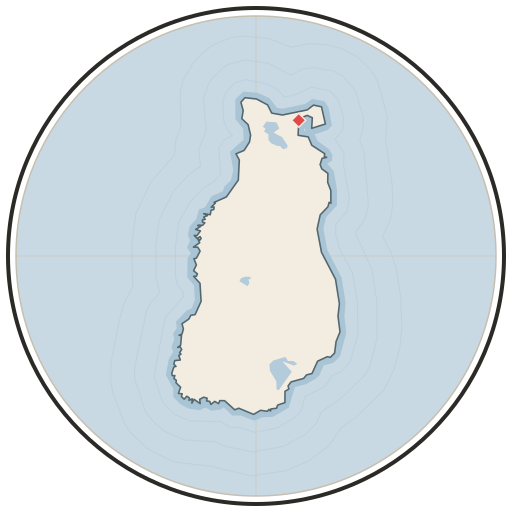
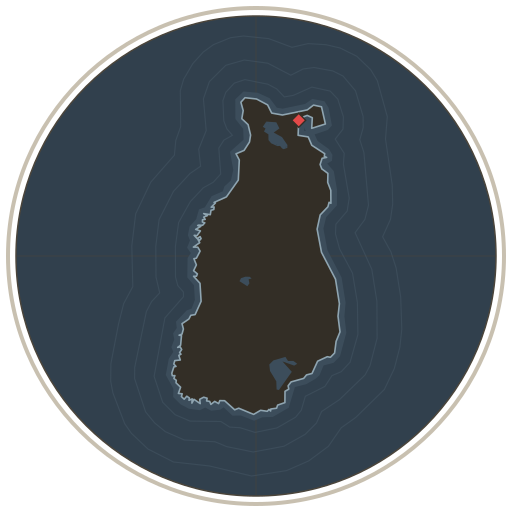
- Beaver Island archipelago
Summary
The Estonia was Arthur “Big Art” Larsen’s diesel-powered fishing tug, remembered in Beaver Island retrospectives as the island’s first diesel-powered fishing outfit. Local Beaver Beacon accounts identify it as the vessel that lifted nets near Gull Island during the Armistice Day storm of 11 November 1940, returned toward Saint James Harbor, broke its moorings as the water rose, and drifted unmanned to beach itself gently at the harbor’s northeastern end, between two older shipwrecks.
History
A 1968 Beacon “Beaver Tales” account gives the fullest narrative. On the morning of the storm, Larsen took the Estonia out to his sets off Gull Island in a flat calm with heavy south swells already rolling up the lake. He had lifted and re-set only four boxes of nets, with thirty-six still out, when he saw what looked less like a dark cloud than a fog bank bearing down from the southwest, and turned for home. Other island tugs — Frank Left’s, Andy Gallagher’s, and Roland McCann’s — came in with him; “Shing” Martin’s tug, the Evelyn, arrived with the storm already on it and ran straight up onto the beach rather than try to tie up. The mail boat Mary Margaret, moored at the old Booth Fish Dock, cast off to ride out the storm in open harbor water as her lines began tearing up the dock; every tug but the Estonia did the same, since the wind by then was too strong for lines to hold. As the harbor rose through the afternoon and evening, the Estonia’s dock lines parted, and — with no one aboard — she backed away from the dock and worked her own way to the harbor’s northeastern end, coming to rest gently on the beach between two older wrecks. By morning the storm had passed; the Estonia and the Evelyn were found high and dry but undamaged, while the docks were battered but repairable.
The storm’s real cost was in fishing gear rather than boats. The June 1964 Beacon obituary “Big Art” gives Larsen’s loss as “nearly seven thousand dollars worth of nets,” while the 1968 account describes forty boxes lost from his sets and puts the value of a ten-box gang at close to $1,200 — figures that describe the same loss at different levels of detail rather than conflicting outright. The 1968 piece calls the 1940 storm a turning point for Great Lakes commercial fishing on the island: gear losses coincided with the onset of sea lamprey predation on lake trout, which the article says “many have speculated” contributed to the trout’s subsequent collapse, though it does not treat that link as established.
Helen Hoffman Collar’s September 1964 retrospective, recalling the St. James harbor of 1915, independently calls the Estonia “the first diesel powered outfit on the Island,” adding that every islander’s children could recognize the distinct sound of their own father’s engine.
A February 1965 “Beaver Tales” column, marking the demolition of the old Gallagher Dock, places the Estonia within that dock’s history. Built at the turn of the century by the Roe Brothers on more than 250 pilings, the dock was bought by Booth Fisheries and managed by “Old” James Gallagher, rebuilt on its original pilings in 1917, and sold in 1933 to “Young” James Gallagher, who also hosted pleasure boaters there as the island’s Yacht Dock. It survived a severe ice shove in the mid-1930s and a high-water threat in the early 1950s, when Gallagher weighted it down with rock, before giving way on 8 February 1965 to an expanded Yacht Dock. The column closes with a roster of “the long list of colorful fish tugs that called it home,” naming the Estonia alongside about twenty other Beaver Island tugs — the Silver Moon, La Fond, Silvia S., Agnes S., Nautilus, Two Sisters, Catherine B., Gypsy, Shirley G., Meadow Mac, Lillian Mae, Silver Star, Lady Agnes, Elliot, the Shamrock, the Evelyn, Irene, Elizabeth G., William J., Panther, and Sidonia — and five boats fished out of High Island. The same “Beaver Tales” column was reprinted, essentially unchanged, in the Beacon’s August 1992 issue, and the Armistice Day storm account was independently reprinted in April 1991, evidence that both stories continued to circulate in the paper’s recurring retrospective feature decades after the events themselves.
Larsen continued fishing until the trout decline made it unsustainable, then worked as a diesel engineer aboard other Great Lakes boats, including the White Swan and the North Shore, before his death on 3 June 1964. He was buried in St. James Township Cemetery on 6 June 1964.
Evidence and limits
The sources establish the name, Larsen connection, diesel description, fishing role, and 1940 storm episode in some narrative detail. They do not establish a registry, dimensions, builder, ownership chain beyond the local retrospective, or the vessel’s later disposition after 1940.
Open questions
- Which registry or shipyard records identify the Estonia?
- When was it built, and what happened to it after the storm and Larsen’s death in 1964?
- Do contemporary 1940 accounts (rather than the 1964–68 retrospectives) survive to corroborate the beaching narrative?
See also
Sources
- Identifies Big Art Larsen’s big diesel tug as the Estonia and reports that it broke its moorings and went high and dry during the 1940 Armistice Day storm; it also gives Larsen’s obituary — born Garden Island 30 January 1898 to Egedius and Christina Larsen, married Sybil Tilley in Charlevoix in 1918, lost nearly $7,000 in nets in the 1940 storm, later worked as a diesel engineer on the White Swan and North Shore, and died 3 June 1964, buried St. James Township Cemetery 6 June 1964.data1 · beaver-island-archive · beaver_beacon · 1964-06_Beaver-Beacon
- The held five-page issue scan is paired with the OCR source and confirms the published notice or report; it does not expand the source-specific identity, event, or outcome claims.data1 · beaver-island-archive · scans · beaver_beacon · issues · 1964-06_Beaver-Beacon
- Recounts the Estonia lifting nets near Gull Island, returning to St. James, breaking its lines as the harbor rose, and beaching at the northeastern end of the harbor.data1 · beaver-island-archive · beaver_beacon · 1968-11_Beaver-Beacon
- The held seven-page issue scan is paired with the OCR source and confirms the published notice or report; it does not expand the source-specific identity, event, or outcome claims.data1 · beaver-island-archive · scans · beaver_beacon · issues · 1968-11_Beaver-Beacon
- Calls the Estonia the first diesel-powered outfit on the Island in Helen Hoffman Collar’s retrospective harbor account.data1 · beaver-island-archive · beaver_beacon · 1964-09_Beaver-Beacon
- The held eight-page issue scan is paired with the OCR source and confirms the published notice or report; it does not expand the source-specific identity, event, or outcome claims.data1 · beaver-island-archive · scans · beaver_beacon · issues · 1964-09_Beaver-Beacon
- A "Beaver Tales" column marking the 8 February 1965 demolition of the old Gallagher Dock (built at the turn of the century by the Roe Brothers, bought by Booth Fisheries and managed by "Old" James Gallagher, rebuilt in 1917, sold to "Young" James Gallagher in 1933, damaged by ice in the mid-1930s and by high water in the early 1950s) to make way for the Yacht Dock. It closes with a roster of the "colorful fish tugs" that worked from the dock, naming the Estonia among about twenty Beaver Island boats and five High Island boats, without supplying registry or technical details for any of them.data1 · beaver-island-archive · beaver_beacon · 1965-02_Beaver-Beacon
- The held eight-page issue scan is paired with the OCR source and confirms the published notice or report; it does not expand the source-specific identity, event, or outcome claims.data1 · beaver-island-archive · scans · beaver_beacon · issues · 1965-02_Beaver-Beacon
- Reprints the same Armistice Day storm narrative as the November 1968 "Beaver Tales" column, near-verbatim, under the same title; it does not add facts beyond the 1968 account and is treated here as a second printing rather than an independent source. The holding institution's portal restricts automated access; the archive holds a copy of this issue and can provide it on request.data1 · beaver-island-archive · beaver_beacon · 1991-04_Beaver-Beacon
- Reprints the same Gallagher Dock history and fish-tug roster as the February 1965 "Beaver Tales" column, near-verbatim, under the same title; it does not add facts beyond the 1965 account and is treated here as a second printing rather than an independent source. The holding institution's portal restricts automated access; the archive holds a copy of this issue and can provide it on request.data1 · beaver-island-archive · beaver_beacon · 1992-08_Beaver-Beacon
Added 1 August 2026 · revised 3 August 2026. Recent changes
Cite this article
Beaver Island Archive, “Estonia”, https://beaverislandarchive.org/vessels/estonia-armistice-storm-1940/, accessed [date], citing Beaver Beacon, June 1964, “Big Art.” (and 9 further sources listed on the page).
Last revised 2026-08-03. Fill in [date] with the date you read it — this page is static and cannot know that.