
- Date
- 1912-08-10
- Eras
- Modern era
- Concepts
- heritagehistoriographymormonismModern era
- Within
- Holy Island
Summary
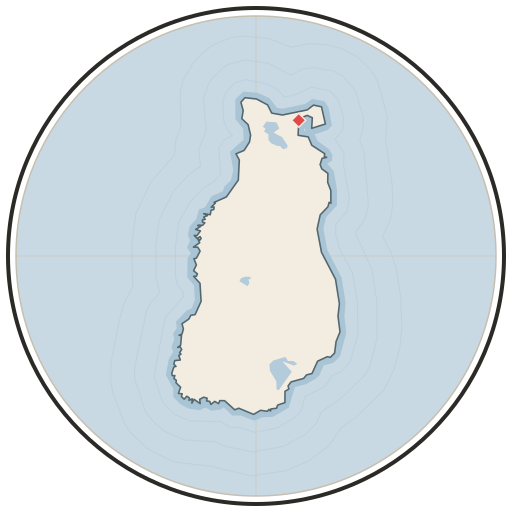
“Treasure on Holy Island” is the earliest explicit Holy Island treasure account currently held. Published in 1912 during the island’s resort development, it says Strang’s followers buried valuables identifiable as stolen when a government vessel approached. It also describes ruins, arches, fortifications, and old excavations through local tradition.
Evidentiary character
The article appeared fifty-six years after Strang’s death. Its Strangites-as- pirates framing belongs to a long hostile narrative, and no contemporary Strangite account, government inventory, sworn testimony, or archaeological report held here verifies the cache. The source is valuable evidence for what people were saying in 1912 and how history was used to make a resort property interesting.
That promotional context is independently visible in nearby advertisements offering a free illustrated history of Holy Island and “King Strang’s Buried Treasure.” It does not make the story worthless; it tells us to ask why this particular version was useful at that moment.
Open questions
- Does a copy survive of I. B. McLean’s illustrated promotional booklet?
- Can the reported ruins or excavations be matched to a survey or archaeological record rather than promotional prose?
See also
Sources
- “Treasure on Holy Island,” *Charlevoix County Herald*, August 10, 1912.Held OCR of the newspaper issue. Establishes what was printed in 1912, not the truth of the alleged Strang-era theft, fortification, or burial. No public copy of this file is known; the archive holds one and can provide it on request.
Added 1 August 2026. Recent changes
Cite this article
Beaver Island Archive, ““Treasure on Holy Island”, 1912”, https://beaverislandarchive.org/documents/treasure-on-holy-island-1912/, accessed [date], citing “Treasure on Holy Island,” *Charlevoix County Herald*, August 10, 1912..
Last revised 2026-08-01. Fill in [date] with the date you read it — this page is static and cannot know that.
BibTeX for ““Treasure on Holy Island”, 1912”RIS for ““Treasure on Holy Island”, 1912”