- Born
- 1813-03-21
- Died
- 1856-07-09
- Work
- Lawyer · Newspaper editor · Michigan state legislator
- Member of
- Church of Jesus Christ of Latter Day Saints, Strangite
- Eras
- Strang era
- Concepts
- mormonismreligionmonarchygovernancetoponymyhistoriography
- Within
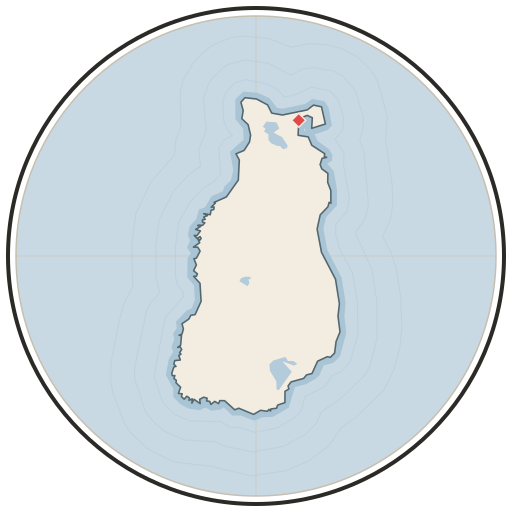
- Beaver Island
- Media
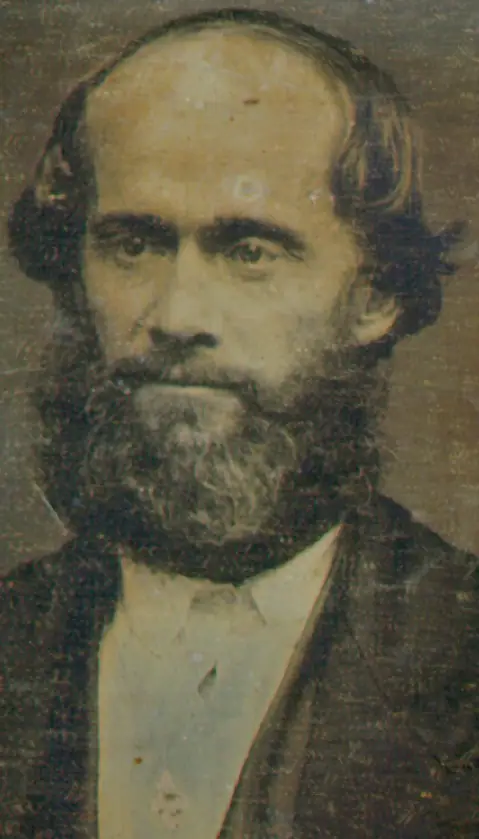
- "James Jesse Strang, the Mormon King" — plate from A Child of the Sea (1905) · James Jesse Strang, daguerreotype, 1856 · The Voree Plates (Record of Rajah Manchou of Vorito), broadside · United States v. James J. Strang and others, 1851: obstructing the mail · United States v. James J. Strang and others, 1851: trespass on public lands (case A) · United States v. James J. Strang and others, 1851: trespass on public lands (case B) + 1 more
Summary
James Jesse Strang (21 March 1813 – 9 July 1856) was a lawyer, newspaper editor, Latter Day Saint prophet, Michigan state legislator, and — from 8 July 1850 — the crowned king of a theocratic settlement on Beaver Island. He claimed to have been appointed Joseph Smith’s successor by a letter written at Nauvoo on 18 June 1844, days before Smith’s death; the claim was rejected by Brigham Young and the Twelve, and Strang was excommunicated. He gathered his followers first at Voree, Wisconsin, then from 1847–48 on Beaver Island, where he named the harbour settlement Saint James, printed the Northern Islander, was twice elected to the Michigan House of Representatives, and was shot by two of his own former followers on 16 June 1856. He died of his wounds 23 days later, on 9 July, at Voree, and his followers were driven from the island within days.
Almost everything else about him is contested. The contemporary press was uniformly hostile; his own newspaper was his personal organ; and the later literature runs from Milo Quaife’s sardonic 1930 Yale narrative to frank vindications. This article attributes rather than adjudicates.
History
Early life and law
Strang was born on Poplar Ridge Road in the town of Scipio, Cayuga County, New York, on 21 March 1813, and was named Jesse James Strang after his maternal grandfather; he reversed the order of his given names in the early 1830s.1 The 1892 Michigan Pioneer sketch — drawing on a manuscript biography by his son Charles J. Strang — records that he joined the Baptist church at twelve, began reading law at twenty-one with borrowed books, was admitted to the bar two years later, married Mary Perce, practised law at Mayville and Ellington, edited a paper at Randolph, held the postmastership at Ellington, and in 1843 emigrated to Burlington, Racine County, Wisconsin, entering a law partnership with C. P. Barnes.2 Quaife gives the marriage to Mary Perce as 1836, in western New York.3
Conversion and the succession claim
The 1892 sketch dates his baptism into the Latter Day Saint communion to 25 February 1844 and his ordination as an Elder to 3 March 1844; Quaife adds that he was baptised by Joseph Smith himself and later ordained an elder.24 Smith was killed by a mob at Carthage, Illinois, later that June.2 Strang produced a letter, dated Nauvoo, 18 June 1844, which he said reached him at Burlington on 9 July, appointing him to plant a stake of Zion in Wisconsin; he read it as designating him Smith’s successor in the prophetic office.25 The 1892 sketch reports that the surviving original carries a postscript, omitted from Strang’s printed version, asking for occasional reports of progress — which, its author argues, reads more like the establishment of a branch than a transfer of the presidency, and whose suppression “was intentional.”2 The Strangite church maintains to this day that Strang “was the only person who claimed a direct appointment by the founding prophet.”6 The authenticity of that letter is the central unresolved question of the whole Strangite literature, and nothing consulted here settles it either way.
Defeated at Nauvoo and excommunicated, Strang returned to Wisconsin and founded the city of Voree at what is now Spring Prairie.2 There he brought forward the “Voree plates” (September 1845) and the Voree Herald, which he began in January 1846 and which ran, under changing titles — Zion’s Reveille, then the Gospel Herald — until its last number on 6 June 1850.78
Beaver Island
By Strang’s own 1854 account he landed on Beaver Island on 11 May 1847 with four companions — Gordon Brown, Nathan Wagner, R. Frederick Mills and William Savage — so short of means that they sold their blankets to pay their passage and went ashore “with less than two days provision, and not one cent of money.”9 The first Mormon winter on the island counted five men and their families, eighteen persons in all; the next winter, sixty-two persons.9 Elizabeth Whitney Williams, writing as a hostile witness in 1905, dates the arrival of Strang’s party from a steamer to the early part of June 1848 — about twenty-five people, with over a hundred more before navigation closed.10 The two accounts describe different events (a 1847 exploring party and an 1848 migration) and are not necessarily in conflict.
On 8 July 1850, in the uncompleted tabernacle at Saint James, Strang was crowned. Quaife’s account: a portion of the newly revealed Book of the Law of the Lord was read; four hundred spectators covenanted to live by it; Strang, in a robe of bright red, was escorted to a platform; George J. Adams acted as master of ceremonies; and the ceremony concluded with “placing on the brow of Strang a crown of metal with a cluster of stars in front.”11 The warrant Strang published for this was chapter XX of the Book of the Law of the Lord: “He hath chosen his servant James to be King: he hath made him his Apostle to all nations: he hath established him a Prophet, above the Kings of the earth; and appointed him King in Zion.”12
He introduced polygamy in his own household from 13 July 1849, when he married Elvira Field; Betsy McNutt followed on 19 January 1852, and Sarah and Phoebe Wright in 1855 (15 July and 27 October respectively, on Charles J. Strang’s family record).13 Quaife estimates that plural marriage prevailed in only about one family in twenty-five on the islands.3
Courts, politics and the press
In 1851 the United States district attorney George C. Bates went to Beaver Island aboard the armed steamer Michigan with warrants charging Strang and others with treason, mail robbery, counterfeiting and trespass on public lands; over a hundred Mormon men and women were carried to Detroit.14 Strang appeared for himself before Judge Ross Wilkins and was acquitted, a result the 1892 sketch says “greatly strengthened Strang’s hold upon the reverence of his followers.”2
At the election of 2 November 1852 he stood for the State Assembly from the Newaygo district, keeping his candidacy secret until election day and receiving every one of the 165 votes cast at the Beaver Islands.15 His seat was contested; the 1892 sketch records that he was admitted by a vote of 49 to 11.2 He was re-elected in 1854 with 695 votes from Emmet and Cheboygan counties.16 During his terms Emmet County was organised (act of 29 January 1853) and the Beaver, Fox and Manitou groups were subsequently detached as the new county of Manitou.16 From 12 December 1850 he published the Northern Islander at Saint James — see Northern Islander, 1850–1856.
Assassination and death
Strang was shot on the dock at Saint James on the evening of 16 June 1856 by Thomas Bedford and Alexander Wentworth, and died at Voree, Racine County, Wisconsin, on 9 July.1718 See Assassination of James Strang. He was buried in the Voree cemetery; the Saints’ title to the ground was never perfected, and Quaife reports that the plot containing the grave was later acquired by a neighbouring farmer and turned into a cowyard, after which a daughter had the body removed to the Burlington cemetery.19
He named no successor. Quaife’s judgement — offered as a judgement, not a fact — is that this refusal, not the mob, destroyed the church: “The man who brought it into being is the man who sealed its doom.”20
Names
Strang’s naming programme is visible on modern maps. The harbour settlement was named Saint James for him; Lake Geneserath and the Jordan River survive as official GNIS names; Mount Pisgah Bay survives only as a GNIS variant of Donegal Bay; and the two townships of Emmet County covering the Beaver Islands were named Peaine and Galilee — the latter the Strang-era name of what is now the Township of Saint James.21 Pine Lake on the mainland was for a time renamed Lake Mormon and carried a “Holy Island.”22
Significance
Strang is the reason Beaver Island has a documentary record at all for the years 1847–1856: the press he brought produced the first newspaper published in northern Michigan, and the controversy he generated put a remote fishing station into the national press for a decade. The island’s toponymy, its township names, its county history and the surviving Mormon Print Shop all date from his eight years there.
Open questions
- The letter of appointment. Its authenticity has never been settled and probably cannot be from the material held here. The 1892 sketch describes an original with a suppressed postscript; Quaife prints a transcript as his Appendix III; the Strangite church treats it as genuine. No image or forensic examination is held here.
- Population. Every figure for the kingdom traces back to Strang’s own census and newspaper. See Kingdom of Saint James for the numbers and the objections to them.
- The Smithsonian paper. Strang’s “Some Remarks on the Natural History of Beaver Islands, Michigan,” dated at Saint James on 7 December 1853, was published in the Smithsonian’s Ninth Annual Report (1854), pp. 282–287. It is a contemporary, Strang-authored source rather than an independent ecological or social account; see James J. Strang’s “Some Remarks on the Natural History of Beaver Islands, Michigan”, 1853.
- Number of children. Quaife’s per-wife counts total fourteen; the 1892 sketch says “five wives and twelve children.” Neither has been reconciled here.
- Burial. The present location and marking of the grave in the Burlington cemetery is not established from any source held here; Quaife (1930) reported it unmarked, with a note added at press time that a subscription for a monument had been opened.
See also
Sources
Footnotes
-
Quaife, The Kingdom of Saint James (1930), pp. 1-2 and p. 1 n. ↩
-
“Sketch of James Jesse Strang and the Mormon Kingdom on Beaver Island” (1892), reprinted from Michigan Pioneer and Historical Collections, XVIII. ↩ ↩2 ↩3 ↩4 ↩5 ↩6 ↩7 ↩8
-
Ibid., p. 10. ↩
-
Ibid., Appendix III, “Joseph Smith’s Letter of Appointment,” p. 235. ↩
-
“About Us,” The Church of Jesus Christ of Latter Day Saints (Strangite), retrieved 28 July 2026, https://www.ldsstrangite.com/about-us.html. ↩
-
Ibid., pp. 185-186. ↩
-
Gospel Herald, vol. 2 no. 27-28, Voree, W. T., 23 September 1847 (masthead and imprint). ↩
-
James J. Strang, Ancient and Modern Michilimackinac (1854), section “Mormon Settlement in Emmet.” ↩ ↩2
-
Elizabeth Whitney Williams, A Child of the Sea; and Life among the Mormons (1905), p. 63. ↩
-
Ibid., pp. 92-95. ↩
-
The Book of the Law of the Lord, chapter XX, “Calling of a King,” verse 6, pp. 168-169. ↩
-
Ibid., pp. 109-110. ↩
-
Ibid., pp. 130-133. ↩
-
Ibid., p. 143. ↩
-
“Shooting of James J. Strang,” New-York Daily Tribune, 21 June 1856, p. 5, https://www.loc.gov/resource/sn83030213/1856-06-21/ed-1/?sp=5. ↩
-
“Death of King Strang,” New York Herald, 15 July 1856, p. 5, https://www.loc.gov/resource/sn83030313/1856-07-15/ed-1/?sp=5. ↩
-
Ibid., p. 179. ↩
-
Ibid., p. 183. ↩
-
Ibid., p. 159 n. ↩
-
Ibid., pp. 157-160. ↩
Sources
- External entity identifier only; historical claims remain grounded in the sources below.
- Described in this archive: The Kingdom of Saint James, Quaife, 1930.Scholarly secondary source, built on the Strang manuscripts then in Quaife's own possession. Basis for birth, name reversal, coronation date, marriages, the 1851 federal prosecution, the legislative career, and death. Quaife is not neutral - he calls the coronation crown "tinsel" and the spectators "credulous" - and is used here for dates and documents rather than for judgement.
- Reprints a *New York Times* letter of 3 September 1882 based on material collected by Henry A. Chaney and Charles K. Backus, itself drawing on a manuscript biography by Strang's son Charles J. Strang. Basis for the early legal career, the 1844 baptism and ordination dates, the legislature vote of 49 to 11, and a full reprint of the *Northern Islander* assassination report.
- Described in this archive: Ancient and Modern Michilimackinac, 1854.Strang's own account of the first landing on Beaver Island (11 May 1847), his four companions, and the settlement's early population. A partisan source written by the subject.
- Described in this archive: Northern Islander, 1850–1856.Strang's own newspaper. Masthead and imprint confirm the paper was "published weekly, at St. James, Beaver Island, Lake Michigan, by Cooper & Chidester."
- Contemporary national press. Fixes the date of the shooting at 16 June 1856.federal · chronicling_america · sn83030213_1856-06-21_ed1_p5
- Reports "Strang, of Beaver Island, died at his former residence, Racine County, on Wednesday last" - i.e. 9 July 1856.federal · chronicling_america · sn83030313_1856-07-15_ed1_p5
- The scriptural warrant Strang claimed for the kingship, in his own published translation.
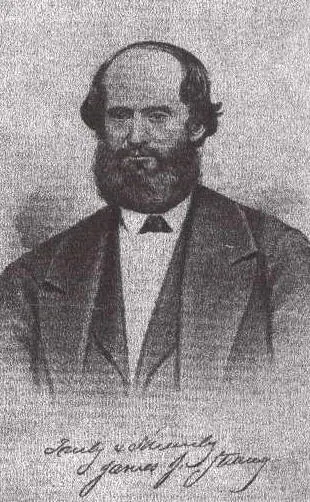
- Verified by opening the file: a half-length halftone portrait of a bearded man in suit and bow tie, with the sitter's own signature reproduced beneath it reading 'Yours truly, James J. Strang'. The signature is the identification; no third-party collection watermark appears on the image. Strang died in 1856, so the underlying portrait is long out of copyright; the gallery copy is published under the Beaver Beacon collection policy recorded in publish/rights_overrides.yaml.

Added 28 July 2026 · revised 2 August 2026. Recent changes
Cite this article
Beaver Island Archive, “James Jesse Strang”, https://beaverislandarchive.org/people/james-jesse-strang/, accessed [date], citing Wikidata, James Strang (Q1142551), retrieved 2026-07-31. (and 8 further sources listed on the page).
Last revised 2026-08-02. Fill in [date] with the date you read it — this page is static and cannot know that.