- Eras
- Strang eraEarly American era
- Concepts
- Strang eramormonismmonarchygovernancestrangite-communitygentile-tradersreligionpublicationwoodingfishingdemographyhistoriographymigration
- Within
- Beaver Island
- Media
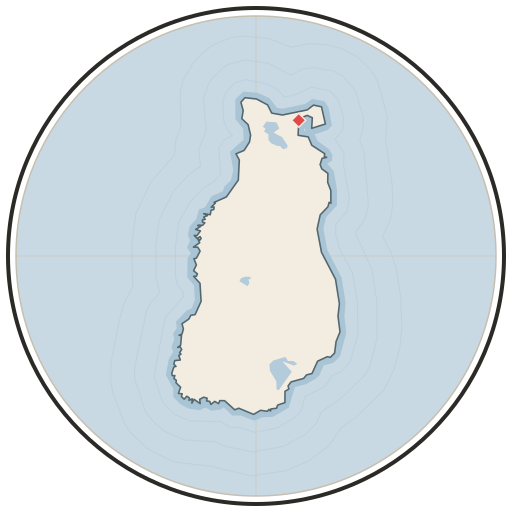
- Beaver Island History Map, 1978 revision
Summary
The Strang era is the nine years between 11 May 1847, when James Jesse Strang landed on Beaver Island with four companions, and July 1856, when the last of his followers were put aboard steamers and taken off it. In that time a fishing station with a few dozen winter residents became the seat of Emmet County, the home of the Northern Islander, and from 8 July 1850 the capital of a proclaimed kingdom. Strang was twice elected to the Michigan House of Representatives, organised the county by statute, renamed the island’s geography after the Bible, and was shot on his own dock by two former followers who were never tried.
The period is documented from two directions and neither is disinterested. The fullest contemporary account of the settlement’s origins is Strang’s own book of 1854, at once a regional history, a settler’s prospectus and a brief for the defence. Against it stands a mainland and national press that ran the kingdom as a scandal serial for six years and, in at least one column quoted below, printed as certain what it had reported as rumour twenty lines earlier. The standard modern narrative, Milo Quaife’s of 1930, was built from Strang’s surviving papers and from interviews with elderly Strangites, and is opinionated throughout.
Three questions in particular do not resolve. The criminal reputation of the community rests on accusations that named no stolen article when Strang demanded a list, and on a federal prosecution that produced no conviction; Strang’s denials are Strang’s. The extent of plural marriage is known only from Strangite informants, and the ratio usually quoted divides one of their figures by a population estimate drawn from Strang’s own census. The instigation of the assassination is contested between a scholar who names Dr. Hezekiah McCulloch as the man who conceived it and an eyewitness who has the same man attending the wounded prophet. What the era left is more legible than what it was: two township names, a set of biblical place names still carried by federal maps, a print shop, and a documentary record thick enough to argue over.
The island Strang found
When the Beaver Islands were erected into the township of Peaine in 1847, the non-Anishinaabe population of the whole archipelago amounted, by Strang’s count, to three white families settled temporarily, four or five white men with Indian wives, several French half-breeds, and twenty or thirty single men wintering there. The township was not their idea. It was granted at the instance of Col. Fisk of Rochester, New York, whose company had put ten thousand dollars into a fishing establishment at the harbour; his associates held every township office and, Strang writes, neglected the public business until the Mormons elected a majority of the officers in 1850 and all of them in 1851.1
Anishinaabe people had been in the archipelago long before either group and remained after both. Strang’s gazetteer counts five villages in Emmet County with about two thousand people in all, one of them on Garden Island, and records that the Garden Island community “formerly resided on the North end of Beaver Island, and have removed to Garden within six years” of his writing.2 He states the move and offers no cause. That history, the limits of a corpus written almost entirely by settlers, and the tribal preservation interest in the archipelago’s cultural resources are surveyed at Anishinaabe presence in the archipelago.
The federal land sale of 1848 shaped everything after it. By Strang’s account the fishermen, numerous because it was the fishing season, each marked a claim on the best quarter section he could find and then proposed that every claim be respected at the sale whether occupied or not. The Mormons agreed, and afterwards found the desirable locations covered by claims “many of them merely fictitious,” which they were then not at liberty to disregard. Thomas and Samuel Bennett entered three lots on which Mormons had built houses; the occupants gave up the land and left the crops unharvested. The Mormons secured one small lot at the harbour.3 No account of that sale from the other side is held here.
Taking possession, 1848-1852
The migration itself is surveyed at Migration and settlement. What belongs here is the friction it generated, which Strang set down in detail and which nobody set down from the other direction.
In 1849 the settlement moved inland: a road cut through the swamp to the agricultural land in the interior, a steam sawmill begun, a small schooner built, and about a hundred emigrants arriving from Voree. Steamboat captains, Strang writes, worked against the settlement, carrying past emigrants who had contracted to be landed at Beaver, and late that autumn the traders announced that they would sell no provisions to the Mormons over the winter.3 The winter that followed produced a catalogue of small violence: a man beaten for refusing to stop getting out timber for the Tabernacle, a debating school broken up, letters taken from Mormons at the post office, and a cow Strang had left for a woman with palsy driven off and sold to a fisherman who said he “would kill any damned Mormon who came for her.” Until the spring of 1850, Strang writes, his people held to non-resistance. Then they announced publicly that they would return blow for blow, and posted guards with heavy canes in the aisles at meetings.4
The confrontation that followed is the clearest single episode in Strang’s account. In May 1850 a general invitation went out on the fishing grounds to come to Whiskey Point for a Fourth of July celebration “to be consummated by the expulsion of the Mormons,” with material aid from Mackinac and vessels engaged to lie in the harbour. The Mormons called a general assembly, bought a cannon, enrolled a guard, anchored an armed schooner with men below deck, and on the night of 3 July sent a party to listen at the gathering and pour some of its powder into the lake. At dawn they fired a national salute whose balls skipped along the water within two rods of the Point, and warned Peter McKinley, the proprietor there, that the first gun fired would be the signal for destroying his establishment. Two vessels and sixteen boats came in from the fisheries with men and a cannon of their own. The attack never came; the party could not agree on a leader, had brought no provisions, and dispersed.5 Four days later, in the unfinished tabernacle, Strang was crowned king. See Coronation of James Strang.
Pressure continued in both directions until the gentile fishing population left the island. By the autumn of 1852 the antagonism had shifted to the mainland shore, where a Mormon officer serving warrants for theft at Pine River found that “almost the entire population” had gone into the woods at his approach, and where the Northern Islander called the settlement “little else than a band of vagabonds and thieves.”6 The sequel was the ambush of Emmet County’s sheriff on 13 July 1853; see Battle of Pine River.
Government, press and economy
Strang’s authority ran on two tracks that are treated in full at Kingdom of Saint James: church law over the faithful, and the ordinary machinery of Michigan township and county government over everyone else. He was elected to the state legislature in 1852 and again in 1854, and he used the seat. Emmet and Charlevoix counties were united and organised as Emmet by an act he introduced and advocated in 1853, carried with only seven votes recorded against it in the House. It was understood by every member, he writes, “that nearly its entire population were Mormons” and that the legal administration of its affairs would be in their hands.7 The jurisdictional relationship between the island and outside authority is surveyed at Law, courts, and external government.
The island’s economy in the same years was wood, fish and print. Strang’s gazetteer describes Saint James as the county seat and the seat of the Lake Michigan fishing trade, with one sawmill, a great number of fish barrels, some boat building and “three large wharves … devoted to the wood business”; Galilee at the south-east extremity had one business only, “getting out wood for steamboats.” Two roads ran the length of the island, and nearly the whole of it was laid out in farms abutting them, fifty to eighty rods wide and one to two miles long.8 The press at Saint James, which Quaife calls “the first newspaper published in northern Michigan,” had been running four years by then.9 The wood trade is surveyed at Lumbering, the fisheries at Commercial fishing, the press at Print and publication, and the renaming programme at Strang's biblical toponyms.
Two figures for the island’s trade circulated in November 1854 and both are Mormon in origin. Strang, in a letter to the Buffalo Republic reported in the Washington Evening Star, put the island’s supply to steamers at 20,000 cords of wood a year and its annual fish sales at $175,000.10 A paragraph from the Chicago Journal, reprinted the same month, repeats those totals and adds four wharves built within four years and a school library of 369 books in eleven languages.11 Nothing held here audits either.
How many people
The Northern Islander of 2 November 1854 printed the Michigan state census returns for Emmet County: Peaine 2,020, Galilee 588, Charlevoix 1,706, unorganized territory 657, a county total of 4,911.12 The two island townships give 2,608, and that is the number the later argument runs on. Quaife took it from this issue, assumed a considerable increase during 1855 and a gentile population on the island of “but a handful,” and arrived at approximately 2,600 people driven out in 1856.13
This distinction matters when reading the 1978 Historical Map. Its Strang-era annotation says the colony grew to “2600 members,” but the nearby contemporary number is 2,608 residents reported for Peaine and Galilee townships—not a church-membership roll. The map’s other clauses can be checked more directly: the Northern Islander documents the settlement’s own press, and Strang’s 1854 gazetteer describes Saint James as the seat of Emmet County. Its phrase “industriously developed the Island” is an interpretation; the source-based version is the specific record of roads, farms, mills, wharves, fishing, wooding, and printing described above.
Two other figures do not fit it. The Chicago Journal paragraph of the same month gives “the civilized and settled population of Big Beaver island by the census of last May” as “something over nineteen hundred,” and separately counts one to three hundred fishing boats in the archipelago “manned by Indians, half-breeds, French, and others having no connexion with the Mormons.”11 The manifesto printed by the party that took the island in July 1856 alleged that the Emmet County returns made under Strang’s own hand “show an aggregate population of 7,000, whilst in reality it falls below 1,000”; the county total printed in Strang’s own paper is 4,911, not 7,000.14 Whether the manifesto describes a different return, a later one, or nothing at all is not established from anything held here. The figures and the objections to them are tabulated at Kingdom of Saint James, and the island’s longer population record at Demography.
Crime, law and reputation
The charge that the settlement was a criminal enterprise was made continuously from 1850 and was never tested to a conviction in any proceeding recorded here.
Its clearest surviving statement and its clearest rebuttal sit together in Quaife’s appendices. The Buffalo Rough Notes of 27 July 1852 wrote that the Mormons “have now driven off all the fishermen from the Island, stolen most of their property, and make a business of appropriating whatever they can lay hands on belonging to the boats which call there,” that they came to the dock armed whenever a boat touched, and that something should be done “to check the highhanded proceedings of this piratical band of desperadoes.” Strang answered in his own paper on 9 September, point by point, demanding particulars: name the fishermen driven off; “Name a thing, one single article, that Mormons have laid felonious hands on”; name the boat approached by armed men, when a hundred steamboats had called that season and their officers were frequently in Buffalo.15 Six months earlier the Islander had published a tally of the prosecutions: Strang six times imprisoned, charged in fourteen indictments and taken on forty criminal charges in less than a year; McCulloch committed five times; fifteen men named as charged with murder, of whom thirteen were held ten weeks. Its conclusion was that “such a vast number of arrests without a single conviction ought to satisfy our most violent enemies that we are maligned and falsely accused.”16
The largest of those proceedings was federal, and is treated at Federal prosecution of Strang and associates, 1851 and Law, courts, and external government. Two details belong here. The Detroit Advertiser reported eight named men brought to Detroit under indictment with Strang for making and passing counterfeit coin, obstructing the mails, and stripping government land of timber, and called Strang’s “pretense of persecution” shallow and false.17 The mail charge alleged an armed attack on the mail train crossing the ice in front of the Anishinaabe village on Garden Island on 18 February 1851; Strang’s later answer was that the assistant postmaster who swore to the attack conceded on cross-examination that he had entrusted the same mail to Mormons on a Mormon-owned schooner that April, and had sent every mail but one by Mormon hands for the eight months before the prosecution began.18 The case ended in acquittal.
Strang’s counter-narrative was that the thefts were real and the thieves were the fishermen. He describes fourteen thousand feet of lumber landed at Whiskey Point in 1850 of which under a thousand remained weeks later, more than twenty shanties on remote fisheries found floored with it and the marks not even obliterated, Mormon gardens and potato fields stripped in 1853, and lifted nets. His set-piece is Henry Van Allen, keeper of the Beaver Island light, who he says had concealed eighteen of Benjamin G. Wright’s stolen nets in the light house, offered to return them when his own nets went missing, was prosecuted, gave bail and left the country.19 Van Allen was the station’s first keeper and served 1851-52, which is consistent; see Beaver Island Light Station. The charge itself rests on Strang alone.
The way an allegation hardened is visible in a single column of the Hillsdale Standard for 23 October 1855. It opens with a gang “who are reported to be Mormons from Beaver Island” robbing stores between the Grand River and the Kalamazoo, and closes, twenty lines later, with “there seems to be no question as to the identity of the robbers, or their hailing place. They are emmissaries from King Strang’s realms.”20 A hostile retrospective of 1907 makes a similar move for an alleged 1855 fight and burning; see Alleged Capture and Burning of the Eclipse.
One piece of evidence cuts across both narratives. In the Voree years, before the move to the island, Strang’s own church council tried John W. Crane on nine charges, among them heresy “in teaching that it is right to plunder unbelievers.”21 The doctrine existed to be condemned. What that establishes is that the church formally rejected it, not what any member did on the water.
Discipline inside the kingdom
The Book of the Law of the Lord devoted a chapter to apparel. It prohibited “every form of dress which pinches or compresses the body or limbs,” inveighed against bell-crowned hats, enormous sleeves and hoop skirts, and prescribed for women a short skirt with pantalet trousers. Quaife’s informant Wingfield Watson, who lived on the island from 1852 to 1856, told him the Mormon women genuinely liked the dress and gave it up with regret; the Islander of 1 May 1856 held one woman up to public scorn for refusing it, and Quaife reports from several sources that Thomas Bedford encouraged his wife in the same refusal.22 Punishment for other offences ran to corporal sentences unknown to state law: an offender convicted in April 1856 of “lying, tale-bearing, and endeavoring to incite to mischief and crime” was given thirty-nine lashes with birch rods after a hearing.22 Quaife writes that one of the two men who later shot Strang had been severely whipped and “rightly enough” ascribed the responsibility to him.22 Bedford’s flogging is sourced four incompatible ways and is treated in full in his article.
Resistance from inside is thinly evidenced, and the fullest account of it is hostile. Elizabeth Whitney Williams records Mrs. Campbell’s account of women who carried their family Bibles to the temple and read against the king’s exposition of the polygamy law, going “with fear and trembling, not knowing sometimes whether she would ever return to her home,” and who concluded that “Strang began to find his power was not absolute.”23 Williams also has Mrs. McCulloch ridiculing the dress rule, wearing long dresses on her annual trips to Baltimore and the prescribed short dress on the island, as she said, “just for fun.”24 The religious substance of Strang’s church, as distinct from its government, is surveyed at Religion and congregations.
Collapse and afterward
James Jesse Strang was shot from behind on the dock at Saint James on the evening of 16 June 1856 by Bedford and Alexander Wentworth, who ran aboard the Michigan, were carried to Mackinac, and were released without trial. Williams records Dr. Hezekiah D. McCulloch arranging for the wounded man to be put on a mattress and taken by steamboat to his first wife in Wisconsin.25 Strang died at Voree on 9 July, twenty-three days after the shooting, without naming a successor. Within three weeks the Mormon population was off the island: some left voluntarily on the Louisville and the Iowa, and the remainder were ordered to the harbour by an armed party from the mainland and put aboard whatever steamers came in. See Assassination of James Strang and Expulsion of the Strangites.
The ground did not stay empty. Irish families, chiefly from Arranmore in County Donegal, resettled the island; see Irish settlement of Beaver Island. What became of the church is treated at Church of Jesus Christ of Latter Day Saints, Strangite; the biblical names still carried by federal maps at Strang's biblical toponyms; the folklore of buried Mormon treasure at Strang treasure traditions; and the literature that followed at Historiography.
Open questions
- The crimes. No conviction is recorded in any source held here, across a federal prosecution, a murder indictment of fifteen men, and six years of press accusation. Strang’s tally of arrests without convictions is Strang’s own, printed in his own paper; the Buffalo Rough Notes named no article of stolen property when challenged; and Strang’s counter-charges against named fishermen rest on the same single source. Nothing held here establishes either that the community was a criminal enterprise or that no member of it stole anything. A court record from Mackinac or Emmet County would move the question.
- The extent of polygamy. Every figure traces to a Strangite source. Quaife writes that there were “never more than eighteen or twenty polygamous families at the Beaver Islands,” on the authority of Wingfield Watson’s statement to him; an 1892 sketch quotes a manuscript by Strang’s wife saying there were “never over 20 cases.”26 Quaife’s frequently quoted ratio of one family in twenty-five is arithmetic on that figure and on a population estimate itself derived from Strang’s own census.27 No outside enumeration of the practice is held here.
- Who instigated the assassination. Quaife names McCulloch flatly: “he was the real assassin of Strang,” the man whose “vengeful brain … conceived the plot.”28 Williams, writing from the gentile side, has the same man dressing the wounds and arranging the removal to Wisconsin.25 The two are not reconcilable, and the summons that brought Strang to the dock is unexplained in every account.
- The population figures. “Something over nineteen hundred” for Big Beaver Island by a May 1854 count and 2,608 for the same island in the same autumn are roughly seven hundred apart, and the earlier figure carries a qualifier (“civilized and settled”) that the later table does not. Nothing held here reconciles them, and the manifesto’s “7,000” matches no return in this corpus.
- The other side of 1848-1852. The land sale, the provisioning boycott, the winter harassment and the failed Fourth of July attack are known almost entirely from one interested witness. A trader’s letterbook, a Mackinac county docket, or the Rochester company’s records would test the account that this article has had to attribute to Strang line by line.
- Anishinaabe relations with the kingdom. The detailed accounts are Strang’s, written by the man whose settlement was the other party to them. See Anishinaabe presence in the archipelago for the documentary gap in full and for the tribal preservation interest that governs work on it.
See also
- Kingdom of Saint James
- Church of Jesus Christ of Latter Day Saints, Strangite
- James Jesse Strang
- Coronation of James Strang
- Battle of Pine River
- Assassination of James Strang
- Expulsion of the Strangites
- Historiography
- Anishinaabe presence in the archipelago
- Strang's biblical toponyms
- Migration and settlement
- Northern Islander, 1850–1856
- Ancient and Modern Michilimackinac, 1854
Sources
Footnotes
-
James J. Strang, Ancient and Modern Michilimackinac (1854), section “Emmet County,”
data/books/internet_archive/ancientmodernmic00stra/. The held OCR does not preserve reliable printed folios for this section. ↩ -
Ibid., section “Indian Population of Emmet.” ↩
-
Ibid., section “Resistance of Aggression by the Mormons.” ↩
-
Ibid., section “First Attempt to Drive the Mormons from Beaver.” ↩
-
Ibid., pp. 153-154, quoting the Northern Islander of 11 November ↩
-
Ibid., sections “Emmet County” and “Strang in the Legislature.” ↩
-
Ibid., section “Big Beaver.” ↩
-
Ibid., Appendices, p. 186. ↩
-
Evening Star (Washington, D.C.), 9 November 1854, p. 2, https://www.loc.gov/resource/sn83045462/1854-11-09/ed-1/?sp=2. ↩
-
“The Mormons on Beaver Island,” Daily National Intelligencer, 17 November 1854, p. 2, credited to the Chicago Journal, https://www.loc.gov/resource/sn83026172/1854-11-17/ed-1/?sp=2. ↩ ↩2
-
“Population of Emmet,” Northern Islander, 2 November 1854,
data/books/internet_archive/NorthernIslander18501856/. ↩ -
Ibid., pp. 174-175, citing the Northern Islander of 2 November 1854. ↩
-
“From Beaver Island: King Strang’s Mormon Settlement Broken Up,” New York Herald, 14 July 1856, p. 8, reprinting the Buffalo Express of 12 July and the “Extra - Islander Redeemed,” https://www.loc.gov/resource/sn83030313/1856-07-14/ed-1/?sp=8. The scanned page is damaged at this passage; the reading follows the regularisation adopted in the expulsion and kingdom articles. ↩
-
Ibid., Appendices, pp. 265-271, reprinting the Northern Islander of 9 September 1852 with the Buffalo Rough Notes article of 27 July 1852. ↩
-
Ibid., Appendices, pp. 264-265, reprinting the Northern Islander of 18 March 1852. ↩
-
“The Beaver Island Arrests,” New-York Daily Tribune, 27 June 1851, p. 7, from the Detroit Advertiser of 24 June, https://www.loc.gov/resource/sn83030213/1851-06-27/ed-1/?sp=7. ↩
-
Ibid., Appendices, pp. 271-272. ↩
-
Ibid., section “Stealing on the Fisheries.” ↩
-
The Hillsdale Standard, 23 October 1855, p. 3, https://www.loc.gov/resource/sn85033637/1855-10-23/ed-1/?sp=3. ↩
-
Quaife, The Kingdom of Saint James (1930), pp. 60-61. ↩
-
Ibid., pp. 166-168, citing the Northern Islander of 3 April and 1 May 1856 and a letter of Wingfield Watson of 15 August 1877. ↩ ↩2 ↩3
-
Ibid., p. 185. ↩
-
Ibid., p. 186. ↩
-
Elizabeth Whitney Williams, A Child of the Sea; and Life among the Mormons (1905), p. 162. ↩ ↩2
-
“Sketch of James Jesse Strang and the Mormon Kingdom on Beaver Island” (1892), p. 8,
data/books/internet_archive/sketchofjamesjes00lans/. ↩ -
Ibid., pp. 106-107. ↩
-
Ibid., p. 164. ↩
Sources
- A participant claimed to have witnessed placement of a copy of *The Book of the Law of the Lord* at an unspecified Beaver Island location in 1979. This is an unverified personal recollection and possible research lead, not evidence of a surviving copy, location, or Strangite institutional action.forum · www.beaverislandforum.com · 00 · t000617
- A participant discussed the 1876 Battle of the Little Bighorn and linked a page about alleged local pirate history, prompting a comparison with James Strang. This is forum commentary and an external referral, not a primary source for either event or a settled characterization of Strang.forum · www.beaverislandforum.com · 13 · t013222
- Described in this archive: Ancient and Modern Michilimackinac, 1854.Strang's own regional history, settler gazetteer and legal brief, printed at Saint James two years before his death. Read here for the pre-Mormon population of the township, the 1848 land sale, the winter 1849-50 harassment, the 4 July 1850 confrontation at Whiskey Point, the 1853 organisation of Emmet County, the theft controversy, and the description of Saint James and Galilee. The held OCR loses most printed folios, so passages are cited by section heading rather than by page; sections read run from "Emmet County" to "Big Beaver." The scan is legibly imperfect and quotations are transcribed conservatively.
- Described in this archive: The Kingdom of Saint James, Quaife, 1930.The standard scholarly narrative, and not a neutral one. Read here for the 1846 Voree trial of John W. Crane, the polygamy estimate and the informant behind it, the Pine River background, the apparel law and church whippings, the derivation of the 2,600 expulsion figure from the *Northern Islander* of 2 November 1854, and the appendix reprints of the *Buffalo Rough Notes* accusation and Strang's reply. Quaife's judgments, including "the real assassin of Strang," are recorded here as his.
- Described in this archive: Northern Islander, 1850–1856.Prints the Michigan state census returns for Emmet County as Peaine 2,020, Galilee 588, Charlevoix 1,706, unorganized territory 657, total 4,911. The two island townships sum to the 2,608 figure that later accounts carry. The same issue notes that the outside was printed on 2 November and the inside matter delayed several days.
- Reports that Strang, in a letter to the *Buffalo Republic*, denied that the schooner *Robert Willis* had been plundered and her crew murdered by the Mormons, and gave annual figures of 20,000 cords of steamboat wood and $175,000 in fish sales.federal · chronicling_america · sn83045462_1854-11-09_ed1_p2
- Gives one to three hundred fishing boats in the archipelago "manned by Indians, half-breeds, French, and others having no connexion with the Mormons"; a "civilized and settled population of Big Beaver island by the census of last May" of "something over nineteen hundred"; four wharves built within four years; 20,000 cords and $175,000 of fish; and a school library of 369 books in eleven languages.federal · chronicling_america · sn83026172_1854-11-17_ed1_p2
- Names eight men brought to Detroit on the steamer *Michigan* under indictment with Strang for making and passing counterfeit coin, obstructing the mails, and stripping government land of timber, and calls Strang's "pretense of persecution" shallow and false.federal · chronicling_america · sn83030213_1851-06-27_ed1_p7
- Describes a gang "who are reported to be Mormons from Beaver Island" robbing stores between the Grand River and the Kalamazoo, then states in the same column that "there seems to be no question as to the identity of the robbers" and that "they are emmissaries from King Strang's realms." A dated instance of an attribution hardening from report to assertion within one article.federal · chronicling_america · sn85033637_1855-10-23_ed1_p3
- Read here only for the passage drawn from a manuscript by Strang's wife: polygamy introduced in the winter and spring of 1849, "never over 20 cases of plural marriages upon the islands," and no man with more than three wives except Strang.
- The expelling party's printed statement, read here for its allegation that the Emmet County census returns made under Strang's hand overstated the population sevenfold. The scanned page is heavily damaged in this passage; the transcription used here regularises evident scanning errors and follows the reading adopted in the expulsion and kingdom articles.federal · chronicling_america · sn83030313_1856-07-14_ed1_p8
- Described in this archive: A Child of the Sea; and Life among the Mormons, 1905.Resident eyewitness hostile to Strang. Read here for Dr. McCulloch arranging the wounded Strang's removal to Wisconsin, for Mrs. Campbell's account of women resisting the polygamy teaching in the temple, and for Mrs. McCulloch wearing the prescribed short dress on the island "just for fun" while ridiculing the rule.
- Project theme article, Historiography, on the partisan split in the Strang literature.Described in this archive: Historiography.Establishes the contemporary and modern poles of this literature and the project rule that follows from them: attribute rather than adjudicate. This survey defers to it on the bibliography and the survival problem. No public copy of this file is known; the archive holds one and can provide it on request.kb · articles · themes · historiography
- Project theme article, Anishinaabe presence in the archipelago.Described in this archive: Anishinaabe presence in the archipelago.The umbrella treatment of Anishinaabe history before, through and after the Strang period, including the documentary limits of a settler-authored corpus and the tribal historic preservation interest in island cultural resources. This survey does not duplicate it. No public copy of this file is known; the archive holds one and can provide it on request.kb · articles · themes · anishinaabe-presence
- Project article, Kingdom of Saint James.Described in this archive: Kingdom of Saint James.The polity's own article: coronation, constitutional basis, dual church and civil authority, township and county structure, and the population dispute in tabular form. This survey covers the period rather than the institution and defers to it. No public copy of this file is known; the archive holds one and can provide it on request.kb · articles · organizations · kingdom-of-saint-james
- Described in this archive: Beaver Island History Map, 1978 revision.Compresses the era as a 2,600-member colony that published a paper, developed the island, founded Saint James, and made it the Emmet County seat. This survey checks those clauses separately: the 2,608 contemporary figure is a reported count of residents in two island townships, not a church-membership roll; the paper and county seat are directly documented; “industriously developed” is evaluative and is replaced with specific activities.
Added 4 August 2026 · revised 7 August 2026. Recent changes
Cite this article
Beaver Island Archive, “The Strang era, 1847-1856”, https://beaverislandarchive.org/themes/strang-era/, accessed [date], citing Beaver Island Forum, "Strang", June 2006, topic 617. (and 15 further sources listed on the page).
Last revised 2026-08-07. Fill in [date] with the date you read it — this page is static and cannot know that.
BibTeX for “The Strang era, 1847-1856”RIS for “The Strang era, 1847-1856”