- Dates
- 1856-06-16 – 1856-07-09
- Kind
- Crime
- Where
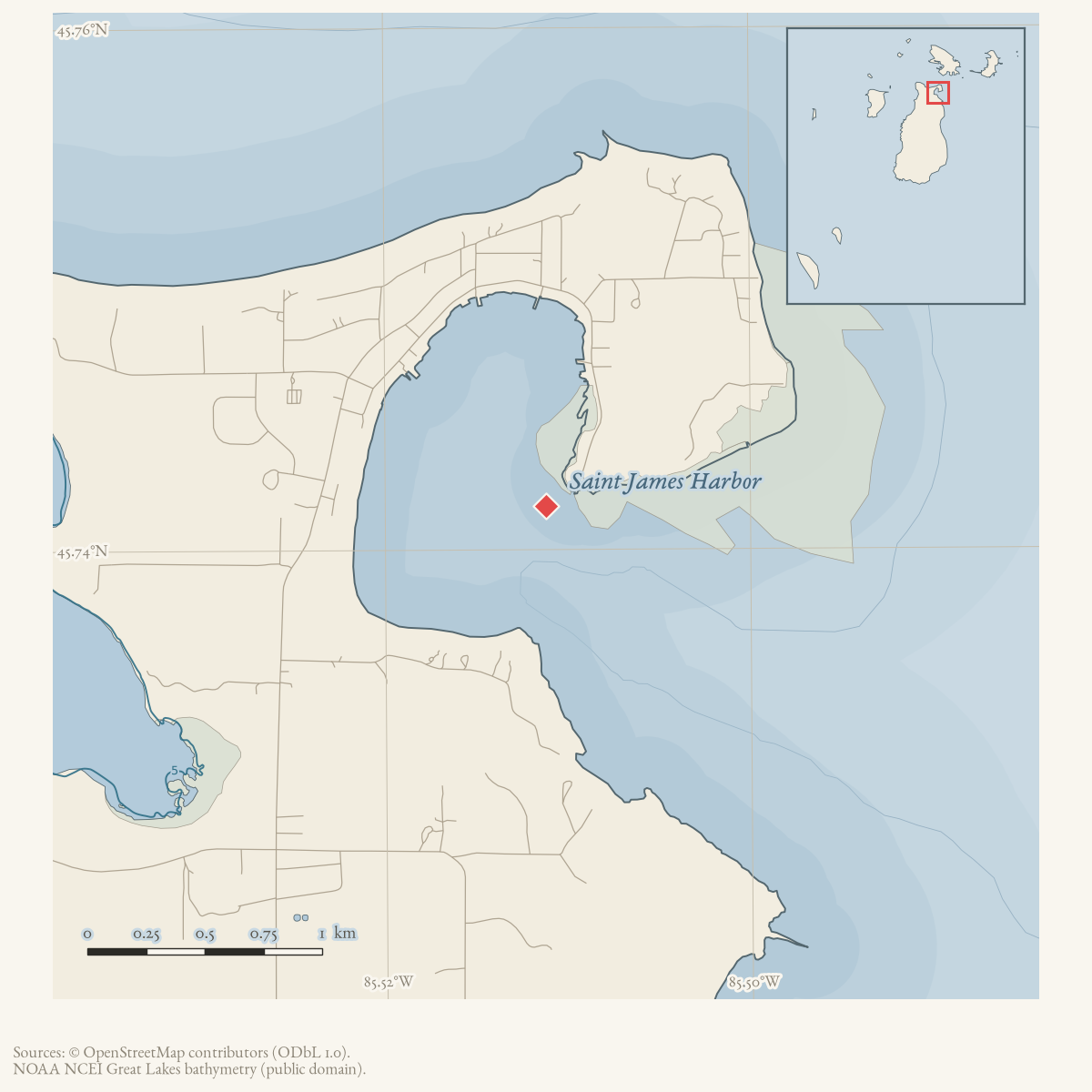
- Saint James Harbor
- Participants
- James Jesse Strang (victim) · Thomas Bedford (assailant) · Alexander Wentworth (assailant)
- Followed by
- Expulsion of the Strangites
- Eras
- Strang era
- Concepts
- monarchygovernancemormonismreligionhistoriography
- Within
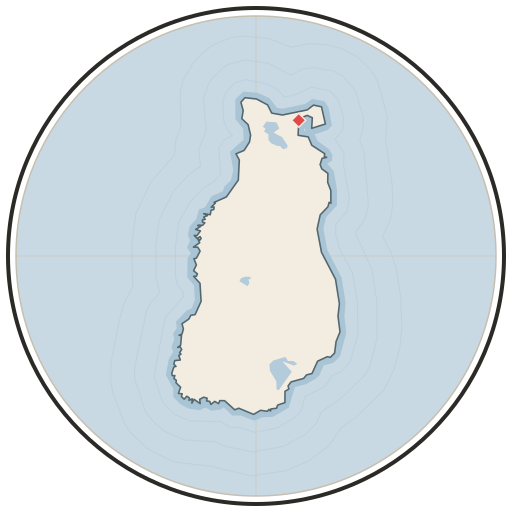
- Saint James · Saint James Harbor · Beaver Island
Summary
James Jesse Strang was shot from behind on the dock at Saint James, Beaver Island, at about seven o’clock on the evening of Monday 16 June 1856, by Thomas Bedford and Alexander Wentworth, two of his own former followers. He had been summoned aboard the United States steamer Michigan, then lying at the Johnson and McCulloch dock, by a messenger sent from the ship. He was struck by three shots and beaten about the head with a pistol butt. The assassins ran aboard the Michigan and were given protection; her commander refused to surrender them to the county sheriff and carried them to Mackinac, where they were released almost immediately and never tried. Strang was taken to Voree, Wisconsin, on 28 June and died there on 9 July 1856.
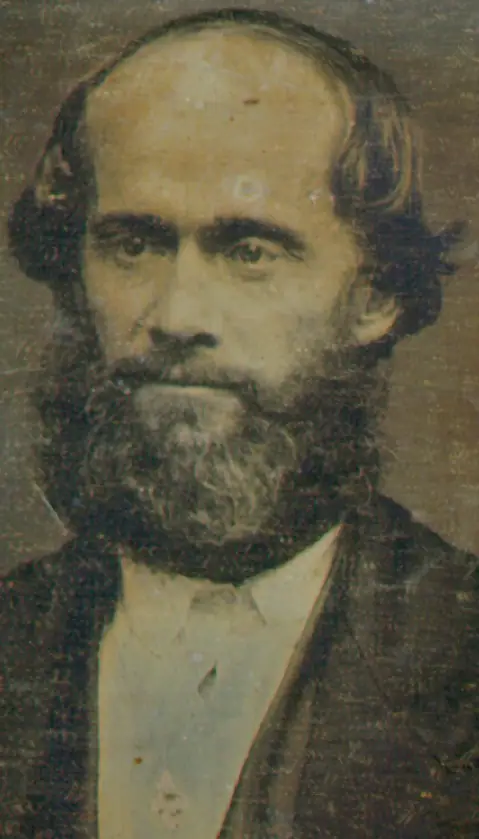
The one likeness of Strang that carries a date carries this one: a daguerreotype of 1856, the year he was shot.
History
The shooting
The Daily Northern Islander of Friday 20 June 1856 — the last issue the paper ever published — carried the account under the headline “Murderous Assault”:
On Monday last the U. S. steamer Michigan entered this harbour at about 1 o’clock, P. M., and was visited by the inhabitants promiscuously during the afternoon. At about 7 o’clock Capt. McBlair sent a messenger (San Barnard, the Pilot) to Mr. Strang, requesting him to visit him on board. Mr. Strang immediately accompanied the messenger, and just as they were stepping on the bridge leading to the pier in front of F. Johnson & Co’s store, two assassins approached in the rear, unobserved by either of them, and fired upon Mr. Strang with pistols.1
The same account describes the wounds: the first shot, from a horse pistol, entering the left side of the head a little behind the top of the ear and rebounding out near the top of the head; a second below the temple on the right side of the face, lodging in the cheek bone; a third on the left side of the spine near the tenth rib. It names the assassins as “Thomas Bedford and Alexander Wentworth. Wentworth had a revolver, and Bedford a horse pistol, with which he struck him over the head and face, while lying on the ground.” The assailants “immediately fled on board the U. S. steamer, with pistols in hand, claiming her protection,” in view of officers and crew and of Dr. H. D. McCulloch and Franklin Johnson, “and no effort made to stop it.”1
The date is independently fixed by the telegraph. The New-York Daily Tribune of 21 June 1856 printed a despatch datelined Detroit, Thursday 19 June: “James J. Strang, the Mormon leader, was shot at Beaver Island on the 16th by two of his former followers.”2 The 16th is the date this article follows, but at least one paper carrying the same despatch printed “on the 17th,” and a modern local-history account also gives 17 June.3 The Islander’s “Monday last,” in a Friday 20 June issue, agrees with the 16th.
Custody and impunity
Strang was carried to the house of the Prindle brothers, where the steamer’s surgeon examined the wounds “and declared recovery hopeless.” Process was taken out and the sheriff of the county demanded the prisoners; Captain McBlair refused, saying he would take them to Mackinac and deliver them to the civil authorities of the State there. The steamer left the next day, “carrying off all the persons supposed to be implicated in the affair, thus affording military protection to murderers and overthrowing the sovereignty of civil law.”1
Quaife notes that this had no legal justification: the crime was committed in the county seat of Emmet County, whose sheriff — Miller — was the proper custodian, but he had neither the power nor the authority to compel an armed federal war vessel.4 At Mackinac, Bedford and Wentworth were turned over to Sheriff Granger, who held them “about five minutes,” after which they were set at liberty and treated as heroes by the townsmen.4 Elizabeth Whitney Williams, recording the story from the gentile side, says they were jailed on Mackinac Island about a week and then quietly released at night; either way, “nothing was ever done in the way of giving these men a trial.”5
Death
Contrary to the surgeon’s verdict Strang lingered. The Detroit Free Press, quoted in Washington on 3 July, reported him “alive on Tuesday, and there was a fair prospect of his recovery. His lower limbs are entirely paralyzed by the shot in the back.”6 Fearing for his safety after a second visit by the Michigan about ten days after the shooting, his followers put him aboard the propeller Louisville on 28 June and sent him to Voree.7 He died there on the morning of 9 July 1856, with two of his polygamous wives, Apostles Hickey and Chidester, and Sheriff George Miller present.8 The telegraph carried it from Buffalo on 14 July: “Strang, of Beaver Island, died at his former residence, Racine County, on Wednesday last.”9
Competing accounts
A second, fuller account reached the national press a week later, apparently from someone aboard the Michigan. It appeared as “Assassination at Beaver Island” in the Daily National Intelligencer and the New York Herald of 24 June 1856 and was reprinted for weeks afterwards. It places the two men “behind the wood-piles, with which both sides of the dock are lined, there being only a passage way between the wood,” has them make “no attempt to escape” but surrender to the captain, and reports that the ship’s surgeon could trace neither the ball in the head nor that in the loins.10
A further contemporary account reached print in October, in a signed travel letter to the Central Presbyterian of Richmond, Virginia. Its writer stopped at the islands soon after Strang’s death and took his information chiefly from the sheriff of Mackinac county, who was his fellow passenger from Mackinac. It gives Bedford’s motive at greater length than any other 1856 source held here: goods he never had charged against him at the Mormon store, judgment given for the store by a court “consisting of the Mormon elders,” a suit brought over his ward’s wages that cost him four hundred dollars, and, when he did not submit, a sentence of whipping for contempt of that court, “executed by taking him from his bed, at night, and whipping him most cruelly with hickory ox-goads.” On the shooting itself the letter stands apart from every other account held here: it has the two men attack “in open day,” and has Strang die “in the course of eight or ten days” rather than twenty-three.11
The sources disagree on nearly every detail except the shooters, the place and the outcome.
| Point | Daily Northern Islander, 20 June 1856 | Press despatch, 24 June 1856 | Quaife, 1930 | E. W. Williams, 1905 | St. Barnard, 1889 |
|---|---|---|---|---|---|
| Commander’s name | Capt. McBlair | Capt. McBride | Capt. McBlair | not named | “our captain” |
| Messenger | “San Barnard, the Pilot” | “his pilot, Alexander St. Aubin” | pilot Alexander St. Bernard | “the officers” sent for him | himself, Alex. St. Barnard |
| Why Strang went to the dock | McBlair “requesting him to visit him on board” | “a request for Strang to come on board … upon some business” | ship’s officer sent to summon him | officers “wished to consult with him about the affair” | he was sent to arrest Strang |
| Number of shots | three | three | three | two | not specified |
| Where the assassins hid | not stated | “behind the wood-piles” lining the dock | emerged from the store | behind a pile of cordwood | “some hiding place” between the wood piles |
| Surrender | “fled on board … claiming her protection” | “made no attempt to escape, but surrendered themselves up” | “rushed on board … and begged protection” | “gave themselves up” | “ran aboard the ship and gave themselves up” |
| Days to death | — | — | shot in June, died 9 July | “eleven days after” | not stated |
Williams also states that Dr. H. D. McCulloch dressed Strang’s wounds and arranged his removal to Wisconsin. Quaife, by contrast, calls McCulloch “the real assassin of Strang,” the man whose “vengeful brain … conceived the plot.”12 Williams further relates that Strang begged to be taken home to Mary, his first wife; Quaife dismisses this as “a bit of amiable fiction” refuted by contemporary evidence.13 These are not reconcilable, and both authors are partisan — Williams for the fishermen, Quaife against Strang but in possession of the Strang manuscripts.
A Strangite tract of 1920 reprinting the Islander account frames the affair as federal complicity: the captain of the U.S. steamer “gave refuge to the dastardly murderers of the Prophet James,” and “in the case of the Prophet James there was never even the least formality of trial.”14
Significance
The assassination ended the Kingdom of Saint James within three weeks and triggered the Expulsion of the Strangites. Because Strang named no successor, it also broke the Church of Jesus Christ of Latter Day Saints, Strangite as a gathered body. A United States naval officer refused to surrender the killers to state process and they were released without trial. No source held here explains why.
Open questions
- Whose idea was the summons? Whether Captain McBlair’s message was an invitation (the Islander), a summons to consult (Williams), or an arrest (St. Barnard) is unresolved, and the difference bears directly on whether the navy was complicit. Quaife raises the possibility and declines to decide it, saying “One hesitates … to charge a responsible official with prostituting an agency of the United States government to the furtherance of a private plot.”
- The date. 16 June 1856 is established by the Islander and the Detroit despatch, but 17 June circulates in both contemporary and modern accounts.
- Elapsed time to death. 16 June to 9 July is twenty-three days. Williams says eleven; the 1920 Strangite tract says nineteen; the Central Presbyterian’s traveller, writing from what the Mackinac sheriff told him, says “eight or ten days.”11 None has been reconciled.
- The ship’s log. The Michigan’s deck log and Captain McBlair’s report, if they survive in Navy records, would settle the summons question. Neither has been located here.
- Whether any inquest was held. No coroner’s or justice’s record from Emmet or Mackinac county has been located here.
See also
Sources
Footnotes
-
“Murderous Assault,” Daily Northern Islander, 20 June 1856, https://archive.org/details/DailyNorthernIslander1856. Quoted from the OCR of the Beinecke Rare Book and Manuscript Library copy; the OCR of this crowded four-column page is imperfect and the transcription above is regularised only in spacing. ↩ ↩2 ↩3
-
“Shooting of James J. Strang,” New-York Daily Tribune, 21 June 1856, p. 5, https://www.loc.gov/resource/sn83030213/1856-06-21/ed-1/?sp=5. ↩
-
Wheeling Daily Intelligencer, 21 June 1856, p. 3 (“At Beaver Island on the 17th…”), https://www.loc.gov/resource/sn86092535/1856-06-21/ed-1/?sp=3; and “The Murder of James Jesse Strang,” Grand Traverse Journal (2015), https://gtjournal.tadl.org/2015/the-murder-of-james-jesse-strang-ruler-of-the-mormon-colony-at-beaver-island-1856/. ↩
-
Elizabeth Whitney Williams, A Child of the Sea; and Life among the Mormons (1905), pp. 177-178. ↩
-
“King Strang will Survive,” Daily National Intelligencer, 3 July 1856, p. 3, https://www.loc.gov/resource/sn83026172/1856-07-03/ed-1/?sp=3. ↩
-
Ibid., p. 173. ↩
-
Ibid., p. 179. ↩
-
“Death of King Strang,” New York Herald, 15 July 1856, p. 5, https://www.loc.gov/resource/sn83030313/1856-07-15/ed-1/?sp=5. ↩
-
“Assassination at Beaver Island,” Daily National Intelligencer, 24 June 1856, p. 3, https://www.loc.gov/resource/sn83026172/1856-06-24/ed-1/?sp=3; also New York Herald, 24 June 1856, p. 1, and New-York Dispatch, 29 June 1856, p. 7. ↩
-
“Notes of Travel at the North and North-West: Beaver Islands and the Mormons,” The Central Presbyterian (Richmond, Va.), 25 October 1856, p. 1, https://www.loc.gov/resource/sn89053987/1856-10-25/ed-1/?sp=1. ↩ ↩2
-
Ibid., p. 164. ↩
-
Quaife, The Kingdom of Saint James (1930), p. 109. ↩
-
A Few Historical Facts Concerning the Murderous Assault at Pine River (1920), https://archive.org/details/fewhistoricalfac00stra. ↩
Sources
- Described in this archive: Northern Islander, 1850–1856.The contemporary account, written by Strang's own paper four days after the shooting and while he was still alive. The last issue of the paper ever published. Held in full as OCR text.
- Independent contemporary confirmation of the date: "James J. Strang, the Mormon leader, was shot at Beaver Island on the 16th by two of his former followers. He received three balls in the body and a severe blow from a pistol on the head."federal · chronicling_america · sn83030213_1856-06-21_ed1_p5
- Reports the death "on Wednesday last" at his former residence in Racine County - 9 July 1856.federal · chronicling_america · sn83030313_1856-07-15_ed1_p5
- The detailed eyewitness-sourced despatch that carried the story nationally. Names the commander "Capt. McBride" and the pilot "Alexander St. Aubin", places the assassins "behind the wood-piles, with which both sides of the dock are lined", gives a different order of wounds, and adds that the men "made no attempt to escape, but surrendered themselves up." Also the source for Bedford's earlier flogging.federal · chronicling_america · sn83026172_1856-06-24_ed1_p3
- Described in this archive: The Kingdom of Saint James, Quaife, 1930.The fullest reconstruction, based on Warren Post's manuscript "Apostolic Testimony," the Daily Northern Islander of 20 June 1856, and interviews with the eyewitness Wingfield Watson. Names the messenger as pilot Alexander St. Bernard, the commander as Captain McBlair, and the Mackinac sheriff as Granger.
- Reprints the *Northern Islander* report in full, and adds Capt. Alexander St. Barnard's own account as given to the *Detroit Free Press* in 1889 at age 80 - a different story, in which he was sent to arrest Strang rather than invite him aboard.
- A hostile eyewitness-adjacent account, written from Traverse City. Differs from the primary report on several points - see the body.
- "Advices from Beaver Island assure us that King Strang was alive on Tuesday, and there was a fair prospect of his recovery. His lower limbs are entirely paralyzed by the shot in the back."federal · chronicling_america · sn83026172_1856-07-03_ed1_p3
- A signed traveller's letter published four months after the shooting, its information gathered largely from the sheriff of Mackinac county, who was the writer's fellow passenger from Mackinac. Says Bedford was driven to the act by judgments given against him in the island court and by a whipping ordered for contempt of that court, and that Strang died "in the course of eight or ten days" - a fourth figure for the interval between the shooting and the death.federal · chronicling_america · sn89053987_1856-10-25_ed1_p1
Added 28 July 2026 · revised 2 August 2026. Recent changes
Cite this article
Beaver Island Archive, “Assassination of James Strang”, https://beaverislandarchive.org/events/assassination-of-james-strang/, accessed [date], citing "Murderous Assault," *Daily Northern Islander* (Saint James, Lake Michigan), Friday 20 June 1856. (and 8 further sources listed on the page).
Last revised 2026-08-02. Fill in [date] with the date you read it — this page is static and cannot know that.
BibTeX for “Assassination of James Strang”RIS for “Assassination of James Strang”