- Founded
- 1844
- Founded by
- James Jesse Strang
- Coordinates
- 45.7511° N, 85.5156° WGoogle Maps: Church of Jesus Christ of Latter Day Saints, StrangiteDownload KML
- Eras
- Strang era
- Concepts
- mormonismreligionmigrationhistoriography
- Within
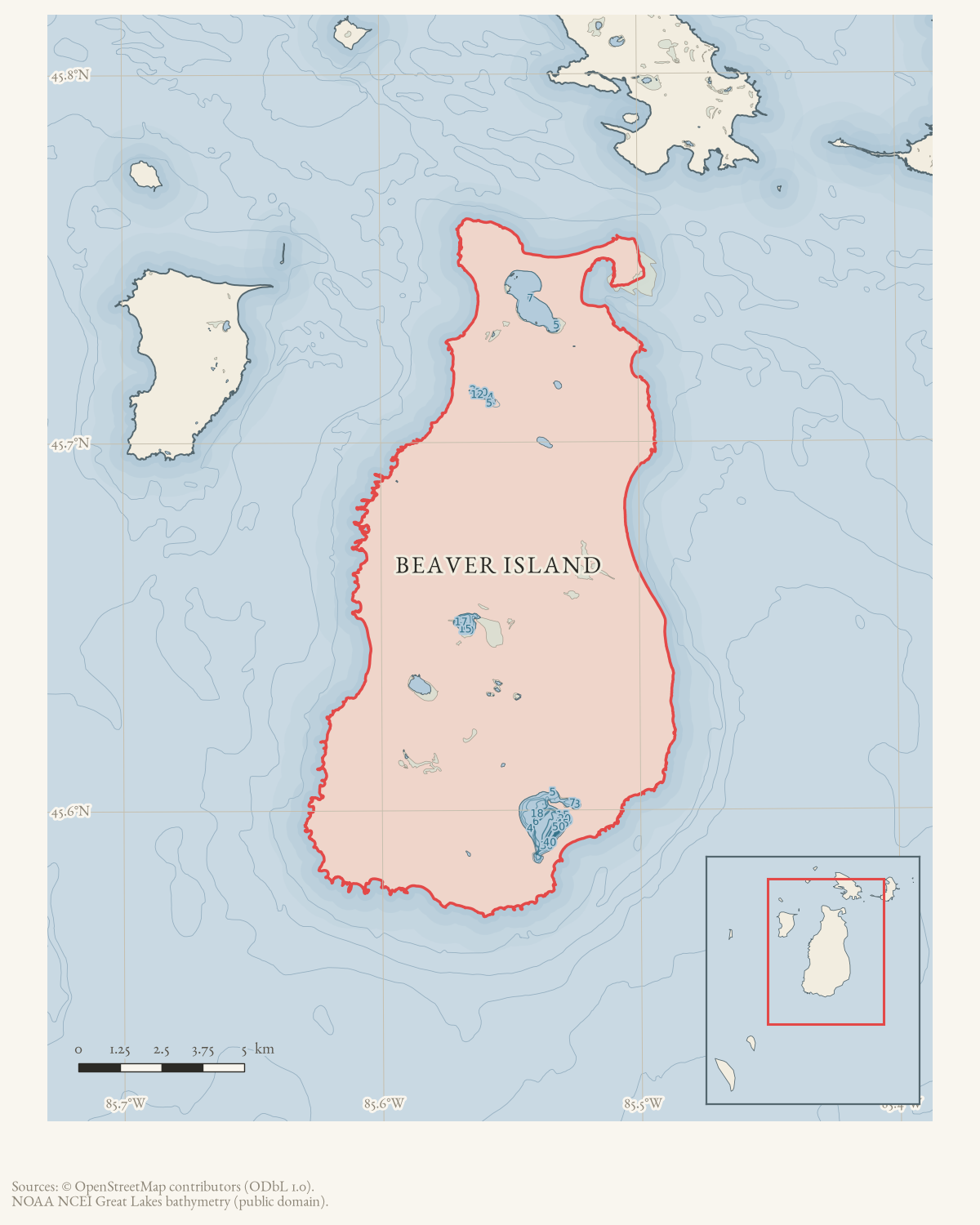
- Beaver Island
- Media
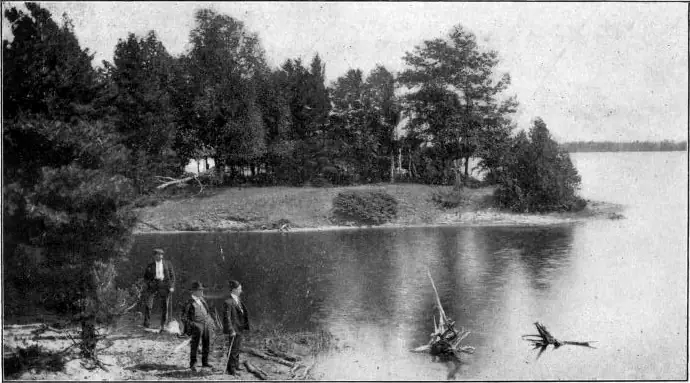
- "Font Lake, Beaver Island, where King Strang baptized his people" — plate from A Child of the Sea (1905)
Summary
The Church of Jesus Christ of Latter Day Saints (Strangite) is the Latter Day Saint body founded on James Jesse Strang’s claim to have been appointed Joseph Smith’s successor in June 1844. It gathered at Voree, Wisconsin, from 1846, moved its headquarters to Beaver Island in 1850, and was scattered in July 1856 after Strang’s assassination. Unlike the Utah church it observes a seventh-day sabbath and accepts a fourth standard work, the Book of the Law of the Lord, which Strang said he translated from the “plates of Laban.” It still exists, in much reduced form, headquartered at Burlington (the old Voree site) in Wisconsin.
History
Foundation and Voree, 1844–1850
Strang was baptised into the Latter Day Saint communion in February 1844 and claimed the presidency after Smith’s death that June. Rejected by Brigham Young and the Twelve and excommunicated, he gathered followers in Wisconsin and founded the city of Voree, where his disciples were “organized into a single community, owning all things in common and living as one family” and were known as the Primitive Mormons.1 The 1892 sketch lists the sect’s four sacred books as the Bible, the Book of Mormon, Smith’s Book of Doctrines and Covenants, and the Book of the Law of the Lord, the last “translated by Strang from eighteen metallic plates.”1
The claim to the succession did not rest on the letter alone. Quaife’s account: on 1 September 1845 Strang reported a second angelic visitation revealing ancient records; twelve days later he took four followers to a hill “in the east of Walworth, against White River in Voree” and dug up, from under the roots of an oak, metallic plates cased up and covered with “an alphabetical and pictorial record.” Quaife calls the finding of those Voree plates “the touchstone of Strang’s prophetic career” — the plates had, he writes, a material objective reality, so either Strang fabricated and planted them or they were what they purported to be — and notes that most of the four witnesses later apostatised and repudiated Strang. The plates themselves were long ago lost; the facsimile Quaife printed was taken from a pamphlet issued by Strang’s follower Wingfield Watson.2
The Voree press ran an official organ continuously from January 1846, under successive titles — Voree Herald, Zion’s Reveille, Gospel Herald — with Strang as the real editor throughout; the last number appeared 6 June 1850.34 Doctrinal practice at Voree included baptism for the dead: Quaife records a conference at which Strang was baptised for James Knox Polk, Oliver Cromwell and Lord Byron, and George J. Adams for Napoleon Bonaparte and three Adamses.5
Beaver Island, 1850–1856
The headquarters moved from Voree to the new village of Saint James, and the Voree Herald was succeeded by the Northern Islander, 1850–1856.1 On 8 July 1850 the church’s government was reorganised “by the union of church and state” into a kingdom — see Kingdom of Saint James.1 The Book of the Law of the Lord, announced that day, was published as an eighty-page volume in 1851 and in an enlarged edition printed at Saint James in 1856; in February 1851 Strang printed a new translation of the ten commandments in the Northern Islander, and three months later showed eighteen brass plates, nine inches by seven and three-eighths, to Warren Post and other Saints at the April conference.6
Ordinances continued alongside the doctrinal announcements. Quaife reproduces a photograph of Font Lake, near Saint James, under the caption “Baptisms for the dead were performed here”; the plate at the head of this article, from Elizabeth Whitney Williams’s 1905 memoir, shows the same lake and names it as the place “where King Strang baptized his people.”78
Distinctive practices attested in the sources held here: a seventh-day sabbath with compulsory attendance; a tithe of a tenth of everything raised, earned or received; prohibition of tea, coffee, tobacco and liquor; a prescribed dress for women (a short skirt with pantalet trousers) in place of hoop skirts and bell-crowned hats; and plural marriage, introduced “during the winter and spring of 1849.”19 Strang had publicly denounced polygamy before embracing it.10
Dispersion and afterlife, 1856–
Strang was shot on 16 June 1856 and died on 9 July without naming a successor, though he had taught for a dozen years that the church could not function without a divinely designated head. Quaife treats this as the decisive cause of the church’s collapse — a judgement, not a fact, and one Strangites reject.11 The membership scattered: many joined the Reorganized Church, some the Utah church, and “the great majority, probably, abandoned, sooner or later, all pretensions to Mormonism.”12
The organisation nevertheless persisted. Five apostles met “in the wilderness” six miles from Racine on 10 February 1857 and concluded that the Twelve could not lead without a prophet; 112 followers conferred at Hixton, Wisconsin, in December 1863; the last surviving apostle, Lorenzo D. Hickey, died at Coldwater, Michigan, in 1900 having ordained Wingfield Watson presiding high priest; Watson died in October 1923 having ordained Samuel H. Martin of Pueblo, Colorado; a conference was held at Kansas City in October 1919 and a monthly paper, The Latter Day Precept, established there under John Flanders; and about forty adherents attended a conference on the site of Voree in July 1928.13
Two items held here confirm that continuity independently of Quaife. Strang’s 1854 “Prophetic Controversy” letter was reprinted by his followers in 1878, 1886 and 1893.14 Edward T. Couch published The Teachings of Jesus at Boyne City, Charlevoix County, Michigan, in May 1913, over the imprint “of the Church of Jesus Christ of Latter Day Saints” — a Strangite presence on the mainland opposite Beaver Island fifty-seven years after the expulsion.15 And a 1920 tract addressed to “the readers of The Precept” reprints the Daily Northern Islander’s assassination report to argue that “the murderers of James J. Strang were never brought to justice.”16
Quaife concluded in 1930 that “whatever the future may hold in store for Mormonism, the Strangite Church is a thing of the past.”13 That verdict has not held. The church’s own website states it is “Headquartered in Burlington, Wisconsin” — the modern name of the Voree locality — and describes itself as “a small remnant of the church”; the copy of the Book of the Law of the Lord held here is a 1991 facsimile reprint issued from Burlington [Voree].1718
Significance
The Strangite church is the reason Beaver Island was settled on the scale it was from 1847 through 1856, and the reason the island appears in the national press of the 1850s. It is one of the few Latter Day Saint succession claimants of 1844 to survive to the present day, and the only one whose history runs through Michigan.
Open questions
- Present-day membership. No membership figure is asserted here. The church’s own “About Us” page, as fetched, gives none; secondary sources circulate a figure of about 130 active members, not verified here against a primary statement.
- The 1856 Saint James edition. The Book of the Law of the Lord printed at the Royal Press was, according to the 1991 reprint’s own preface, “never bound with a title page, testimony, or preface” before Strang was killed. How many copies were completed and distributed before the dispersion is not established here.
- Michigan continuity. Wingfield Watson lived at Boyne, Charlevoix County, and Edward T. Couch published from Boyne City in 1913. Whether a congregation, as distinct from individuals, persisted in Charlevoix County is not established from the material held here.
- The letter of appointment. The foundational document is disputed; see James Jesse Strang.
See also
Sources
Footnotes
-
“Sketch of James Jesse Strang and the Mormon Kingdom on Beaver Island” (1892), pp. 6-8. ↩ ↩2 ↩3 ↩4 ↩5
-
Ibid., pp. 16-18, and the plate “The Voree Plates” (“Reproduced from a pamphlet issued by Wingfield Watson. The plates have long since been lost.”). ↩
-
Ibid., pp. 185-186. ↩
-
Gospel Herald, vol. 2 nos. 27-28, Voree, W. T., 23 September 1847 (masthead). ↩
-
Quaife, The Kingdom of Saint James (1930), p. 78. ↩
-
Ibid., pp. 187-188. ↩
-
Ibid., plate “Font Lake, near Saint James, Beaver Island.” ↩
-
Elizabeth Whitney Williams, A Child of the Sea; and Life among the Mormons (1905), plate “Font Lake, Beaver Island, where King Strang baptized his people.” ↩
-
Ibid., pp. 166-167. ↩
-
Ibid., chapter VII, “The Saints Become Polygamous,” pp. 96-100, and index s.v. “Polygamy” (“Strang denounces, 96-98; embraces, 98, 100”). ↩
-
Ibid., pp. 182-183. ↩
-
Ibid., pp. 180-181. ↩
-
The Prophetic Controversy (reprints of 1878, 1886, 1893). ↩
-
Edward T. Couch, The Teachings of Jesus (Boyne City, Mich., May 1913), title page. ↩
-
A Few Historical Facts Concerning the Murderous Assault at Pine River (1920). ↩
-
“About Us,” The Church of Jesus Christ of Latter Day Saints (Strangite), retrieved 28 July 2026, https://www.ldsstrangite.com/about-us.html. ↩
-
The Book of the Law of the Lord, 1991 enlarged facsimile reprint, Burlington [Voree], Wisconsin, publisher’s note. ↩
Sources
- The named Saint James village feature corroborates the settlement identity. The article's point is an approximate representative location for the church's documented 1850–1856 Beaver Island headquarters; it is not the exact headquarters, church building, or current Burlington headquarters.
- External entity identifier only; historical claims remain grounded in the sources below.
- Described in this archive: The Kingdom of Saint James, Quaife, 1930.Doctrine, the finding of the Voree plates in September 1845, the plates of Laban and the Book of the Law of the Lord, the dissolution after 1856, and the named line of continuation down to Samuel H. Martin in the 1920s. Quaife's plate of Font Lake is captioned "Baptisms for the dead were performed here." Quaife's closing verdict - "the Strangite Church is a thing of the past" - was written in 1930 and has since been overtaken.
- The church's distinctive scripture, and evidence of continuing Strangite publication - the copy held here is a 1991 reprint issued from Voree.
- Described in this archive: Gospel Herald, Voree, 1847-1850.Masthead and imprint: "Zion's Reveille, printed and published weekly, for the Church of Jesus Christ of Latter Day Saints … All letters and communications must be directed to James J. Strang." Shows the Voree paper's changing titles and Strang's personal control.
- A Strang apologetic letter kept in print by his followers for four decades after his death - direct evidence that the church continued to publish long after the 1856 dispersion.
- Imprint reads "of the Church of Jesus Christ of Latter Day Saints, Boyne City, Charlevoix County, Michigan" - evidence that a Strangite presence persisted in Charlevoix County, on the mainland opposite Beaver Island, into the twentieth century.
- A Strangite tract addressed to "the readers of The Precept," reprinting a Northern Islander Extra of 14 July 1853 and the Daily Northern Islander account of the assassination. Confirms the existence and audience of *The Latter Day Precept*.
- The church's own present-day statement: "Headquartered in Burlington, Wisconsin"; describes itself as "a small remnant of the church"; asserts that Joseph Smith appointed Strang "by a letter written and mailed from Nauvoo, Illinois on June 18, 1844" and that Strang "was the only person who claimed a direct appointment by the founding prophet."
- A hostile memoirist's photograph of the lake where the church's baptisms were performed. Used here for the plate and its caption, not for Williams's judgement of the Mormons.
Added 28 July 2026 · revised 2 August 2026. Recent changes
Cite this article
Beaver Island Archive, “Church of Jesus Christ of Latter Day Saints, Strangite”, https://beaverislandarchive.org/organizations/church-of-jesus-christ-strangite/, accessed [date], citing OpenStreetMap contributors, Saint James, retrieved 2026-08-06 (ODbL 1.0). (and 9 further sources listed on the page).
Last revised 2026-08-02. Fill in [date] with the date you read it — this page is static and cannot know that.
BibTeX for “Church of Jesus Christ of Latter Day Saints, Strangite”RIS for “Church of Jesus Christ of Latter Day Saints, Strangite”