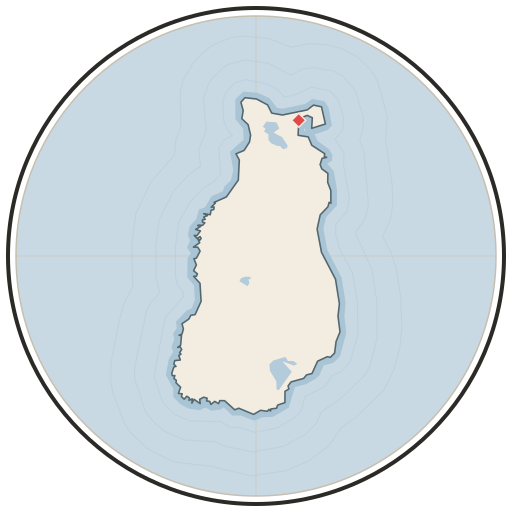
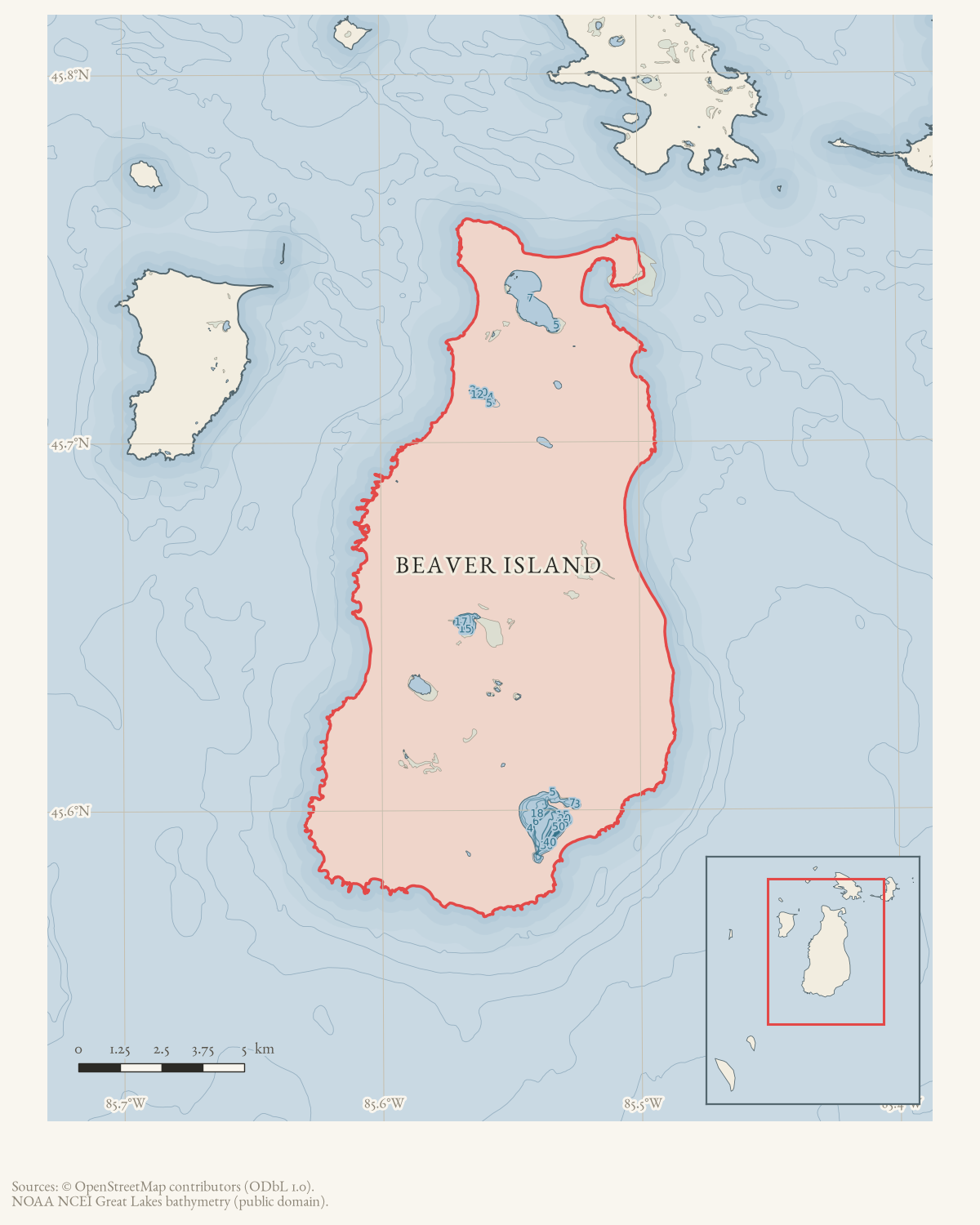
- Founded
- 1850-07-08
- Dissolved
- 1856
- Founded by
- James Jesse Strang
- Coordinates
- 45.7511° N, 85.5156° WGoogle Maps: Kingdom of Saint JamesDownload KML
- Eras
- Strang era
- Concepts
- monarchygovernancemormonismreligiondemographytoponymy
- Within
- Beaver Island · Saint James
- Media
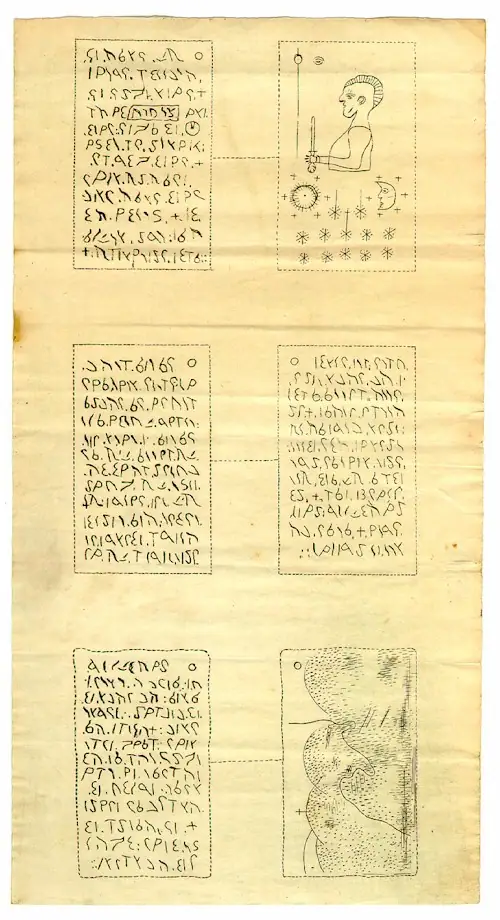
- The Voree Plates (Record of Rajah Manchou of Vorito), broadside
Summary
The Kingdom of Saint James was the theocratic monarchy proclaimed by James Jesse Strang on Beaver Island on 8 July 1850, and destroyed in July 1856 in the weeks after his assassination. It occupied the same ground and the same people as Strang’s church: he ruled the faithful as prophet and king under the Book of the Law of the Lord, and ruled everyone else through the ordinary machinery of Michigan township and county government, which the Mormon vote controlled. Its capital was the village of Saint James on Saint James Harbor; its press was the Northern Islander, 1850–1856; its extent is still legible in the island’s biblical place names.
Its population is genuinely unknown. The figures in circulation — roughly 2,600 in 1854–56 — derive from a census taken under Strang’s own authority and printed in his own newspaper. The party that expelled the Mormons alleged in the same year that those returns overstated Emmet County’s population sevenfold. No independent count survives, and every population figure given below is reported here as a claim by an interested party rather than as a settled number.
History
Foundation
Strang appointed a church conference at Big Beaver for early July 1850. On 8 July, in the uncompleted tabernacle, a portion of the newly revealed Book of the Law of the Lord was read; the assembly covenanted to live by it; Strang, in a robe of bright red, was escorted to a platform surrounded by the apostles and the Quorum of Seventy; George J. Adams acted as master of ceremonies; and a crown of metal with a cluster of stars in front was placed on his head. Quaife puts four hundred spectators in the building. On the same day Strang announced a revelation appointing “the Islands of the Great Lakes” as the inheritance of the Saints and giving the King power to apportion the land among them; the anniversary was to be kept annually with sacrifices and a public feast.1
The published warrant was chapter XX of the Book of the Law of the Lord: “He hath chosen his servant James to be King … and appointed him King in Zion: by his own voice did he call him, and he sent his Angels unto him to ordain him.”2 The volume’s own imprint reads “PRINTED BY COMMAND OF THE KING, AT THE ROYAL PRESS, SAINT JAMES, A. R. VI” — dated by regnal year, the sixth of the reign.3
What the kingship claimed
Strang’s follower Wingfield Watson, interviewed for the 1882 account reprinted in 1892, put the claim narrowly: “Mr. Strang did claim to be a king only to the Mormon people, and upon the same principles … upon which Moses, Melchisedec, Elijah, Elisha, Noah, Enoch, Peter, Joseph Smith, and all the great and leading prophets of God claimed that office,” and only over those who chose to receive him as such.4 The same account observes that Strang “carefully kept his monarchial pretensions for home consumption,” submitted to state and federal authority when required, and used the civil law where it suited him.4
Quaife describes the resulting dual system: church law governed the faithful among themselves, civil office governed dealings with gentiles, and the two diverged. A Saint who withdrew forfeited his real estate, since the Law of the Lord vested control of that class of property in the Prophet.5 Punishments unknown to state law — public whippings in particular — were inflicted under church authority; see Thomas Bedford.6
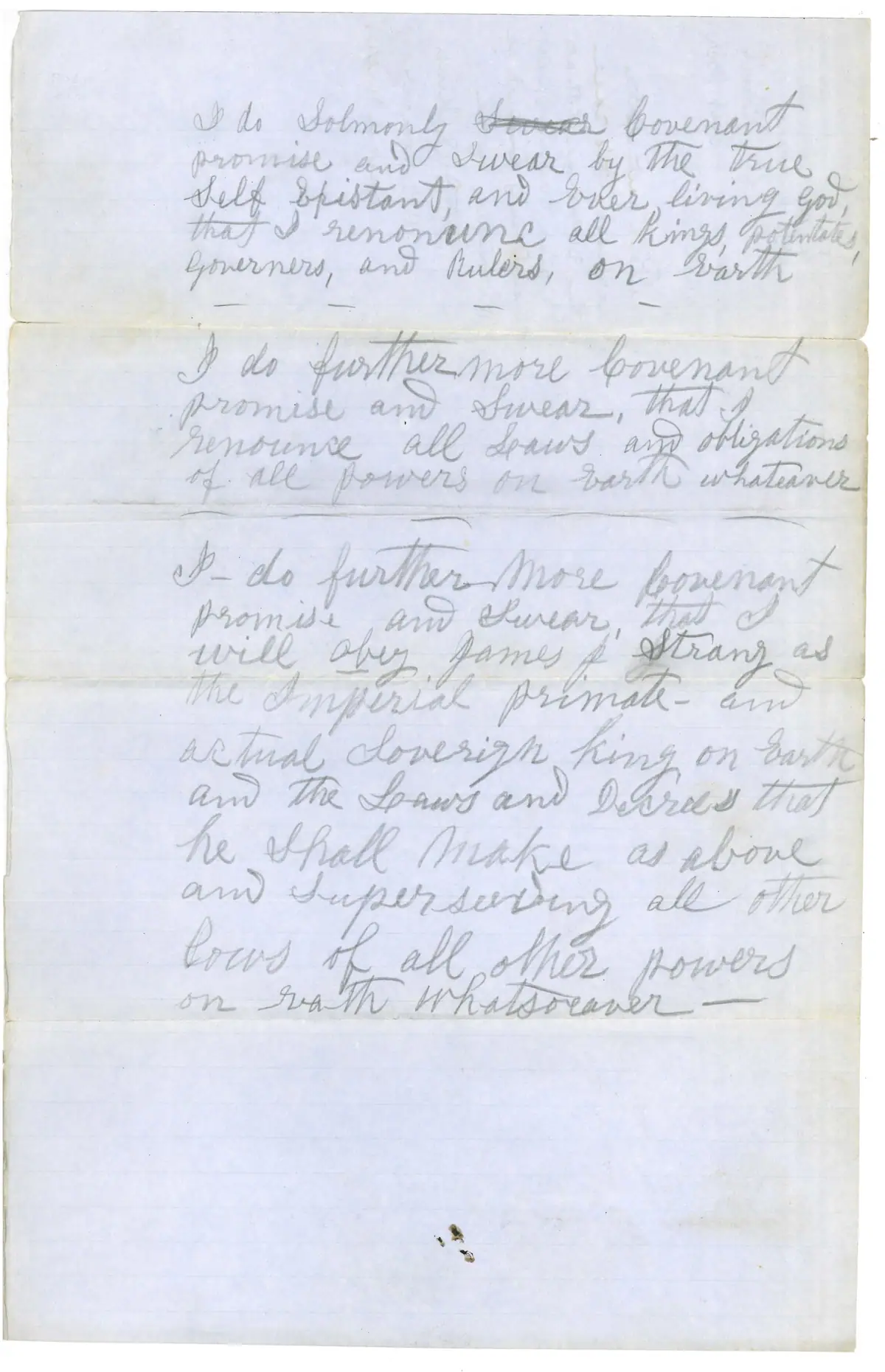
The federal government was shown a very different account of the claim. Among the papers in the 1851 prosecution of Strang and ten other islanders for obstructing the United States mail is a handwritten copy of an oath, in which the taker covenants to “renounce all kings, potentates, Governers, and Rulers, on Earth”, to “renounce all Laws and obligations of all powers on earth whatsoever”, and to “obey James J. Strang as the Imperial primate — and actual Soverign king on Earth … Superseding all other laws of all other powers on earth whatsoever.”
What that document proves is contested and should be held carefully. It is a prosecution exhibit in a case the government lost: it establishes what the United States alleged the kingdom required of its subjects, not that any islander swore it. Its language is nonetheless the exact opposite of the position Watson described thirty years later — not a kingship “only to the Mormon people” beside an accepted civil authority, but one superseding every other law on earth.
Government and daily order
A manuscript by Strang’s wife, quoted in the 1892 sketch, describes the domestic regime: tea, coffee, tobacco and liquor prohibited; the seventh day kept as the sabbath with compulsory attendance; a tithe of everything raised, earned or received paid into a public fund used for improvements, the poor, and state, county and township taxes, with no other tax levied; by-laws printed and a copy in every household; schools organised; and a printing office maintained “of sufficient capacity to print all the papers, books, pamphlets, tracts, etc., needed for the church.”4 The same source states there were “never over 20 cases of plural marriages upon the islands,” and that no man had more than three wives except Strang.4
Civil government ran in parallel. The Beaver Islands were erected into the township of Peaine in 1847, at the instance of the Rochester fishing interest rather than the Mormons.7 Emmet County was organised by act of 29 January 1853, during Strang’s first legislative session; it then contained three townships — Peaine and Galilee on the Beaver Islands, and Charlevoix Township on the mainland.8 Galilee is the Strang-era predecessor of the modern Township of Saint James. In Strang’s second term the Beaver, Fox and Manitou groups were detached as the new county of Manitou.9
The kingdom also expanded to the mainland: Strang’s people settled around Pine Lake, which the Northern Islander was calling Lake Mormon by 1855, and held a conference and built a synagogue on its “Holy Island.”10
Population — a contested number
| Claim | Source | Status |
|---|---|---|
| 2,608 residents on Big Beaver Island, autumn 1854 | census printed in the Northern Islander, 2 November 1854 | Strang’s own count in Strang’s own paper |
| about 2,600 driven from the island in 1856 | Quaife’s estimate, built on the 1854 figure | derived from the above |
| Mormon population of islands and adjoining mainland “in excess of 2,500” in 1856 | Quaife, p. 107 | derived from the above |
| “between two thousand and three thousand Mormons” | Capt. Alexander St. Barnard, recalling at age 80 in 1889 | recollection, 33 years later |
| Emmet County returns “show an aggregate population of 7,000, whilst in reality it falls below 1,000” | manifesto of the expelling party, July 1856 | the victors, alleging census fraud |
Quaife supports his figure with a contemporary letter recording 490 exiles taken to Chicago on one boat, 300 previously on the Iowa, and the Louisville carrying “all she could stow” to Detroit.11 That is a floor of roughly 800 by direct report; the rest is extrapolation. The federal decennial census cannot settle the question: county-subdivision population figures are available only from 2000 onward, more than a century after the kingdom’s end. For reference, Quaife notes the 1920 census returned 779 residents in the two townships that make up the island.11
End
Strang was shot on 16 June 1856 and died on 9 July; within days of the shooting the population began to leave, and in early July an armed party from the mainland cleared the island. See Assassination of James Strang and Expulsion of the Strangites. The manifesto issued by the victors and printed on the captured press declared: “The dominion of King Strang is at an end. … The land is redeemed; a kingdom no longer exists upon the borders of one of our most populous States.”12
Significance
The kingdom is the reason Beaver Island’s civil geography exists in its present form: Peaine and Saint James townships, the short-lived Manitou County, the village of Saint James, and a set of biblical place names that outlived the regime that imposed them. It is also the island’s principal claim on national attention.
Open questions
- The population. No independent count survives. Reconciling Strang’s 1854 census with the expelling party’s counter-claim would require the manuscript Michigan state census returns for Emmet County, which are not held here.
- A formal style. No contemporary document located gives the polity a formal name. “Kingdom of Saint James” appears to be Quaife’s coinage; contemporaries wrote “the dominion of King Strang.”
- Territorial extent. The kingdom’s claimed inheritance was “the Islands of the Great Lakes,” but its actual settlement extended to the Pine Lake / Lake Mormon mainland and, by 1855, into Antrim and Otsego counties. No map of the settled extent has been located.
- The crown. Quaife describes “a crown of metal with a cluster of stars in front” and elsewhere calls it a “tinsel crown.” Whether the object survives is not established here.
See also
Sources
Footnotes
-
Quaife, The Kingdom of Saint James (1930), pp. 92-95. ↩
-
The Book of the Law of the Lord, chapter XX, “Calling of a King,” verse 6, pp. 168-169. ↩
-
Ibid., title page of the Saint James edition as reproduced in the 1991 facsimile. ↩
-
“Sketch of James Jesse Strang and the Mormon Kingdom on Beaver Island” (1892), pp. 7-9, 13. ↩ ↩2 ↩3 ↩4
-
Ibid., pp. 164-165. ↩
-
Ibid., pp. 166-168. ↩
-
James J. Strang, Ancient and Modern Michilimackinac (1854), sections “Emmet County” and “Mormon Settlement in Emmet.” ↩
-
Ibid., p. 159 and n. ↩
-
Ibid., p. 147. ↩
-
Ibid., pp. 157-161. ↩
-
“Extra - Islander Redeemed,” reprinted in the New York Herald, 14 July 1856, p. 8 (from the Buffalo Express, 12 July 1856), https://www.loc.gov/resource/sn83030313/1856-07-14/ed-1/?sp=8; also in the Daily National Intelligencer, 25 July 1856, p. 3. ↩
Sources
- The named Saint James village feature corroborates the settlement identity. The article's point remains an approximate representative location for the historical kingdom's capital, not a boundary, palace site, or surviving administrative parcel.
- Described in this archive: The Kingdom of Saint James, Quaife, 1930.Coronation of 8 July 1850; the dual church/civil basis of Strang's authority; the township and county structure; the 1854 census figure of 2,608 on Big Beaver Island and Quaife's estimate of about 2,600 expelled.
- The kingdom's own constitutional text. Its imprint - "printed by command of the King, at the Royal Press, Saint James, A. R. VI" - dates by regnal year, a form of dating found on no other imprint held here.
- Quotes Strang's follower Wingfield Watson on the limited nature of the royal claim, and a manuscript by Strang's wife on the kingdom's domestic regulations - tithing, sabbath, temperance, schools, "never over 20 cases of plural marriages upon the islands." Also carries Capt. Alexander St. Barnard's old-age estimate of "between two thousand and three thousand Mormons."
- Described in this archive: Ancient and Modern Michilimackinac, 1854.Strang's own account: the erection of Peaine township in 1847, the 1848 land sale, and Mormon population figures of 18 and then 62 persons in the first two winters.
- The victors' own statement, printed as an "Extra - Islander Redeemed" on the captured press. Alleges "The census returns made for the county of Emmet, under his own hands, show an aggregate population of 7,000, whilst in reality it falls below 1,000." Directly contradicts the Mormon figures.federal · chronicling_america · sn83030313_1856-07-14_ed1_p8
Added 28 July 2026 · revised 2 August 2026. Recent changes
Cite this article
Beaver Island Archive, “Kingdom of Saint James”, https://beaverislandarchive.org/organizations/kingdom-of-saint-james/, accessed [date], citing OpenStreetMap contributors, Saint James, retrieved 2026-08-06 (ODbL 1.0). (and 5 further sources listed on the page).
Last revised 2026-08-02. Fill in [date] with the date you read it — this page is static and cannot know that.
BibTeX for “Kingdom of Saint James”RIS for “Kingdom of Saint James”