- Born
- circa 1815
- Work
- Farmer
- Spouse
- Ruth Ann Bedford
- Member of
- Church of Jesus Christ of Latter Day Saints, Strangite
- Eras
- Strang era
- Concepts
- governancemormonismreligionfishinghistoriography
- Within
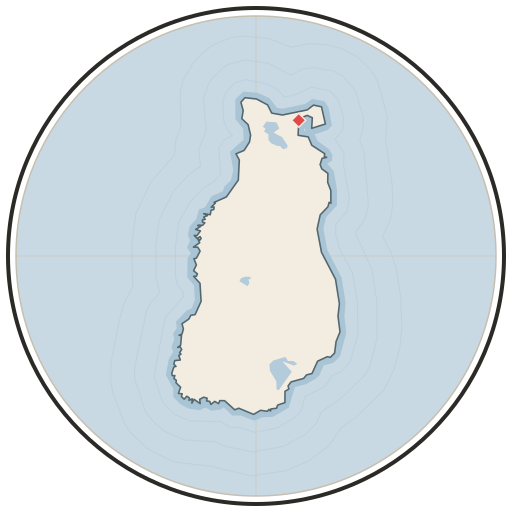
- Beaver Island
Summary
Thomas Bedford was one of the two men who shot James Jesse Strang on the dock at Saint James, Beaver Island, on 16 June 1856. He carried a horse pistol, fired the shot that lodged near Strang’s spine, and beat him about the head and face with the weapon while he lay on the ground. He had earlier been publicly flogged on the bare back under the authority of Strang’s church, and every source agrees that this was his motive; no two sources agree on why he was flogged. He surrendered aboard the U.S. steamer Michigan, was landed at Mackinac with his family, was released within days, and was never tried. He was English by birth, about 45 in the 1860 Beaver Island agricultural schedule, and still farming there after the expulsion; the 1882 interview tradition likewise places him alive and speaking about the events. His death remains unestablished, and the precise later family record remains partly secondary, so this later period is recorded here as contested.
History
Who he was
The contemporary despatch of 24 June 1856, reprinted across the national press, states that both Bedford and Wentworth “had been Mormons, but had seceded, and had joined with the McCulloch faction, in the late schism,” and that both had families.1 Quaife, drawing on interviews conducted in 1918–1920 with Sarah Wing (a widow of Strang) and Zenas Wright, describes him as “a fisherman, who married a Mormon woman and joined the Church, but never became a ‘strong professor,’” and a fishing partner of one David Brown.2 Elizabeth Whitney Williams says he “was employed by Mr. Peter McKinley” at the Point.3 These are compatible: a fisherman in the gentile trade who married in and half-belonged.
The flogging
That Bedford was publicly whipped by Strangite authority is attested by hostile and sympathetic sources alike, and by the physical object: the Buffalo Express was presented in the summer of 1856 with “the bundle of rods with which the man Bedford was whipped, by order of King Strang” — five beech, birch and maple sticks, about seven feet long and half an inch thick at the butt, bound together with strings, and “bent, twisted and splintered by the force of the blows delivered.”4 Williams and the press despatch agree that the rods were “blue beach [beech] sprouts.”31
Beyond that, the accounts diverge completely.
| Source | Stated cause | Number of lashes | Ordered by Strang? |
|---|---|---|---|
| Press despatch, 24 June 1856 | “neglecting to disclose facts concerning a robbery” | forty | “This had been done by Strang’s orders” |
| E. W. Williams, 1905 | gave information about Mormon thefts from Peter McKinley — though “the Mormons never proved” he had | seventy-five | implied |
| Quaife, 1930 (p. 168 n., from Wing and Wright) | caught in adultery by his fishing partner David Brown, who “and some others gave Bedford a whipping” | not stated | not by order; a private beating |
| Quaife, 1930 (p. 167) | encouraged his wife to refuse the dress prescribed by the Prophet | not stated | condemnation by Strang |
| 1892 Michigan Pioneer sketch | “subjected to public discipline” | not stated | “as he believed, by Strang’s orders, although this was denied” |
| Evening Star, 5 Aug 1893; Princeton Union, 31 Aug 1893 (one syndicated feature) | — | forty-three | — |
| The Sun (New York), 27 Jan 1895 | — | forty-seven | — |
The count is not two-valued but four, and it inflates with distance from the event: forty in the contemporary press of 1856, forty-three in an 1893 syndicated retelling, forty-seven in 1895, seventy-five in Williams’s 1905 memoir. That gradient is itself evidence about how the story travelled, and it argues for the 1856 figure.
Quaife records that Wingfield Watson — a lifelong Strangite — told him in 1918 that he remembered hearing Strang say, when the matter was under discussion, “Whatever you do, let it be done quickly,” and that Watson inclined to exculpate Strang on the ground that he did not positively order the whipping but was merely aware of the plan. Quaife rejects that: “Having in mind Strang’s position of dominance over his followers, it seems clear to the writer that he must bear the responsibility for it.”2 That is Quaife’s judgement, not a finding.
The shooting and after
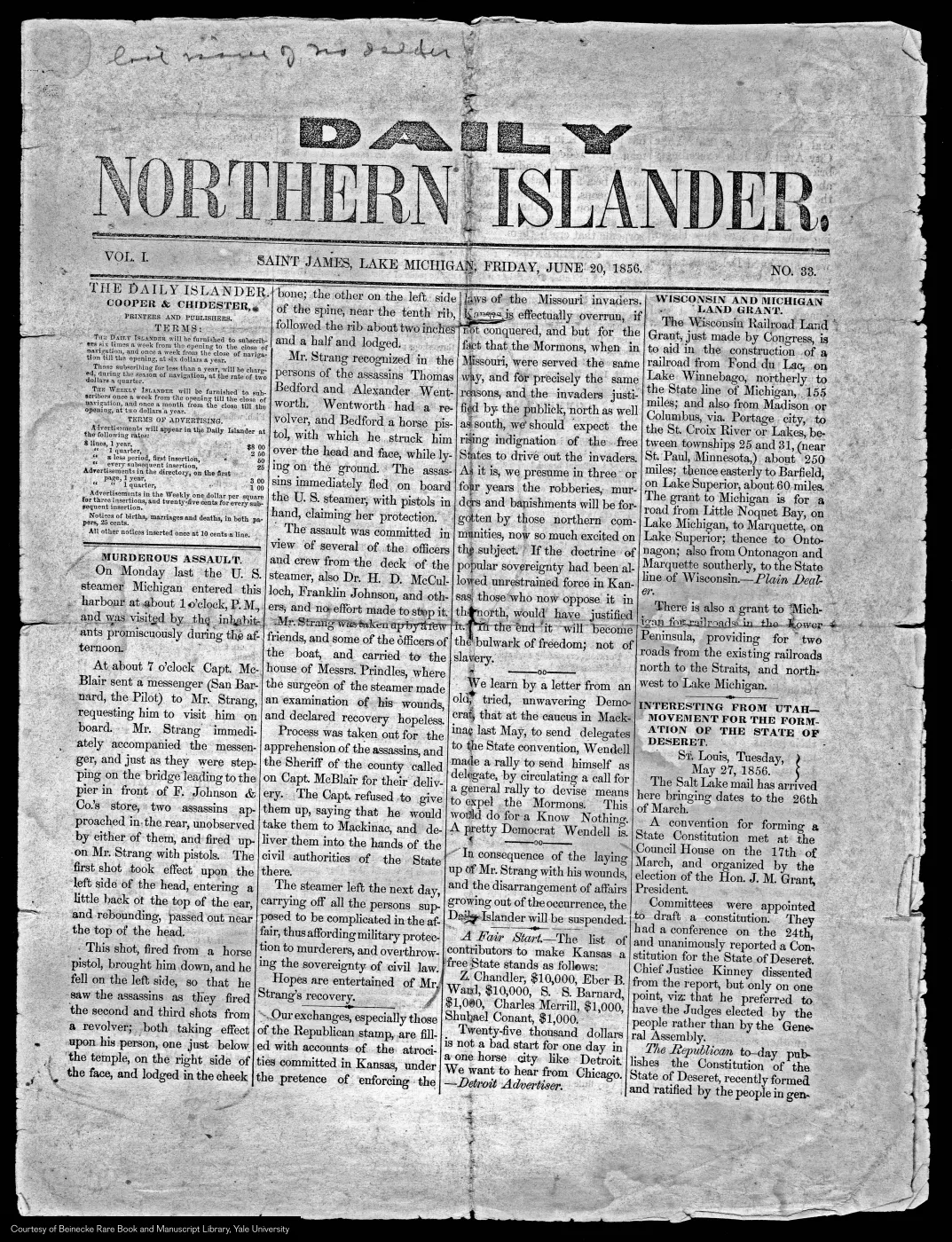
On the evening of 16 June 1856 Bedford and Alexander Wentworth shot Strang from behind as he walked toward the Michigan. Strang’s own paper named them four days later: “Wentworth had a revolver, and Bedford a horse pistol, with which he struck him over the head and face, while lying on the ground.”5 See Assassination of James Strang.
The two “made no attempt to escape, but surrendered themselves” aboard the steamer.1 Her commander refused to give them up to the Emmet County sheriff, and carried them — with their families and five other families who wished to leave the island — to Mackinac, where they were handed to the county sheriff and released almost at once.16 Williams, who knew Wentworth well in later years, records simply that “nothing was ever done in the way of giving these men a trial. Public sentiment was so great at the time against the Mormons it would have been impossible to find a jury to convict them.”7
About ten days later Bedford returned to Saint James aboard the Michigan with McCulloch and Wentworth and took part in an attempt to “arrest” Mormons in sight.8 The 1860 agricultural schedule still places him farming on Beaver Island, with 60 improved and 140 unimproved acres valued at $500.9 A newspaper account published in 1882 also reports Bedford speaking in the first person about the killing and says he had “since lived” on the island; the held page image is cited under Open questions below. Between them the two records displace an earlier conclusion here that he vanished from the record in 1856.
Significance
Bedford is the point at which the internal discipline of Kingdom of Saint James — punishment inflicted under church authority and unknown to the law of the State — produced the violence that destroyed it. The competing explanations of his flogging are a compact case study in the partisanship of this literature: the anti-Mormon press makes him an informer punished for honesty, Williams makes him a wronged employee, and Quaife’s Strangite informants make him an adulterer beaten privately by his own partner. The one thing all agree on is that the beating happened and that Bedford avenged it.
Open questions
-
Why was he whipped? Four incompatible answers, listed above. A church court record, if one was kept, would settle it; the Northern Islander would not ordinarily have reported such a proceeding, and Quaife notes that “ordinarily it would be kept out of the church paper, and no record be made of it.”
-
How many lashes? Four values, not two — forty (1856 press, now attested by three separate 1856 papers), forty-three (1893), forty-seven (1895), seventy-five (Williams 1905). The monotonic increase with distance from the event is the finding.
-
Death and later life. Birth is now established (circa 1815, England) but death is not. He does not vanish in mid-1856: he is farming on Beaver Island in the 1860 census. See the History section.
-
The 1882 interview could not be found.FOUND, 2026-07-31. An earlier note here recorded that a Chronicling America sweep of 1882–83 — 487 full-text-verified pages across ~35 query formulations — returned zero results, and that the interview rested solely on a 2002 Beaver Beacon column.That conclusion was wrong, and the reason matters: Chronicling America does not hold the papers that carried it. A newspapers.com search found 195 matches in 1882 alone. The interview was syndicated across at least: Cincinnati Enquirer, 15 July 1882 p.10; Green Bay Press-Gazette, 17 July 1882 p.2; Green Bay Advocate, 20 July 1882, pp. 1 and 4; Green Bay Weekly Gazette, 22 July 1882 p.2; New York Times, 3 September 1882 p.10; and, remarkably, the Devon and Exeter Gazette (England), 14 July 1882, and The Guardian (London), 13 October 1882.
The Green Bay Advocate installment of 20 July 1882 p.4 is headed “Strang’s Murder Concluded” — so it is the second part of a series — and is a first-person account sourced to Bedford: the text says “Mr. Bedford additionally relates…” and, of Bedford, “where he has since lived.” Bedford was alive and giving interviews in 1882, which settles the article’s long-standing doubt on that point and vindicates the Beaver Beacon column.
The lesson for method, not just for Bedford: an exhaustive negative in one corpus is a statement about that corpus. 487 verified pages of absence in Chronicling America meant only that Chronicling America lacks these titles.
-
No attestation of either assassin’s later life, testimony or death survives in Chronicling America. Seventeen later pages (1875–1939) mention them; every one is a retrospective retelling of the 1856 killing.
-
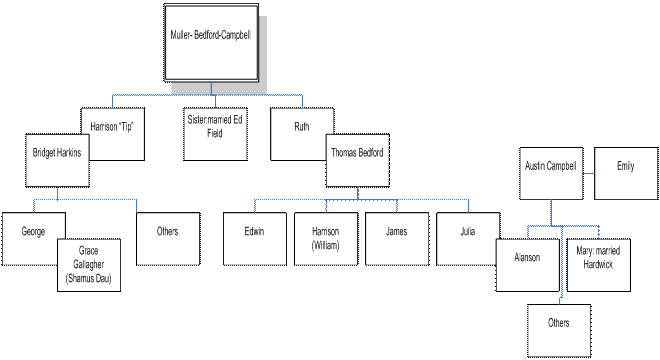
His wife. Ruth Ann (Miller) Bedford is identified by the 2025 community newspaper and later family material, but the original civil record and the chronology of her marriage still need direct checking. She was a sister of lighthouse keeper Harrison “Tip” Miller; Edwin Bedford was their son, not an unrelated nephew, according to the family and census reconstruction. Do not treat the exact death date repeated in user-contributed genealogy as established.
-
Whether any charge was ever filed. No Emmet or Mackinac county record has been located.
-
The rods. The Buffalo Express held the physical scourge in 1856. Whether it survives in any Buffalo or Michigan collection is unknown here.
See also
Sources
Footnotes
-
“Assassination at Beaver Island,” Daily National Intelligencer, 24 June 1856, p. 3, https://www.loc.gov/resource/sn83026172/1856-06-24/ed-1/?sp=3; the same despatch in the New York Herald, 24 June 1856, p. 1, and the New-York Dispatch, 29 June 1856, p. 7. ↩ ↩2 ↩3 ↩4
-
Quaife, The Kingdom of Saint James (1930), pp. 167-168 and p. 168 n. ↩ ↩2
-
Elizabeth Whitney Williams, A Child of the Sea; and Life among the Mormons (1905), pp. 75-76. ↩ ↩2
-
Evening Star (Washington, D.C.), 4 August 1856, p. 2, https://www.loc.gov/resource/sn83045462/1856-08-04/ed-1/?sp=2. ↩
-
“Murderous Assault,” Daily Northern Islander, 20 June 1856. ↩
-
Ibid., pp. 171-172. ↩
-
Ibid., pp. 177-178. ↩
-
Ibid., p. 173. ↩
-
U.S. Census, 1860 agricultural schedule, Beaver Island, Manitou County, p. 859, as transcribed in NPS, Tending a Comfortable Wilderness (2000), App. F, http://npshistory.com/publications/slbe/comfortable_wilderness.pdf. ↩
Kin
Read the document
12 pages, rendered from the held scan.
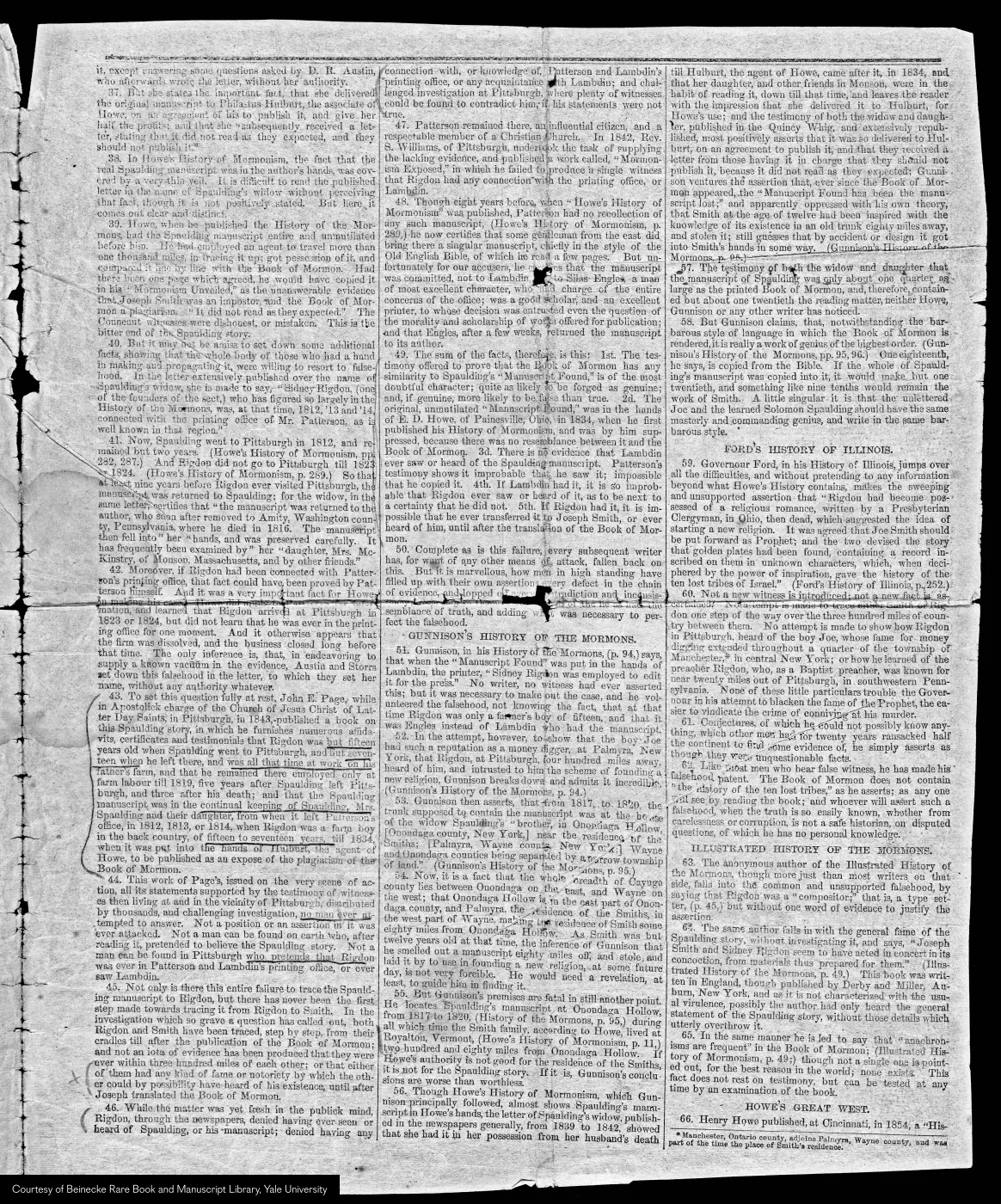
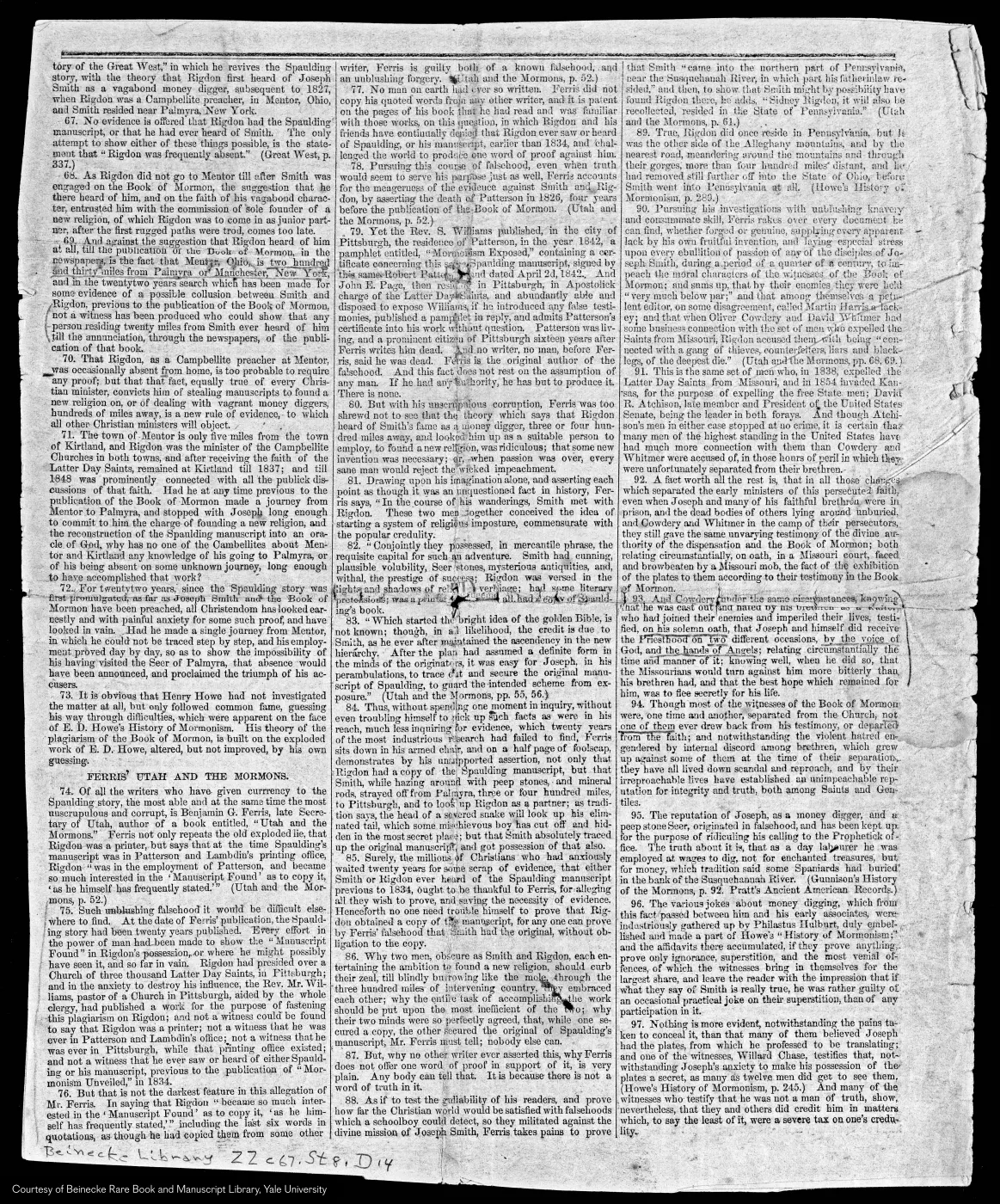
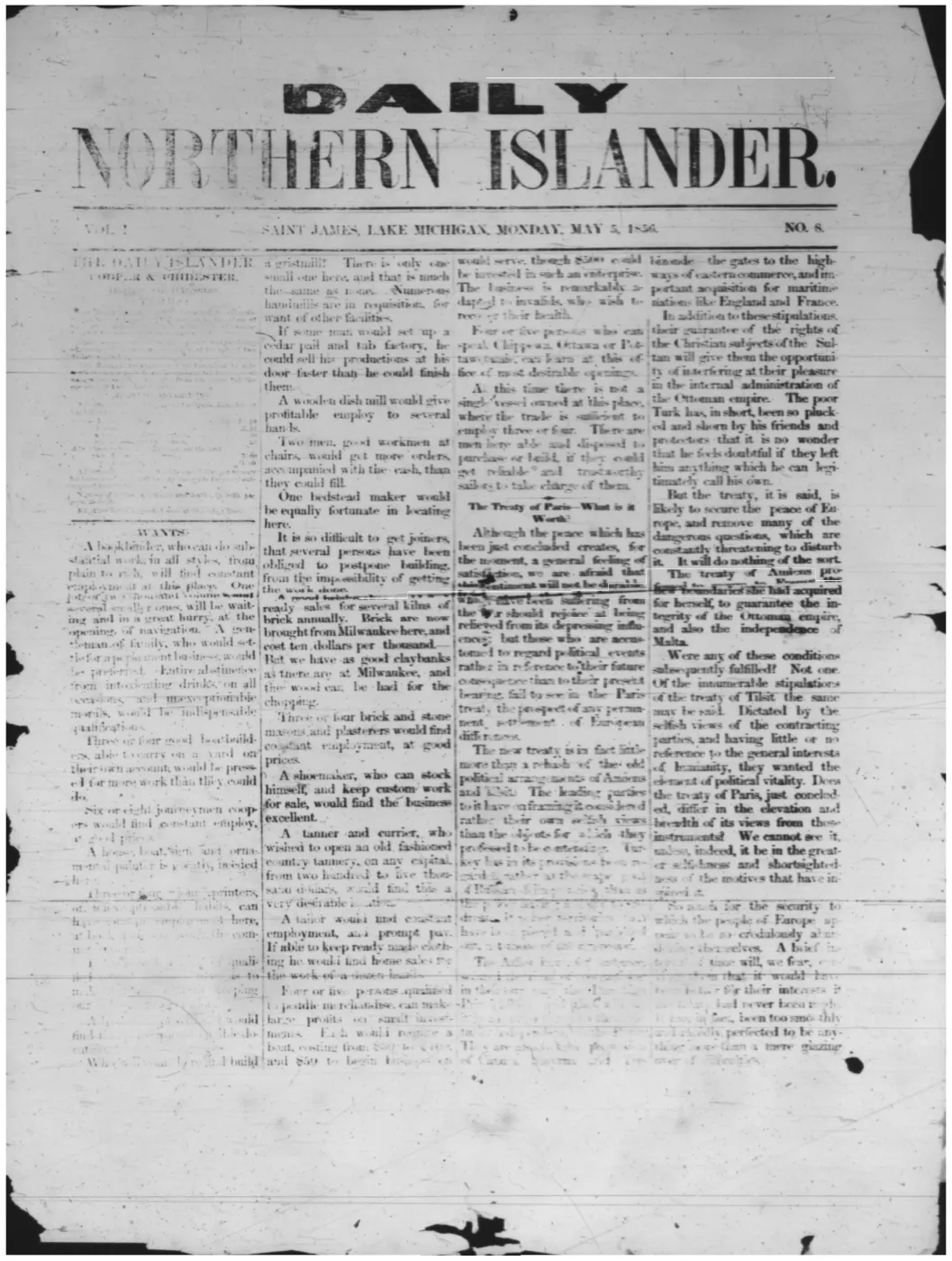
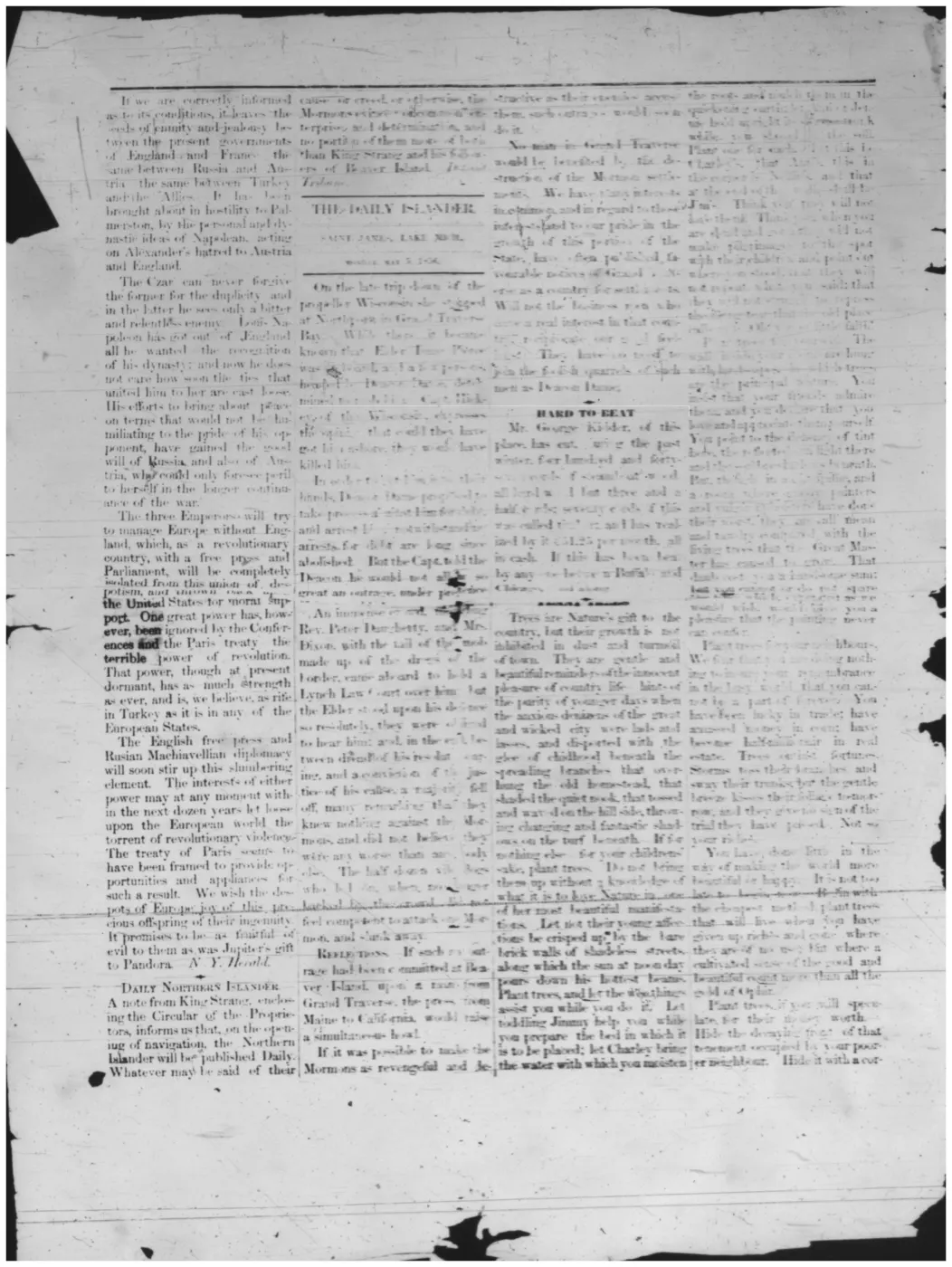
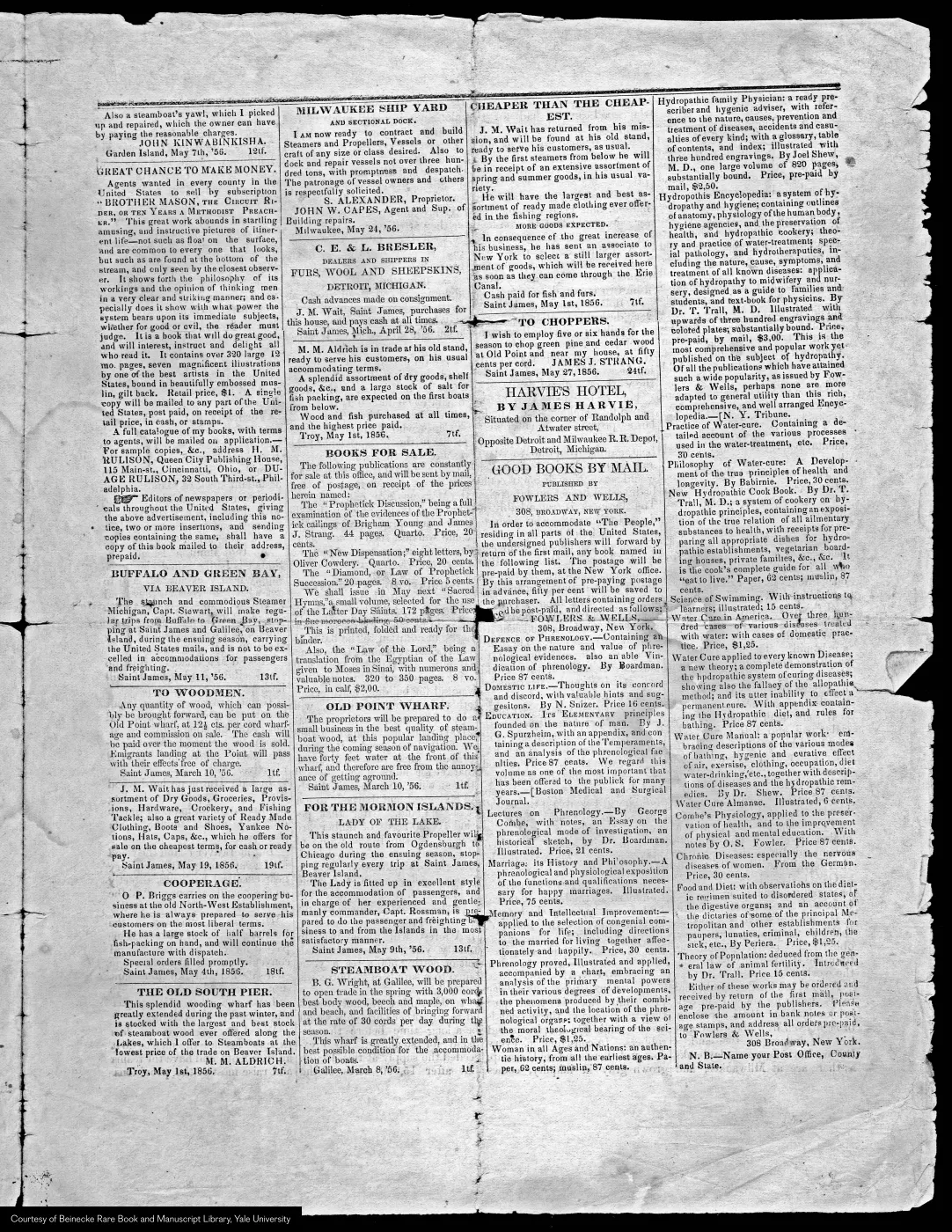
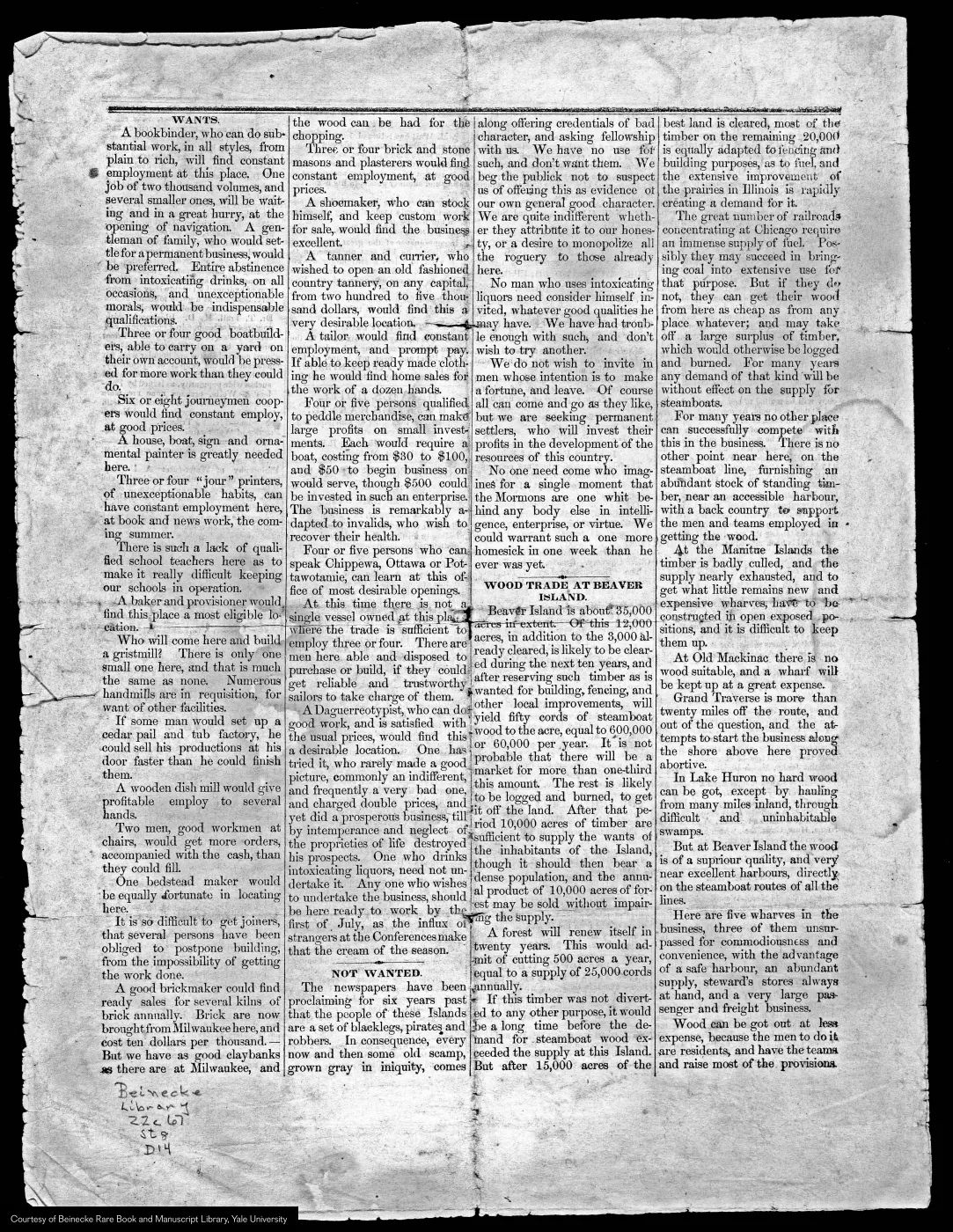
Sources
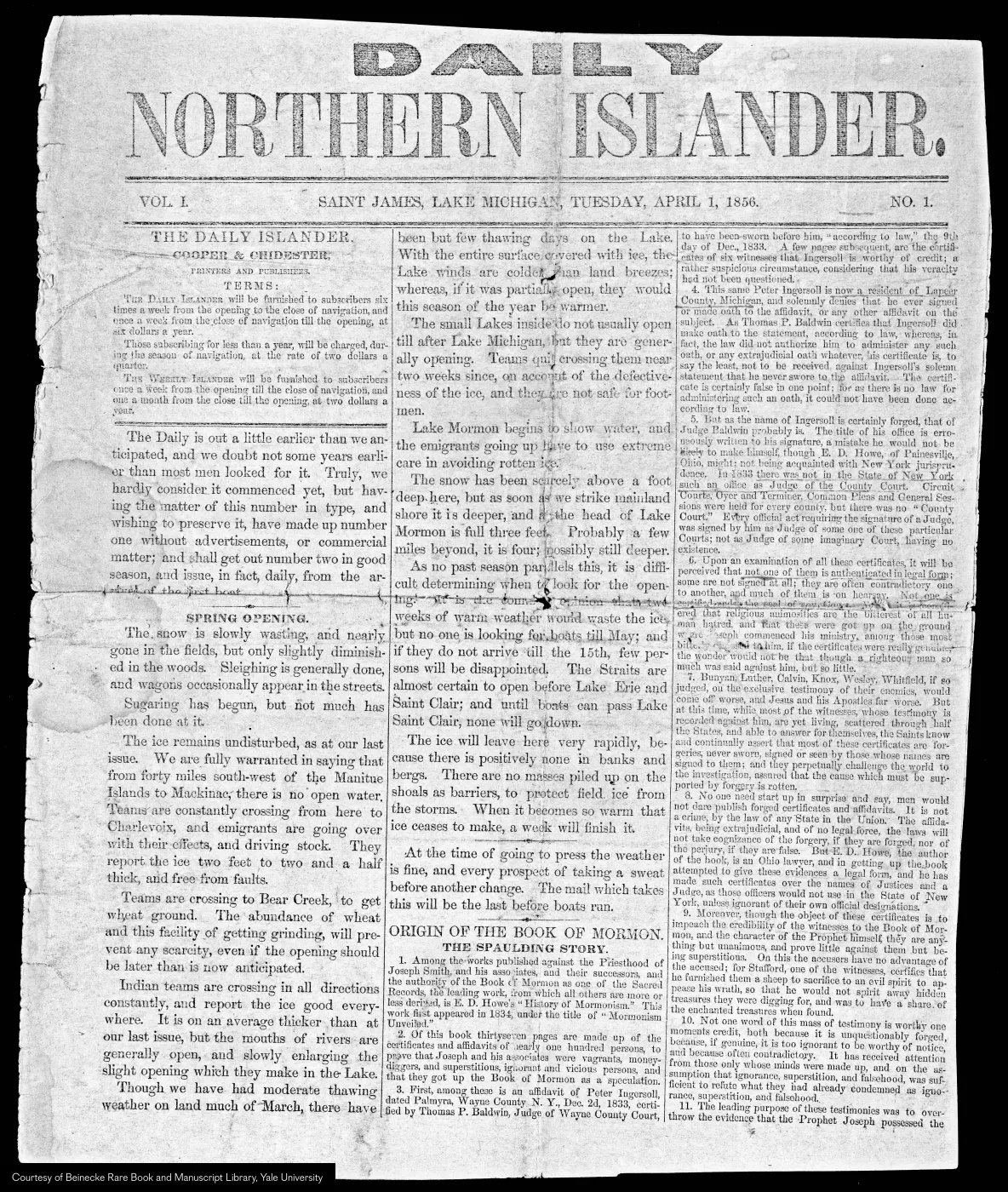
- Described in this archive: Northern Islander, 1850–1856.Names him: "Mr. Strang recognized in the persons of the assassins Thomas Bedford and Alexander Wentworth. Wentworth had a revolver, and Bedford a horse pistol, with which he struck him over the head and face, while lying on the ground."
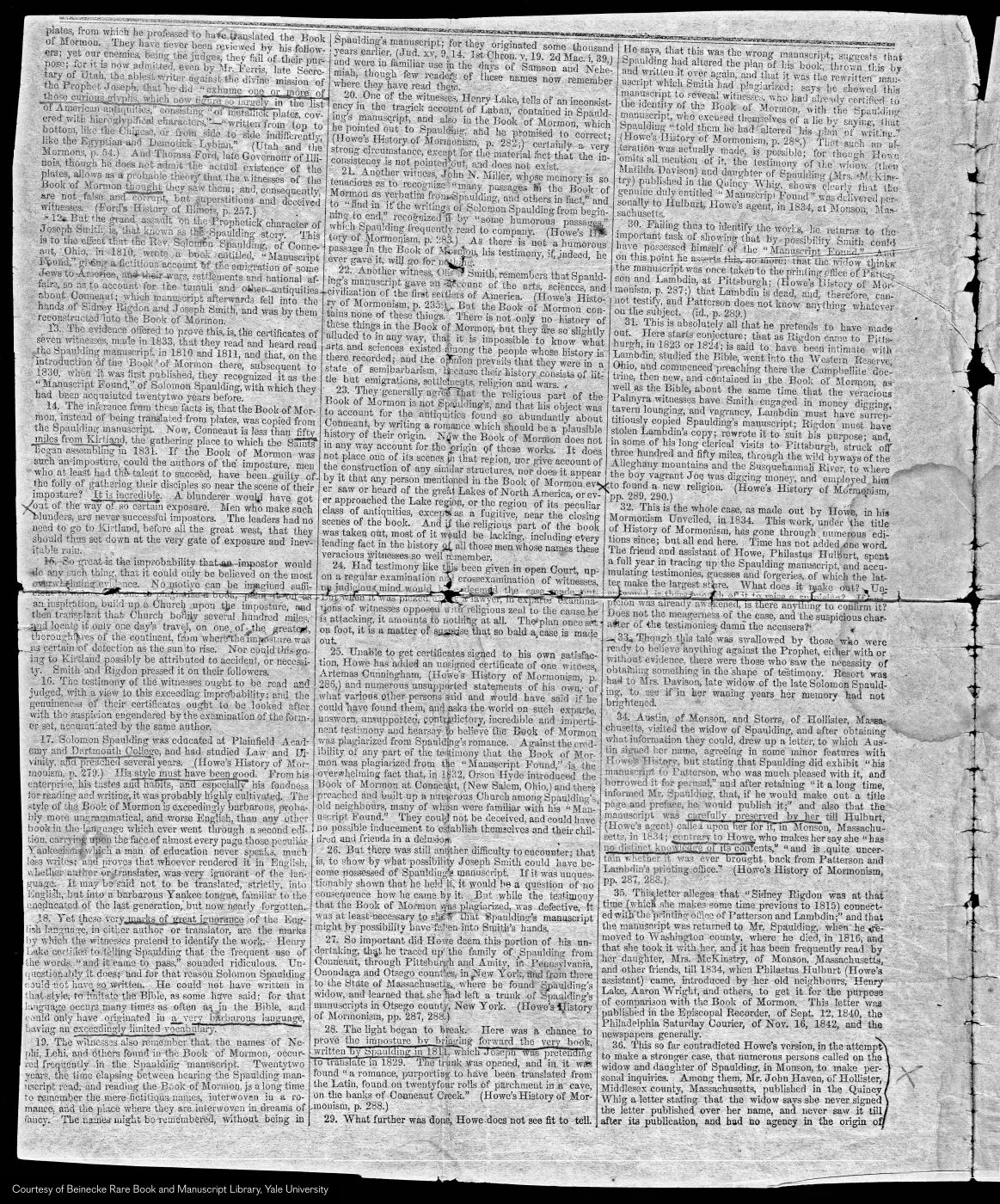
- The most detailed contemporary statement of the flogging: "Thomas Bedford, one of the men who committed the act, had been whipped forty lashes on the bare back, with a scourge made of blue beach sprouts, twisted together, some time since, upon a charge of neglecting to disclose facts concerning a robbery. This had been done by Strang's orders. Both Bedford and Wentworth had been Mormons, but had seceded, and had joined with the McCulloch faction, in the late schism. Both had families." Syndication note (2026-07-31): this despatch also ran in the *Weekly Indiana State Sentinel* (Indianapolis), 3 July 1856, p. 4 (https://www.loc.gov/resource/sn82014286/1856-07-03/ed-1/?sp=4), which adds that the two were "delivered into the custody of the Sheriff of Mackinaw" having fled "to the Michigan for protection against the fury of the Mormons". That printing is the SAME wire story, not an independent witness -- the wording is identical -- so it corroborates transmission, not the facts. A Chronicling America sweep found the forty-lash figure only in this one despatch and its reprints.federal · chronicling_america · sn83026172_1856-06-24_ed1_p3
- Physical description of the instrument: "The Buffalo Express has been presented with the bundle of rods with which the man Bedford was whipped, by order of King Strang … made of beech, birch and maple sticks, about seven feet in length and five in number, each of them about half an inch in diameter at the butt, and all tightly bound together by strings."federal · chronicling_america · sn83045462_1856-08-04_ed1_p2
- Described in this archive: The Kingdom of Saint James, Quaife, 1930.Gives a third account of the cause of the flogging, from interviews with Mrs. Sarah Wing and Zenas Wright in 1918-1920, and Wingfield Watson's recollection of Strang's words on the subject: "Whatever you do, let it be done quickly."
- A fourth account: Bedford "was employed by Mr. Peter McKinley," gave information about Mormon thefts, and "received seventy-five of the cruel stripes with the 'blue beaches.'" Also states that no trial was ever held.
- "Two men named Bedford and Wentworth had been subjected to public discipline. One of them had been severely whipped, and, as he believed, by Strang's orders, although this was denied."
- Contemporary report describes Bedford as English by birth and as having emigrated with his family and father-in-law's family.
- Records Thomas Bedford farming on Beaver Island after the 1856 expulsion; the fact is used here without adopting the transcription's unsourced later death candidate.
- "Strang's Murder Concluded," *Green Bay Advocate* (Green Bay, Wis.), 20 July 1882, p. 4.Newspapers.com page image, citation copy only. The syndicated first-person account says of Bedford that "he has since lived" and identifies him as the source of the account. The original Newspapers.com image ID was not retained when the file was acquired; see the sidecar and Open questions. No public copy of this file is known; the archive holds one and can provide it on request.newspapers_com · page_evidence · green_bay_advocate_1882-07-20_p4_strangs_murder_concluded
- Community-history account reproducing the 1882 interview tradition; useful as a lead, not an independent substitute for the newspaper page image.
- Community newspaper account identifies Ruth Ann as Bedford's wife and describes the family's later Beaver Island history; its genealogy is secondary.
- Described in this archive: Helen Collar family-tree images.Visual research aid that connects Thomas Bedford and Ruth within the Miller–Bedford–Campbell diagram. It corroborates the held Collar card’s wife and sibling bridge, without replacing an original marriage or census record.web · collar_family_trees · collar-bio-b-004-thomas-bedford-01-mueller-bedford-campbell-family-tree
Added 28 July 2026 · revised 2 August 2026. Recent changes
Cite this article
Beaver Island Archive, “Thomas Bedford”, https://beaverislandarchive.org/people/thomas-bedford/, accessed [date], citing "Murderous Assault," *Daily Northern Islander* (Saint James, Lake Michigan), Friday 20 June 1856. (and 11 further sources listed on the page).
Last revised 2026-08-02. Fill in [date] with the date you read it — this page is static and cannot know that.