- Dates
- 1856-06-28 – 1856-07
- Kind
- Migration
- Along road
- King's Highway
- Eras
- Strang eraIrish era
- Concepts
- migrationsocietydemographymormonismreligionhistoriography
- Within
- Beaver Island · Saint James · Saint James Harbor
Summary
Within three weeks of the shooting of James Jesse Strang on 16 June 1856, the entire Mormon population of Beaver Island was removed from it. The departures began voluntarily: Strang himself left on the propeller Louisville on 28 June, and families followed on the Iowa two days later. They ended in early July with an armed party from the mainland ordering the remaining Saints to the harbour on pain of having their houses burned, crowding them aboard whatever steamers came in, and taking possession of their property. Quaife estimates about 2,600 people were driven out; that estimate rests on Strang’s own 1854 census and is contested. The land was afterwards occupied by the fishermen and their successors, and Beaver Island’s Irish Catholic settlement dates from this moment.
History
Sequence
| Date (1856) | Event |
|---|---|
| 16 June | Strang shot; assassins carried to Mackinac on the Michigan.1 |
| c. 26 June | The Michigan returns to Saint James with McCulloch, Wentworth and Bedford aboard; they attempt “arrests,” fire on Samuel C. Field, and withdraw.2 |
| 28 June | Strang leaves Saint James on the propeller Louisville for Voree.2 |
| 30 June | A number of families depart for Voree and other points aboard the Iowa.2 |
| 3 July | A party from Mackinac, led by that county’s sheriff, comes to arrest Mormon leaders and fails; the leaders have already gone.2 |
| 4–7 July | Notice given to the remaining Saints to leave forthwith; forced embarkation over two or three days.3 |
| 9 July | Strang dies at Voree.4 |
| 12 July | The victors’ manifesto printed at Saint James as an “Extra — Islander Redeemed.”5 |
The removal
Quaife’s account, drawn from the church historian Warren Post and from survivors he interviewed in 1918–1920:
Bands of swearing, drunken ruffians went about the island commanding the Mormons to assemble at the harbor for immediate departure, on peril of having their homes burned over their heads. There they were crowded on board steamers, as many as the vessels could carry, and started into exile; up the Lake or down the Lake, it was all the same to the mobbers, who, even before the Saints had left the harbor began the appropriation of their property.3
Named vessels: the Keystone State (which took a load to Chicago), the Iowa, and the Louisville (to Detroit, “all she could stow”).67 A contemporary letter records 490 taken to Chicago on a single boat and 300 having gone earlier on the Iowa.6 Quaife’s illustrative case is Wingfield Watson, ordered to bring his goods to the harbour within a day although his wife had given birth three days before; the family walked the King’s Highway to the harbour and were put aboard the Keystone State without their cattle or possessions, and landed on a Chicago dock to sit in the July sun for most of a day.7
The 1892 Michigan Pioneer sketch is briefer and equally categorical: “a mob of angry fishermen and others descended upon the Mormon settlement, burned the temple, sacked the ‘royal palace,’ and drove the subjects of the fallen monarch from the islands in hot haste. The dispersion of the Beaver island Mormons was complete.”8
Quaife names St. Helena Island, near the Straits, as the assembly point for the attacking party, and the Newton brothers — traders there — as prominent in it, quoting a local ballad: “‘Arch Newton now must lead us on, / We’ll sweep the Beavers clean.’”9
The other version
Elizabeth Whitney Williams heard the story from her brother Lewis, who was “one of the men chosen the year before to help preserve law and order in the sending away of the Mormons” and who went to the island “to help get the people away on the steamboats that were sent to carry them from the island.” In her telling many Mormons left at once and voluntarily, having means of their own; the scenes at the dock were of grief rather than violence — “Women fainted and were carried on board; children were crying. Even men were sobbing, and two or three attempted to throw themselves from the dock into the water to end their misery” — and, critically, “All were allowed to take their household goods, yet many did not do so.”10 The Cleveland Plaindealer, reported in Louisiana on 22 July, likewise described the Mormons as “leaving Beaver Island … en masse, and selling their property for the most they can get.”11
Against her, a New Hampshire paper of 19 July reported: “About ninety Mormons, driven out from Beaver Island, arrived at Chicago last Wednesday, in a state of destitution. Others were landed at Milwaukie and Racine. They were compelled to leave their property behind them.”12 The number in that paragraph is much smaller than the 490 in Quaife’s source, and may refer to a single arrival; the statement about property is flatly contrary to Williams.
A contemporary account that belongs to neither camp reached print in October. A signed travel letter in the Central Presbyterian of Richmond, Virginia, of 25 October 1856 describes a stop at the islands shortly after Strang’s death, its information taken chiefly from the sheriff of Mackinac county, a fellow passenger. The writer found a flag flying at the wharf inscribed “No King Strang”; reports that the elders had fled ahead of the sheriff, the general impression being that they would make their way to Utah; and says the sheriff’s men found the undressed hides of cattle stolen from them months before, still carrying their owners’ marks. Where Quaife and the 1892 sketch describe a population swept off the island entirely, this letter reports “the other Mormons, most of whom would seem to have been duped by their leaders … we found living quietly at the Islands — no longer Mormons, however, in their faith.”13 That is a contemporary report of people remaining, and it does not sit easily with a complete removal. The letter’s own dating is loose, though — it places the coronation three years rather than six before 1856 — and its sympathies are plainly with the party that broke the colony up.
The character of the removal is contested. Whether it is best described as an expulsion at gunpoint, a panicked voluntary exodus, or both in sequence depends on which witness is preferred; the sources held here support a sequence beginning with voluntary flight and ending in coercion.
The manifesto
The party that took the island printed its own statement on the captured press of the Northern Islander, 1850–1856, as an “Extra” retitled Islander Redeemed. The Buffalo Express received a copy and remarked that the slip was “shockingly printed” because “the only means they possess for printing are so rude as scarcely to afford a tangible result,” adding that “the time has come for the redemption of that unfortunate portion of Michigan, and we shall soon receive from there a respectable newspaper, in lieu of the despicable Islander.”5
The dominion of King Strang is at an end. The band of marauders, once occupying the Beaver group of islands, under the administration and direction of James J. Strang, their reputed Prophet, have fled at the approach of the Sheriff. The land is redeemed; a kingdom no longer exists upon the borders of one of our most populous States. … It should be matter, therefore, of public rejoicing to all persons living contiguous to the Lakes that this nest of banditti have been exterminated, and we would take this occasion to caution the citizens of Wisconsin against many of them who have fled within her precincts.5
The same document accuses Strang of census fraud: “The census returns made for the county of Emmet, under his own hands, show an aggregate population of 7,000, whilst in reality it falls below 1,000.” That allegation is the principal counterweight to the Mormon population figures; see Kingdom of Saint James.5
Numbers
Quaife’s estimate of about 2,600 expelled is an extrapolation from the Northern Islander’s report of a census of autumn 1854 showing 2,608 residents on Big Beaver Island. The direct evidence of vessel loads in his sources totals about 790 (490 to Chicago plus 300 on the Iowa) plus the Louisville’s unspecified load.36 Everything above that figure is extrapolation from a count Strang’s own people made and Strang’s own paper printed.
Aftermath
Quaife records that the exiles scattered — many to the Reorganized Church, some to Utah, most out of Mormonism altogether — and that the church, left without a designated successor, disintegrated. The Michigan historian Byron M. Cutcheon, quoted by Quaife, called the day of the expulsion “the most disgraceful day in Michigan history.”3 The men who took the island stayed: the 1892 sketch notes that they and their successors “are still in possession of the fruits of conquest,” living in the abandoned Mormon cabins, with the office of the Northern Islander converted into “the best hotel” in St. James and Catholicism become the island’s dominant religion.8
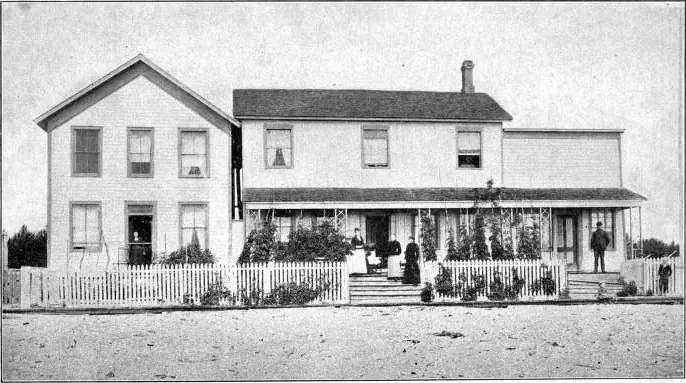
Elizabeth Whitney Williams’s 1905 memoir carries a photograph of the printing office in a later use as a boardinghouse, captioned “the old Mormon Printing Office, now the Gibson House.”
Williams’s memoir, writing of her family’s own return to the island afterward, gives the fullest account held here of the unfinished Mormon temple’s end, and it does not match the 1892 sketch’s claim that the mob burned it during the mobbing itself: “At the time the Mormons left the island the temple was left standing. The excitement was so great and the Gentiles feared the Mormons might return with another leader in Strang’s place, so they thought best to burn the temple. It was of the exact pattern as the one at Kirtland, Ohio, as Strang had built it after the same plans. The building was all up and inclosed, but not yet finished.”14 On her account the burning was a later, deliberate act by the settlers who took over the island, driven by fear of a Strangite return, not part of the expulsion violence itself.
Significance
In a few days the expulsion ended the Strang era and transferred an entire built landscape — cleared farms, hewn-log houses, roads, a sawmill and a printing office — from one population to another. The Irish fishing settlement that has defined the island ever since begins here. It is also the reason the island’s Mormon documentary record is so thin: the press stopped, the files scattered, and the victors wrote the history.
Open questions
- How many people. See above. The figure cannot be settled without the manuscript Michigan state census returns for Emmet County, which are not held here.
- Coercion or flight. Quaife and the 1892 sketch describe an armed expulsion; Williams and the Cleveland Plaindealer describe a largely voluntary departure with goods. Both may describe different phases.
- Was the temple burned during the expulsion itself? The 1892 sketch says the mob “burned the temple” in the same breath as the mobbing; Williams’s memoir, by contrast, states the unfinished temple was left standing when the Mormons left and was burned only later, deliberately, by the settlers who took the island, out of fear the Mormons might return under a new leader. No source held here gives a date for the burning Williams describes, and no independent contemporary (1856) report of it — under either version — has been located.
- Did anyone stay? The Central Presbyterian‘s traveller reports finding islanders still “living quietly at the Islands - no longer Mormons, however, in their faith” after the removal. Whether that describes people never expelled, people who had already conformed, people who came back, or a confusion on the writer’s part is not resolved by anything held here, and it sits against the other accounts’ picture of a complete clearance.
- Where they went. Chicago, Detroit and Wisconsin are attested; no reconstruction of where the exiles settled has been attempted here.
- Property title. How the Mormon land holdings passed to their occupiers is not settled by the narrative sources held here. The now-held BLM General Land Office patents document federal grantees, including an 1849 patent to James J. Strang, but they do not provide the later private conveyances needed to reconstruct how particular Mormon holdings passed to post-1856 occupiers.
See also
Sources
Footnotes
-
“Murderous Assault,” Daily Northern Islander, 20 June 1856. ↩
-
Quaife, The Kingdom of Saint James (1930), p. 173. ↩ ↩2 ↩3 ↩4
-
“Death of King Strang,” New York Herald, 15 July 1856, p. 5, https://www.loc.gov/resource/sn83030313/1856-07-15/ed-1/?sp=5. ↩
-
“From Beaver Island: King Strang’s Mormon Settlement Broken Up,” New York Herald, 14 July 1856, p. 8, reprinting the Buffalo Express of 12 July 1856 and the “Extra - Islander Redeemed,” https://www.loc.gov/resource/sn83030313/1856-07-14/ed-1/?sp=8. ↩ ↩2 ↩3 ↩4
-
“Sketch of James Jesse Strang and the Mormon Kingdom on Beaver Island” (1892), pp. 12-13. ↩ ↩2
-
Ibid., p. 178. ↩
-
Elizabeth Whitney Williams, A Child of the Sea; and Life among the Mormons (1905), pp. 175-177. ↩
-
The Morning Comet (Baton Rouge), 22 July 1856, p. 2, https://www.loc.gov/resource/sn88064473/1856-07-22/ed-1/?sp=2. ↩
-
Granite Farmer and Visitor (Manchester, N.H.), 19 July 1856, p. 6, https://www.loc.gov/resource/sn84027719/1856-07-19/ed-1/?sp=6. ↩
-
“Notes of Travel at the North and North-West: Beaver Islands and the Mormons,” The Central Presbyterian (Richmond, Va.), 25 October 1856, p. 1, https://www.loc.gov/resource/sn89053987/1856-10-25/ed-1/?sp=1. ↩
-
Ibid., p. 196. ↩
Sources
- Described in this archive: The Kingdom of Saint James, Quaife, 1930.The fullest narrative, built on Warren Post's manuscript "Apostolic Testimony," a letter of Edward Chidester of 3 August 1856, and interviews with Wingfield Watson and Zenas H. Wright. Gives the sequence of departures, the named vessels, the numbers carried, and the estimate of about 2,600 expelled.
- The victors' own statement, printed on the captured press of the Northern Islander. The Herald's introduction notes the slip was "shockingly printed" because "the only means they possess for printing are so rude as scarcely to afford a tangible result."federal · chronicling_america · sn83030313_1856-07-14_ed1_p8
- Shows how widely the manifesto circulated in the national press within a fortnight.federal · chronicling_america · sn83026172_1856-07-25_ed1_p3
- "The Sheriff went to execute a process against those who shot King Strang, when the whole party pulled up stakes and off. They have gone off into Wisconsin, but will not be suffered hereafter to form laws and institutions of their own adverse to those of the State."federal · chronicling_america · sn85026945_1856-08-07_ed1_p2
- "The Mormons are leaving Beaver Island, in Lake Michigan, en masse, and selling their property for the most they can get." Evidence that some departure was voluntary and some property was sold rather than seized.federal · chronicling_america · sn88064473_1856-07-22_ed1_p2
- "About ninety Mormons, driven out from Beaver Island, arrived at Chicago last Wednesday, in a state of destitution. Others were landed at Milwaukie and Racine. They were compelled to leave their property behind them." Contradicts Williams on property; the figure conflicts with Quaife's 490 to Chicago.federal · chronicling_america · sn84027719_1856-07-19_ed1_p6
- The account from the other side, via her brother Lewis, "one of the men chosen ... to help preserve law and order in the sending away of the Mormons." Says "All were allowed to take their household goods" - directly contrary to Quaife, and that "two or three attempted to throw themselves from the dock into the water." Separately (p. 196), on her family's later return to the island, states the unfinished temple was left standing when the Mormons left and was burned only afterward by the Gentiles, from fear of a Strangite return.
- "A mob of angry fishermen and others descended upon the Mormon settlement, burned the temple, sacked the 'royal palace,' and drove the subjects of the fallen monarch from the islands in hot haste."
- Contemporary report that the assassins of James Jesse Strang were carried to Mackinac aboard the steamer *Michigan*.
- A signed traveller's letter describing a stop at the islands shortly after Strang's death, its information gathered largely from the sheriff of Mackinac county. Reports a flag flying at the wharf inscribed "No King Strang"; that the elders had fled ahead of the sheriff; that the sheriff's men found hides of stolen cattle bearing their owners' marks; and that the remaining islanders were found "living quietly at the Islands - no longer Mormons, however, in their faith." The account's own dating is loose - it places the coronation three years rather than six before 1856.federal · chronicling_america · sn89053987_1856-10-25_ed1_p1
Added 28 July 2026 · revised 2 August 2026. Recent changes
Cite this article
Beaver Island Archive, “Expulsion of the Strangites”, https://beaverislandarchive.org/events/expulsion-of-the-strangites/, accessed [date], citing Milo M. Quaife, *The Kingdom of Saint James: A Narrative of the Mormons* (New Haven, Yale University Press, 1930), pp. 173-178. (and 9 further sources listed on the page).
Last revised 2026-08-02. Fill in [date] with the date you read it — this page is static and cannot know that.
BibTeX for “Expulsion of the Strangites”RIS for “Expulsion of the Strangites”