- Eras
- Strang eraModern era
- Concepts
- governancemonarchylegal-instrumenthistoriographymormonism
- Within
- Beaver Island
Summary
Beaver Island’s relationship to authority outside itself has run through the Michigan legislature, federal courts, the Charlevoix County sheriff and circuit court, and state land and wildlife agencies. In the Strang period that relationship was adversarial and unusually direct: James Jesse Strang was prosecuted in federal court and, in the same years, twice elected to the Michigan legislature, where he helped draw the county lines that still approximate the island’s civil geography. The 1856 assassination and the expulsion that followed it exposed how thin the machinery of law actually was at the moment it mattered most — a county sheriff without the power to compel a federal warship, and an armed removal of thousands of people carried out under the rhetorical cover of a sheriff’s process rather than any court’s. After 1856 the record is thinner and more procedural: circuit-court trials held at Charlevoix, arrests made on the island and defendants transported to the mainland, and state agencies regulating hunting and holding land as landowner and lessor. Township self-government is not this survey’s subject — see Island civic governance and public institutions — and neither is the operational history of the sheriff’s deputy, the Coast Guard, or the post office, covered in Public service and emergency response. What is gathered here is the jurisdictional relationship itself: who had authority over the island, on what legal footing, and how far that authority actually reached.
A jurisdictional patchwork before Strang
When the state legislature erected the Beaver Islands into the township of Peaine in 1847, it did not give the new township a single governing county. Peaine was part of Emmet County on paper but was attached to Mackinac County for judicial purposes, to the Newaygo district for the election of a state representative, and to Lapeer for the election of a state senator — three different seats of authority for three different functions, none of them on the island.1 Quaife judged that this arrangement, combined with the islands’ geography, gave the Mormon settlers effective control once their numbers grew: whoever could deliver the vote in a sparsely settled, physically remote district could not easily be checked by the counties nominally responsible for it.1
Strang in federal court
In May 1851, United States District Attorney George C. Bates brought the armed revenue steamer Michigan to Beaver Harbor under a set of federal warrants charging Strang and dozens of others with treason, mail robbery, counterfeiting, and trespass on public land.2 Aboard the vessel, Strang was shown a list of thirty-eight men wanted for trespass; he sent it ashore, and thirty-one of them came voluntarily to be arrested within two hours.3 A commissioner’s court was set up on deck, but one of the complainants could not produce his witnesses, and it was dismissed; Strang and three others agreed to go to Detroit under surveillance for further proceedings, on Strang’s personal pledge for their appearance.3
Testimony was taken on Beaver Island itself before U.S. Commissioner W. D. Wilkins, with Strang appearing alongside counsel Alexander T. McReynolds; the resulting evidence went before Judge Ross Wilkins — a different official — at the United States district court in Detroit in June 1851.2 A jury of ten Whigs and two Democrats acquitted the defendants, and the remaining indictments were dismissed.4 Bates blamed the loss on the judge’s charge against prosecuting “for religion’s sake”; Strang answered the timber-theft charge by producing an official letter from Bates himself granting permission to cut government timber, and the counterfeiting charge collapsed when the witness who had supplied it confessed under questioning that he had invented the story.56 Quaife’s own retrospective judgment, writing eighty years later, sided with the jury: the charges were “the product of excited gentile imaginations.”5
The prosecution’s cost fell hardest on the settlement’s ordinary members. Strang counted ninety-nine Mormons arrested on the island and carried away for trial between 11 April and 23 June 1851, leaving as few as twenty-four adult men on the island at one point; women worked the fields to bring in the season’s crops.7 With the men away, “hostile individuals clothed with official authority” plundered Mormon property and divided farms among themselves in anticipation of convictions that never came; when the defendants returned, restitution was obtained not through Mackinac’s courts but through a Mormon proceeding presided over by Strang himself, sitting as justice of the peace at Saint James.7 The fuller newspaper record of the case, including the acquittal’s reception in the Detroit press, is gathered in Federal prosecution of Strang and associates, 1851.
Strang in the legislature
At the general election of 2 November 1852, Strang stood for the Michigan House of Representatives from the Newaygo district — an apportionment that, because of the jurisdictional patchwork above, happened to include the Beaver Islands — keeping his candidacy secret until election day and winning all 165 votes cast there.8 Opponents at Mackinac tried to have him arrested on an old indictment as he traveled to Lansing to take his seat; the 1892 sketch records the same maneuver directly, and Strang evaded it by using his privilege as a legislator.2 His seat was contested in the House and upheld by a vote of forty-nine to eleven.9
During that first term Emmet County was organized by act of 29 January 1853, detached from Mackinac County jurisdiction.10 Strang was reelected in 1854 with 695 votes from Emmet and Cheboygan counties, and in his second term the legislature detached the Beaver, Fox, and Manitou island groups from Emmet’s mainland territory to form the short-lived county of Manitou — a measure the Mormons read as a compromise confining them to the islands, and one that, by putting the entire new county’s first election in Mormon hands, worked in their favor regardless.10
Emmet County’s organization also gave it jurisdiction over the waters of Lake Michigan and brought an 1851 state liquor law — restricting sales to Indians and requiring bonded sureties — within reach of enforcement for the first time. Strang moved to enforce it, publishing notice in the Northern Islander that “if the trade is persisted in, the sheriff will go out with sufficient force and make arrests.”11 Mackinac County answered with a public meeting of its supervisor, district attorney, and four justices of the peace, which formed a “Committee of Safety” and printed resolutions encouraging armed resistance from the traders at Pine River — the mainland settlement that became Charlevoix.12 Quaife holds those Mackinac officials substantially responsible for what followed: the armed clash at Pine River in July 1853, fought between the two counties’ rival claims to authority over the same stretch of water.13 Strang’s control of Emmet County’s civil offices ran in parallel with his religious authority: as township supervisor and one of its justices of the peace, he chaired the board of health and moderated township meetings, centering the settlement’s civil government in the same hands as its church.1
Assassination, custody, and expulsion
The county sheriff’s practical reach over the island failed at the moment it mattered most. When Strang was shot on the dock at Saint James on 16 June 1856, process was taken out and the Emmet County sheriff demanded custody of the two assailants; the commander of the U.S. steamer Michigan refused, carrying them instead to Mackinac. Quaife notes this had no legal justification — the crime occurred in Emmet County’s own seat, whose sheriff was the lawful custodian — but he had no way to compel an armed federal vessel.14 At Mackinac the assailants were briefly held by that county’s sheriff and released; no trial was ever held.14 The fuller account, including the competing versions of what happened on the dock, is in Assassination of James Strang.
The removal of the rest of the settlement three weeks later carried a similar gap between the appearance and the substance of legal process. On 3 July an armed party from Mackinac, led by that county’s sheriff, came to arrest the Mormon leaders and found them already gone.15 The manifesto the victors printed on the captured Northern Islander press afterward cast the whole affair in the sheriff’s name — “the band of marauders … have fled at the approach of the Sheriff” — and a contemporary newspaper paraphrase likewise described “the Sheriff” as having gone “to execute a process against those who shot King Strang.”15 But the forced removal that followed over the next several days, in which an estimated hundreds to thousands of people were ordered to the harbor on threat of having their homes burned, had no comparable warrant, arrest, or hearing behind it for anyone but the small number of named leaders the 3 July party had sought. Whether that removal is better described as an expulsion, a panicked flight, or both by turns is contested and is addressed in full in Expulsion of the Strangites; what belongs here is only that a process aimed at a handful of named men supplied the legal language under which an entire population left.
Charlevoix County after 1856
The island became part of Charlevoix County after Manitou County was dissolved in 1895, a change documented in a later county-name retrospective rather than in the dissolution act itself; see Island civic governance and public institutions for that source and its limits. What the held newspaper record shows directly is that Charlevoix, the county seat on the mainland, has been the venue for the island’s serious legal proceedings ever since, with no held record of a resident circuit court or courthouse on the island itself. In September 1919 a Saint James man was shot; the county sheriff took the accused to Charlevoix, a report that also notes there was no physician on the island to treat the wound before it was carried there by boat.16 In June 1947 a Beaver Island fisherman stood a three-day trial in Charlevoix circuit court on an arson charge and was acquitted after an hour’s jury deliberation.17 In June 1982 a sheriff’s deputy arrested a man on the island on an outstanding warrant from another county and escorted him to Charlevoix.18 A 1936 hearing in the death of a High Island man employed by the House of David colony was held not at Charlevoix but at Shamrock, Michigan, according to a 1963 retrospective account that is the only record of it held here and is treated with the caution its own article states.19 None of these newspaper accounts supplies a docket, a charge statute, or a judge’s name; they establish only that the island’s courts, in the twentieth century as in Strang’s, sat somewhere else.
The forum also preserves a small 2020 campaign trace: attorney Robert Banner introduced himself as a candidate for 90th District Court Judge for Emmet and Charlevoix Counties and proposed an island meet-and-greet for September 12. A later post said weather postponed the visit. These are campaign statements and scheduling notices, not an official candidate filing, election result, court record, or proof that the event occurred.20
State agencies as regulator and landowner
Michigan exercises authority on the island in two distinct capacities besides the courts: as regulator and as landowner. As regulator, the Conservation Department (later the Department of Natural Resources) issued binding orders directly, such as a September 1938 Conservation Commission order closing deer hunting on Big Beaver Island for five years, signed by Director P. J. Hoffmaster.21 The fuller history of state game regulation on the island, including decades of conservation-officer postings and DNR enforcement, belongs to Wildlife and game management and is not restated here. As landowner, the DNR holds and leases land directly to township government: a 2019–2048 lease places five public-recreation sites within the Beaver Island State Wildlife Research Area — including the Lake Geneserath boat access and Martin’s Bluff Scenic Outlook — in Peaine Township’s hands as lessee, subject to the state’s continuing consent requirements.22 That instrument is a lease, not a transfer of title, and establishes only the state’s landowning relationship with the township, not a parcel boundary or a completed improvement.
Federal presence on the island predates all of this: a post office was established in 1849, and federal life-saving and Coast Guard coverage followed from the 1870s. Both are public-service institutions rather than legal or judicial ones, and their fuller record is in Public service and emergency response. The federal government’s relationship to the region’s original Anishinaabe inhabitants — the 1836 Treaty of Washington and 1855 Treaty of Detroit, which set the treaty-era terms for the Beaver Island Band before the archipelago’s Odawa and Chippewa population was displaced by the settlements this survey otherwise describes — is a distinct legal and sovereignty question addressed in Anishinaabe presence in the archipelago and is not adjudicated here.
Evidence and limits
This survey is built from Quaife’s 1930 narrative — itself dependent on manuscripts and interviews not held independently here — the 1892 Michigan Pioneer sketch, and a handful of twentieth-century newspaper notices. None of the twentieth-century items is a court record: no docket, judge’s name, charge statute, or case file has been located here for the 1919, 1936, 1947, or 1982 proceedings. The Strang-era material is richer but comes overwhelmingly from two secondary or semi-partisan retrospectives; the contemporary Northern Islander material used here is limited to the victors’ own manifesto, which is an interested party’s account of the very process it describes. No county tax roll, circuit-court calendar, or state land-parcel inventory specific to the island has been consulted for this survey; the tithing-funded county and township tax payments described in the 1892 sketch are the only direct evidence held here that Strang-era residents paid county taxes at all.
Open questions
- No held source gives the docket, charge statute, judge, or complete defendant list for the 1851 federal case beyond what Federal prosecution of Strang and associates, 1851 already records as open.
- Whether any coroner’s inquest or justice’s proceeding followed Strang’s shooting is not established from any source held here.
- The precise legal instrument, if any, effecting Manitou County’s 1895 dissolution and Charlevoix County’s assumption of the island has not been located; only a 1912 retrospective is held.
- No held source documents when or whether Michigan’s justice-of-the-peace system on the island was replaced by a district court, or where island residents have been arraigned in the twentieth century beyond the isolated newspaper notices cited above.
- The full extent of DNR land ownership on the island — beyond the single lease cited here — has not been surveyed for this article.
See also
- James Jesse Strang
- Kingdom of Saint James
- Federal prosecution of Strang and associates, 1851
- Assassination of James Strang
- Expulsion of the Strangites
- Island civic governance and public institutions
- Public service and emergency response
- Wildlife and game management
- Anishinaabe presence in the archipelago
Sources
Footnotes
-
Milo M. Quaife, The Kingdom of Saint James (1930), pp. 141-142. ↩ ↩2 ↩3
-
“Sketch of James Jesse Strang and the Mormon Kingdom on Beaver Island” (1892), pp. 8, 10,
data/books/internet_archive/sketchofjamesjes00lans/. ↩ ↩2 ↩3 -
Ibid., p. 134. ↩
-
Ibid., p. 136. ↩
-
Ibid., p. 143. ↩
-
Ibid., pp. 144-145. ↩
-
Ibid., p. 151. ↩
-
Ibid., p. 152. ↩
-
Ibid., p. 153. ↩
-
Sources gathered in Expulsion of the Strangites: Quaife, The Kingdom of Saint James (1930), p. 173; “The Mormon Kingdom on Beaver Island is destroyed,” Abbeville Banner, 7 August 1856, p. 2, https://www.loc.gov/resource/sn85026945/1856-08-07/ed-1/?sp=2; “Extra — Islander Redeemed,” reprinted in the New York Herald, 14 July 1856, p. 8, https://www.loc.gov/resource/sn83030313/1856-07-14/ed-1/?sp=8. ↩ ↩2
-
“St. James Man Badly Wounded,” Charlevoix County Herald, 26 September 1919,
data/newspapers/charlevoix/ocr/markdown/Charlevoix_County_Herald_1919-09-26.md. ↩ -
Charlevoix County Herald, 6 June 1947, “Beaver Islander Acquitted of Arson,”
data/newspapers/charlevoix/ocr/markdown/Charlevoix_County_Herald_1947-06-06.md. ↩ -
“Arrest Made on Beaver Island,” Beaver Beacon, June 1982,
/data1/beaver-island-archive/ocr/beaver_beacon/markdown/1982-06_Beaver-Beacon.md. ↩ -
Beaver Beacon, March 1963, retrospective report,
/data1/beaver-island-archive/ocr/beaver_beacon/text/1963-03_Beaver-Beacon.txt; see Claude Swafford murder hearing for the source’s own stated limits. ↩ -
State of Michigan, Order of the Conservation Commission — Deer — Certain Area Beaver Island, 9 September 1938, reprinted in Charlevoix County Herald, 9 October 1942,
data/newspapers/charlevoix/ocr/markdown/Charlevoix_County_Herald_1942-10-09.md. ↩ -
Michigan Department of Natural Resources and Peaine Township, lease for public-recreation sites in the Beaver Island State Wildlife Research Area, initial term 2019-2048,
data/research/island_governance/text/peaine-lake-geneserath-dnr-lease.txt. ↩
Sources
- Participants debated firearms, school safety, mental illness, law, and an alleged school security response. This is national political commentary with unverified claims, not a Beaver Island gun-violence, law-enforcement, or school-security record.forum · www.beaverislandforum.com · 12 · t012775
- Participants continued a national gun-policy debate, citing broad statistics and proposing firearm collection or school-security measures. The statistics and proposals are not independently verified here and do not document Beaver Island conditions.forum · www.beaverislandforum.com · 12 · t012770
- Candidate Robert Banner introduced himself as an attorney in Boyne City running for 90th District Court Judge for Emmet and Charlevoix Counties and proposed a September 12 island meet-and-greet. This is a candidate's own campaign statement, not an election result or official court record.forum · www.beaverislandforum.com · 15 · t015600
- A follow-up attributed to Banner said a planned island visit was postponed because of weather. It documents campaign scheduling, not that the visit occurred or that Banner won or held the judgeship.forum · www.beaverislandforum.com · 15 · t015648
- Described in this archive: The Kingdom of Saint James, Quaife, 1930.Chapters VIII-IX ("Misdeeds and Gentile Persecution" and "The King as Lawgiver"), read directly. Supports the 1851 federal prosecution, the jurisdictional attachment of Peaine Township to three different counties, Strang's 1852 and 1854 legislative elections and contested seat, the 1853 Emmet County organization and liquor-law conflict with Mackinac culminating at Pine River, and the later Emmet/Manitou county split. Pages 171-172 support the custody of Strang's assassins.
- Read directly. Page 8 states county and township officers were elected as elsewhere in the state and that tithing paid state, county, and township taxes. Page 10 names U.S. Commissioner W. D. Wilkins (testimony taken on Beaver Island) and Judge Ross Wilkins (U.S. district court, Detroit, June 1851) as two distinct officials, and reports an attempted arrest of Strang to keep him from taking his legislative seat.
- Event record for the 1851 federal prosecution, cited here for its own held sources and open questions rather than restated.Described in this archive: Federal prosecution of Strang and associates, 1851.Companion record; this survey adds the commissioner's-court and Detroit-trial detail Quaife supplies but does not restate the newspaper sources already gathered there. No public copy of this file is known; the archive holds one and can provide it on request.kb · articles · events · strang-federal-prosecution-1851
- Event record for the 1856 expulsion, cited here for the sheriff-led arrest attempt of 3 July 1856 and the victors' manifesto.Described in this archive: Expulsion of the Strangites.This survey draws only the jurisdictional framing (the manifesto's claim of legal process against a removal that had none for the general population); the full sequence and contested numbers are that article's subject. No public copy of this file is known; the archive holds one and can provide it on request.kb · articles · events · expulsion-of-the-strangites
- Event record for the 16 June 1856 shooting, cited here for the custody dispute between the county sheriff and the U.S. steamer *Michigan*.Described in this archive: Assassination of James Strang.This survey draws only the "Custody and impunity" material; the shooting itself and its competing accounts are that article's subject. No public copy of this file is known; the archive holds one and can provide it on request.kb · articles · events · assassination-of-james-strang
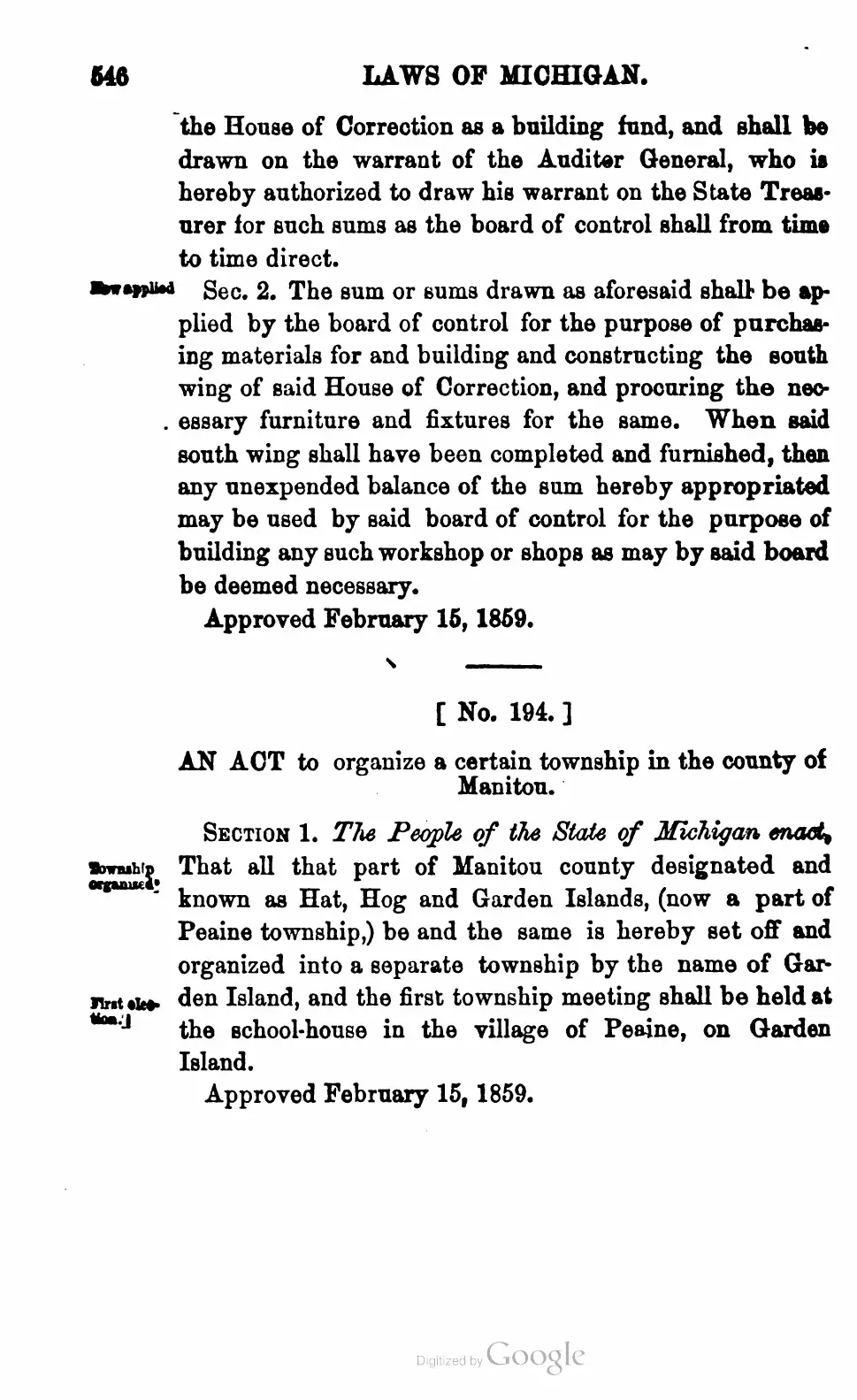
- Described in this archive: Michigan Local Act No. 194 organizing Garden Island Township, 1859.Checked page image, held separately; cited here only as a second example of the state legislature directly setting island civil-government boundaries by statute.
- "St. James Man Badly Wounded," Charlevoix County Herald, September 26, 1919.Described in this archive: Shooting of John Floyd at Saint James.Reports the county sheriff transporting the accused to Charlevoix by boat; used here as evidence of the mainland county seat as the seat of judicial process. No public copy of this file is known; the archive holds one and can provide it on request.
- Described in this archive: Claude Swafford murder hearing.A retrospective, not a court record; cited for the venue (Shamrock, Michigan) and outcome only, with the same caution the event article states.data1 · beaver-island-archive · beaver_beacon · 1963-03_Beaver-Beacon
- Charlevoix County Herald, June 6, 1947, "Beaver Islander Acquitted of Arson."Described in this archive: Arson Trial and Acquittal of John R. Martin in 1947.Reports a three-day Charlevoix circuit-court trial and acquittal. No public copy of this file is known; the archive holds one and can provide it on request.
- Described in this archive: Deputy Ham Gebert arrests Thomas Weger on an outstanding warrant, 1982.Reports an island arrest on an outstanding mainland warrant, with the arrestee escorted to Charlevoix. The holding institution's portal restricts automated access; the archive holds a copy of this issue and can provide it on request.data1 · beaver-island-archive · beaver_beacon · 1982-06_Beaver-Beacon
- State of Michigan, Order of the Conservation Commission — Deer — Certain Area Beaver Island, September 9, 1938, reprinted in Charlevoix County Herald, October 9, 1942.Described in this archive: Michigan Conservation Commission Beaver Island Deer Closure Order, 1938.Cited only as one example of a state agency regulating the island directly by order; the fuller regulatory history belongs to theme/wildlife-and-game-management. No public copy of this file is known; the archive holds one and can provide it on request.
- Described in this archive: DNR–Peaine Township public-recreation lease, 2019–2048.Cited only as evidence of the state as a landowner on the island dealing directly with a township; the lease's own limits are stated in its own article.research · island_governance · peaine-lake-geneserath-dnr-lease
Added 4 August 2026. Recent changes
Cite this article
Beaver Island Archive, “Law, courts, and external government”, https://beaverislandarchive.org/themes/law-courts-and-external-government/, accessed [date], citing BradG and participants, "Gun control," Beaver Island Forum, February 19, 2018, topic 12775. (and 15 further sources listed on the page).
Last revised 2026-08-04. Fill in [date] with the date you read it — this page is static and cannot know that.
BibTeX for “Law, courts, and external government”RIS for “Law, courts, and external government”