- Date
- 1851
- Kind
- Legal proceeding
- Where
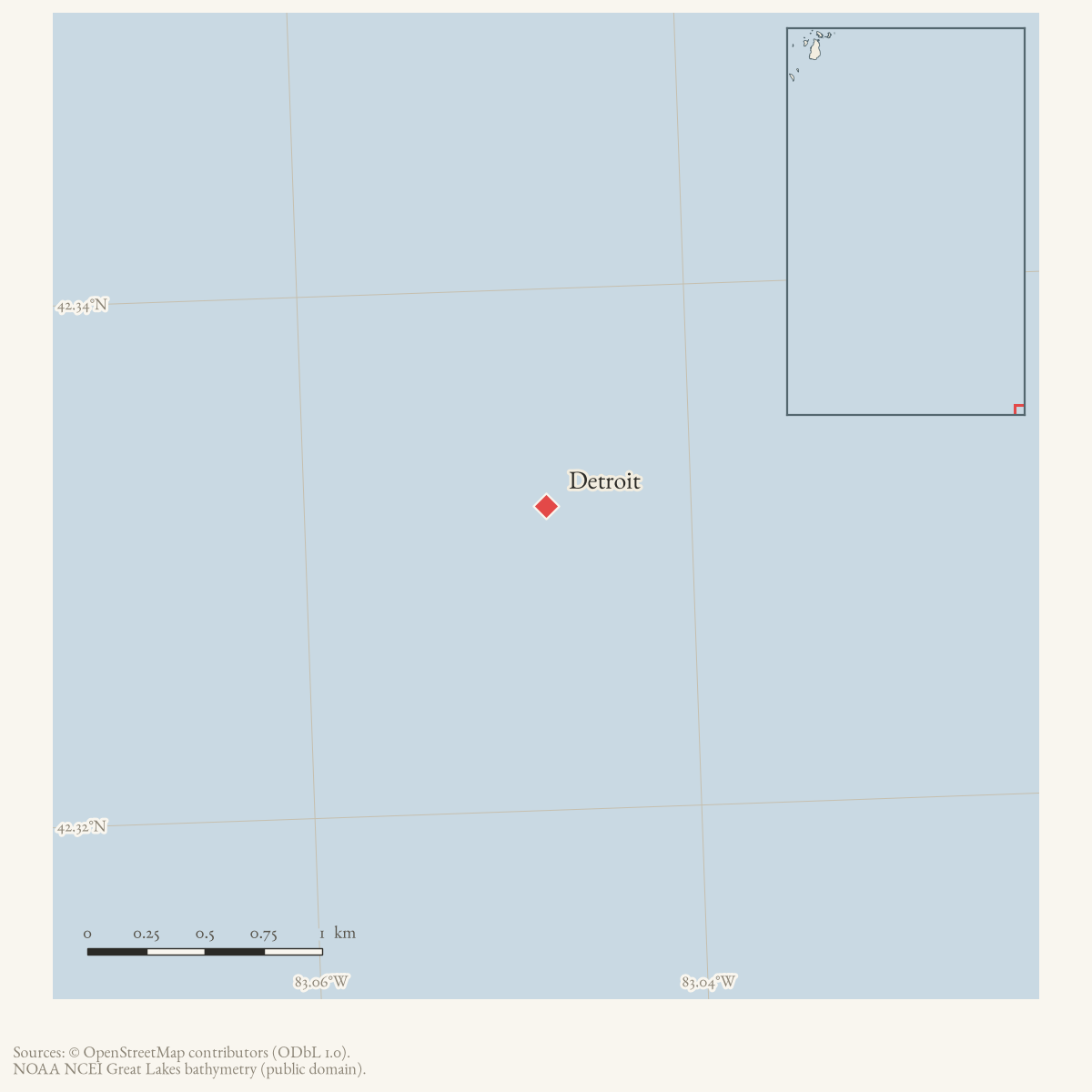
- Detroit
- Participants
- George J. Adams (witness)
- Eras
- Strang era
- Concepts
- governancemormonismhistoriography
Summary
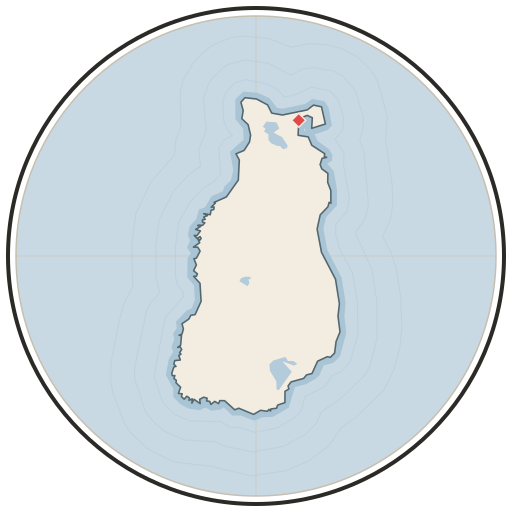
In 1851 federal authorities prosecuted James Jesse Strang and associates in Detroit after District Attorney George C. Bates went to Beaver Island aboard the armed steamer Michigan. The charges reported in the held accounts included treason, mail robbery, counterfeiting, and trespass on public lands. More than a hundred men and women were taken to Detroit; the principal mail-robbery case ended in acquittal, and the remaining indictments were dismissed.
The newly held 14 July 1851 Daily Crescent report independently places the Detroit trial in progress on 30 June and says Strang addressed the jury in person. It does not report the case’s disposition and is not used for the larger charge list or outcome.1
An independently transmitted report, printed in the Monmouthshire Merlin on 1 August and preserved here as a modern university transcription, states that every defendant was acquitted in the mail-obstruction trial. That supports the reported disposition, though it cannot establish the complete scope of the prosecution or substitute for the judgment.2
Evidentiary character
The proceeding is recorded as a LegalProceeding because the court action is a
distinct event with its own place, actors, charges, and outcome. No Detroit
place record or individual judicial officer is asserted here: the held evidence
is a later narrative and partisan contemporary accounts, not a complete docket.
George Adams is linked only as a witness because Quaife’s notes identify him as
engaged in the prosecution; this is not a claim that he was a party or
defendant. Strang is retained as a related subject, but no controlled legal role
is asserted for him until the defendant list is checked against a docket.
The acquittal is better supported than either side’s moral interpretation of the case. Strang’s account calls the prosecution persecution; Quaife’s later account describes the same proceedings through a critical secondary lens. Both are preserved in the sources rather than collapsed into a single verdict about the underlying Beaver Island disputes.
Open questions
- The federal docket, indictment numbers, exact trial dates, judge, jury, and complete defendant list remain to be located.
- A separate article for the 1850 local contempt proceeding against Strang would require distinguishing it from this federal case.
- The relationship between Bates’s 1877 retrospective and the contemporary Northern Islander reports should be checked against the cited newspaper pages.
See also
Footnotes
Sources
- Described in this archive: “Acquittal of the Mormons in Michigan,” Monmouthshire Merlin, 1851.A modern university transcription of a near-contemporaneous newspaper item. It reports that every defendant was acquitted in the mail-obstruction trial; it is not an original page image, docket, indictment, transcript, or formal judgment.research · strang_legal · sources · byu-rsc-monmouthshire-merlin
- Described in this archive: “Trial of the Beaver Island Mormons,” Daily Crescent, 1851.Contemporaneous newspaper report. It says the Detroit trial continued on 30 June and that Strang addressed the jury in person; it does not provide the docket, indictment, full evidence, verdict, or final disposition.research · strang_legal · sources · loc-daily-crescent-1851-07-14-seq1
- Described in this archive: The Kingdom of Saint James, Quaife, 1930.Prints or summarizes the prosecution history: warrants for treason, mail robbery, counterfeiting, and trespass; Strang and associates taken to Detroit; a mail-robbery trial; acquittal of the defendants and dismissal of remaining indictments.
- Described in this archive: Ancient and Modern Michilimackinac, 1854.Contemporary partisan account of the federal prosecution and its local causes; it records the prosecution as part of the conflict between the Beaver Island settlement and surrounding authorities.
- Held Internet Archive OCR of the volume identifies Bates's article at pp. 225–235. The series preserves a later newspaper reprint, not the original 1877 newspaper or a court docket; quotations and page-level readings require checking a scan image.
Added 31 July 2026 · revised 3 August 2026. Recent changes
Cite this article
Beaver Island Archive, “Federal prosecution of Strang and associates, 1851”, https://beaverislandarchive.org/events/strang-federal-prosecution-1851/, accessed [date], citing “Acquittal of the Mormons in Michigan,” *Monmouthshire Merlin*, 1 August 1851, p. 2, as transcribed by the Religious Studies Center, Brigham Young University. (and 4 further sources listed on the page).
Last revised 2026-08-03. Fill in [date] with the date you read it — this page is static and cannot know that.
BibTeX for “Federal prosecution of Strang and associates, 1851”RIS for “Federal prosecution of Strang and associates, 1851”