- Dates
- 1874 – 1915
- Eras
- Early American eraStrang era
- Concepts
- historiographyheritageanishinaabe-odawaEarly American eraStrang era
Summary
The project holds a complete text-derivative working corpus of the 40-volume Michigan Historical Collections run and its two contemporary indexes. The series is a broad Michigan historical compilation, not a Beaver Island archive, but it contains material relevant to the project’s early-state, treaty-era, Mackinac, Strangite, and historiographical research paths.
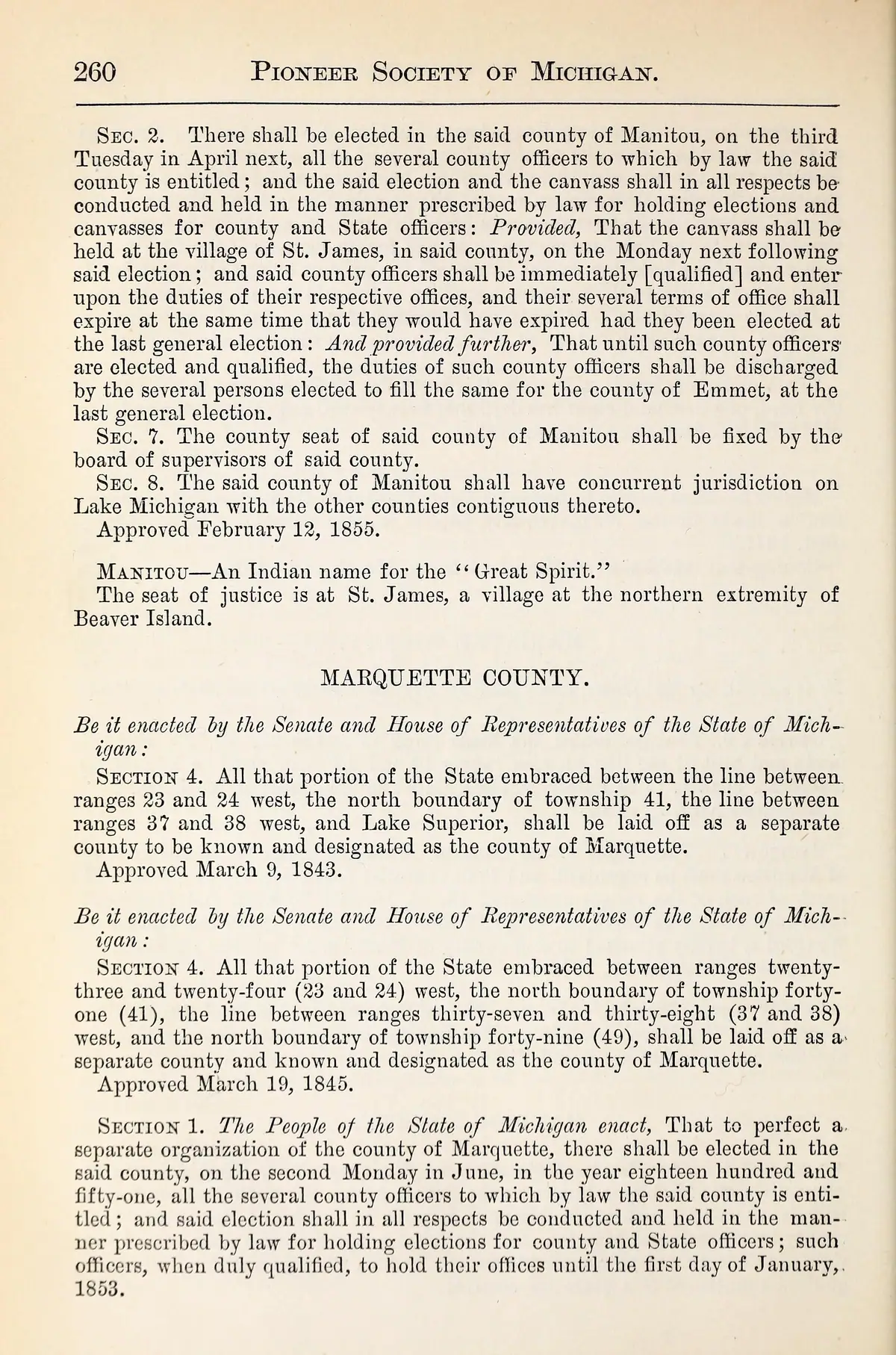
The corpus is retained as a searchable source layer and lead generator. It does not make every reprinted document primary in its own right, and a hit must be checked against its printed page image and underlying source before it supports a KB claim.
Initial screen and limits
The reproducible lexical screen counts “Beaver Island” and “Beaver Islands” across whitespace-expanded OCR, rather than requiring one literal space; Internet Archive OCR often inserts line breaks inside a printed phrase. It is a discovery screen, not a transcription or a count of historical events. Any hit can be a later reprint, editorial summary, unrelated namesake, or an OCR error, and must be checked on the printed page before use.
The screen also checks “Isles du Castor,” but a zero result for that or any other form is not evidence that the series contains no relevant material: OCR can fail, historical terminology varies, and relevant records may be indexed under people, missions, treaties, Mackinac, or other regional terms.
The screen’s per-volume counts are uneven. Most volumes return zero or a handful of hits; a few stand out as denser candidate material. Volume 32 (1902) returns 103 “Beaver Island”/“Beaver Islands” hits and 4 “Isles du Castor” hits, by far the highest of any volume in the run. Volume 18 (1891) returns 18 hits, Volume 39 (1915) returns 14 plus 1 “Isles du Castor” hit, and Volumes 9 (1886) and 26 (1894) each return 6. The two contemporary indexes, covering volumes 1–15 and 16–30, return 5 and 4 hits respectively. These are discovery counts from the held manifest, not a ranking of historical importance, and every volume — including the many at zero — can still hold relevant material indexed under a name other than the island’s.
The two indexes remain especially useful for an issue- and page-directed review. They should be used to narrow candidate passages, not treated as substitutes for reading the cited volume or for resolving whether a reprinted text is accurate.
Individually catalogued volumes
The 40-volume text corpus is a discovery layer; it is distinct from the smaller set of volumes the project has catalogued as their own citable articles. Ten of the forty volumes currently have an individual KB record: Volume 1 (1874), Volume 9 (1886), Volume 12 (1887), Volume 21 (1892), Volume 23 (1893), Volume 26 (1894), Volume 28 (1897), Volume 32 (1902), Volume 38 (1912), and Volume 39 (1915). Those ten are the volumes cited by name elsewhere in this knowledge base; the remaining thirty are held only as the raw text corpus described above, and a claim should not be attributed to “the Michigan Historical Collections” generally when only one of the thirty uncatalogued volumes has actually been read.
Open questions
- Which index entries for Mackinac, Ottawa/Odawa, Chippewa, treaties, missions, or named Strang contemporaries point to material relevant to the archipelago?
- Which candidate passages can be checked against page images and their cited underlying documents?
- Does the corpus contain a useful independent attestation of an already-held source, rather than merely a later reprint or editorial summary?
See also
Sources
- The held manifest records 42 resolved, open Internet Archive items: one DjVu text derivative for every numbered volume and both contemporary indexes. Each text file has its own source URL, checksum, file size, retrieval time, and metadata-volume check in a provenance sidecar.
- Project retrieval manifest for the Michigan Pioneer and Historical Society corpus.The retriever uses explicitly checked identifiers rather than a title-only search, rejects a numbered item whose IA volume metadata does not match its target, retains text rather than duplicate scan PDFs, and records phrase counts as discovery metrics only. No public copy of this file is known; the archive holds one and can provide it on request.scripts · retrieve_michigan_pioneer_collections
Added 2 August 2026. Recent changes
Cite this article
Beaver Island Archive, “Michigan Pioneer and Historical Society collections corpus”, https://beaverislandarchive.org/documents/michigan-pioneer-historical-collections/, accessed [date], citing Michigan Pioneer and Historical Society, *Michigan Historical Collections*, vols. 1–40 (1874–1915), and indexes to vols. 1–15 and 16–30, Internet Archive items retrieved 2026-08-02. (and 1 further source listed on the page).
Last revised 2026-08-02. Fill in [date] with the date you read it — this page is static and cannot know that.
BibTeX for “Michigan Pioneer and Historical Society collections corpus”RIS for “Michigan Pioneer and Historical Society collections corpus”