- Date
- 1854
- Eras
- Strang era
- Concepts
- mormonismhistoriographygovernancetoponymytransportationsettlement
- Within
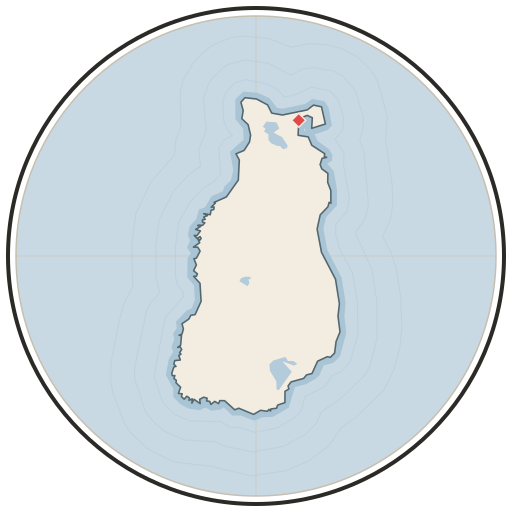
- Saint James · Beaver Island
Summary
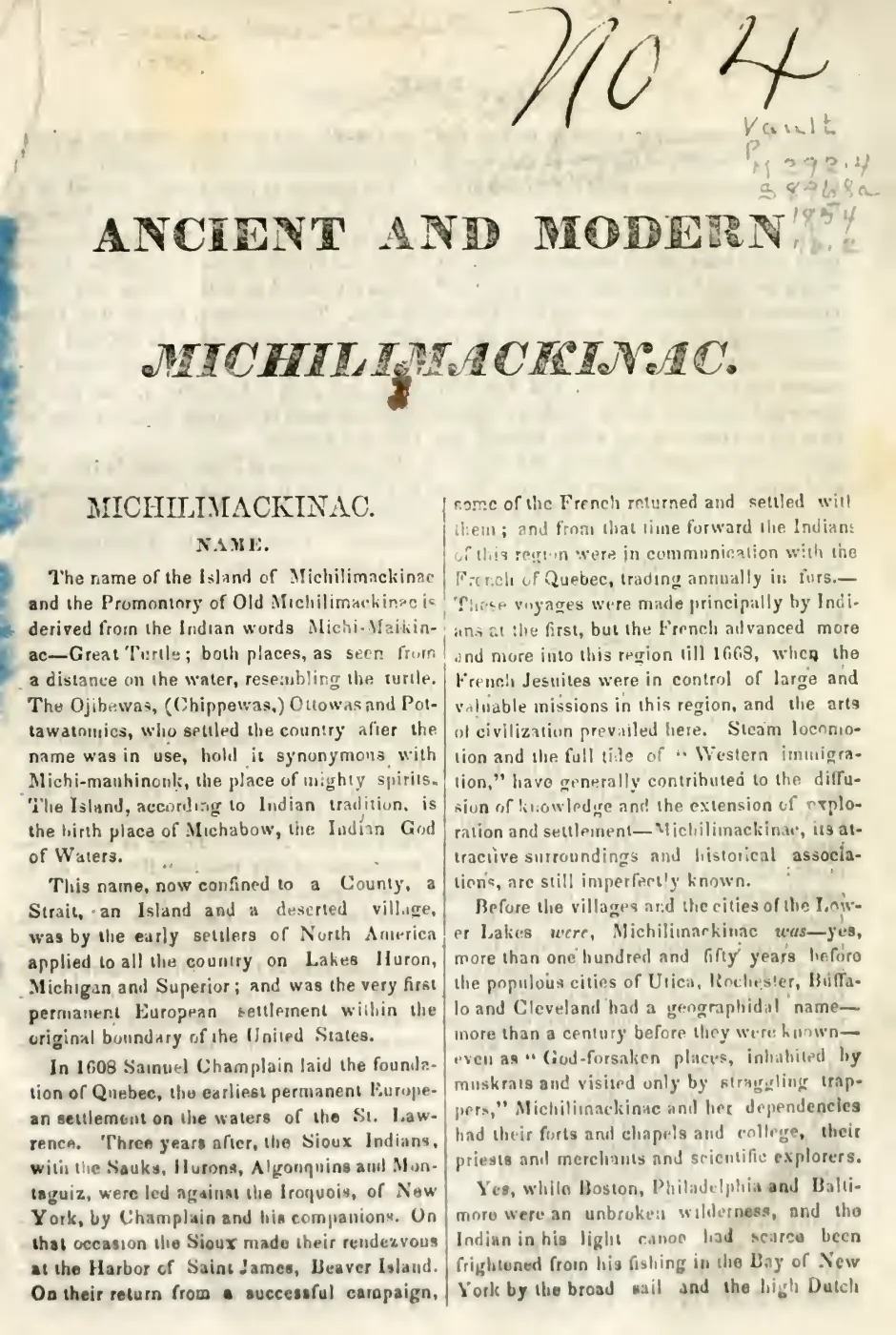
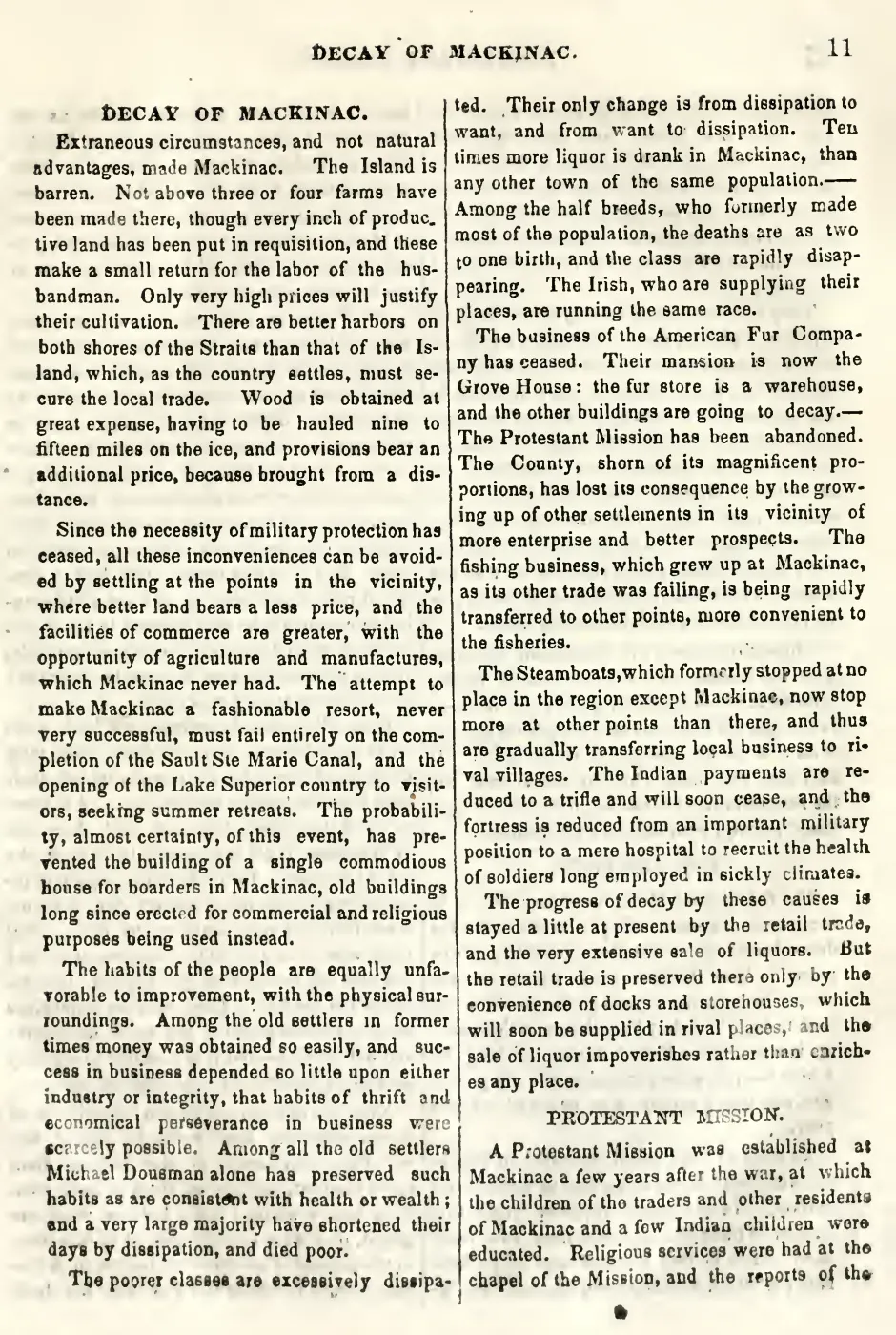
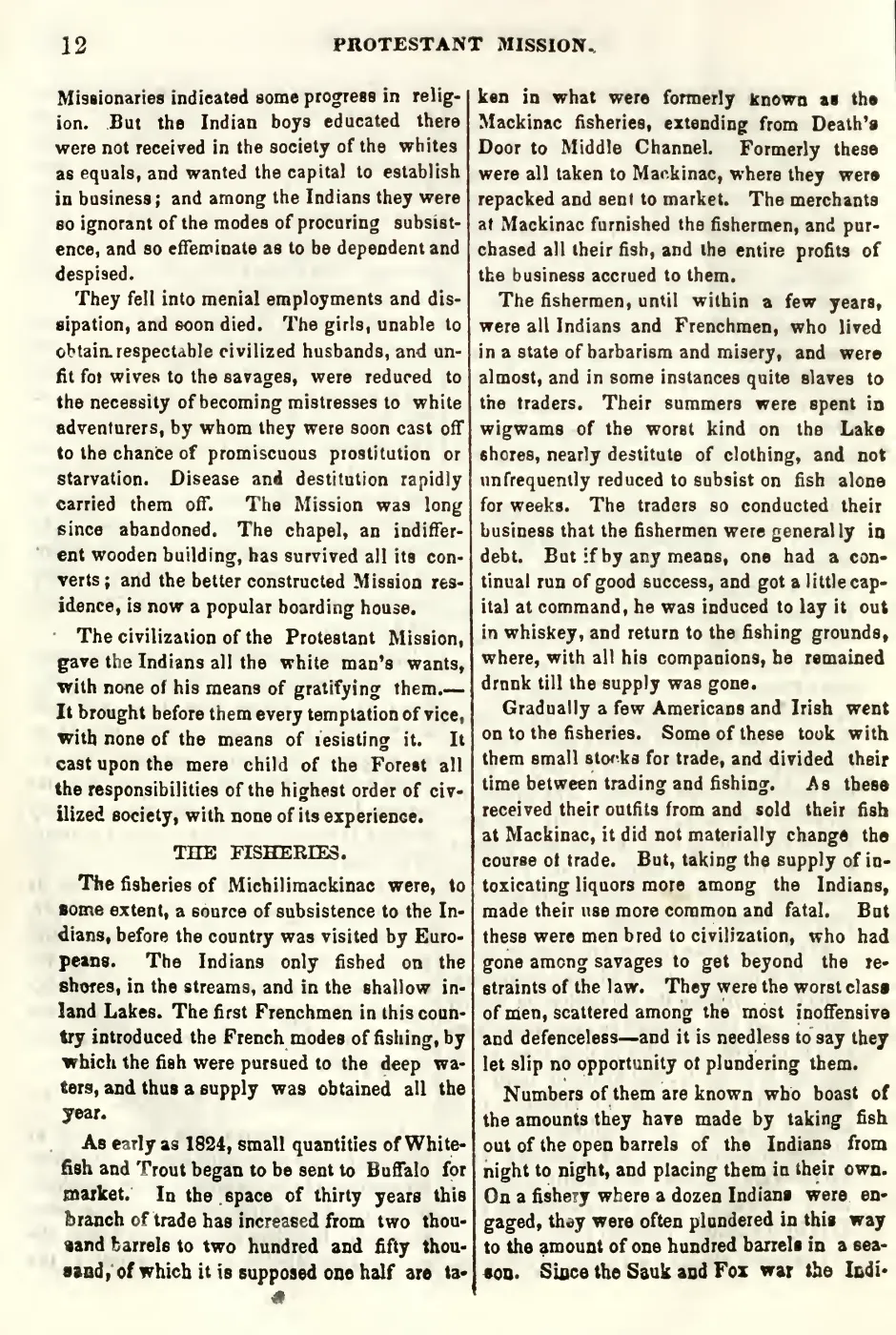
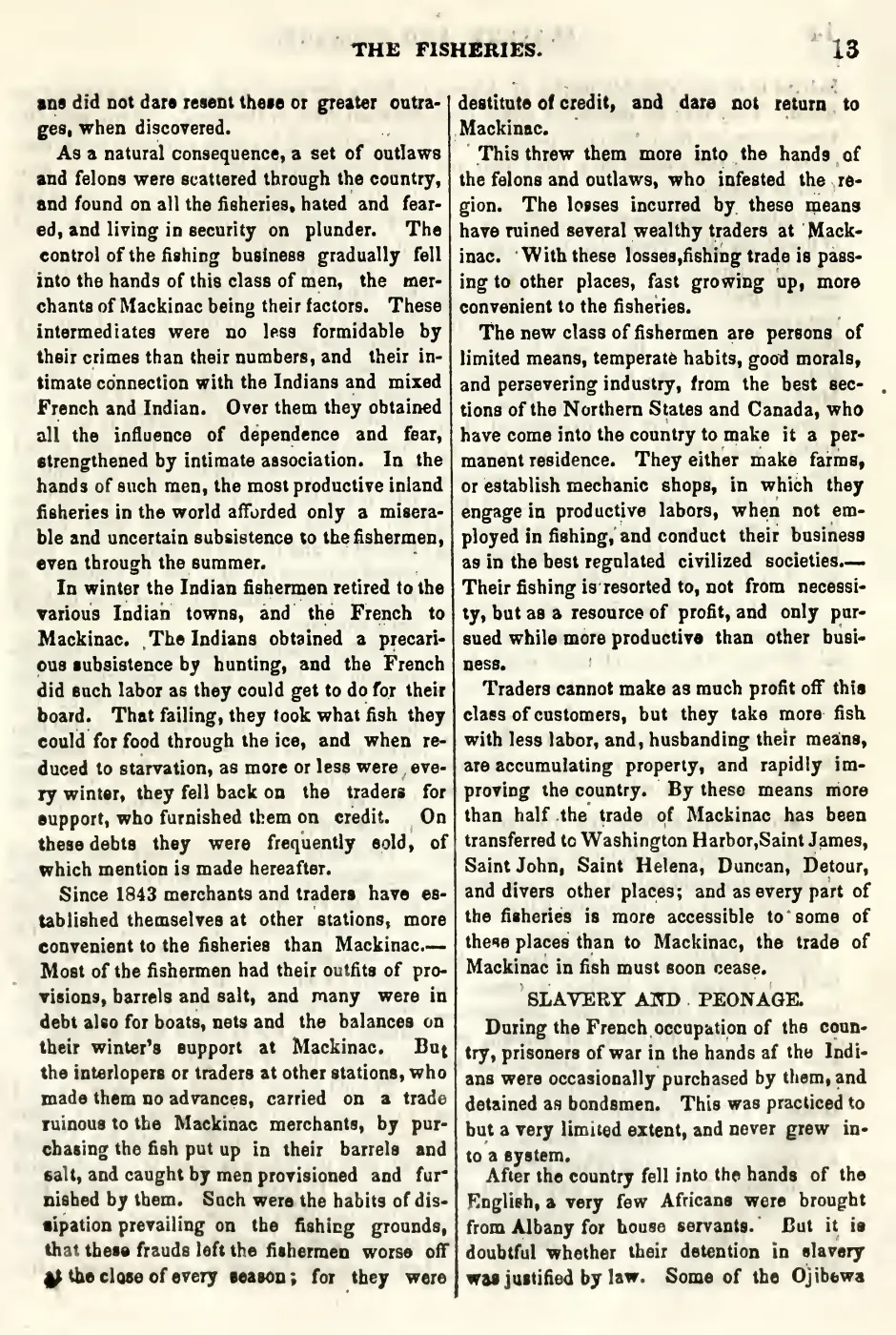
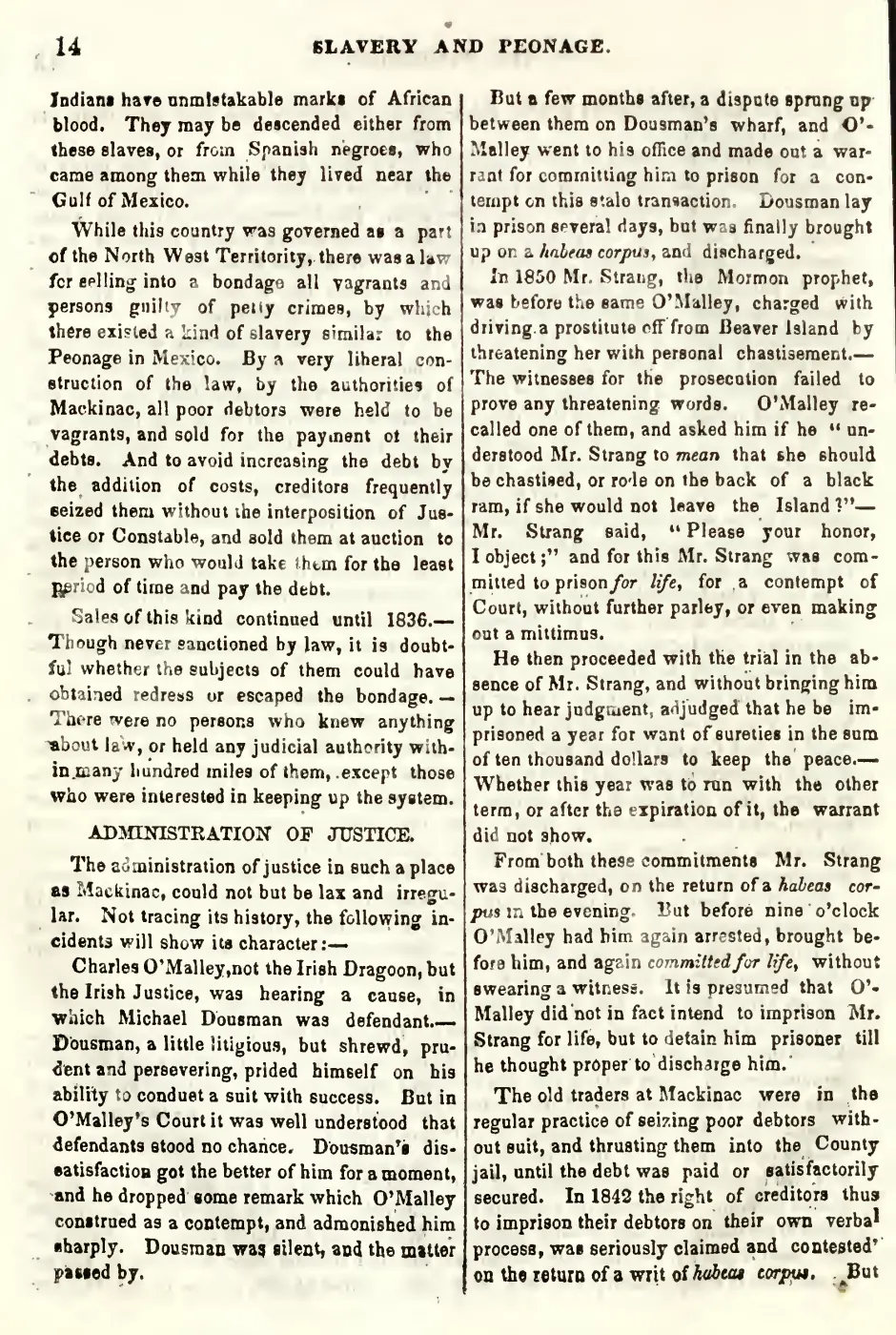
Ancient and Modern Michilimackinac is James Jesse Strang’s own 1854 history of the Straits of Mackinac region, written to carry an account of “the controversy between Mackinac and the Mormons” from his own point of view. It was first serialized in his newspaper the Northern Islander from January to April 1854, then issued later that year as a forty-eight-page pamphlet, both produced on Strang’s press at Saint James, Beaver Island. Three digitized copies are held here. Its title gives no hint of Beaver Island content – it was found only because a deliberately broad Internet Archive search on “Michilimackinac” was kept running for discovery, rather than narrowed to obvious Beaver Island search terms.
History
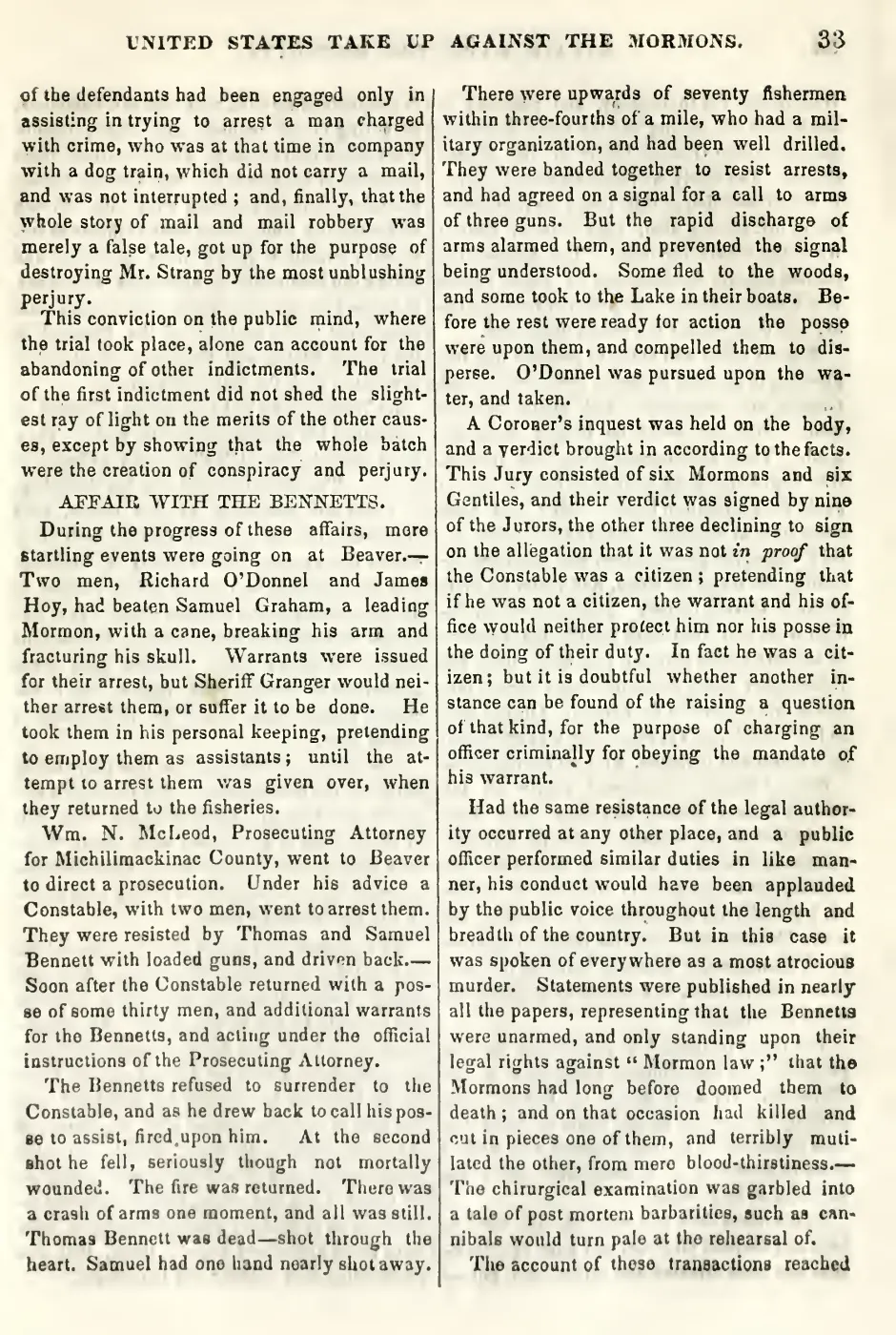
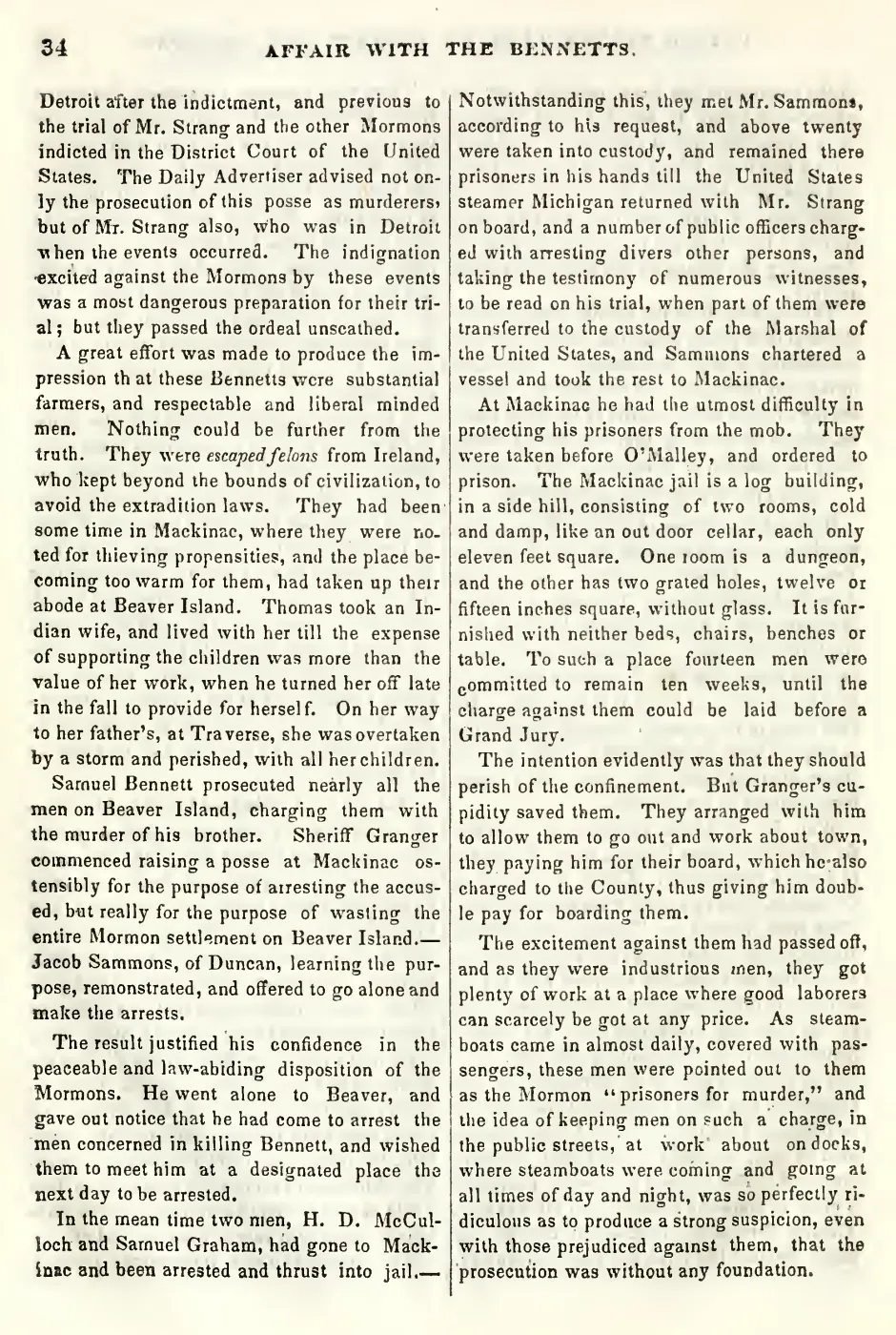
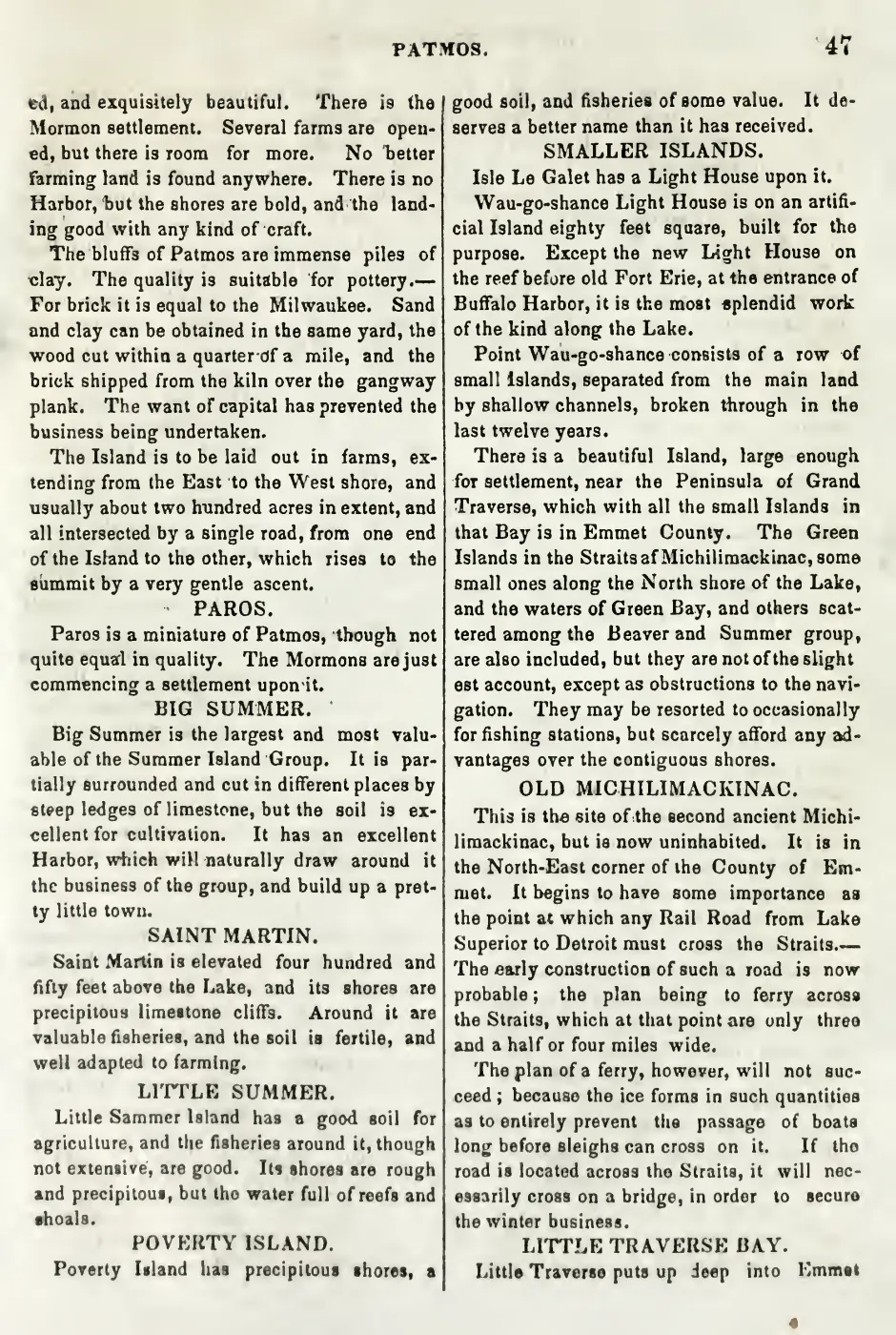
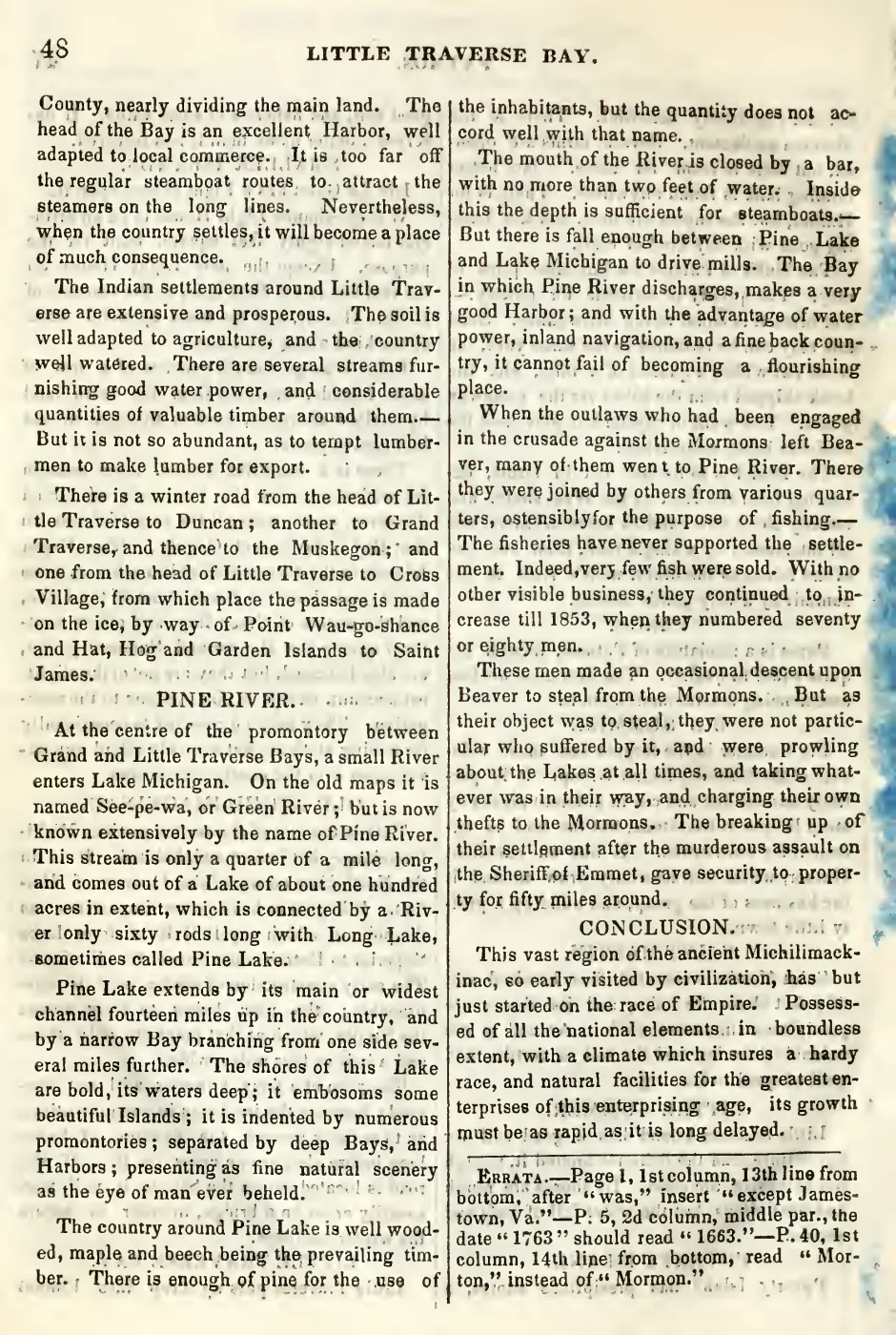
The book opens as a general regional history: the Indigenous and French-colonial etymology of “Michilimackinac,” Champlain’s 1608 founding of Quebec, and the fur trade, well before any mention of Strang’s own settlement.1 It closes with an account, told in the third person, of the 1853 “crusade” against the Mormon settlement – an “outlaw” party that grew to “seventy or eighty men,” made “occasional descents upon Beaver to steal from the Mormons,” and was broken up only “after the murderous assault on the Sheriff of Emmet.”2 Quaife’s scholarly account of the kingdom cites this book repeatedly and directly for the narrative of Mormon-gentile conflict on Beaver Island, while cautioning that it is “a partisan document” reflecting “the Mormon point of view of the events described,” and that “it is not improbable … that Strang’s sense of the dramatic led him to improve the narration by drawing upon his imagination for certain of its details.”3
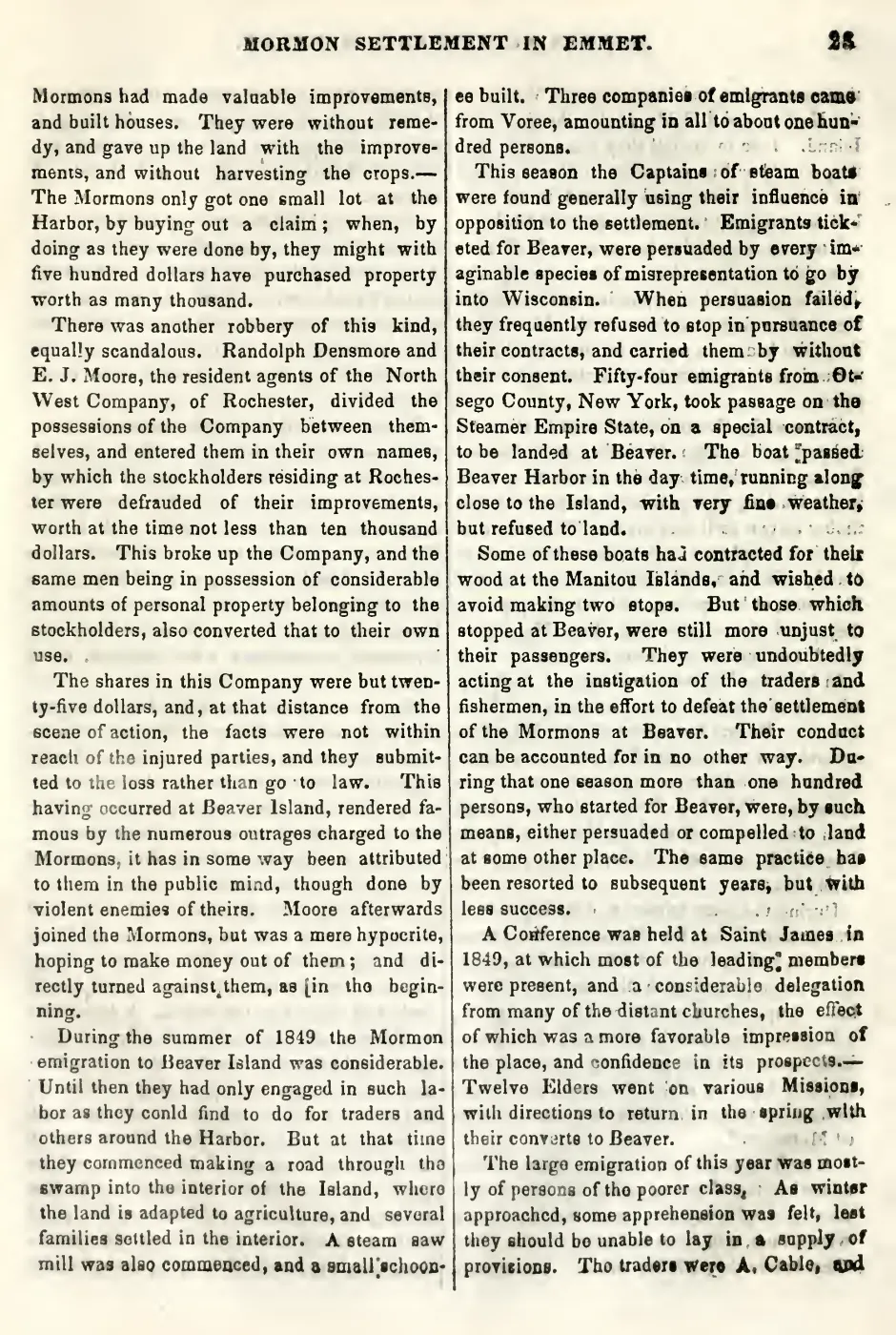
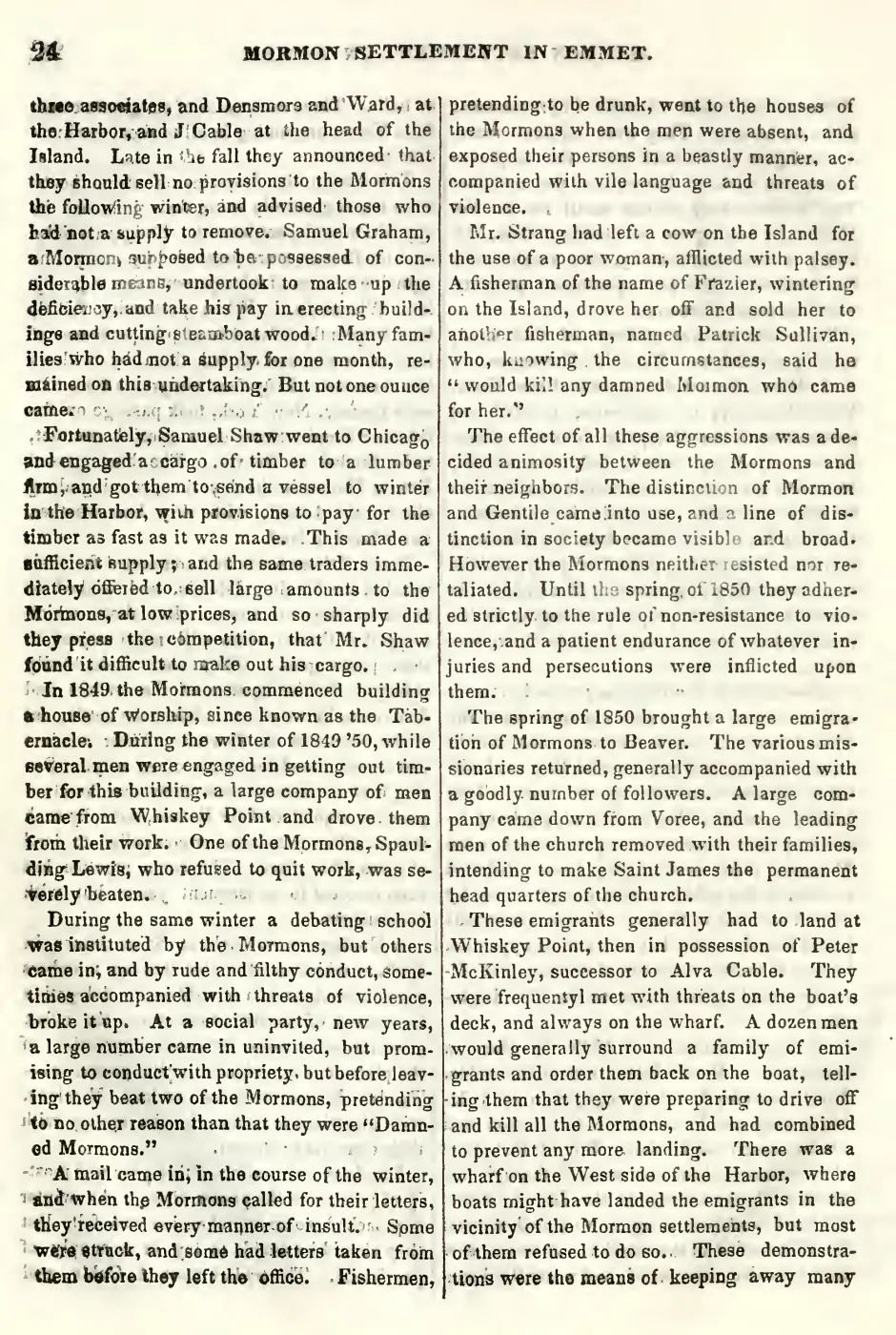
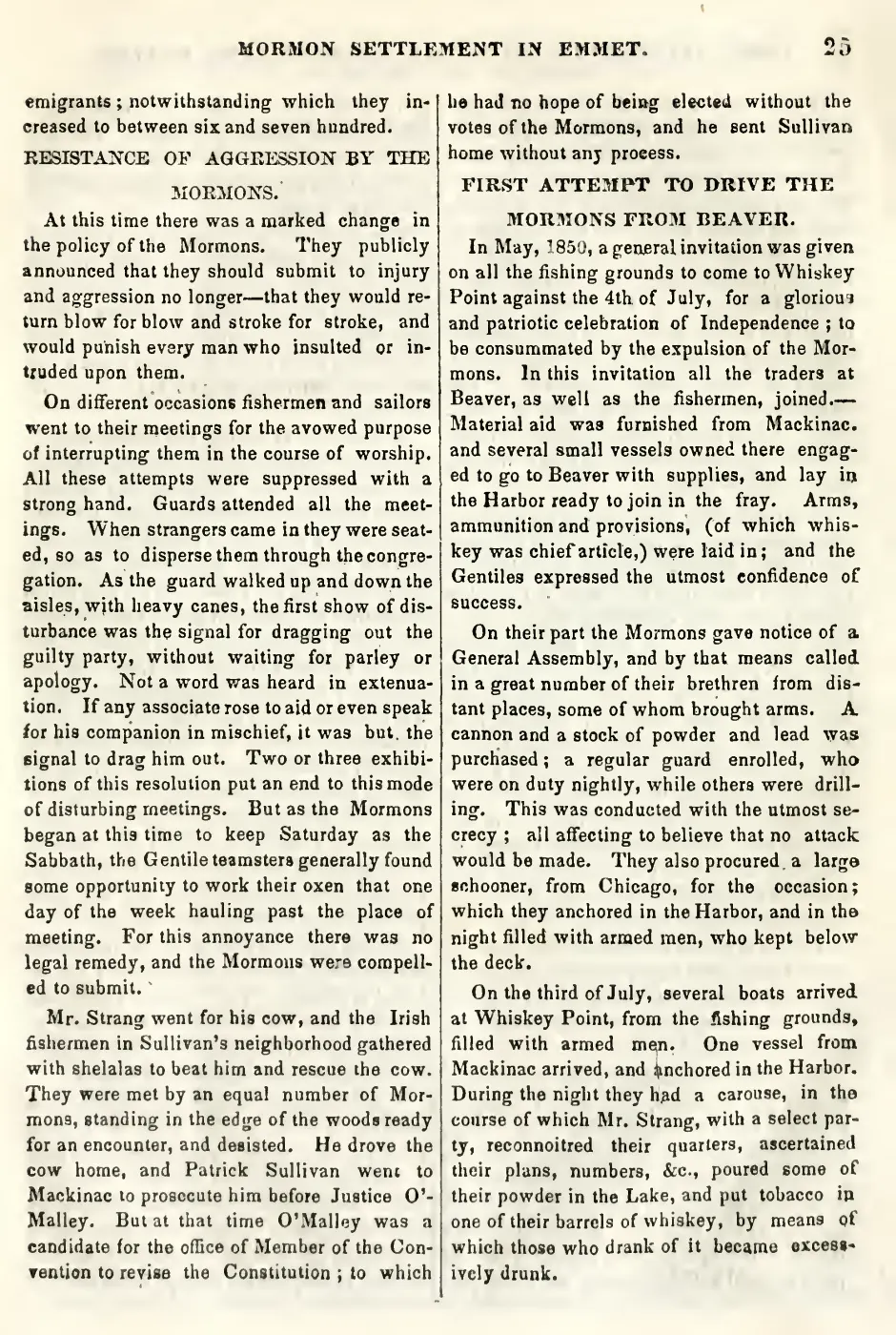
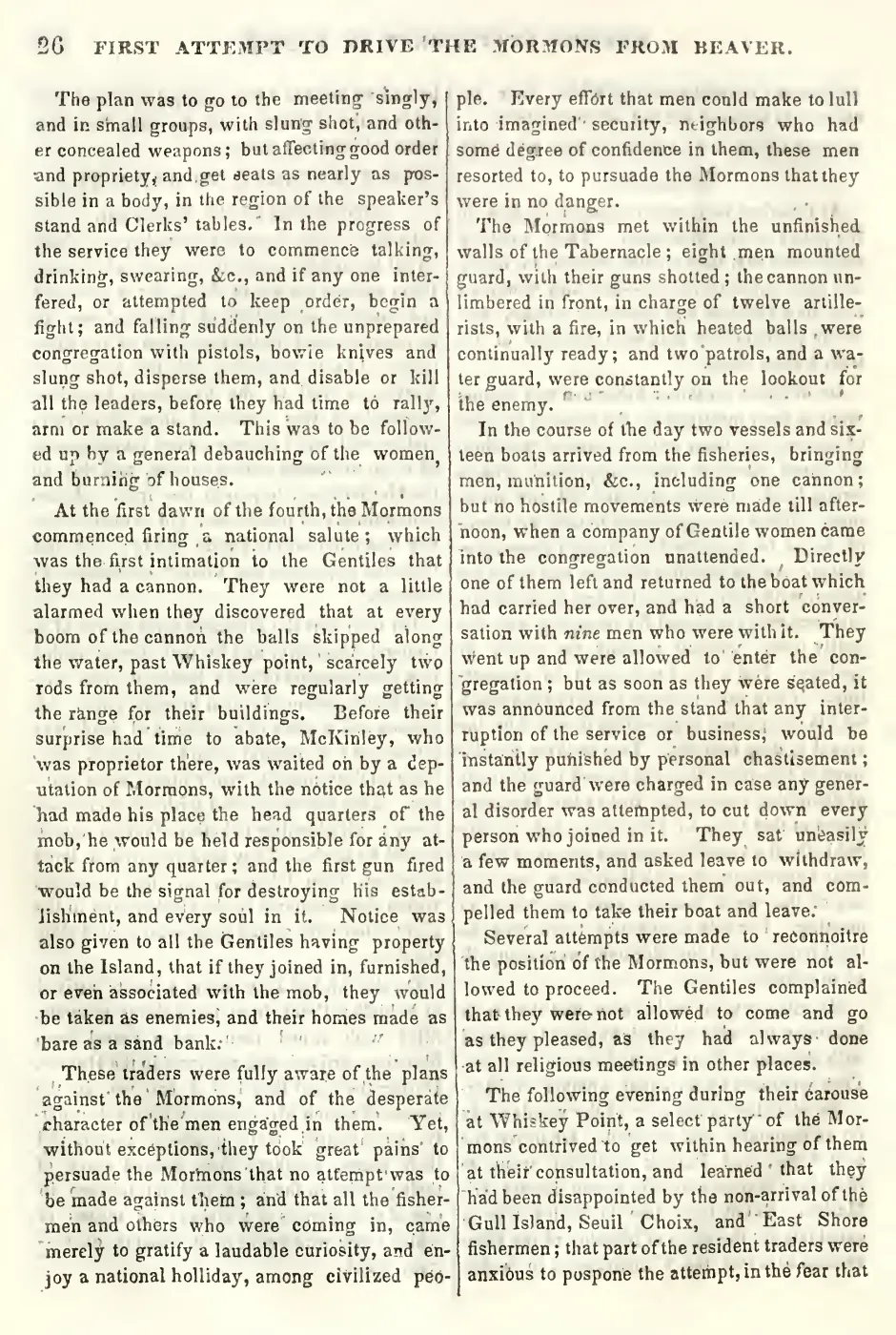
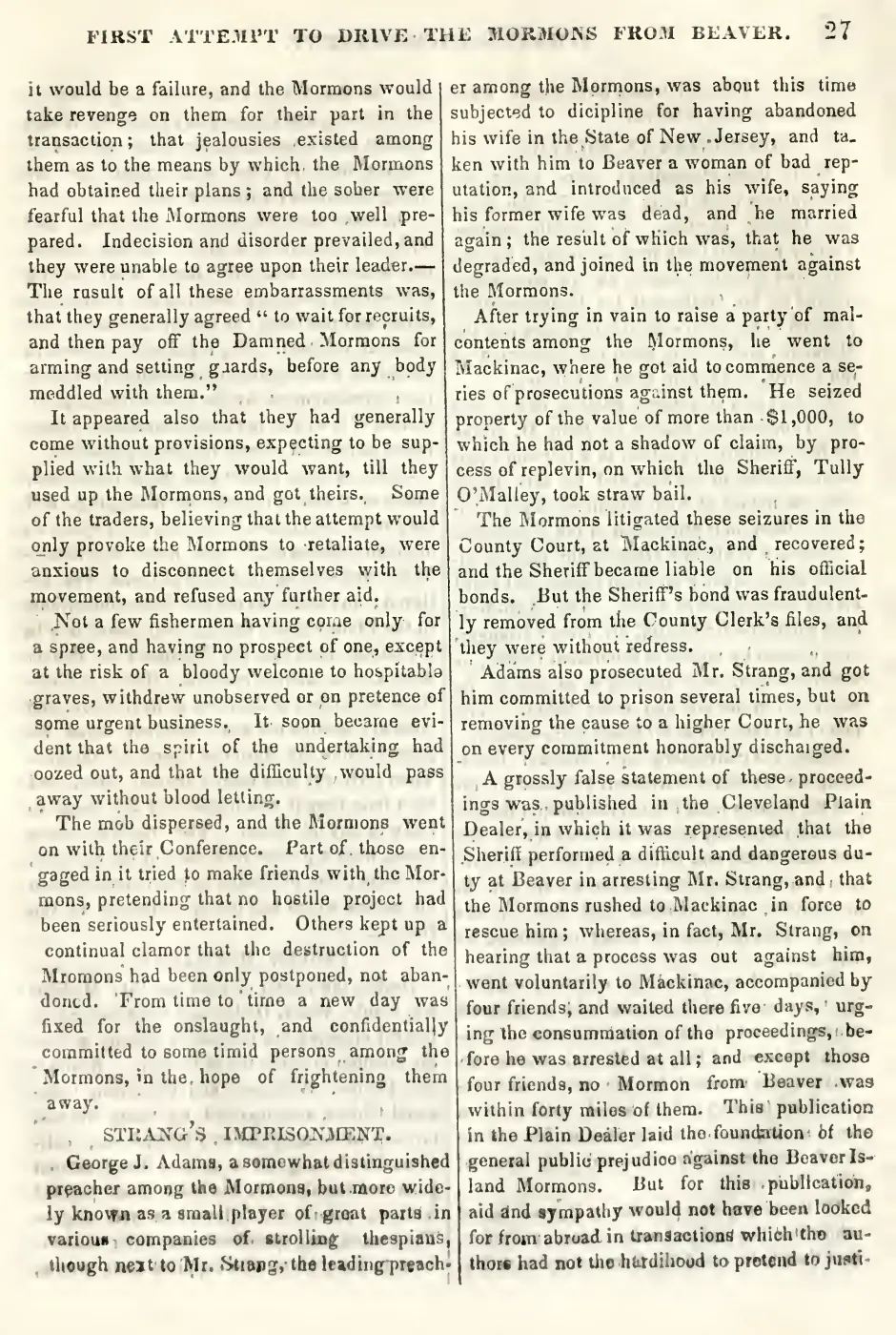
The book’s chapter “First Attempt to Drive the Mormons from Beaver” narrates, in detail not summarized by Quaife’s brief citation, a planned assault timed for 4 July 1850. A general invitation went out on the fishing grounds to gather at Whiskey Point for an Independence Day “celebration” meant to end in the Mormons’ expulsion; Mackinac traders sent material aid and small vessels, and the plan called for armed men to enter the Mormon assembly in small groups, provoke a disturbance, and then attack the unprepared congregation with pistols, bowie knives and slung shot, “followed up by a general debauching of the women, and burning of houses.” Strang’s account describes the Mormons’ countermeasures: a purchased cannon and powder, a nightly guard, secret drilling, and an armed schooner concealed in the harbor. On the night before the Fourth, Strang writes that he personally led a party that reconnoitered the Gentiles’ camp at Whiskey Point, spoiled their gunpowder, and doctored a barrel of their whiskey with tobacco. At dawn on the Fourth the Mormons fired a cannon salute whose shot skipped past Whiskey Point “scarcely two rods” from the assembled men, and a Mormon deputation warned trader McKinley, as the mob’s host, that he would be held responsible for any attack. The account describes the day passing under armed guard at the Mormons’ unfinished tabernacle, several failed attempts by the Gentiles to reconnoiter, and finally the plan’s collapse from indecision, missing reinforcements, and short supplies: “the mob dispersed, and the Mormons went on with their Conference,” without bloodshed.4 This is Strang’s own telling of an episode also reported, at second hand, in Quaife’s history.
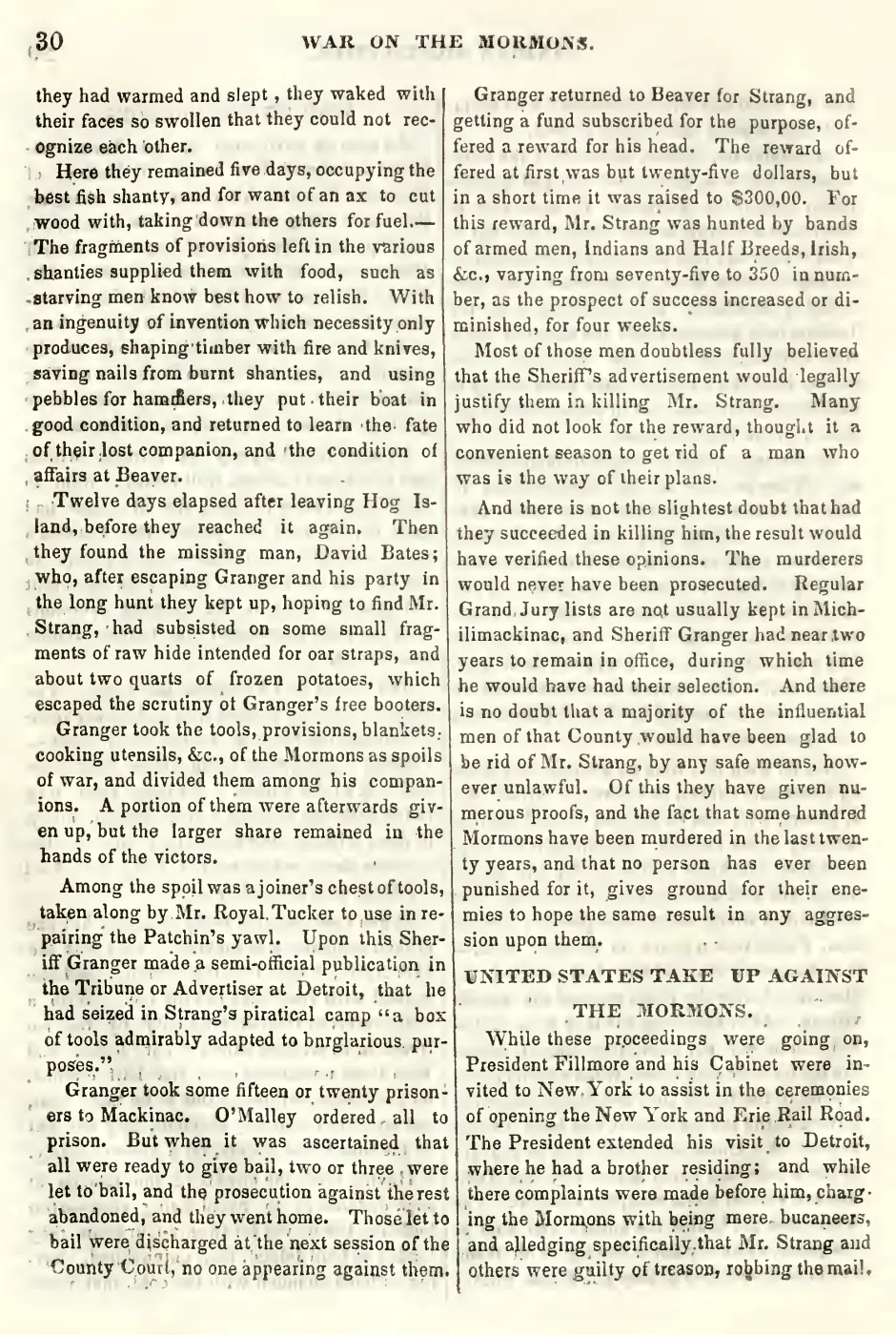
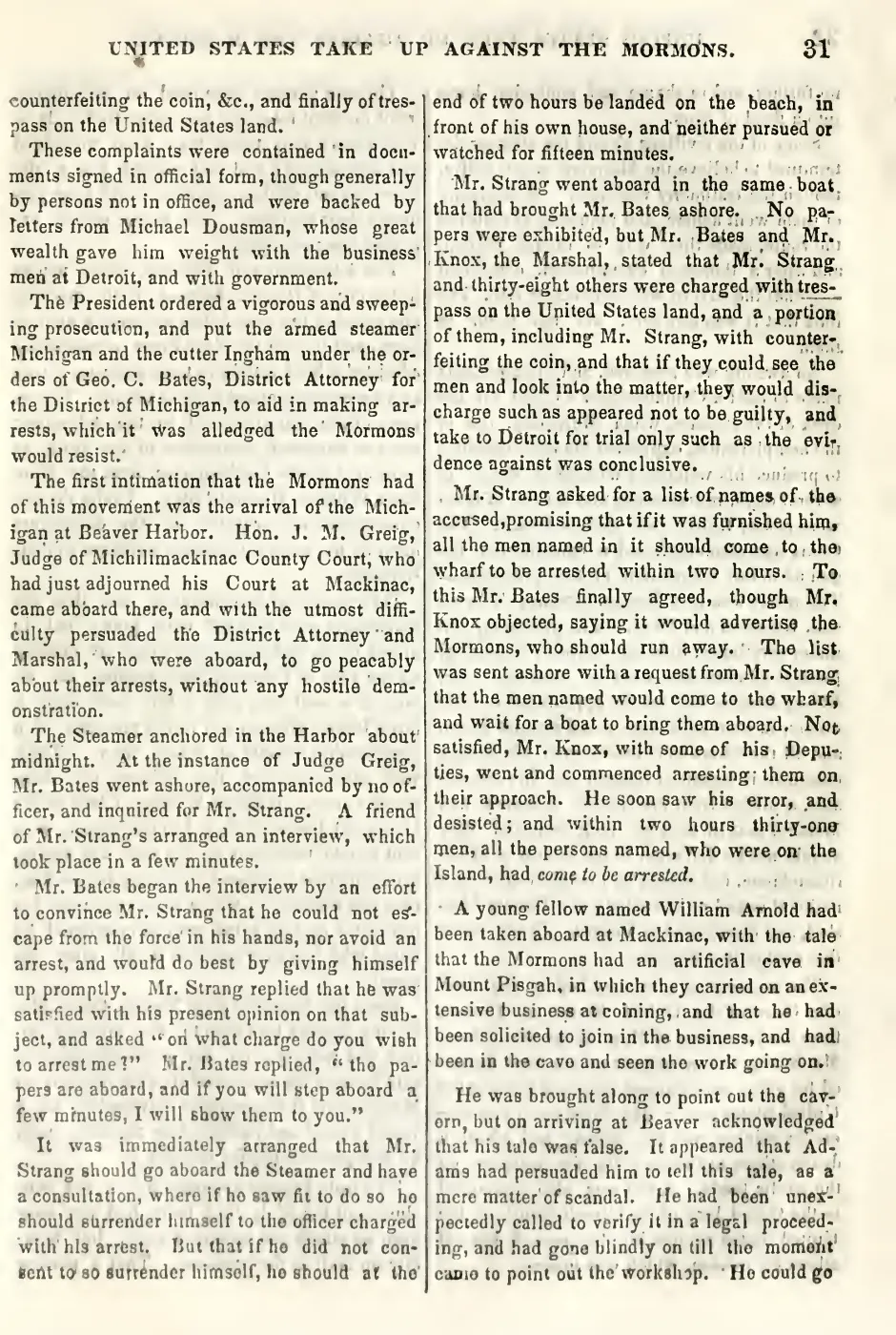
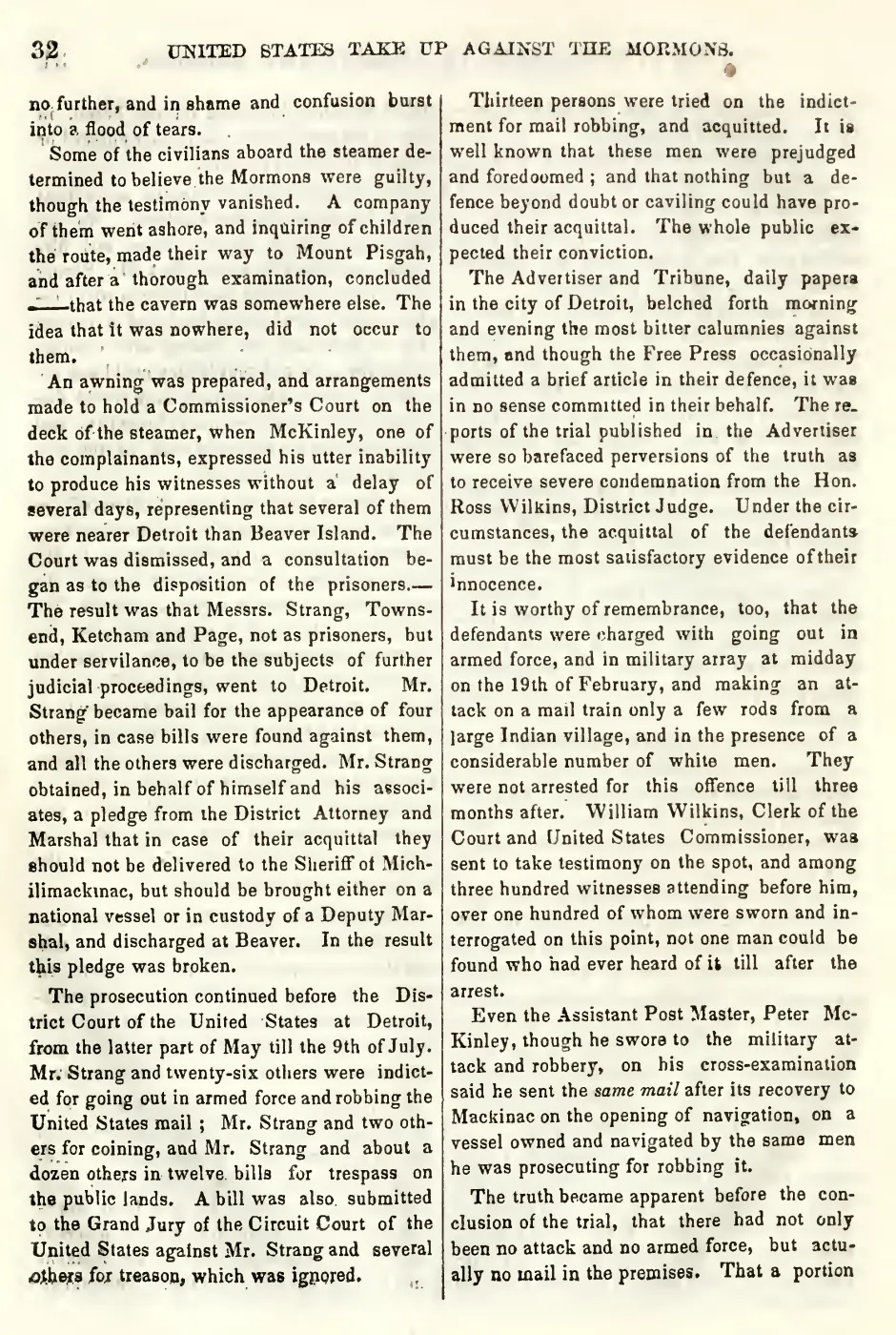
A later chapter, “United States Take Up Against the Mormons,” gives Strang’s account of the 1851 federal action against the settlement: complaints laid before authorities at Detroit – backed, the book says, by letters from Michael Dousman – accused Strang and others of treason, mail robbery, counterfeiting, and trespass on federal land, leading the President to order “a vigorous and sweeping prosecution” and to place the armed steamer Michigan and the cutter Ingham under District Attorney George C. Bates to make arrests. The book describes the Michigan’s arrival at Beaver Harbor and Judge J. M. Greig’s intervention to keep the arrests peaceable.5 No dedicated article on the resulting 1851 arrest and trial exists elsewhere in this archive; the episode is recorded here only as this book’s own account of it.
Quaife dates the work precisely: serialized in the Northern Islander from January to April 1854, then “later in the same year” issued as a “paper-covered pamphlet” of forty-eight pages.6 The Northern Islander was itself established by Strang “at Saint James” (Beaver Island) in the winter of 1850-51, and its printing office stood at Saint James until the 1856 expulsion.7 Because the pamphlet reused the same serialized text and, per Quaife’s account of Strang’s other publications, the same type as the newspaper that carried it, the pamphlet is properly described as printed on Beaver Island. Quaife records two later reprints – by the St. Ignace News and Free Press in 1885, and by the Strangite Wingfield Watson in 1894 – neither of which is among the three copies held here.6
One of the three copies (1265185.0001.001.umich.edu) carries a preface,
absent from the other two, labelling itself “This second edition … by Mr.
Strang’s own pen” and framing the book as a defense of the Beaver Island Saints
against persecution comparable to that suffered by earlier prophets – likely a
later (undated in the copy itself) reissue rather than a variant first printing;
when that preface was added, and by whom, has not been established.8
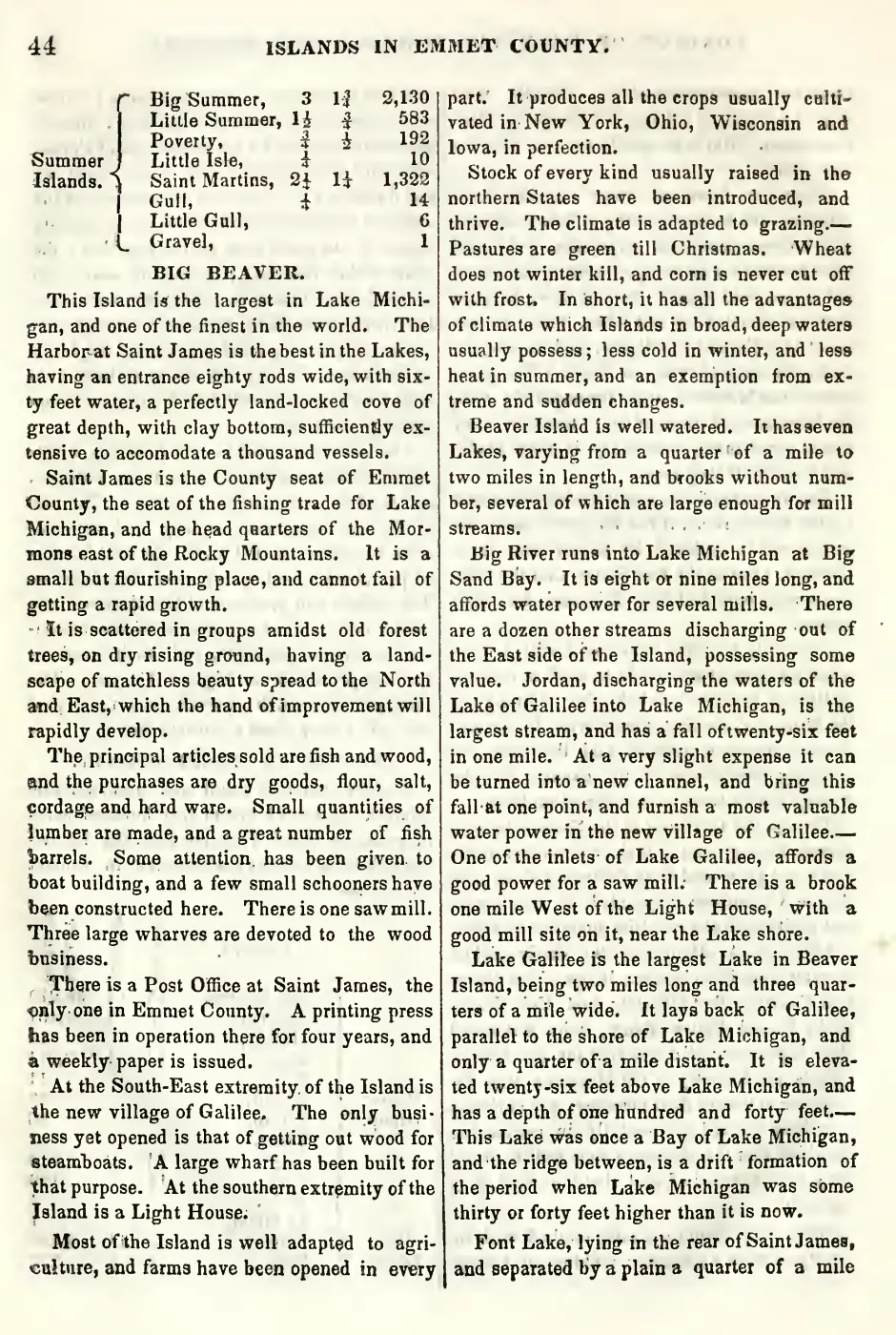
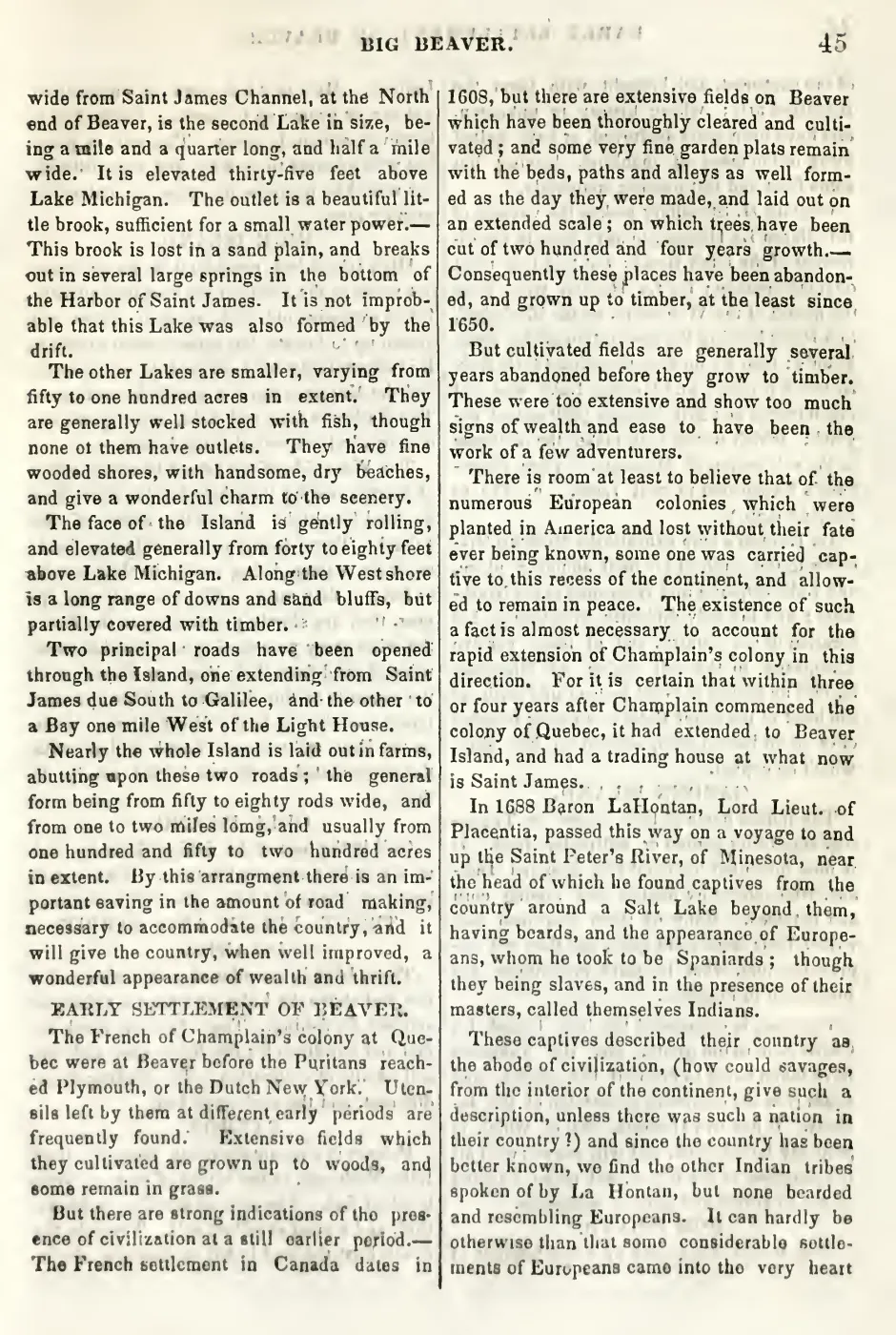
The book is also the strongest contemporary textual source for Beaver Island’s interior road system. In its “Big Beaver” section Strang describes the lake he called Lake Galilee, the new village of Galilee, and two principal roads. One, he writes, extended from Saint James “due South to Galilee”; nearly the whole island was laid out in long farms abutting the two roads.9 This passage is a close textual counterpart to the road-and-field pattern on the 1854-55 North End of Lake Michigan Including the Beaver Island Group, 1855 Lake Survey chart. It does not use the name King’s Highway, so it establishes the route axis and settlement plan but not contemporary use of the later road name.
Significance
This is Strang’s own historical narrative of the settlement he founded and ruled, independent in register from his doctrinal tracts (The Diamond: Being the Law of Prophetic Succession, 1848) and cited directly by Quaife’s 1930 narrative, The Kingdom of Saint James, Quaife, 1930, as a primary (if partisan) source for the Kingdom of Saint James’s conflicts with its neighbors. It is also a caution about discovery methodology: narrowing a search to obvious Beaver Island terms would have missed it entirely, since its own title never mentions the island.
Open questions
- The exact relationship between the three held copies – which is closer to the 1854 first printing and which (if any) reproduces one of the 1885 or 1894 reprints Quaife names – has not been established; only the University of Michigan copy’s added preface was noticed as a textual difference, and the three have not been fully collated against each other.
- No colophon or printer’s imprint naming “Saint James” or “Beaver Island” was found within the OCR text of any of the three copies examined; the printing location rests on Quaife’s account of the Northern Islander’s press, not on a statement in the pamphlet itself.
See also
Sources
Footnotes
-
Opening section, “MICHILIMACKINAC,” Ancient and Modern Michilimackinac (1854),
data/books/internet_archive/ancientmodernmic00stra/. ↩ -
“Conclusion” and preceding paragraphs on the 1853 “crusade,” same file (also present verbatim in
data/books/internet_archive/1265185.0001.001.umich.edu/). ↩ -
Quaife, The Kingdom of Saint James (1930), p. 117 note,
data/books/internet_archive/kingdomofsaintja0000milo/. ↩ -
“First Attempt to Drive the Mormons from Beaver,” pp. 26-27,
data/books/internet_archive/ancientmodernmic00stra/ancientmodernmic00stra_djvu.txt(running-header page numbers confirmed in the OCR text; printed folios, not PDF pages). ↩ -
“United States Take Up Against the Mormons,” p. 31,
data/books/internet_archive/ancientmodernmic00stra/ancientmodernmic00stra_djvu.txt(running-header page number confirmed in the OCR text). ↩ -
Ibid., p. 186; printing office location also given p. 189 (destruction of the press at Saint James, 1856). ↩
-
Prefatory note,
data/books/internet_archive/1265185.0001.001.umich.edu/. ↩ -
“Big Beaver,” pp. 44-45, University of Michigan copy,
data/books/internet_archive/afk0709.0001.001.umich.edu/afk0709.0001.001.umich.edu_djvu.txt. ↩
Read the document
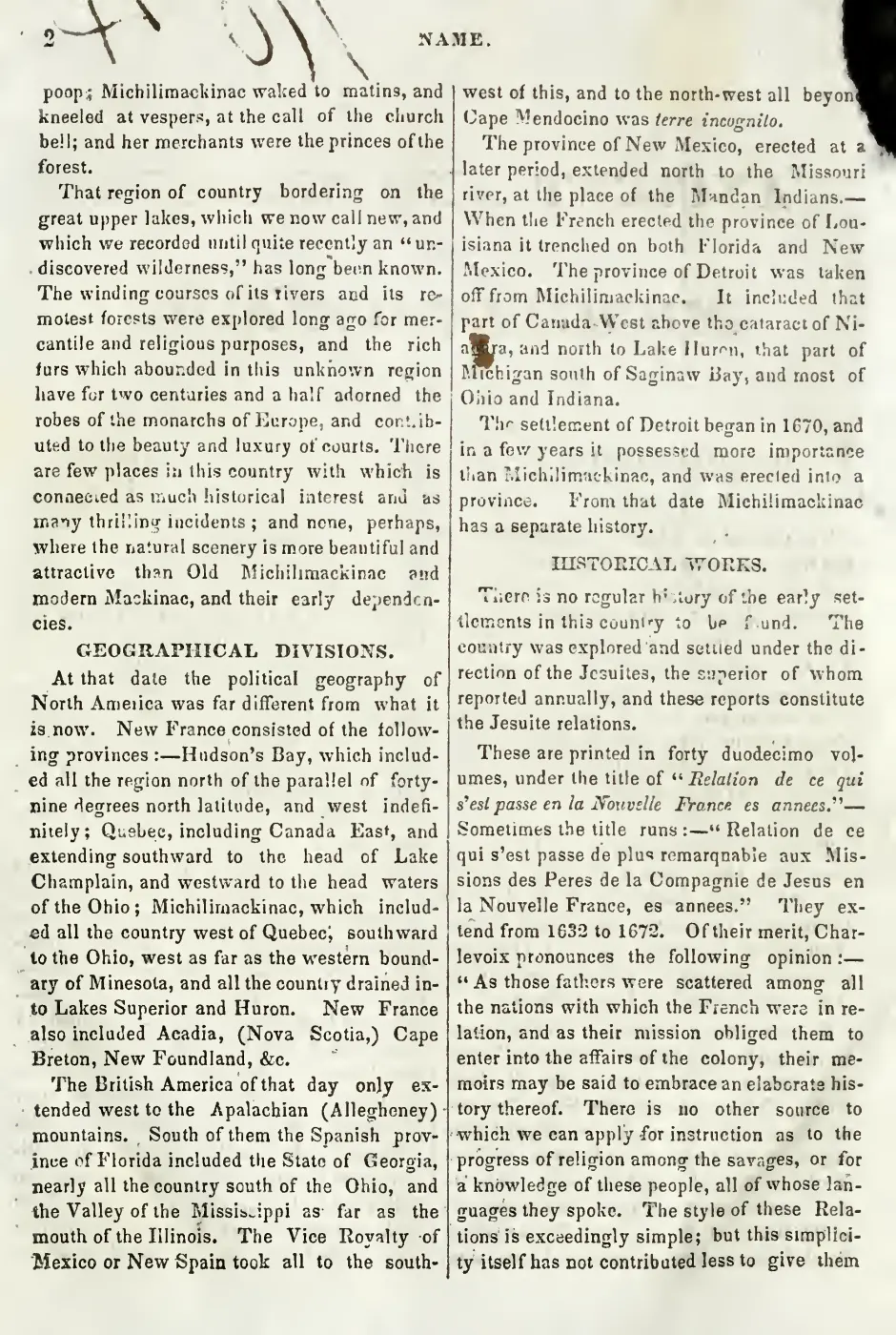
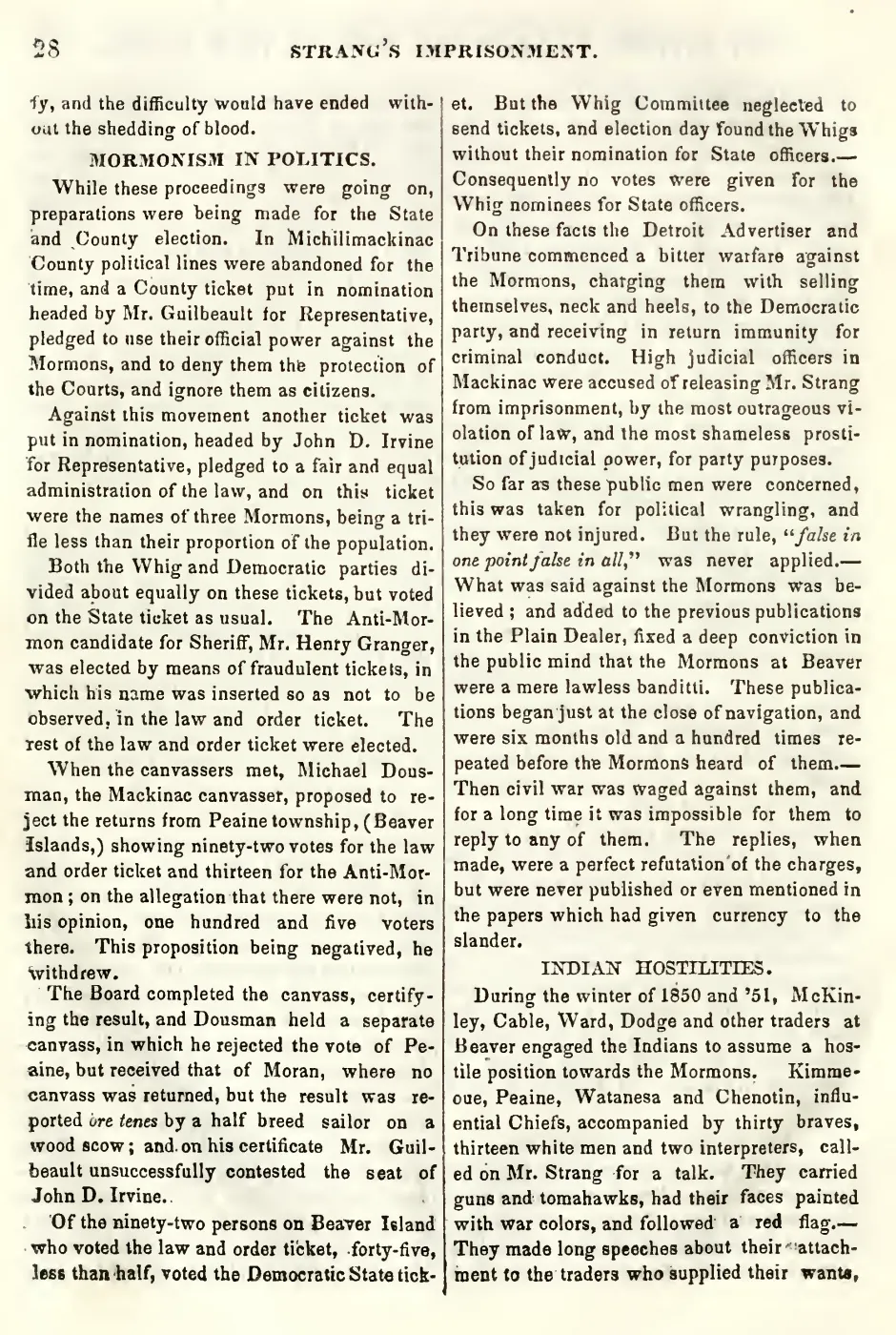
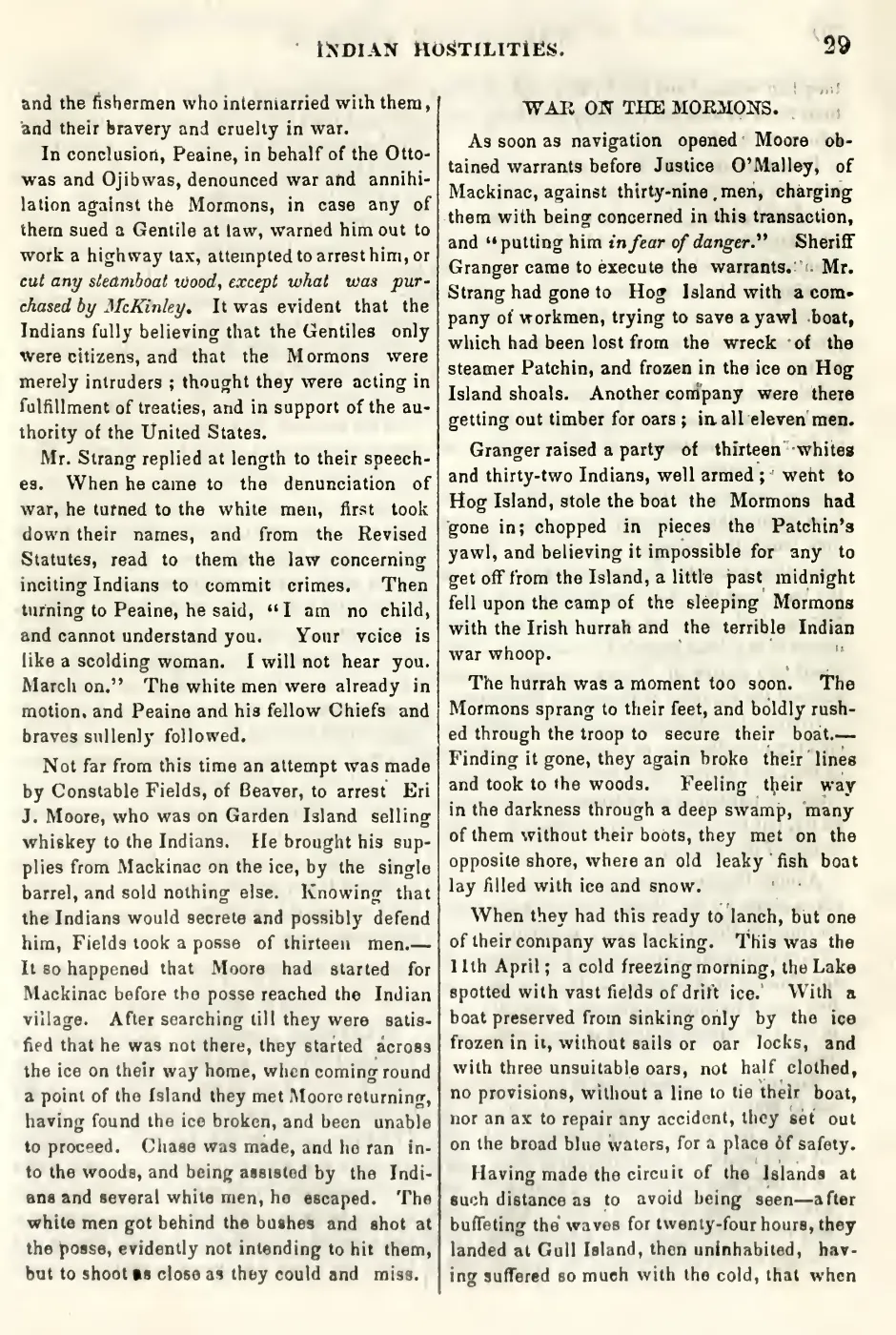
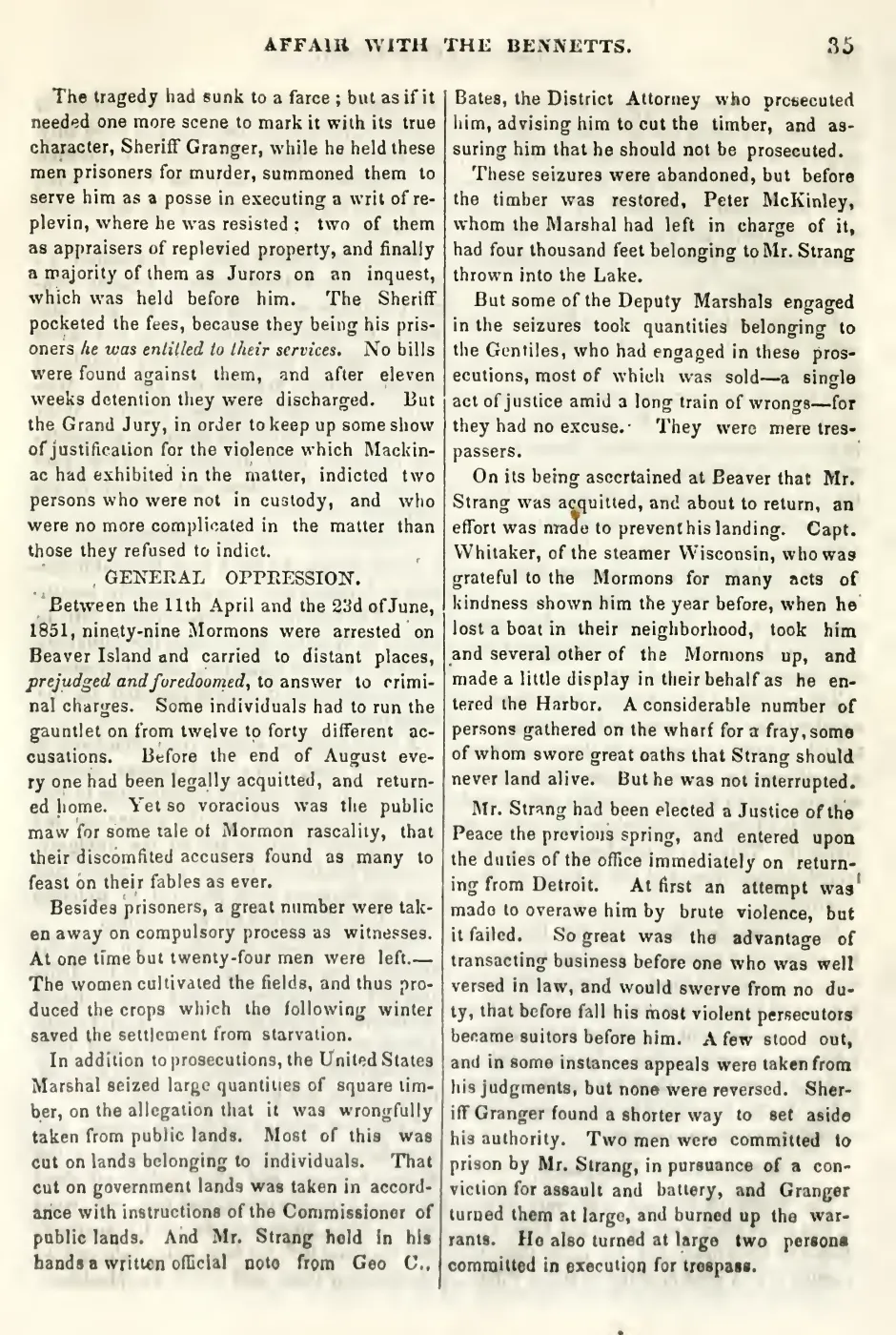
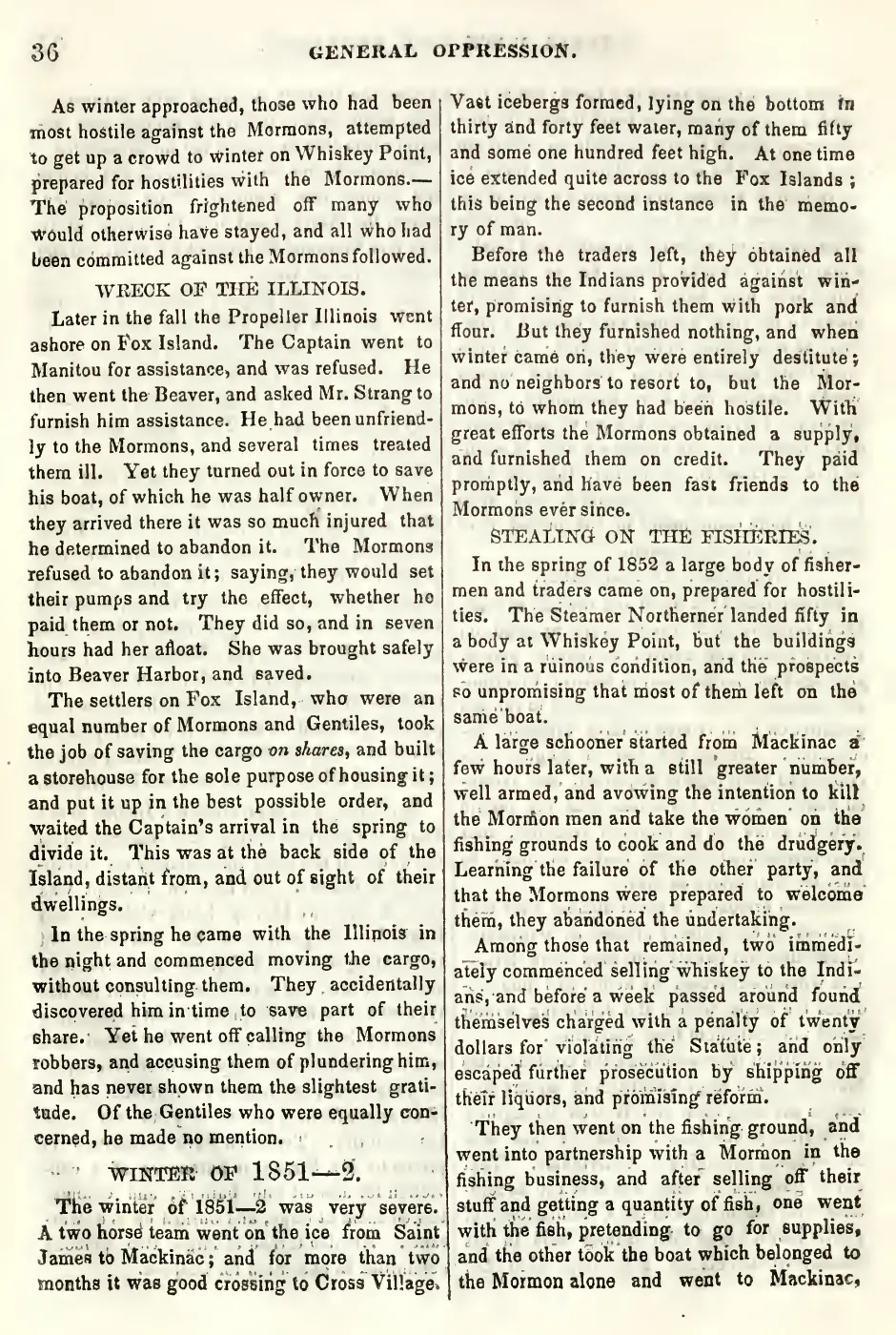
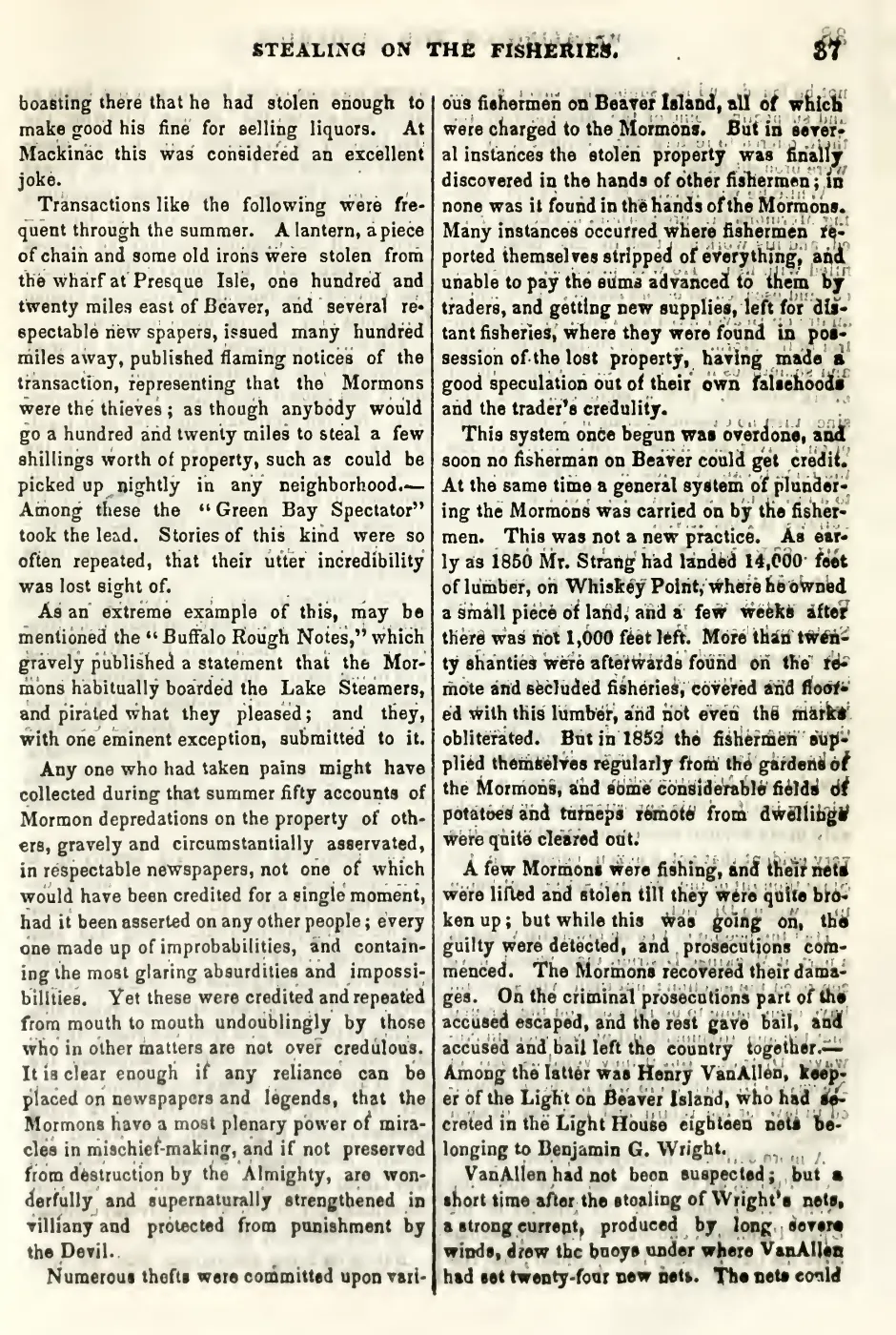
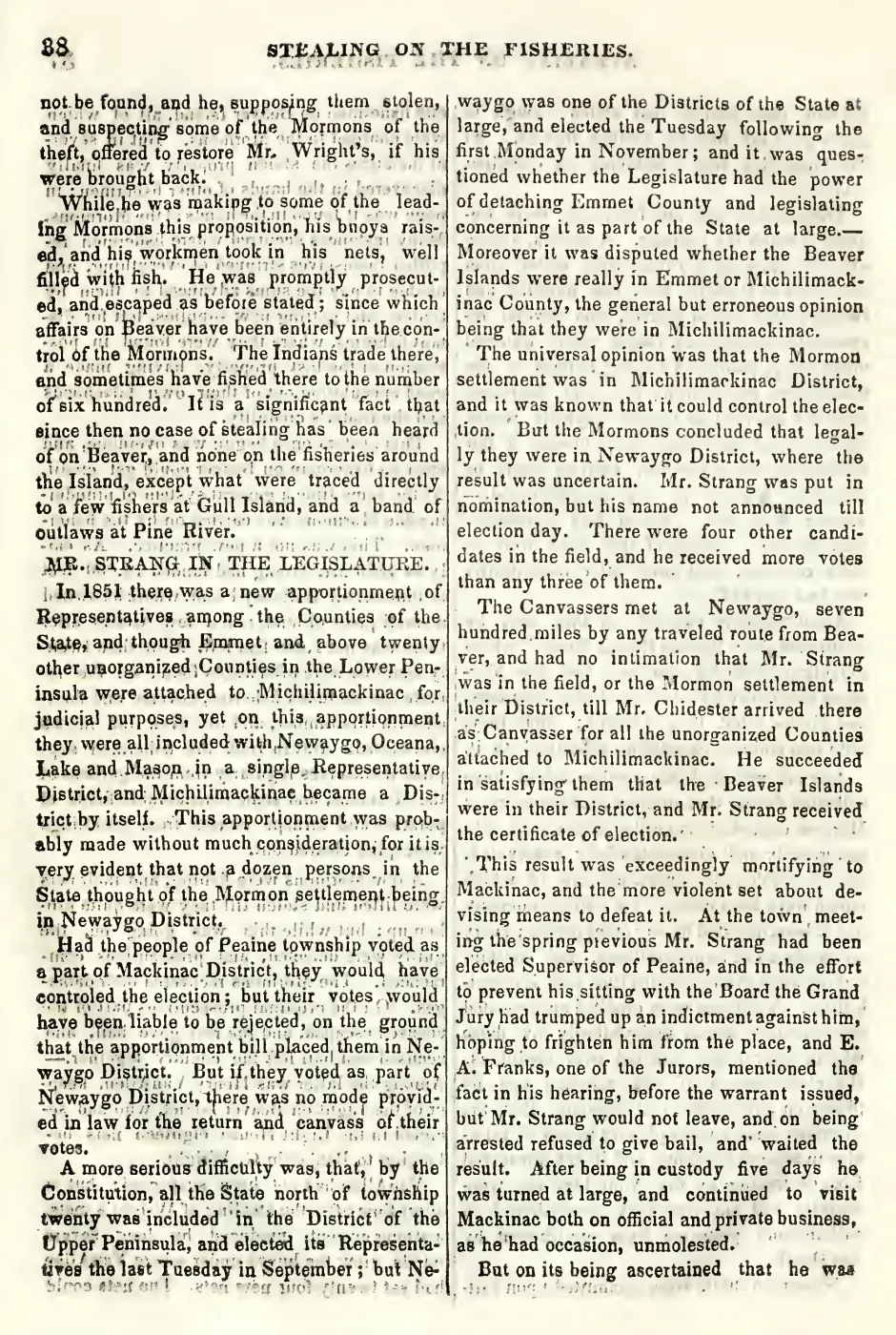
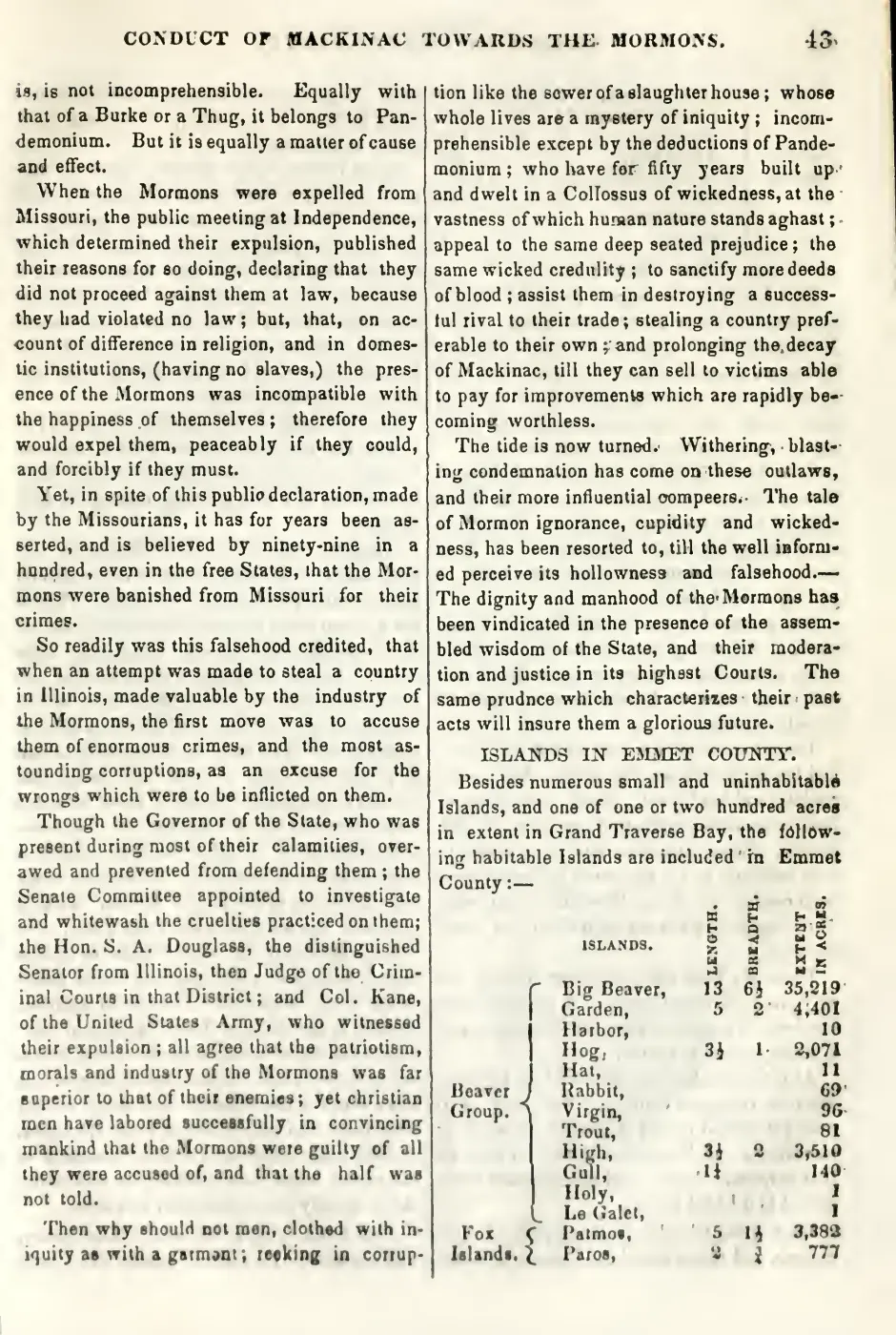
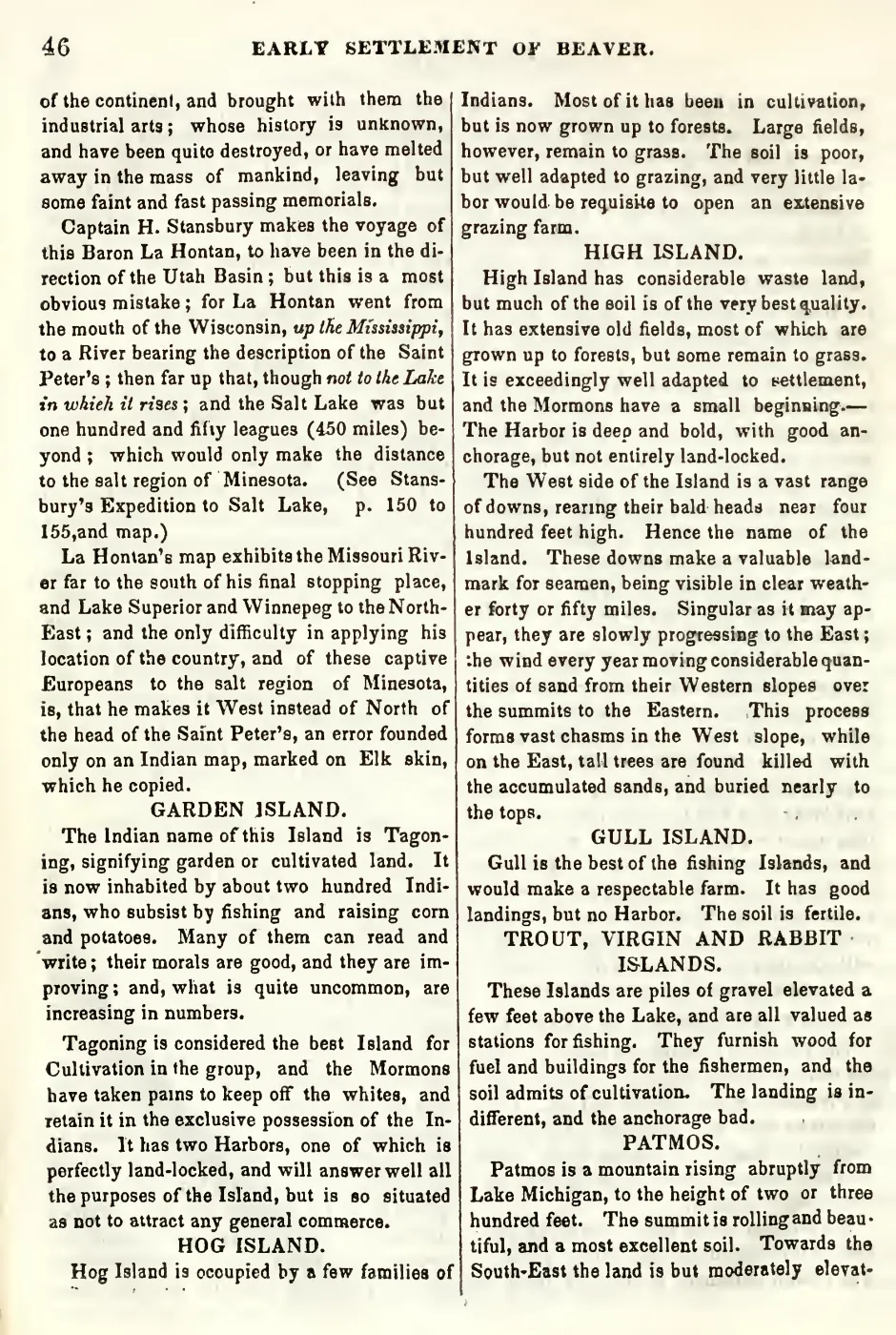
48 pages, rendered from the held scan.
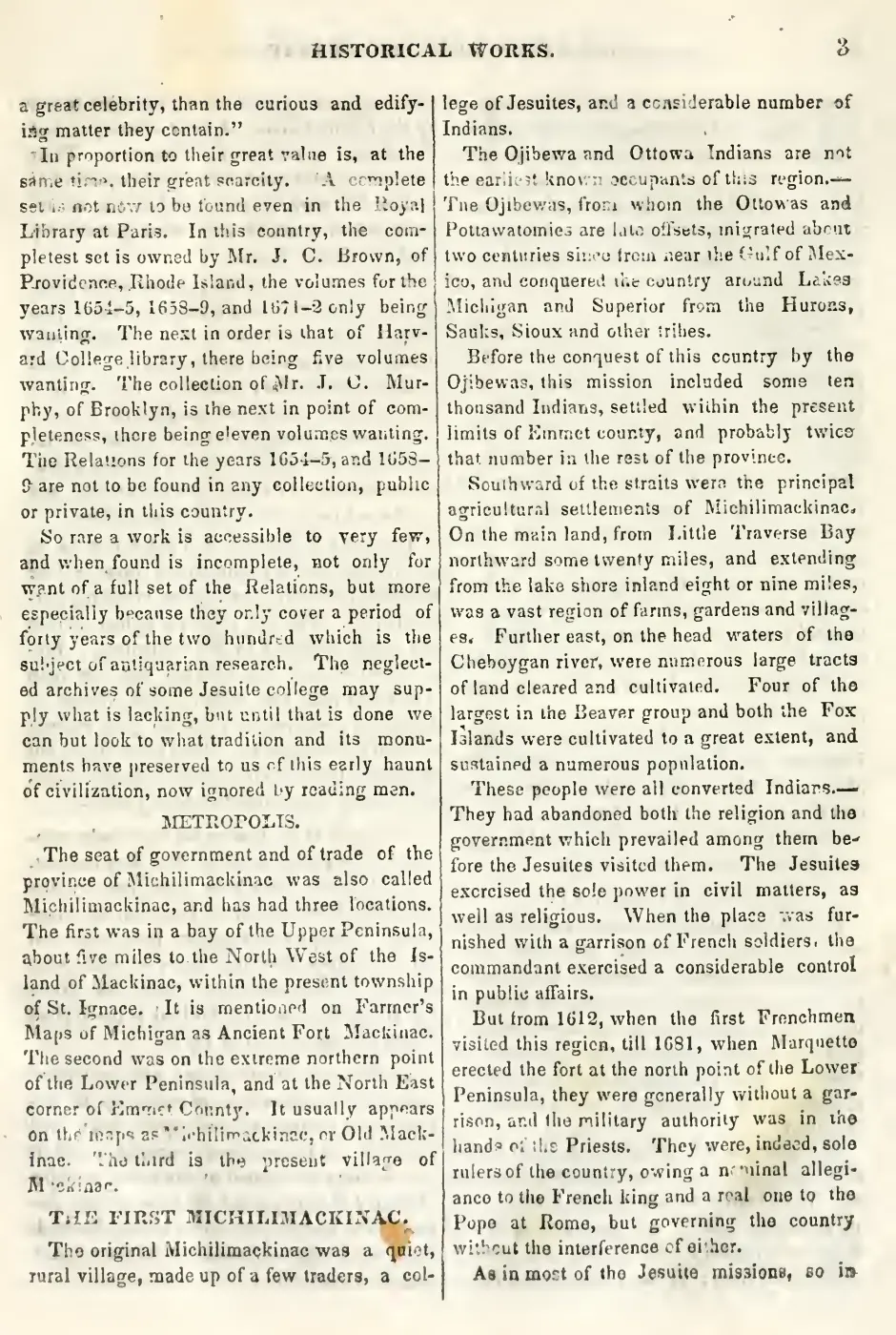
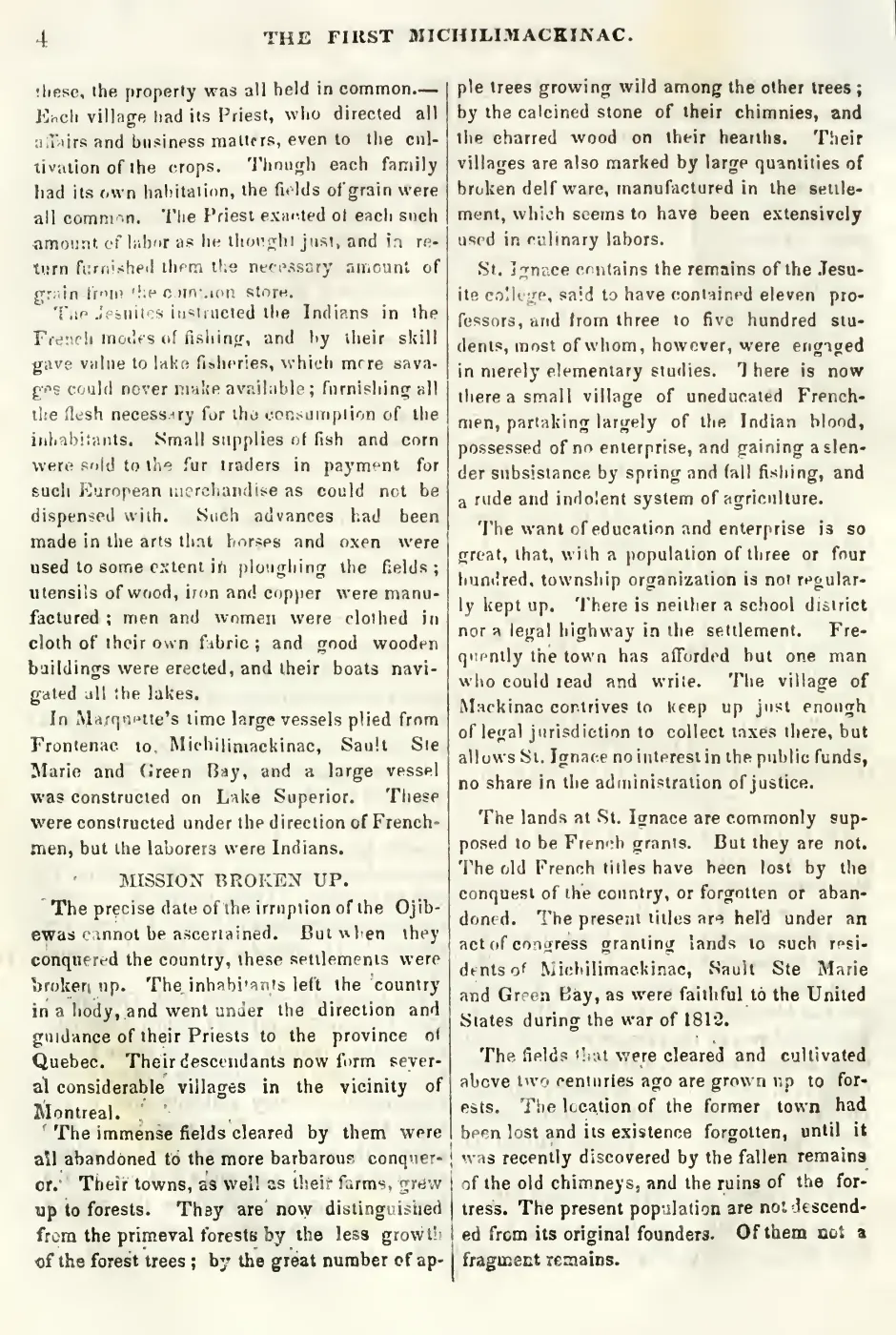
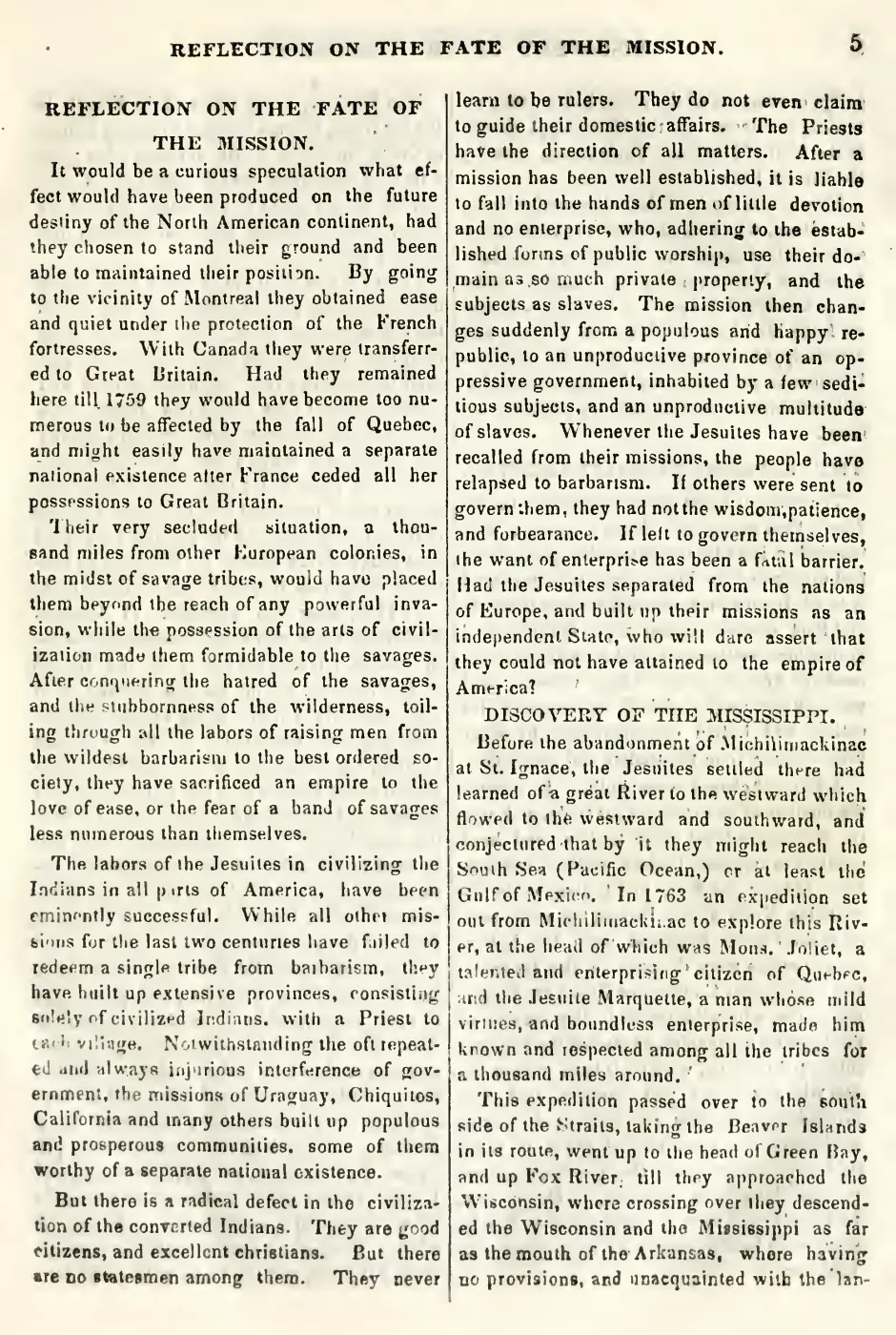
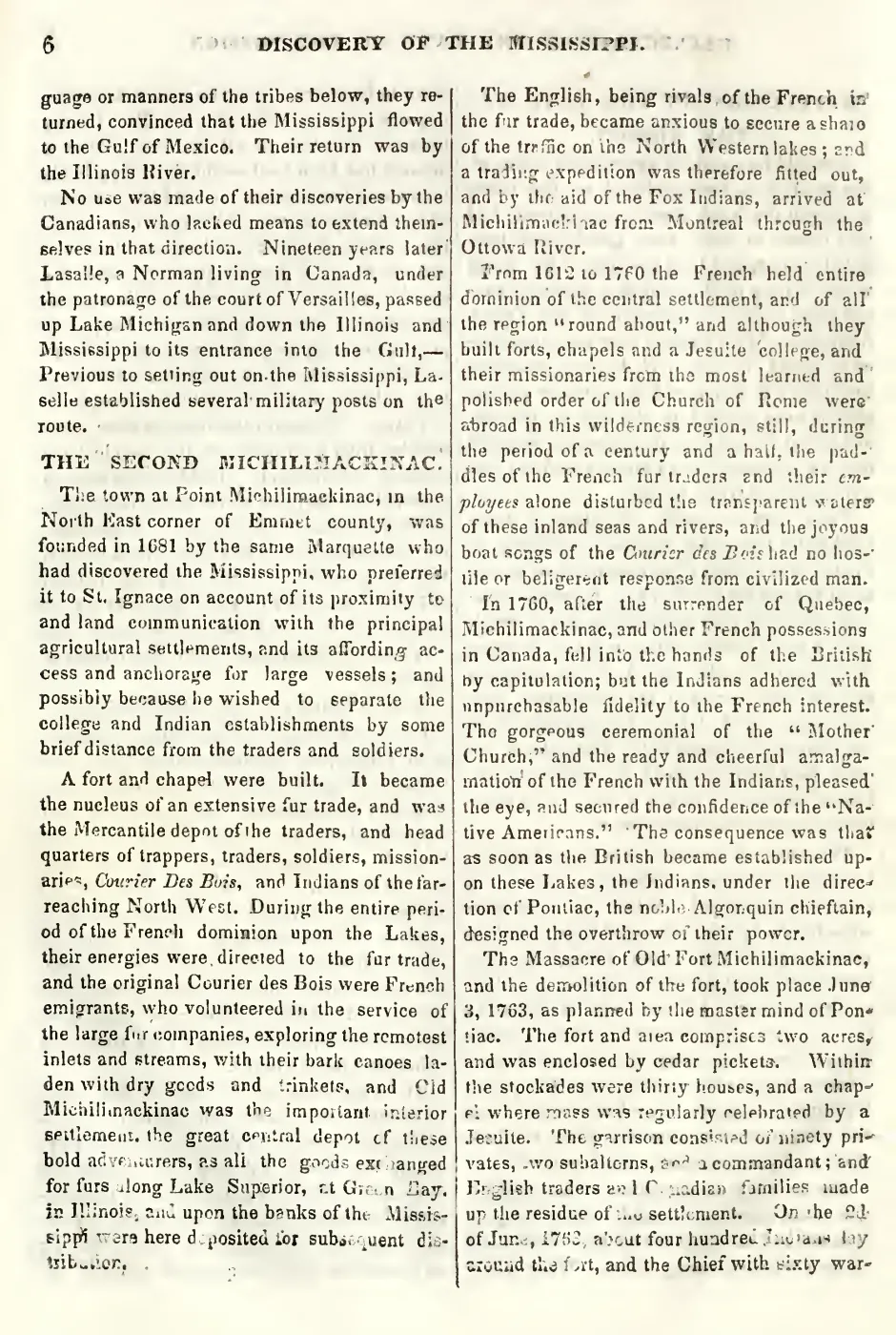
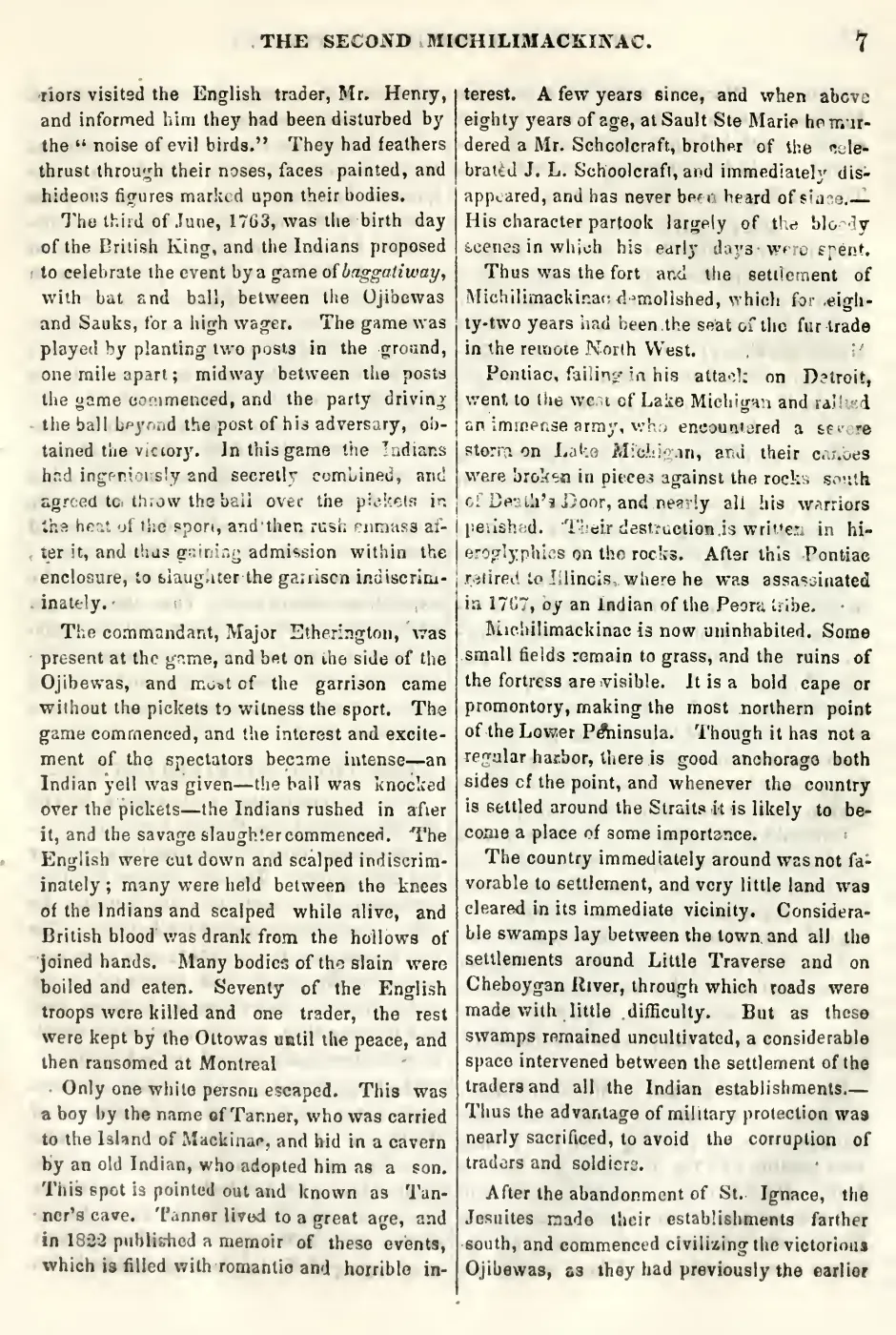
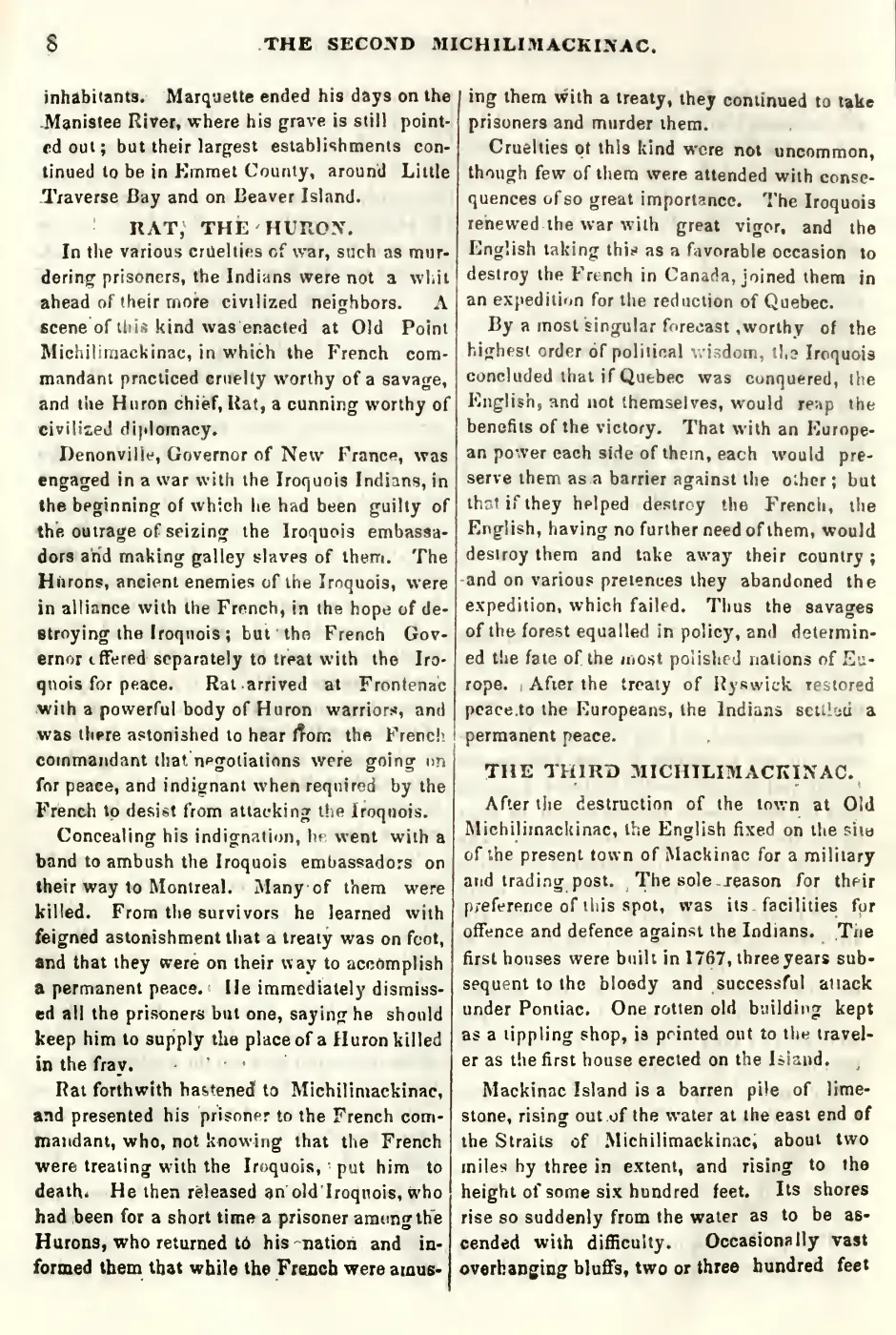
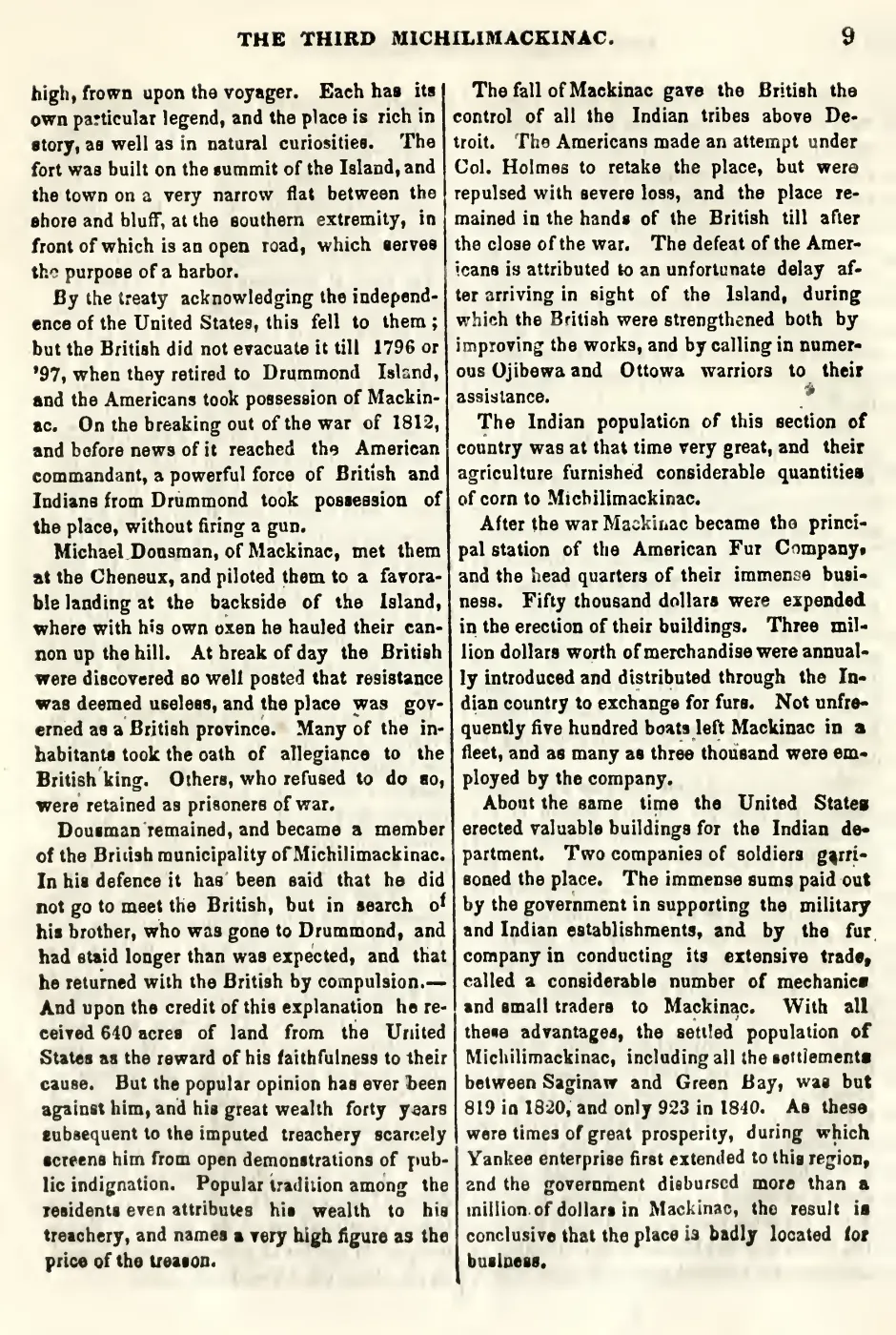
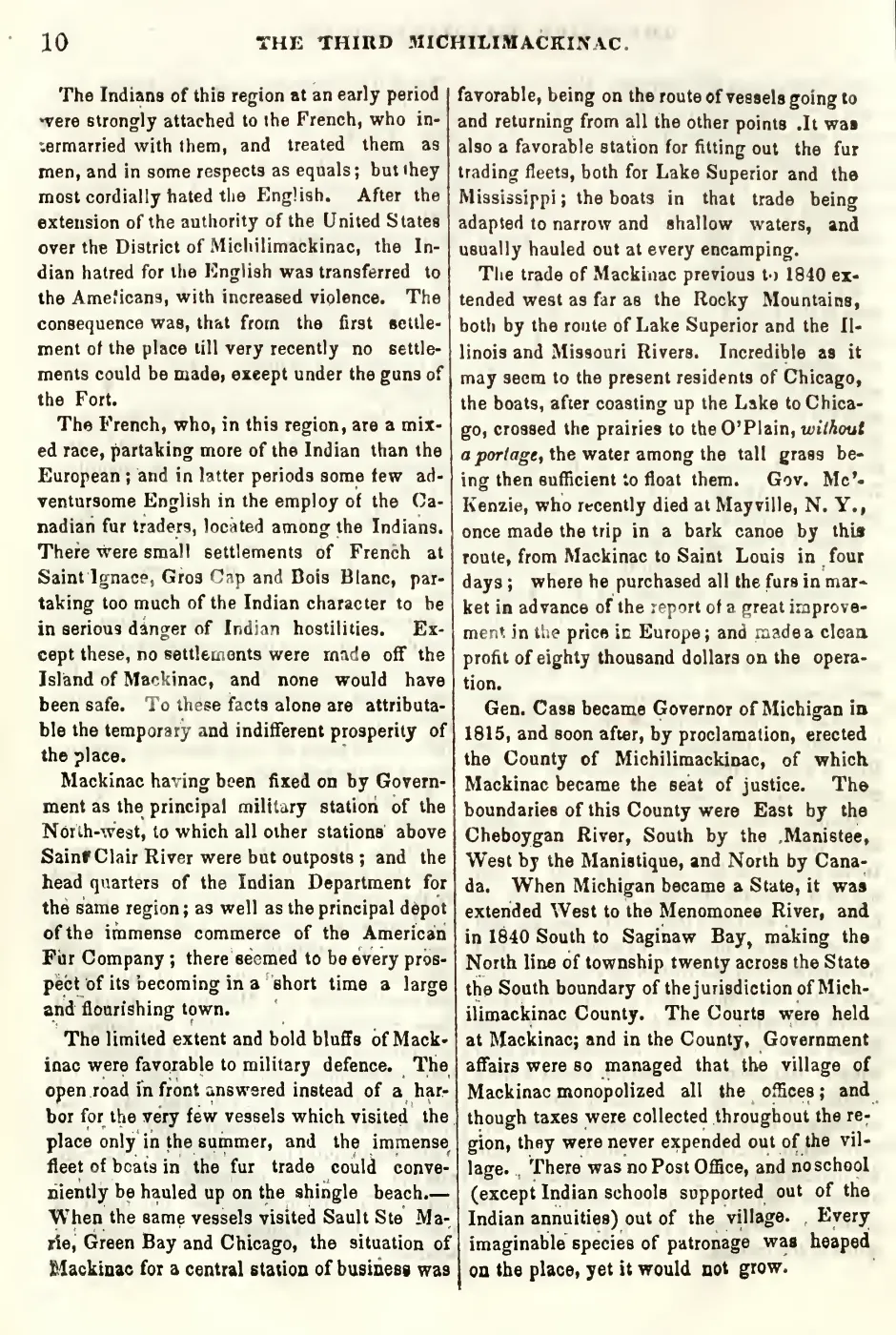
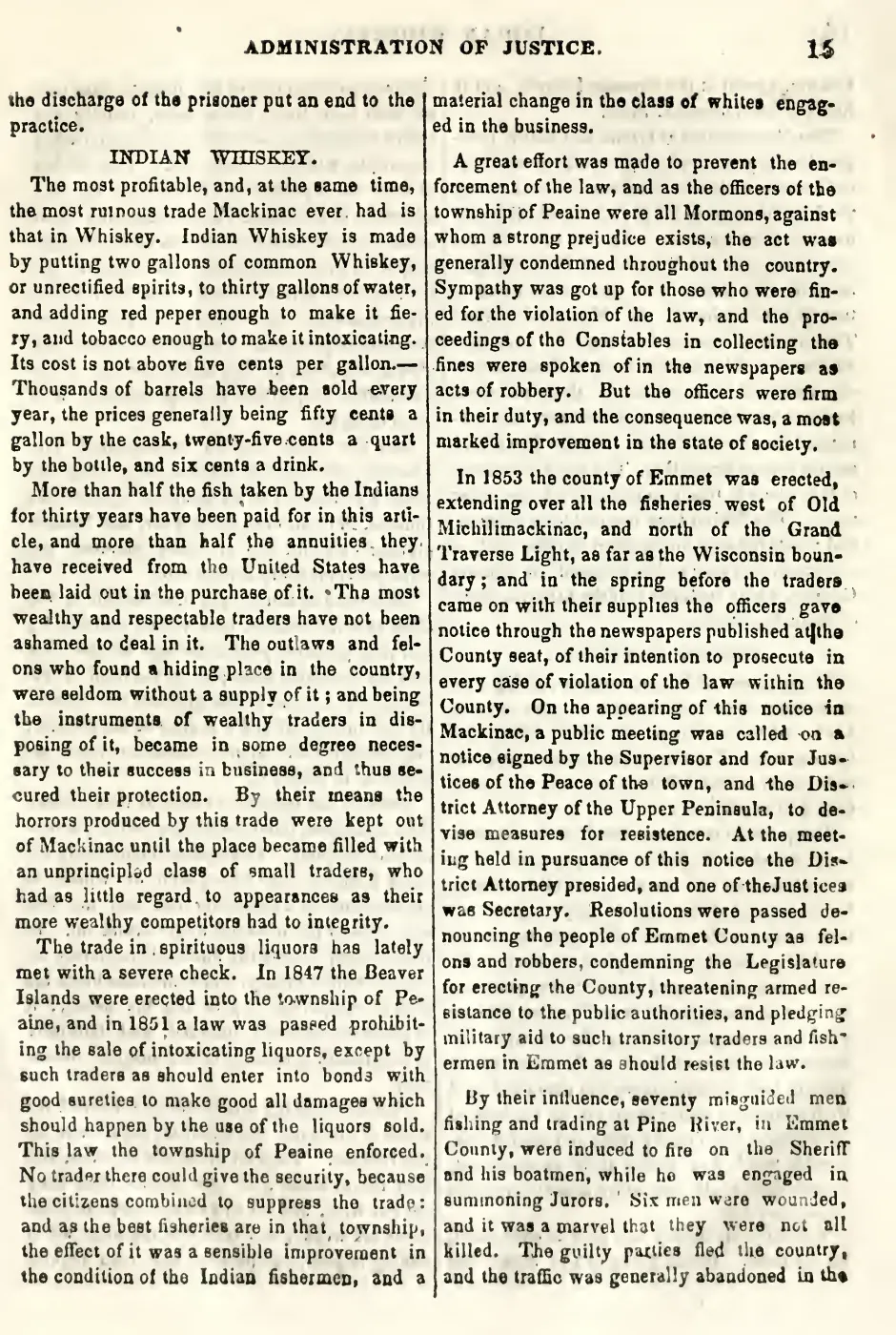
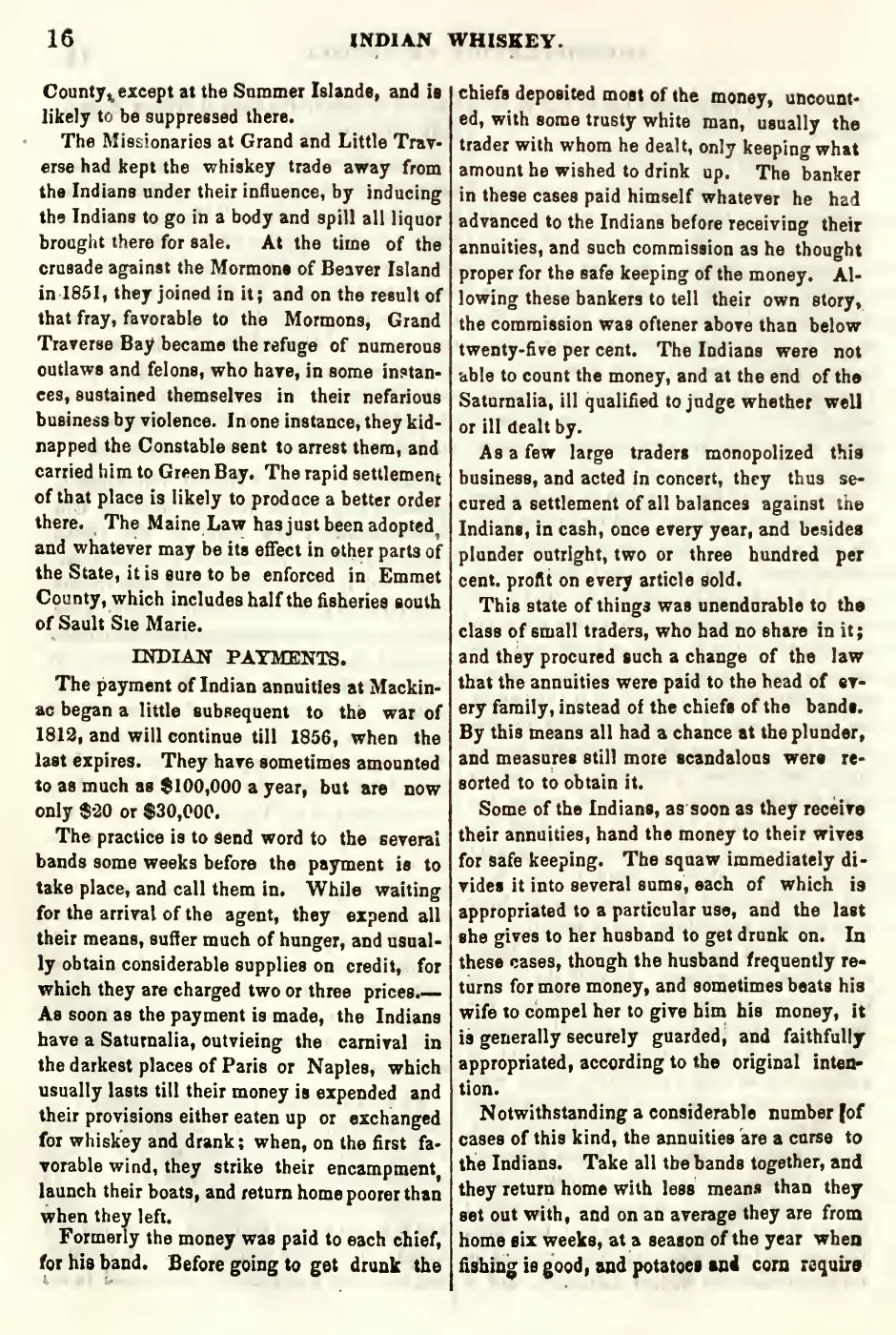
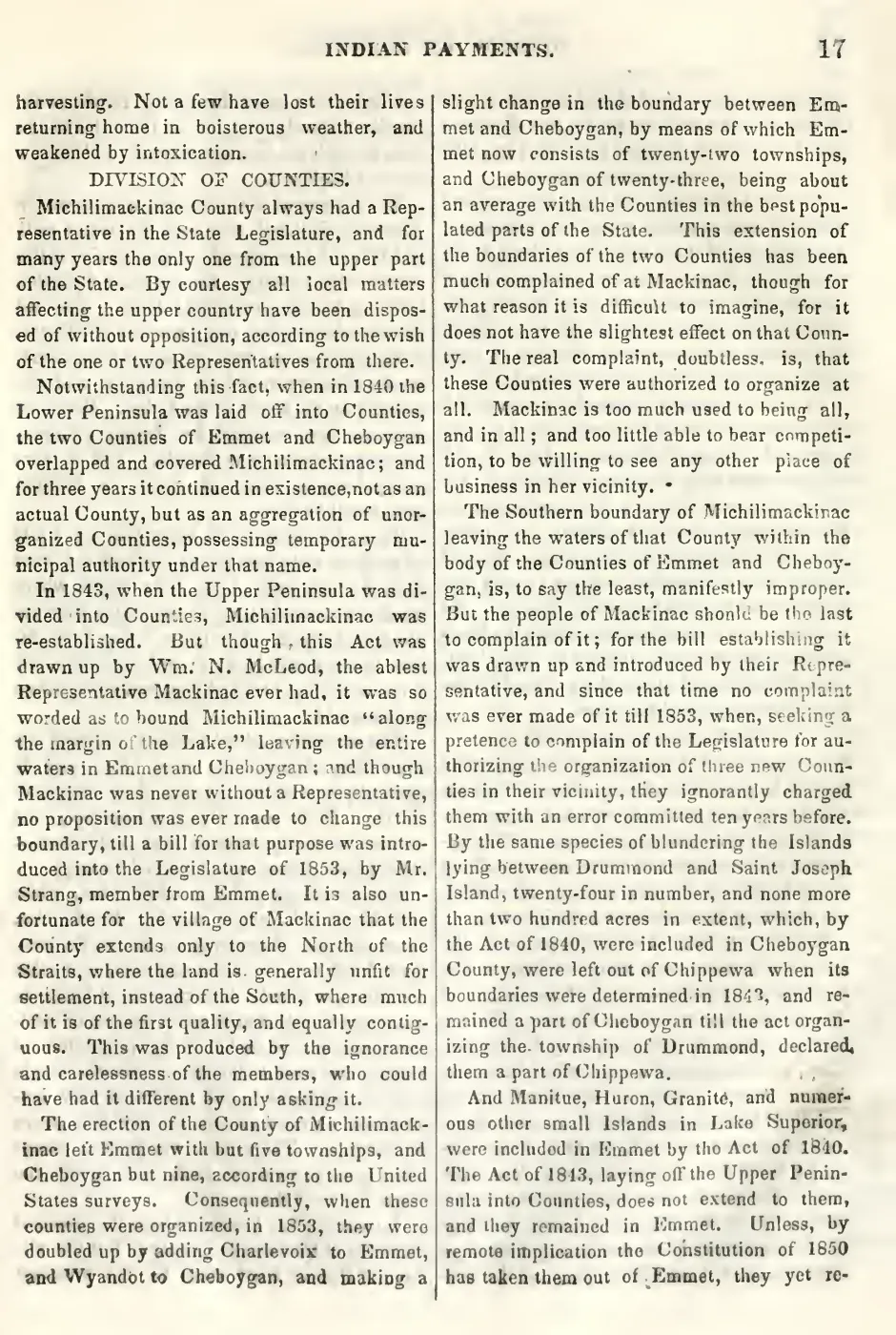
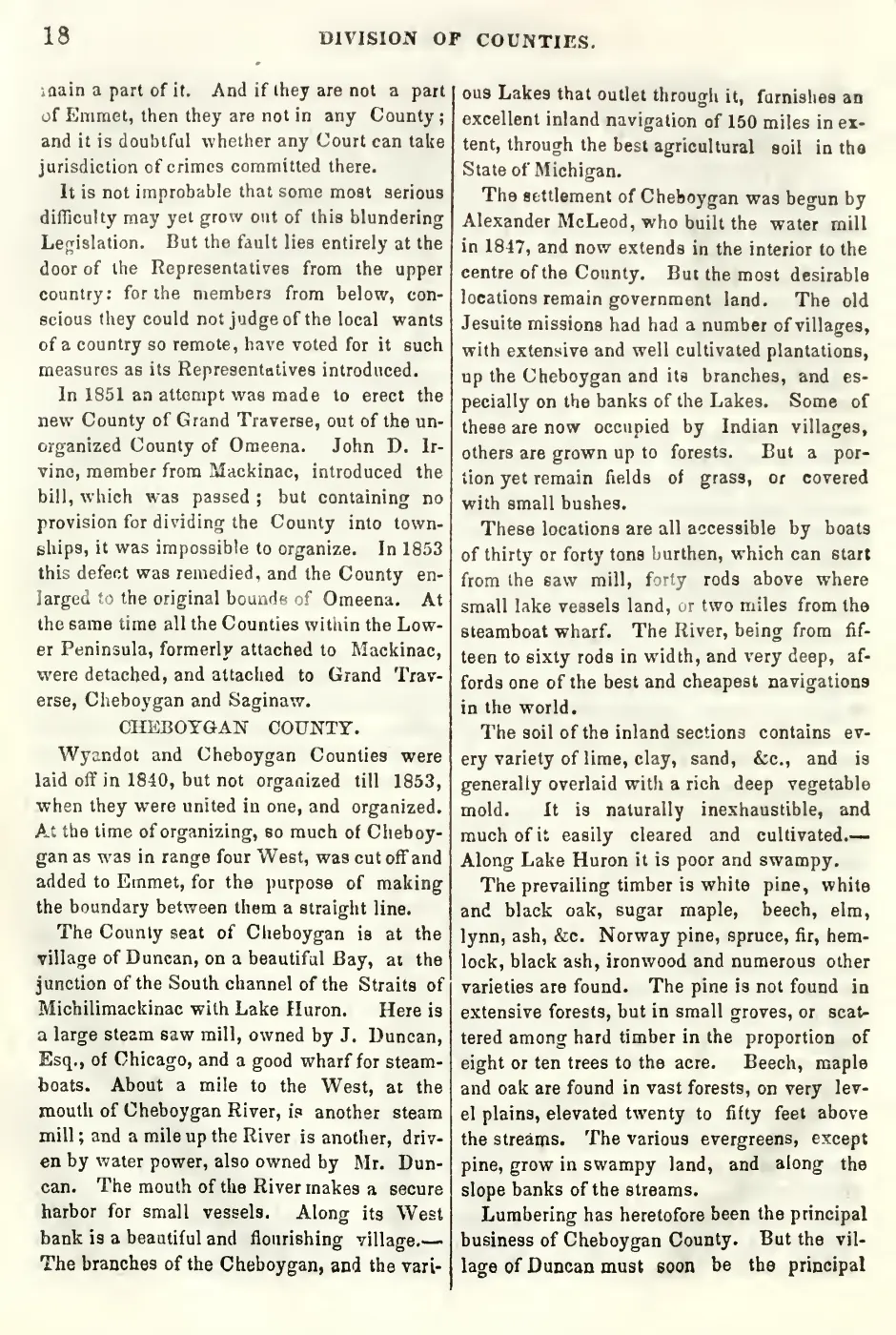
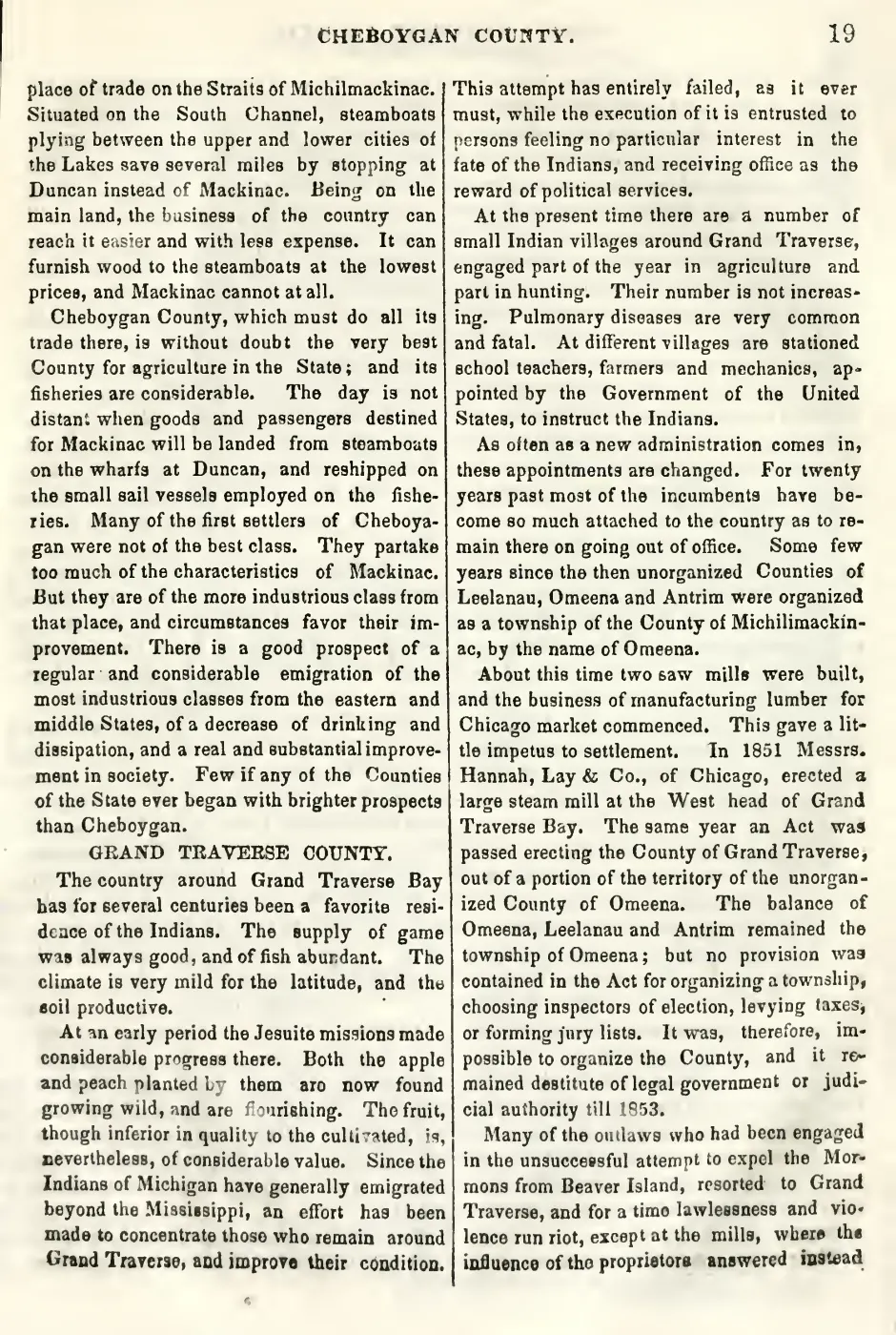
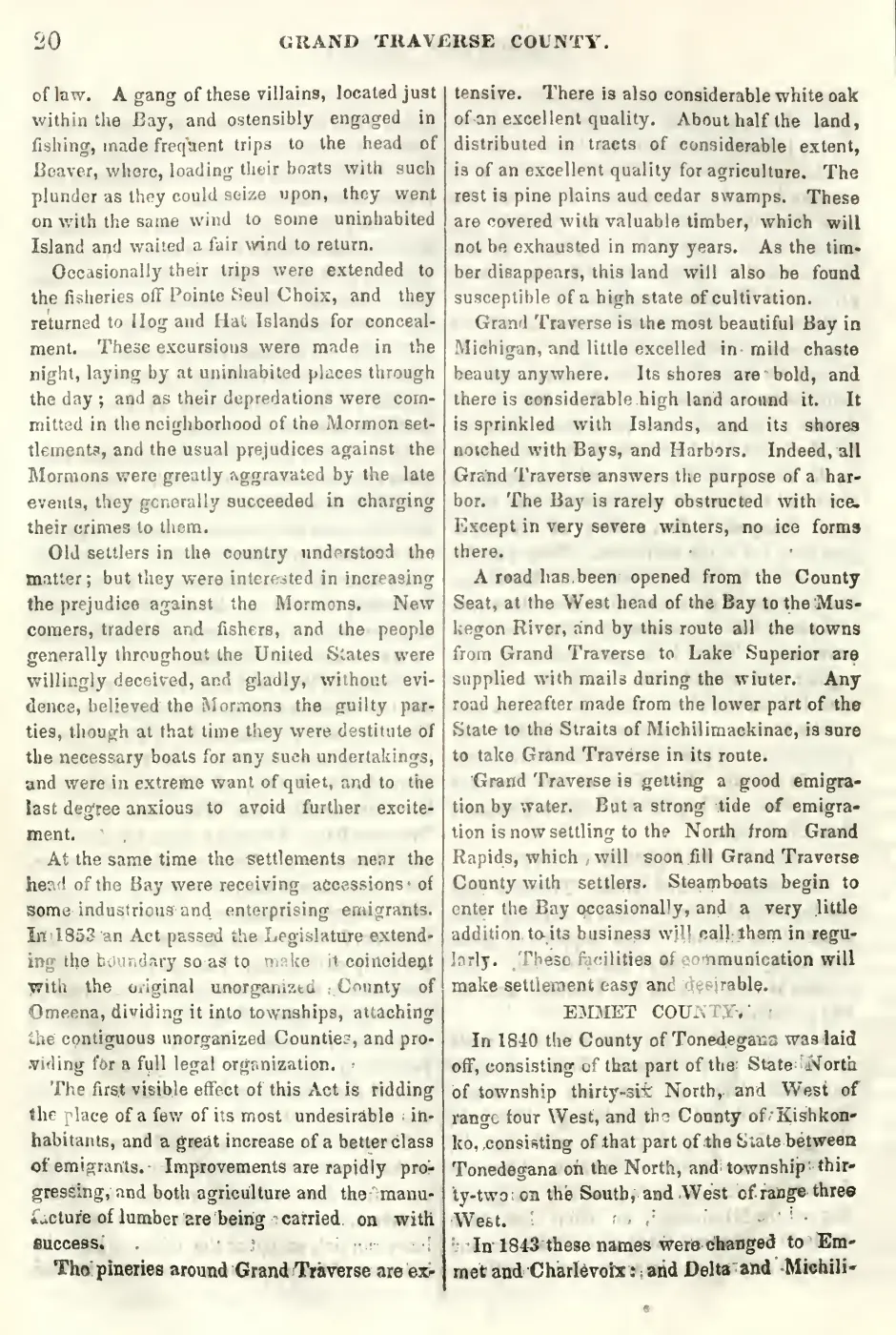
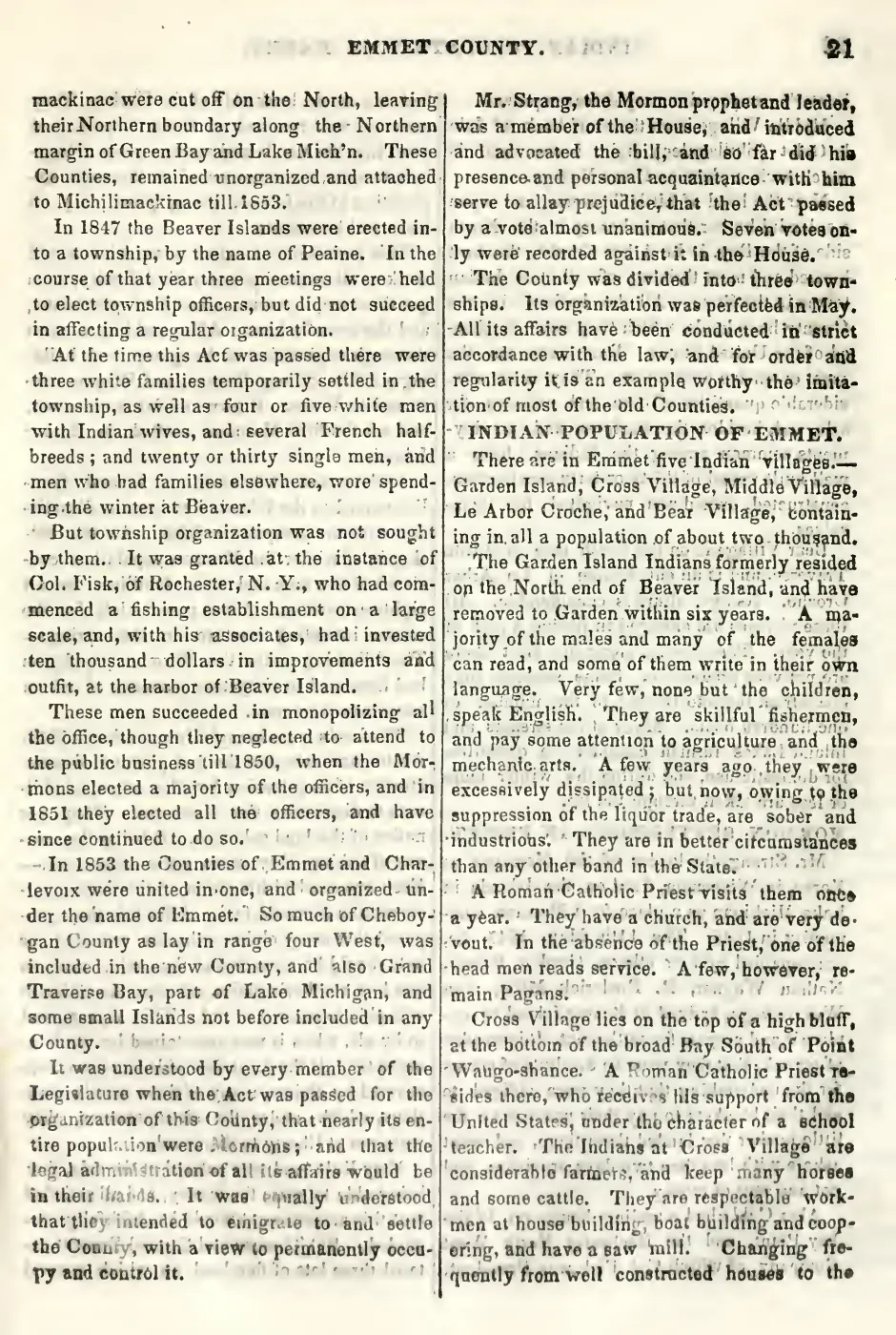
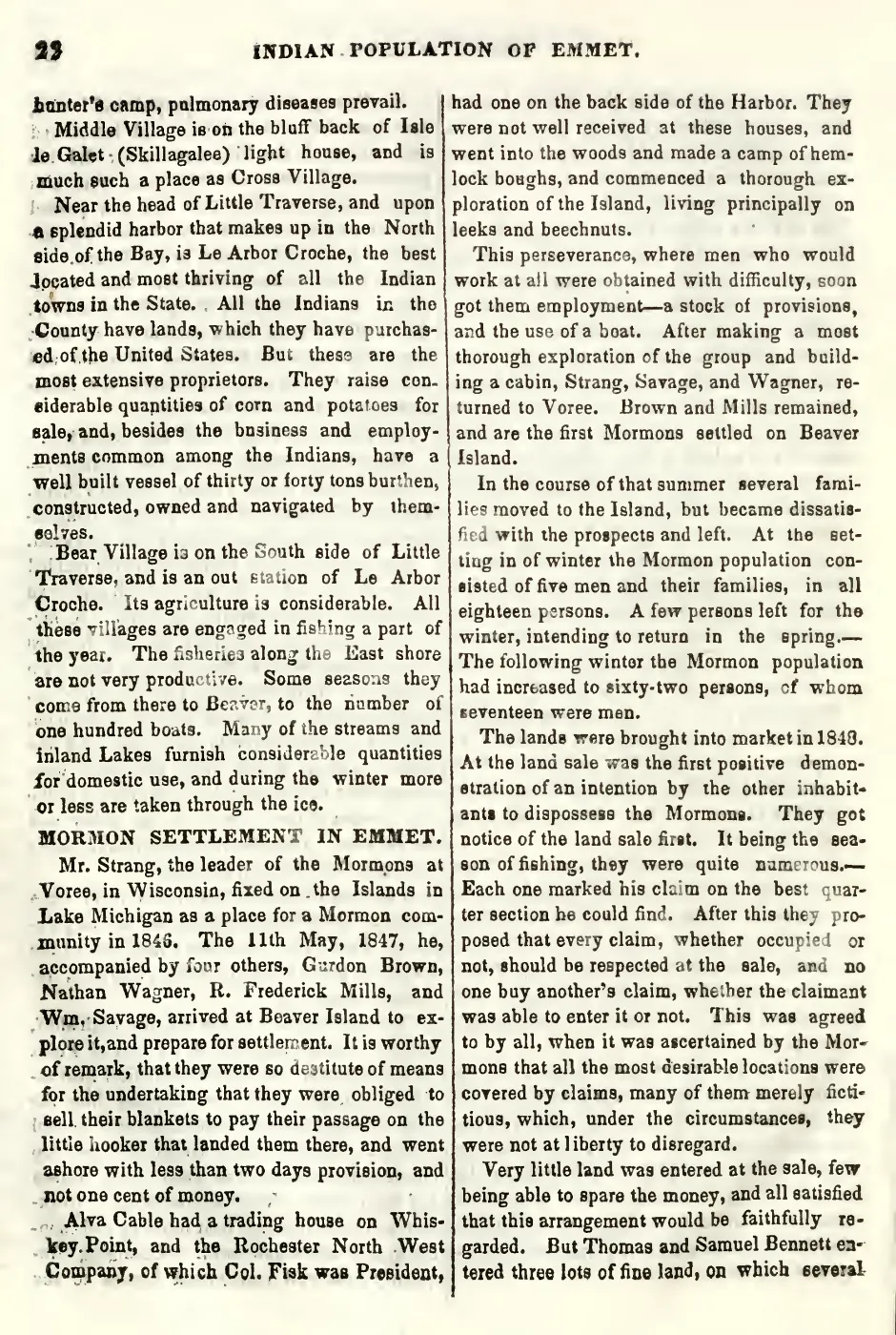
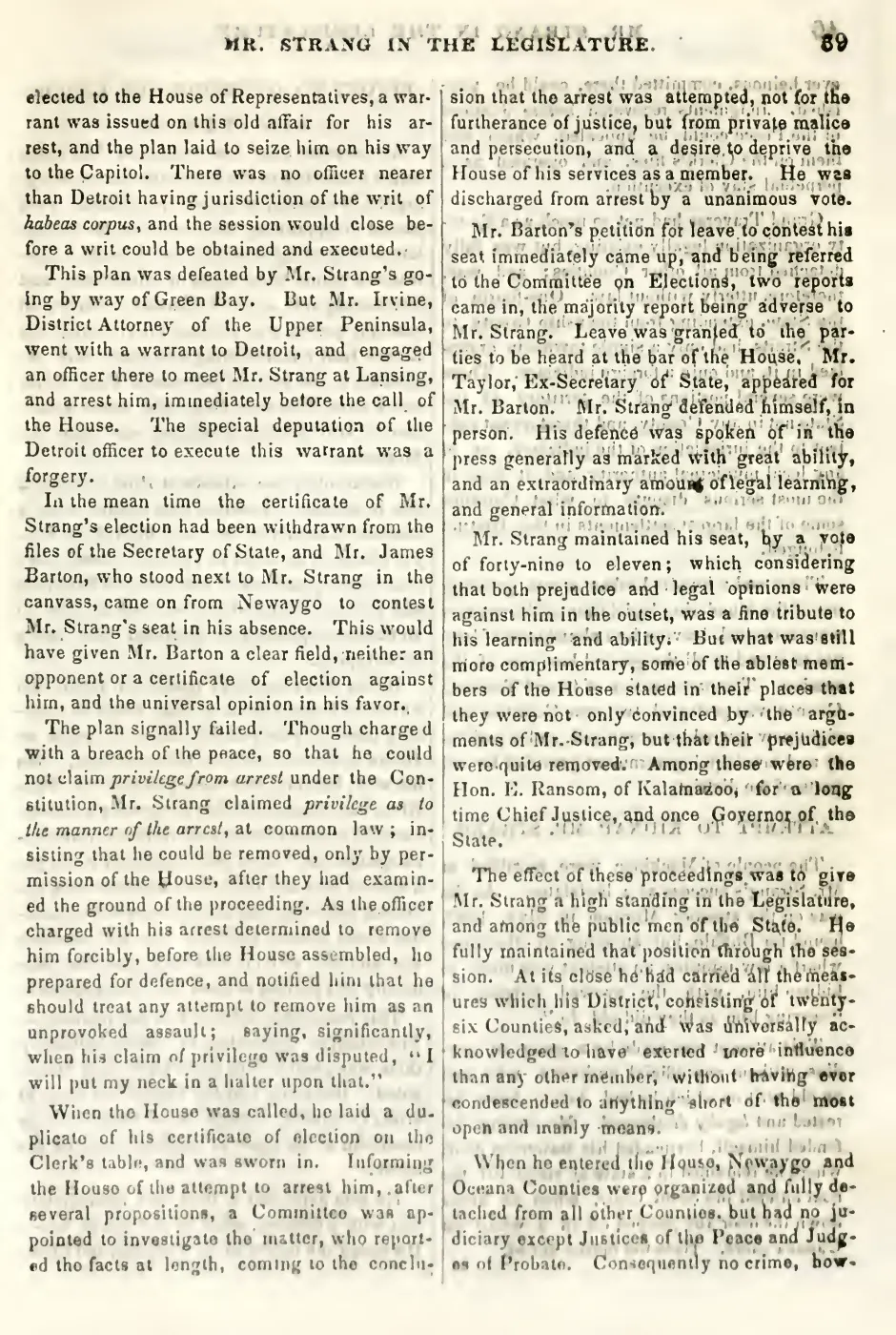
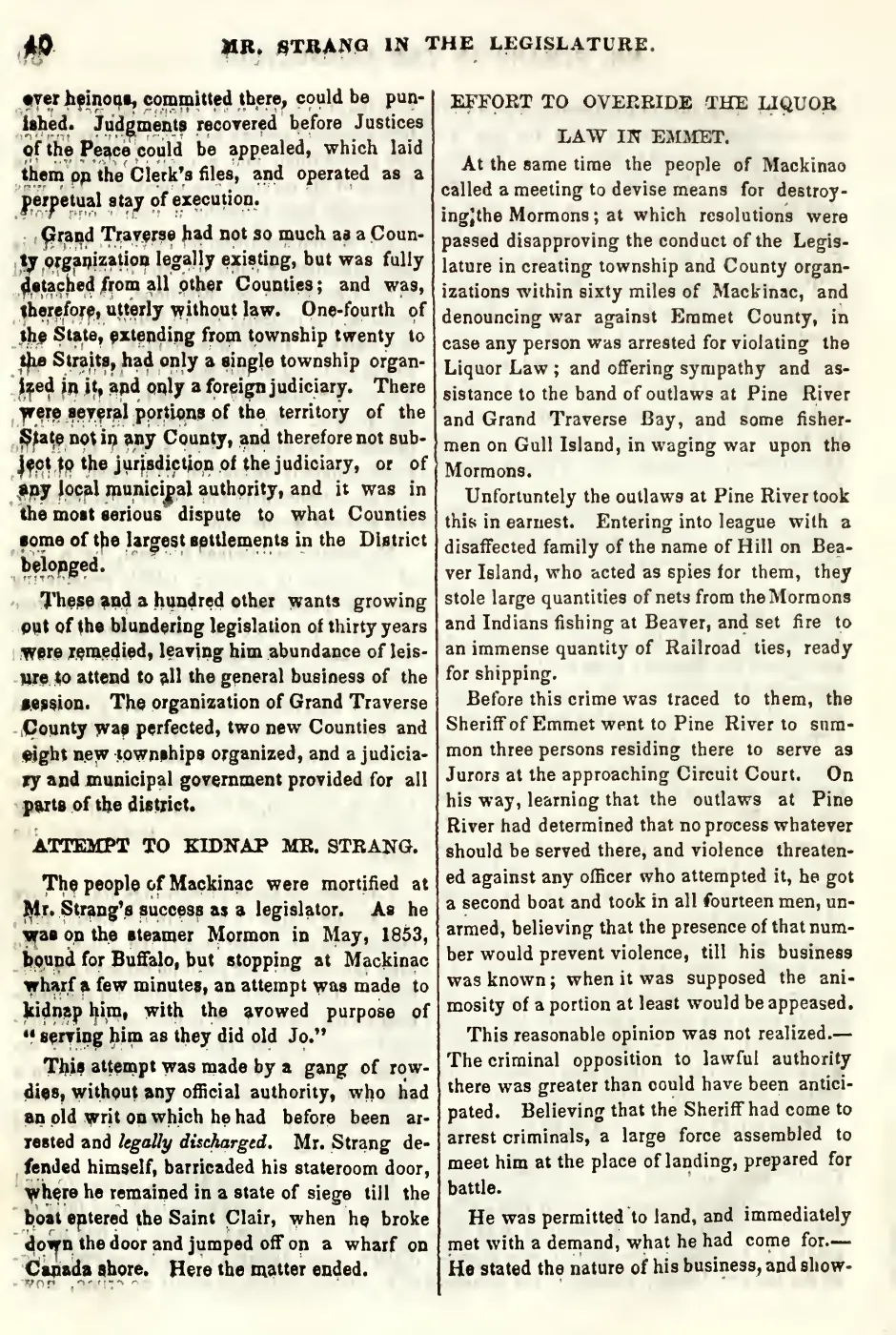
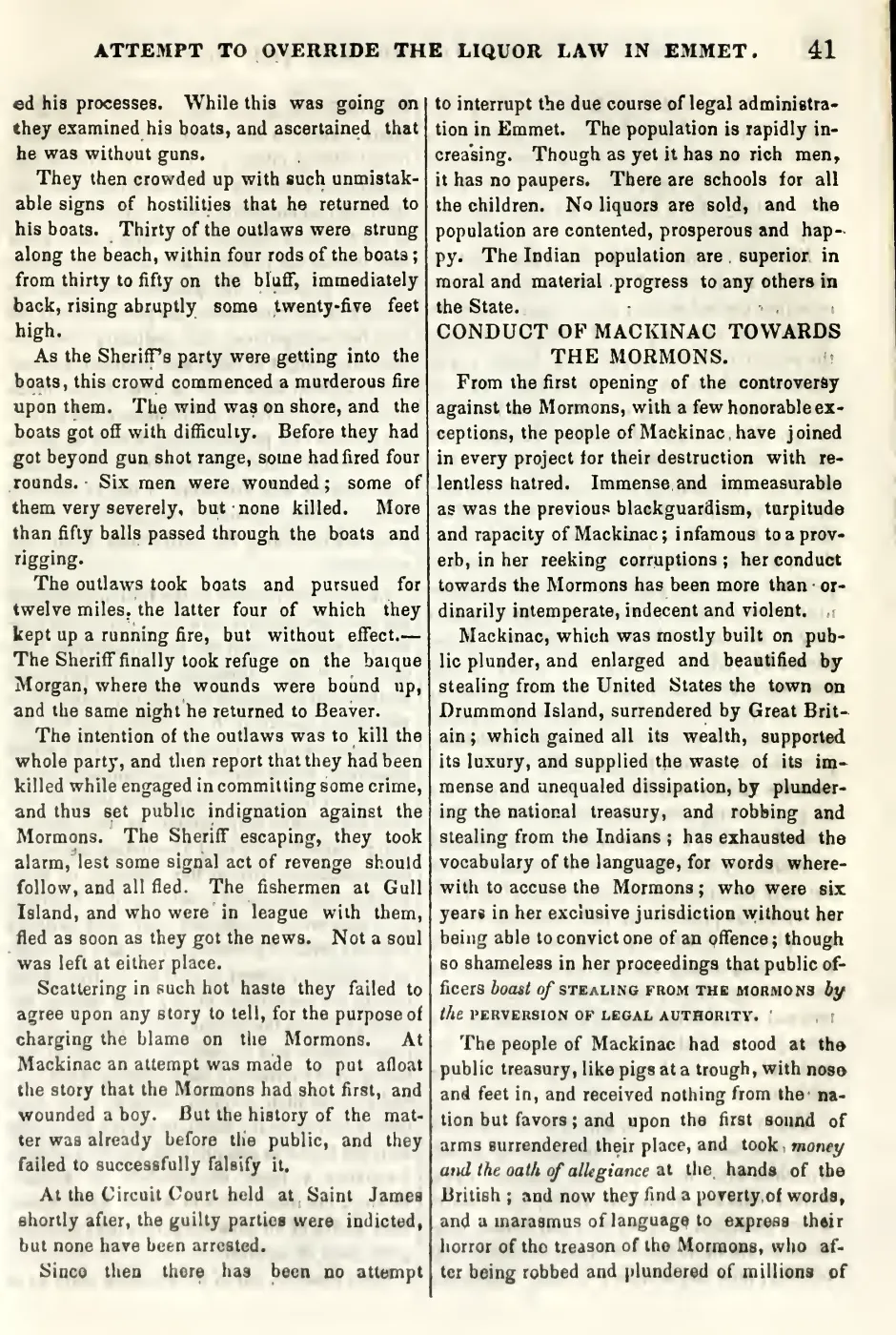
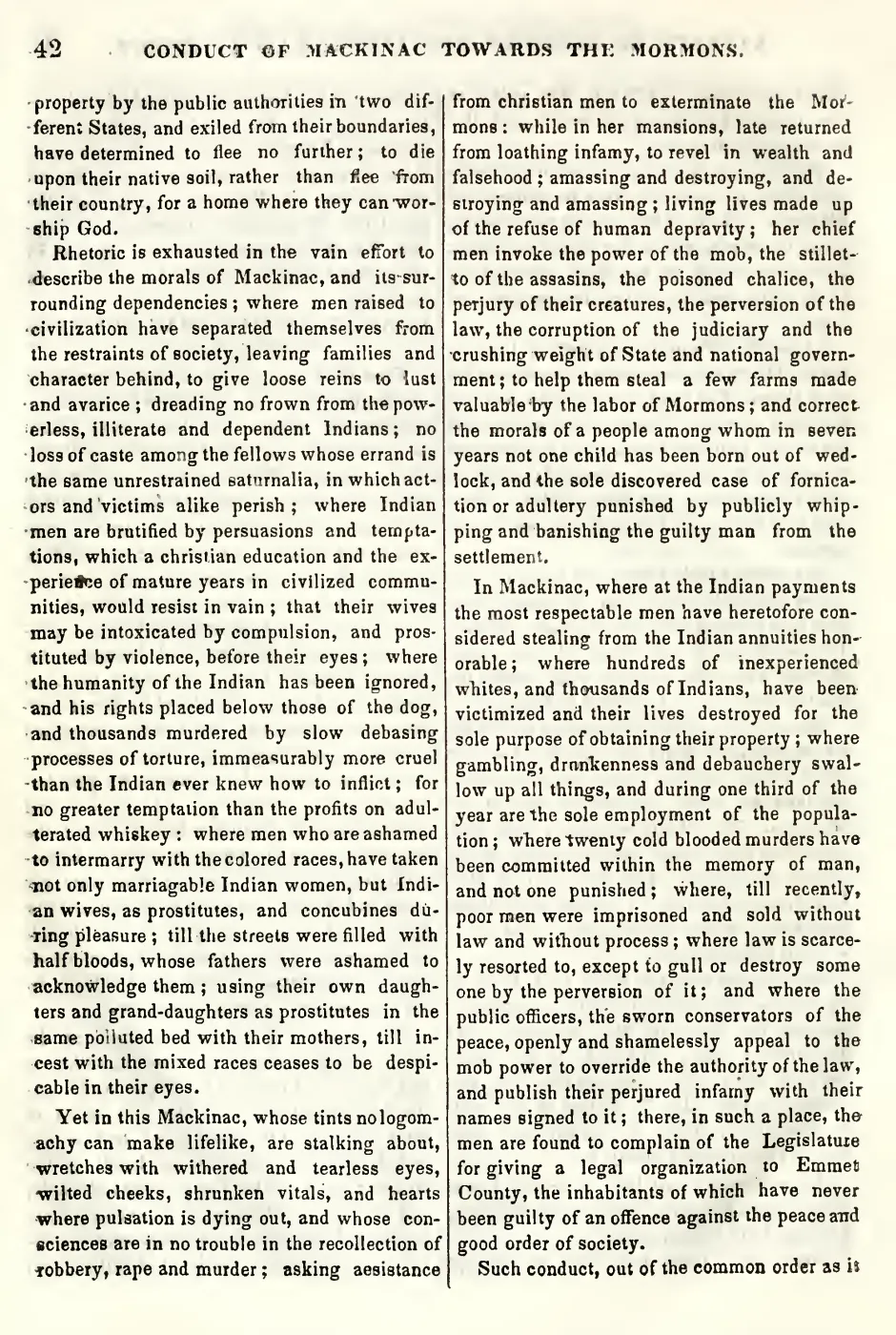
Sources
- First copy read in full (5,539 lines of OCR). Opens with the etymology of "Michilimackinac" and a history of the region from Champlain's founding of Quebec (1608) through the Mormon settlement and the 1853 anti-Mormon "crusade."
- A second copy, headed by a preface (absent from the other two copies examined) explicitly labelling itself "This second edition of Ancient and Modern Michilimackinac by Mr. Strang's own pen," defending the "Latter Day Saints on the Islands of Lake Michigan" against the same treatment given earlier prophets. Otherwise the same narrative text, corroborated by spot comparison of the concluding pages of both copies (verbatim match on the 1853 "crusade" and "Conclusion" passages).
- A third digitized copy (University of Michigan), title page confirmed by direct read; not collated line-by-line against the other two.
- States the work was first serialized in the Northern Islander from January to April 1854, then issued "later in the same year" as a forty-eight-page paper-covered pamphlet; identifies its "real purpose" as the subtitle's account of the Mackinac-Mormon controversy, told "from the Mormon point of view," and records two later reprints (St. Ignace News and Free Press, 1885; Wingfield Watson, 1894). Also establishes (p. 186) that the Northern Islander itself was "established by Strang at Saint James" -- the press on which this work was first serialized and, using the same type, later set as a pamphlet.
- Reports that the Beaver Island Civic Association had a limited number of reprint copies for sale at $7.50 plus tax and says only three originals were known to exist. This is evidence of a 1960 local reprint offer, not an independent bibliographic or scarcity record.data1 · beaver-island-archive · beaver_beacon · 1960-01_Beaver-Beacon
- The held four-page issue scan is paired with the OCR source and confirms the published notice or report; it does not expand the source-specific identity, event, or outcome claims.data1 · beaver-island-archive · scans · beaver_beacon · issues · 1960-01_Beaver-Beacon
- Says only a few copies of King Strang’s book remained. This preserves a later local availability statement without treating it as a verified count of surviving copies.data1 · beaver-island-archive · beaver_beacon · 1960-04_Beaver-Beacon
- The held four-page issue scan is paired with the OCR source and confirms the published notice or report; it does not expand the source-specific identity, event, or outcome claims.data1 · beaver-island-archive · scans · beaver_beacon · issues · 1960-04_Beaver-Beacon
- Reports a final shipment of the local reprint, 500 numbered copies, no planned reprint, and 28 copies available through the Civic Association. These are local sales claims and do not independently establish the print run or surviving-copy count.data1 · beaver-island-archive · beaver_beacon · 1960-05_Beaver-Beacon
- The held three-page issue scan is paired with the OCR source and confirms the published notice or report; it does not expand the source-specific identity, event, or outcome claims.data1 · beaver-island-archive · scans · beaver_beacon · issues · 1960-05_Beaver-Beacon
Added 28 July 2026 · revised 4 August 2026. Recent changes
Cite this article
Beaver Island Archive, “Ancient and Modern Michilimackinac, 1854”, https://beaverislandarchive.org/documents/ancient-and-modern-michilimackinac/, accessed [date], citing James J. Strang, *Ancient and Modern Michilimackinac, Including an Account of the Controversy Between Mackinac and the Mormons* (Saint James, Beaver Island, 1854). (and 9 further sources listed on the page).
Last revised 2026-08-04. Fill in [date] with the date you read it — this page is static and cannot know that.
BibTeX for “Ancient and Modern Michilimackinac, 1854”RIS for “Ancient and Modern Michilimackinac, 1854”