- Eras
- Strang era
- Concepts
- governancetoponymyStrang erasettlement
- Within
- Beaver Island archipelago · Manitou County
Summary
Patmos was the civil township covering the Fox Islands. Section 5 of Act No. 92 of 1855, the act that organized Manitou County, provided that “the north and south Fox Islands shall be organized into a separate township by the name of Patmos, and the first township meeting shall be held on the south Fox Island, at the district school house.” It was one of the new county’s four original townships, alongside Peaine and Galilee on Beaver Island and Manitou on the Manitou Islands.
The township covered both Fox Islands. That is worth holding on to, because Strang-era sources also use “Patmos” as the name of South Fox alone, with North Fox called Paros. The township and the island name are not the same thing, and a source that says “Patmos” may mean either.
When Manitou County was disorganized in 1895, the repealing act expressly preserved Patmos’s township organization and attached its territory to Leelanau County. Two and a half years later the Leelanau County board of supervisors treated the Fox Islands as unorganized territory and attached them to Leelanau township. No instrument vacating the township has been found here; see Open questions.
History
Creation, 1855
Act No. 92 of 1855, approved 12 February 1855, organized the Beaver, Fox and Manitou island groups as the county of Manitou and divided the new county into four townships. Sections 3 and 4 made Peaine and Galilee out of the Beaver group; section 5 made Patmos out of the Fox Islands; section 6 made Manitou out of the Manitou Islands.1
The choice of meeting place is itself a record: the act sends the first township meeting to “the district school house” on South Fox, which means a school district was already organized there in February 1855. Strang’s Latter Day Saint settlement had farms on South Fox and, per the same 1854 gazetteer, was “just commencing a settlement” on North Fox; the settlement history sits in the two island articles rather than here.2
The township was separated from the county’s other townships, and from the county canvass at Saint James, by open water: North Fox lies 27 km from Beaver Island’s own reference point and South Fox 36 km, measured between federal feature points. Strang’s own paper printed the act at Saint James in the same year, spelling the county’s name “Manitue” but the township’s as Patmos.3
1895 and after
Local Act No. 362 of 1895, approved 4 April 1895, repealed the 1855 organizing act. Its first section carried an exception: “the township organization of the townships of Manitou, Patmos, Peaine and Galilee, as described and organized in section three, four, five and six of said act shall not be affected by this act so far as the township and school organization, officers and records of said townships are concerned.” Section 2 then attached “the North and South Fox Islands, composing the township of Patmos” to Leelanau County — where the Beaver group went to Charlevoix County — and directed that “the respective township organizations shall continue as aforesaid, and the several township, school and highway officers shall continue and discharge the duties of their respective offices according to law.” The same section required the register of deeds of Leelanau County to transcribe the conveyance records for the Fox and Manitou islands into his own books.4
On the face of the statute, then, Patmos survived the county that made it and became a township of Leelanau County.
It did not survive long. At a session held at Leland on 15 October 1897, the Leelanau County board of supervisors adopted a report and a resolution disposing of “unorganized territory formerly a part of the late Manitou county attached to Leelanau county.” North Manitou Island was attached to Leland township, South Manitou Island to Glen Arbor township, and “the North and South Fox Islands … to the township of Leelanau,” the resolution to take effect on 27 March 1898. The county clerk certified the transcript on 26 October 1897, and it was printed in the appendix to that year’s session laws.5
The wording is the evidence. By October 1897 the Leelanau board treated the Fox Islands not as the township of Patmos but as unorganized territory needing to be attached to a township, which means the township organization the 1895 act had preserved had lapsed at some point in the intervening thirty months. Nothing held here records when, or by what act or board action, or whether Patmos ever held a township meeting after 1895.
Since 27 March 1898 the Fox Islands have been part of Leelanau township, Leelanau County — which is why Fox Islands material sits in a different county’s records from the rest of the archipelago.
Geography
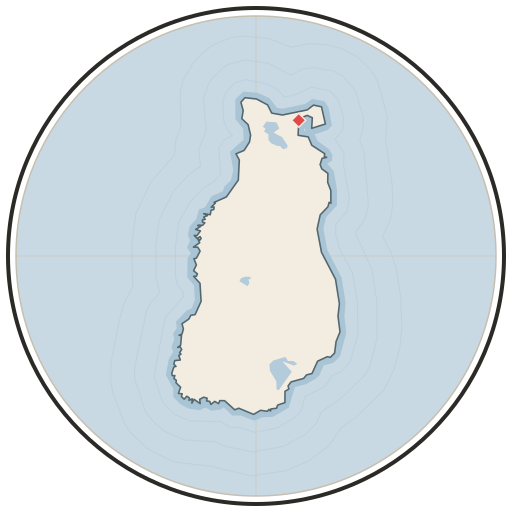
The township consisted of two islands and nothing else. North Fox has an area of 3.47 km² and South Fox 14.04 km², measured in Michigan GeoRef from shoreline polygons. Their federal feature points lie 9.1 km apart, with South Fox to the south-west, and the pair sits well south of the Beaver group and west of the mainland shore between Charlevoix and Leland.
No boundary geometry for the township is held here, and none is needed to describe its extent: it was the two islands, which carry their own coordinates in their own articles. Its designated meeting place, the district school house on South Fox, has not been located.
Names
Two senses of “Patmos” run through the sources and must be kept apart.
The township covered both Fox Islands, from 1855. That is the sense used in the 1855 and 1895 statutes.
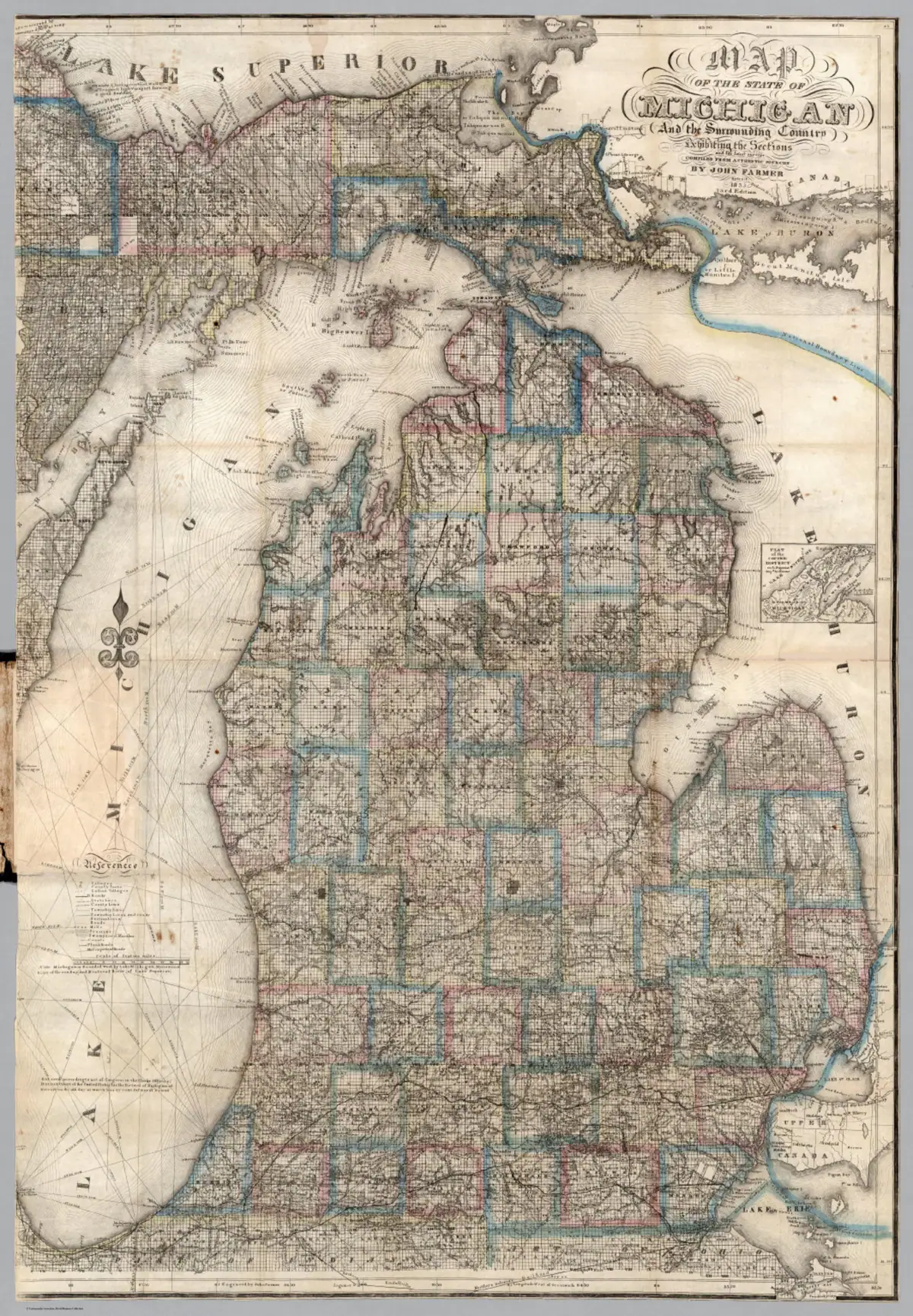
The island name applies to South Fox alone. John Farmer’s 1853 map of Michigan labels the two islands “South Fox I. or Patmos I.” and “North Fox I. or Paros I.,” and Strang’s 1854 gazetteer describes a Patmos that is “a mountain rising abruptly from Lake Michigan, to the height of two or three hundred feet” with a Mormon settlement and opened farms on its south-eastern side. Its companion entry, “Paros,” calls that island “a miniature of Patmos, though not quite equal in quality,” with the Mormons “just commencing a settlement upon it.”62 Both are Aegean island names, and Patmos is the island of the Revelation of John; they belong to the same layer of Strangite naming as Galilee, Enoch and Mount Pisgah. See Strang's biblical toponyms, which sets out that layer and, working from the 1854 gazetteer alone, declines to identify which modern islands Strang’s Patmos and Paros were; the identification used here rests on the Farmer map.
The township name therefore took a name already attached to one of its two islands and applied it to both. Neither the 1855 act nor any source held here says who proposed it.
Neither name survived. The islands are North Fox Island and South Fox Island in federal names data today, and no township called Patmos appears in Michigan’s list of election jurisdictions for the 2024 general election.7
Significance
Patmos is the reason the Fox Islands belong in the archipelago’s civil history rather than beside it. For forty years they were not an outlying navigational reference but a township of the same county as Beaver Island, with a school district the founding act took for granted and township, school and highway officers the 1895 repeal still assumed were in place.
It is also the clearest case in this archipelago of a township whose end is not documented. Peaine, Galilee, Chandler and Saint James each have a statute or a county board action marking the change; Patmos has a saving clause in 1895, and then silence until the Fox Islands turn up as unorganized territory in 1897.
Open questions
- No instrument vacating the township has been found. The 1895 act preserved it; the October 1897 Leelanau County record treats its territory as unorganized. The name Patmos does not appear anywhere in the 1897 or 1901 session-law volumes held here, and appears in the 1895 volume only in the repealing act itself. The Leelanau County board’s own proceedings for 1895 and 1896, and the session laws for the years between, have not been read here and are the obvious next places to look.
- No officers, meeting record or township roll for Patmos has been located. Whether the first meeting ordered for the South Fox district school house in 1855 ever took place is unknown.
- No population figure for the township has been located. The census series read here begins with the Beaver Island townships in 1890 and does not carry Patmos.
- The school district on South Fox is unidentified. The 1855 act refers to “the district school house” as an existing building; nothing else held here records the district, the school or the teacher.
- One unchecked lead on the island name. A navigational notice in Strang’s Northern Islander, warning of a reef between the Fox Islands and Gull Island, appears in a machine transcription to equate “north Fox or Paros” and “south Fox or Patmos.” That would be the strongest Strang-era attestation of the two island names, but the passage has not been checked against the printed page and is not relied on above.
See also
Footnotes
-
Michigan, Public and Local Acts (1855), Act No. 92, §§3–6, printed p. 198; approved 12 February 1855. ↩
-
[Strang], Ancient and Modern Michilimackinac (1854), gazetteer entry headed “PATMOS.” The held printings paginate differently, so the entry is cited by its heading rather than by folio. ↩ ↩2
-
“An Act to Organize the County of Manitue,” printed in Strang’s Northern Islander, Saint James, Beaver Island. ↩
-
Michigan, Local Acts (1895), Act No. 362, §§1–2, printed pp. 132–133; approved 4 April 1895. ↩
-
Leelanau County board of supervisors, 15 October 1897, certified by county clerk Z. E. Hinshaw 26 October 1897, printed in the appendix to Michigan, Public and Local Acts (1897), p. 1200. ↩
-
John Farmer, Map of the State of Michigan and the Surrounding Country (1853). ↩
-
Michigan Department of State, precinct-results jurisdiction file for the general election of 5 November 2024; 1,617 jurisdictions, none named Patmos or Galilee. ↩
Sources
- Primary statute, and the only source held here that carries all eight sections in an official printing. Printed pp. 197, 198 and 199 were rendered from the held scan and read as images rather than from OCR: p. 197 carries the act's head and section 1, p. 198 sections 2 through 7 including the four township sections, p. 199 section 8 and the approval. The volume's own index lists 'Patmos, township of, organized' and 'Peaine, township of, organized' at p. 198. The act does not name the county seat, does not prove any first meeting took place, and does not explain the choice of name.
- Described in this archive: Northern Islander, 1850–1856.Contemporary island printing of the whole act, sections 1 to 8, with the enrolment signatures of the Speaker, the President of the Senate, the Governor and the Deputy Secretary of State. It spells the county's name 'Manitue' throughout but the township as 'Patmos'. Read here from the held transcription only; the issue date was not confirmed here from the printed masthead. Its wording agrees with the session-law volume's page images, which is what supports using the transcription.
- Printed p. 132, carrying the title, section 1 and most of section 2, read as a page image; the remaining pages were read from the volume's OCR and the opening page and approval date are confirmed by the volume's own list of local acts. The act repeals Act No. 92 of 1855 while saving the township organization of Manitou, Patmos, Peaine and Galilee, attaches the Beaver group to Charlevoix and the Manitou and Fox islands to Leelanau, moves the territory from the thirty-third to the thirteenth judicial circuit, and apportions the property and debts. It does not mention the township of Chandler.
- Printed p. 1200 read as a page image; the committee report, the resolution and the clerk's certificate all fit on that page. The resolution attaches 'unorganized territory formerly a part of the late Manitou county attached to Leelanau county' to that county's townships: North Manitou Island to Leland, South Manitou Island to Glen Arbor, and the north and south Fox Islands to Leelanau township, effective 27 March 1898. It describes the Fox Islands as unorganized territory and does not mention the township of Patmos.
- Checked negatives for the fate of the township. The word 'Patmos' does not occur anywhere in either volume's text. In the 1895 volume it occurs only twice, both within Act No. 362. The 1897 volume is held separately as publicandlocala07buregoog.
- Described in this archive: John Farmer map of Michigan, 1853.Labels the two islands 'South Fox I. or Patmos I.' and 'North Fox I. or Paros I.', which is the basis on which this archive identifies Strang's Patmos with South Fox and Paros with North Fox. The labels rest on the holding library's on-map name index; the held raster is not legible at those coordinates, so this is an indexed reading rather than a reading of the engraving.maps · rumsey · farmer_1853_michigan · full
- Described in this archive: Ancient and Modern Michilimackinac, 1854.Describes Patmos as 'a mountain rising abruptly from Lake Michigan, to the height of two or three hundred feet', with rolling summit, excellent soil, a Mormon settlement and opened farms toward the south-east, and no harbour but bold shores. The held printings of this book paginate differently, so the entry is cited by its heading rather than by folio. The companion entry headed 'PAROS' calls that island 'a miniature of Patmos, though not quite equal in quality' with the Mormons 'just commencing a settlement upon it.' The gazetteer does not say which modern islands either entry means.
- Source of the island areas quoted: North Fox 3.47 km2 and South Fox 14.04 km2, computed in EPSG:3078.osm · islands
- GNIS features 633577 (North Fox Island) and 1623085 (South Fox Island), both in Leelanau County. The distances given in Geography and History were computed here between those feature points and the Beaver Island feature point, as great-circle distances; they are point-to-point figures, not shoreline separations.federal · gnis · gnis_names
- The series begins in 1890 and carries only Peaine for that year, with the note that St. James Township was organized from part of Peaine afterwards. It carries no county-level figure for Manitou County and no row for Chandler, Galilee, Patmos or Manitou townships. No public copy of this file is known; the archive holds one and can provide it on request.demographics · historical_census · township_population_1890_1990
- The jurisdiction table lists 1,617 Michigan election jurisdictions for that election. None is named Patmos, and none is named Galilee. Used here only for that negative.state · michigan · elections · precinct · 2024-11-05_699
Added 20 August 2026. Recent changes
Cite this article
Beaver Island Archive, “Township of Patmos”, https://beaverislandarchive.org/places/township-of-patmos/, accessed [date], citing Michigan, Public and Local Acts of the Legislature of the State of Michigan (1855), Act No. 92, 'An act to organize the county of Manitou,' printed pp. 197-199; approved 12 February 1855. (and 10 further sources listed on the page).
Last revised 2026-08-20. Fill in [date] with the date you read it — this page is static and cannot know that.