- Eras
- Strang eraIrish era
- Concepts
- governancetoponymyStrang eraIrish erahistoriography
- Within
- Beaver Island archipelago
Summary
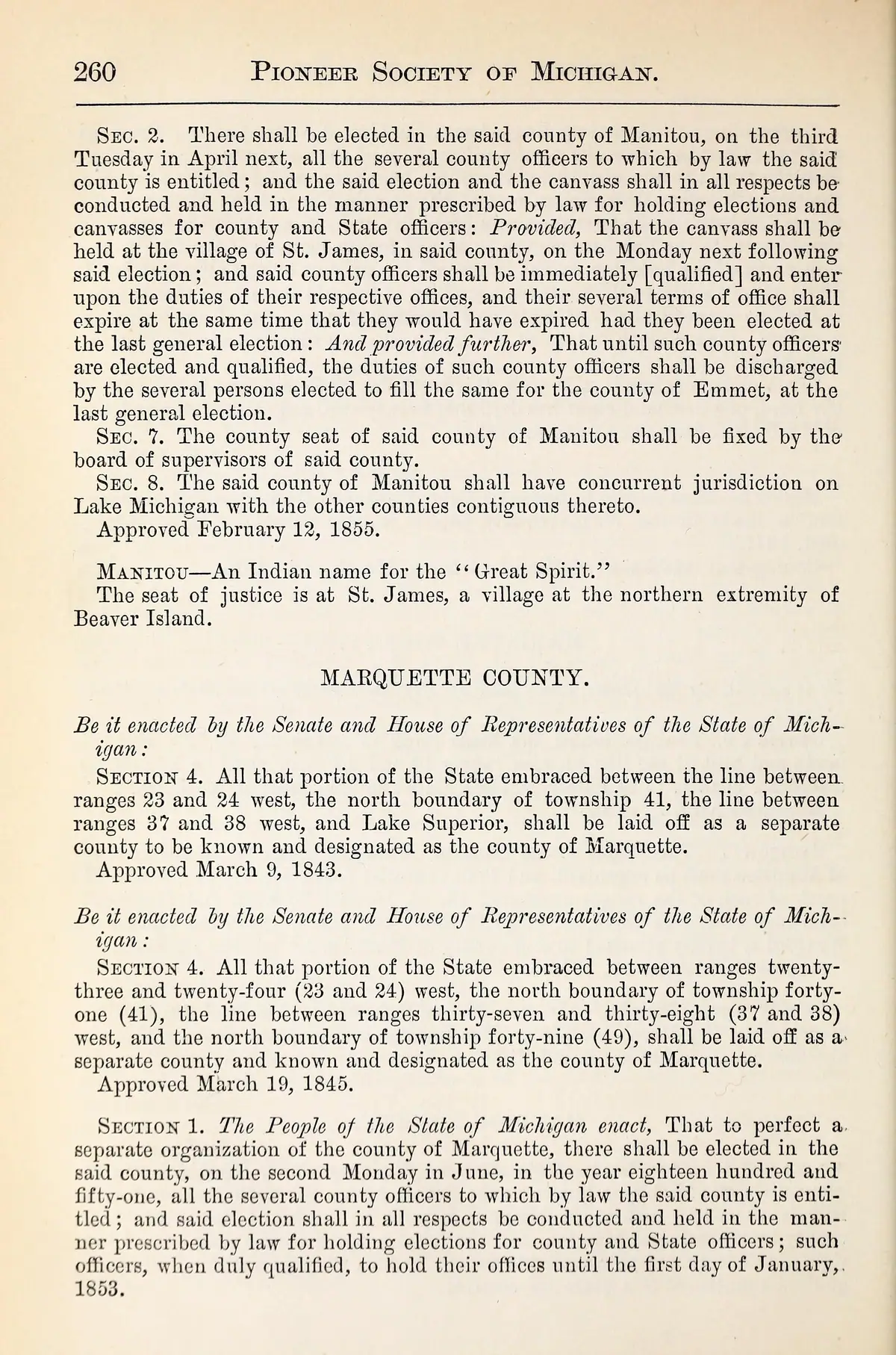
Manitou County was a Michigan county made entirely of islands. Act No. 92 of 1855, approved 12 February 1855, organized “the several islands in Lake Michigan, known as the Beaver group, the north and south Fox Islands, the north and south Manitou Islands” into a separate county named Manitou, and divided it into four townships: Peaine and Galilee on Beaver Island, Patmos on the Fox Islands, and Manitou on the Manitou Islands. The act ordered the first county canvass at the village of Saint James, left the county seat to be fixed by the county’s own board of supervisors, and gave the county concurrent jurisdiction on Lake Michigan. An 1874 state compilation reports the seat of justice as Saint James.
The county lasted forty years. Local Act No. 362 of 1895, approved 4 April 1895, repealed the organizing act, attached the Beaver group to Charlevoix County and the Fox and Manitou islands to Leelanau County, and set out how the property and debts were to be divided. The debts outlived the county. In 1897 the legislature directed the Auditor General to cancel the unpaid state taxes of what it called “the defunct county of Manitou,” and Charlevoix County was still levying a judgment tax and paying “Manitou County” claims as late as 1912.
History
The archipelago before the county, 1847–1855
The Beaver Islands received their first civil government in 1847. Section 8 of Michigan Public Act No. 69 of that year set off “all that part of the county of Mackinaw designated as the Beaver Islands in Lake Michigan” and organized it as the township of Peaine, with the first township meeting appointed at the store of A. Cable, Beaver Island Harbor, on 1 May.1 The archipelago was then in Mackinac County.
It moved once before Manitou County existed. Act No. 18 of 1853, approved 29 January 1853, organized the county of Emmet. It ordered Emmet’s first county canvass at “the village of St. James in said county,” and provided that until Emmet’s officers were elected and qualified the officers of Mackinac County would perform Emmet’s duties. Section 5 extended “the boundaries of the township of Peaine in the county of Emmet” to take in the rocks, bars and land under water contiguous to the Beaver Islands. Section 6 then divided Peaine for the first time: the part lying in towns 37 north of ranges 10 and 11 west, and the south half of towns 38 north of the same ranges, became “a separate township by the name of Galilee,” with its first meeting at the store occupied by Ludlow Hill. Section 8 annexed to Emmet every island, bar and rock contiguous to Emmet and Charlevoix that no earlier act had placed in a county.2
That act matters for reading anything about the townships. The Township of Galilee already existed, by statute, two years before the county did, and the 1853 act describes its territory in the same terms the 1855 act would use.
The organizing act of 1855
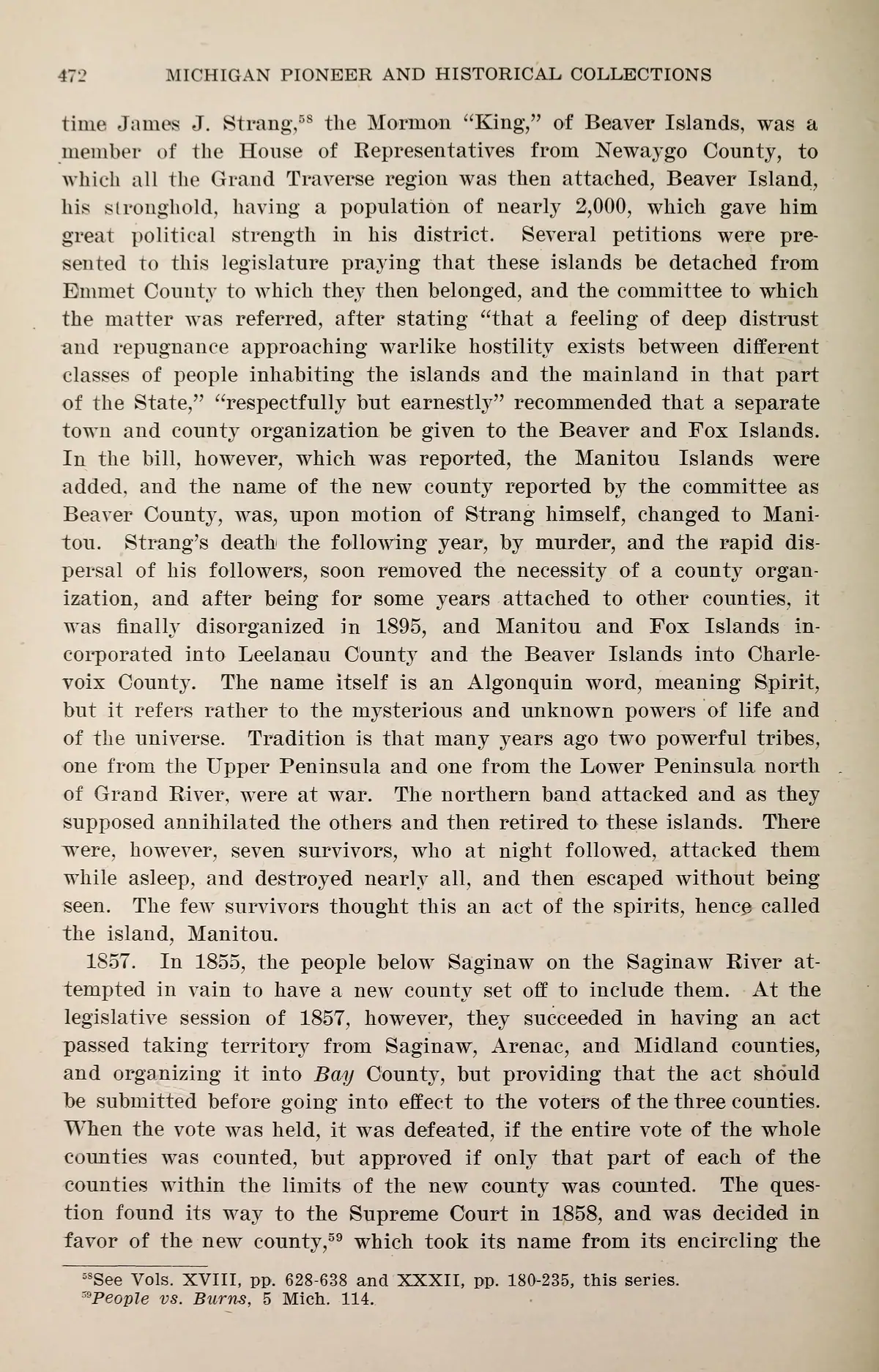
The move to detach the islands is recorded in a 1912 county-name history by William L. Jenks. Jenks writes that James J. Strang was then a member of the House of Representatives from Newaygo County, to which the Grand Traverse region was attached; that several petitions asked that the islands be detached from Emmet County; and that the committee to which the matter went, after stating “that a feeling of deep distrust and repugnance approaching warlike hostility exists between different classes of people inhabiting the islands and the mainland in that part of the State,” recommended a separate town and county organization for the Beaver and Fox Islands. The Manitou Islands were added in the bill as reported, and “the name of the new county reported by the committee as Beaver County, was, upon motion of Strang himself, changed to Manitou.”3 That is a retrospective written fifty-seven years after the fact; the committee report and the legislative journals behind it have not been read here.
The act itself is Act No. 92 of 1855, printed at pages 197 to 199 of that year’s session laws and approved 12 February 1855. Its eight sections run:
- Section 1 organizes the Beaver group, the north and south Fox Islands and the north and south Manitou Islands as a separate county named Manitou, with the inhabitants entitled to the rights of other organized counties.
- Section 2 orders all county officers elected “on the third Tuesday in April next,” with the canvass at the village of St. James on the Monday following, and provides that until those officers qualify the duties are discharged by the persons elected for the county of Emmet at the last general election.
- Sections 3 to 6 organize the four townships. Peaine takes the Beaver group except towns 37 north and the south half of towns 38 north, ranges 10 and 11 west, meeting at Saint James. Galilee takes that excepted part, meeting at the school house at Galilee. Patmos takes the north and south Fox Islands, meeting at the district school house on South Fox. Manitou takes the north and south Manitou Islands, meeting at the store house of Pickard and Brother on North Manitou.
- Section 7 leaves the county seat to be fixed by the county’s board of supervisors.
- Section 8 gives the county concurrent jurisdiction on Lake Michigan with the other counties contiguous to it.4
Two other printings of the act are held, and they behave differently. Strang’s own Northern Islander printed it in full at Saint James, spelling the name “Manitue” throughout and carrying the enrolment signatures of the Speaker, the President of the Senate and the Deputy Secretary of State.5 The state’s 1874 Michigan Historical Collections printed only sections 1, 2, 7 and 8, omitting the four township sections entirely — so that compilation supports the county’s creation and its island membership and is silent on the townships. It adds two things the statute does not: a gloss, “Manitou — An Indian name for the ‘Great Spirit,’” and the statement that “the seat of justice is at St. James, a village at the northern extremity of Beaver Island.”6
Five townships, not four
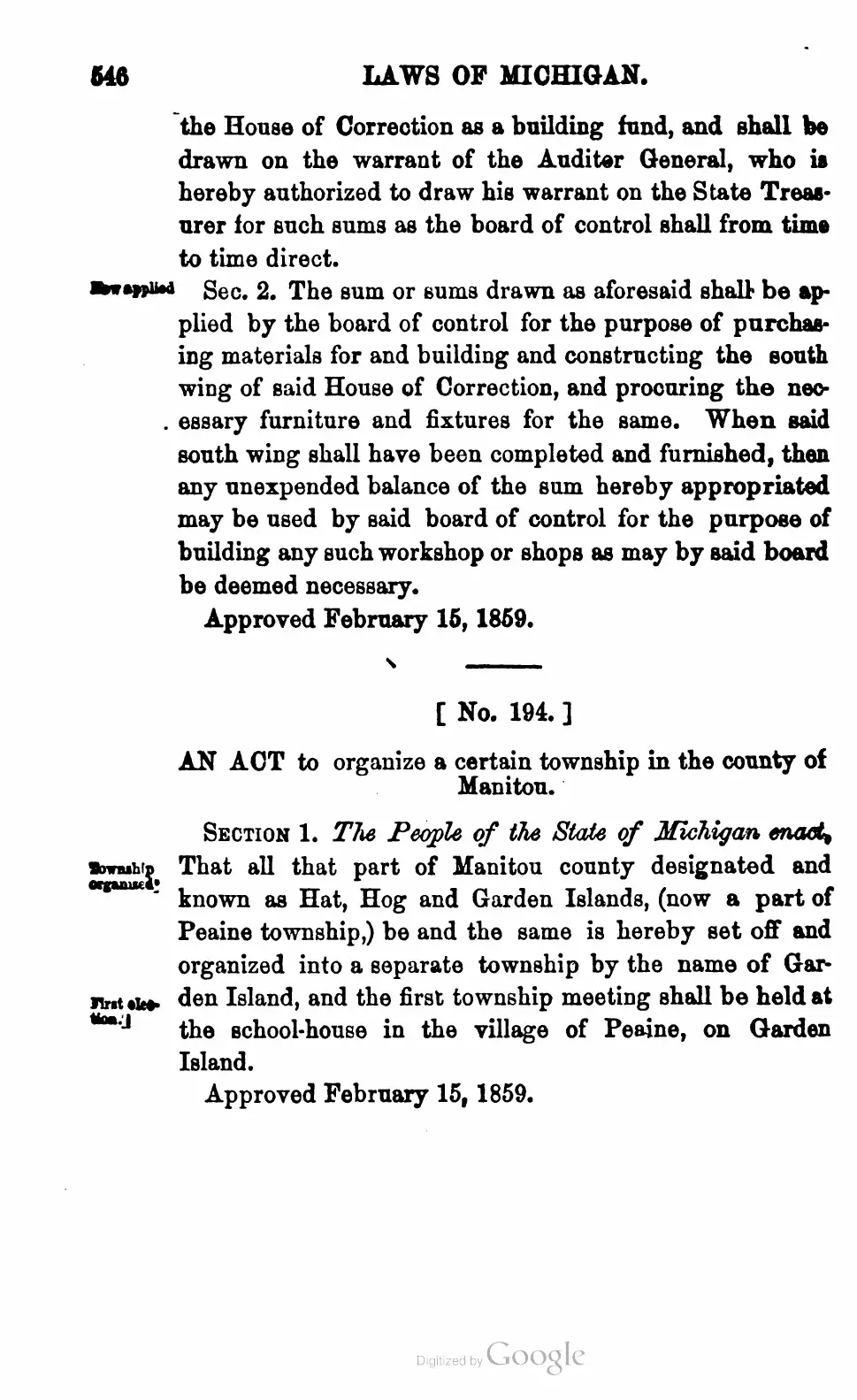
The county did not keep the shape the organizing act gave it. Local Act No. 194 of 1859, approved 15 February 1859, set Hat, Hog and Garden islands off from Peaine and organized them as the township of Garden Island, with the first township meeting at the school house in the village of Peaine on Garden Island.7 Two years later Act No. 86 of 1861, approved 1 March 1861, replaced that arrangement with Chandler, a township taking in the north end of Beaver Island above the quarter line through sections 27, 28 and 29 of town 39 north, range 10 west, together with High, Trout, Whiskey, Squaw (now Ojibwa), Garden, Hog and Hat islands.8 From 1861 the county had five townships, four of which were on or around Beaver Island.
Government, and the limits of it
The county’s own machinery was thin, and the legislature repeatedly propped it up. Act No. 23 of 1861, approved 2 February 1861, extended the time for collecting and returning taxes “in the unorganized territory in Manitou county” to 1 June each year “until said territory shall become organized” — the county contained ground that its township system did not reach.9 Act No. 262 of the same session, approved 16 March 1861, attached the whole county to Mackinac County “for the purposes of the jurisdiction of the district court for the Upper Peninsula, sitting in said county, over the same, until other provision is made by law for holding a court in said county of Manitou.” Manitou’s own sheriff still served process and was to charge mileage from his county seat.10 A modern local-history timeline, summarising Joan C. Vyse’s 2002 research, says the islands’ county affiliations moved between Mackinac and Leelanau and back between 1861 and 1869, and that the county’s government “collapsed” after Strang’s assassination in 1856.11 No statute for the Leelanau leg of that sequence has been found here.
The clearest description of the county at work is a visitor’s account from the Petoskey Record of 19 September 1879, reprinted in the Beaver Beacon in 2002. It calls Saint James “the capital of Manitou County,” puts the village population at about 350 and the island’s at 1,200 to 1,500, and reports “the county offices located at various points of the village, the court, which is held by Judge Goodwin of the 11th district at the Boyle & Dunleavy store.”12 On that account the county transacted its business in rented rooms and a shop, not in a courthouse.
Disorganization, 1895
Local Act No. 362 of 1895, approved 4 April 1895 and printed at pages 132 to 136, repealed Act No. 92 outright — with one exception. It provided “that the township organization of the townships of Manitou, Patmos, Peaine and Galilee, as described and organized in section three, four, five and six of said act shall not be affected by this act so far as the township and school organization, officers and records of said townships are concerned.” Section 2 then attached “the territory embraced in said township of Galilee, viz., the Beaver group of islands” to Charlevoix County, and the Manitou islands and the Fox islands to Leelanau County. Section 3 detached the territory from the thirty-third judicial circuit and attached it to the thirteenth, transferring pending suits to Charlevoix. Sections 5 to 10 wound the county up: its real property was to be sold by the Charlevoix County treasurer, its clerk and treasurer were to meet the Charlevoix and Leelanau officers and audit the accounts, and its debts were to be apportioned between the two counties by the relative assessed valuation fixed by Manitou’s board of supervisors at its October 1894 session. Any excess over Charlevoix’s own debt ratio was to “remain as a separate obligation and indebtedness against the territory so attached,” paid by taxes spread on that territory alone.13
Two features of the repeal are worth stating plainly. Its saving clause names only the four townships of 1855, so Chandler — created six years later, and by then the northern township of Beaver Island — is not mentioned anywhere in the act. And its description of Galilee’s territory as “the Beaver group of islands” is broader than the territory section 4 of the 1855 act had actually given Galilee, which was the southern part of Beaver Island. The act is quoted here as printed; no source held here explains the discrepancy.
The county’s afterlife
The remaining pieces were disposed of over the following three years. Local Acts Nos. 363 and 366 of 1897, both approved 18 March 1897, vacated Galilee and Chandler and attached their territory to Peaine, fixing the reorganized township’s polling place in the village of St. James.1415 On 15 October 1897 the Leelanau County board of supervisors, sitting at Leland, resolved that “unorganized territory formerly a part of the late Manitou county attached to Leelanau county” be attached to that county’s townships: North Manitou Island to Leland, South Manitou Island to Glen Arbor, and the north and south Fox Islands to Leelanau township, all to take effect on 27 March 1898.16 Charlevoix County’s board formed the Township of Saint James out of Peaine at the end of the century; the date is unsettled, and that article carries the competing evidence.
The county’s obligations lasted longer than its offices. Joint Resolution No. 19 of 1897, approved 29 May 1897, recited that the state had for many years failed to collect the taxes apportioned to Manitou County, that the Auditor General had charged the arrears to Charlevoix and Leelanau, and that the officials of those counties “have no means of compelling the defunct county of Manitou to pay the same”; it directed him to cancel the accounts.17 Private creditors were more persistent. The Charlevoix County Herald of 3 October 1902 noted that “the Manitou County order case is on for hearing before the Supreme Court at the October term.” The county treasurer’s published statement for the year ending 1 October 1911 lists receipts of $1,249.01 from a “Judgment Tax for Curtis & Wylie” and a disbursement of $1,350.00 to “Curtis & Wylie, Manitou County Claims”; the statement to 1 July 1912 carries a further $360.00 to “Curtis & Wylie, Manitou County Judgment.”181920 Seventeen years after the repeal, a tax was still being spread on the former Manitou territory to pay the old county’s debts, which is what section 9 of the 1895 act had provided for.
Geography
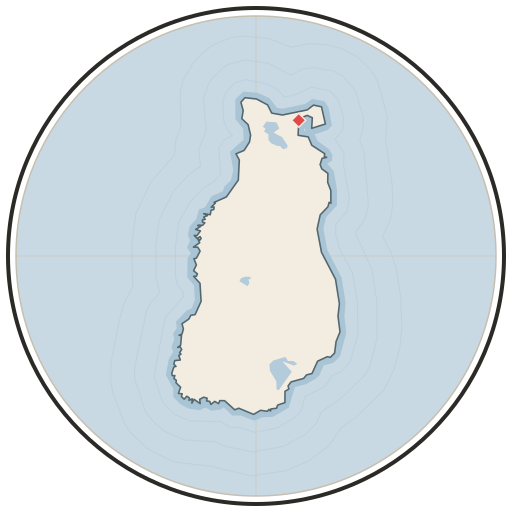
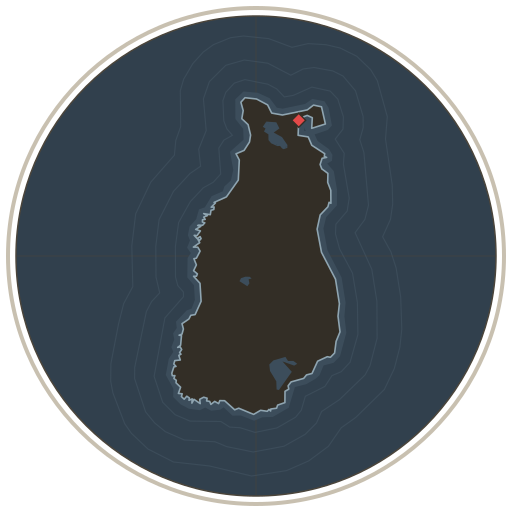
The county was islands and water. It contained the immediate Beaver group — Beaver Island itself with Garden, High, Hog, Hat, Trout, Whiskey and Squaw islands and their neighbours — together with North and South Fox and the North and South Manitou islands, which lie off the mainland shore south of Leland. Section 8 of the organizing act gave it concurrent jurisdiction on Lake Michigan with the counties contiguous to it, which for a county with no mainland was the only way its authority could reach the water between its parts.
No boundary geometry for the county is held here. Its former territory is divided today between Charlevoix County, which holds the Beaver group, and Leelanau County, which holds the Fox and Manitou islands — the division made by the 1895 act and still the reason the Fox Islands sit in a different county’s records from the rest of the archipelago.
Names
The statute spells the name Manitou. Strang’s own paper spelled it Manitue throughout its printing of the act, including in the county’s name and in the names of the Manitou Islands and the township of Manitou.5 Both forms are contemporary.
The name was chosen late. Jenks reports that the committee reported the bill under the name Beaver County, and that the change to Manitou was made on Strang’s own motion.3 No source held here records his reason.
Two glosses of the name are held, and both are compilers’ statements rather than evidence from Anishinaabe speakers. The 1874 compilation gives “Manitou — An Indian name for the ‘Great Spirit.’”6 Jenks in 1912 calls it “an Algonquin word, meaning Spirit, but it refers rather to the mysterious and unknown powers of life and of the universe,” and attaches a tradition about two warring bands and seven survivors from which, he says, the Manitou islands take their name.3 Neither is sourced to an informant, and the name attaches in the first instance to the Manitou Islands rather than to the archipelago the county governed. See Anishinaabe presence in the archipelago.
Significance
For forty years the archipelago was not the edge of a mainland county but the whole of one, with its seat on Beaver Island. That is a filing fact before it is anything else: county-level records for 1855 to 1895 — deeds, court files, supervisors’ proceedings, tax rolls — were made under Manitou, and a search of Charlevoix or Leelanau records for that period finds nothing, while a search of Manitou records finds nothing before 1855 or after 1895.
It also fixes the scope of island government in the period. Four and then five townships, not two, and a jurisdiction that reached from the Beaver group to the Manitou Islands. Reading the modern two-township arrangement backward across that interval loses Galilee, Chandler, Patmos and Manitou, and loses the county that contained them. See Island civic governance and public institutions and Law, courts, and external government.
Open questions
- No population figure for the county has been located here. The earliest township counts read here are for 1890; no county-level count for 1860, 1870 or 1880 has been read.
- The board of supervisors’ action fixing the county seat has not been found. Section 7 of the 1855 act left the seat to the board. The 1874 compilation reports the seat of justice at Saint James without citing that action, and the 1879 Petoskey Record account calls Saint James the capital while describing county offices scattered through the village.
- Whether a courthouse was ever built is unresolved. The 1879 account puts the court in a store. A 1976 Beaver Beacon report of the Beaver Island Historical Society’s site-marking project lists a “Manitou County Court House site” among fifty sites chosen for marking, which implies a located building but supplies neither a date nor a place.21
- The Curtis & Wylie litigation is unidentified. Who the parties were, what the judgment was for, and how the 1902 Supreme Court hearing came out are all unknown here; the Michigan Reports for 1902–1903 would settle it.
- The Leelanau interval is unverified. A modern timeline says the islands’ county affiliation moved to Leelanau and back to Mackinac between 1861 and 1869. Only the 1861 attachment to Mackinac for district-court purposes has been read in the statutes here.
- No Manitou County record series has been obtained. The county’s own supervisors’ proceedings, tax rolls, deeds and court files have not been located or read here. The nearest thing this archive can name is a Chandler Township record book known from a catalogue description; see Township of Chandler, Beaver Islands.
See also
Footnotes
-
Michigan, Public and Local Acts (1847), Act No. 69, §8, printed pp. 83–84. ↩
-
Michigan, Public and Local Acts (1853), Act No. 18, §§2, 5–8, printed pp. 15–17; approved 29 January 1853. ↩
-
William L. Jenks, county-name history, Michigan Historical Collections, vol. 38 (1912), printed p. 472. ↩ ↩2 ↩3
-
Michigan, Public and Local Acts (1855), Act No. 92, printed pp. 197–199; approved 12 February 1855. ↩
-
“An Act to Organize the County of Manitue,” printed in Strang’s Northern Islander, Saint James, Beaver Island. ↩ ↩2
-
Michigan Historical Collections, vol. 1 (1874), “Manitou County,” printed pp. 259–260. ↩ ↩2
-
Michigan, Acts of the Legislature (1859), Act No. 194, printed p. 546; approved 15 February 1859. ↩
-
Michigan, Public and Local Acts (1861), Act No. 86, printed pp. 120–121; approved 1 March 1861. ↩
-
Michigan, Public and Local Acts (1861), Act No. 23, printed p. 19; approved 2 February 1861. ↩
-
Michigan, Public and Local Acts (1861), Act No. 262, printed pp. 556–557; approved 16 March 1861. ↩
-
Bobbi Welke, “A Short History of Governance on the Beaver Island Archipelago,” Northern Islander, February 2026. ↩
-
“A Visit to the Beaver Islands – September 19, 1879, from the Petoskey Record,” reprinted Beaver Beacon, September 2002, p. 20. ↩
-
Michigan, Local Acts (1895), Act No. 362, printed pp. 132–136; approved 4 April 1895. ↩
-
Michigan, Local Acts (1897), Act No. 363, printed pp. 267–268; approved 18 March 1897. ↩
-
Michigan, Local Acts (1897), Act No. 366, printed p. 346; approved 18 March 1897. ↩
-
Leelanau County board of supervisors, 15 October 1897, certified by county clerk Z. E. Hinshaw 26 October 1897, printed in the appendix to Michigan, Public and Local Acts (1897), p. 1200. ↩
-
Michigan, Public Acts (1897), Joint Resolution No. 19, printed pp. 437–438; approved 29 May 1897. ↩
-
Charlevoix County Herald, 3 October 1902, p. 5. ↩
-
Charlevoix County Herald, 21 October 1911, p. 1, “County Finances.” ↩
-
Charlevoix County Herald, 13 July 1912, p. 1, “County Finances.” ↩
-
Beaver Beacon, July 1976, p. 6, “The Bicentennial Projects.” ↩
Sources
- Primary statute, and the only source held here that carries all eight sections in an official printing. Printed pp. 197, 198 and 199 were rendered from the held scan and read as images rather than from OCR: p. 197 carries the act's head and section 1, p. 198 sections 2 through 7 including the four township sections, p. 199 section 8 and the approval. The volume's own index lists 'Patmos, township of, organized' and 'Peaine, township of, organized' at p. 198. The act does not name the county seat, does not prove any first meeting took place, and does not explain the choice of name.
- Described in this archive: Northern Islander, 1850–1856.Contemporary island printing of the whole act, sections 1 to 8, with the enrolment signatures of the Speaker, the President of the Senate, the Governor and the Deputy Secretary of State. It spells the county's name 'Manitue' throughout but the township as 'Patmos'. Read here from the held transcription only; the issue date was not confirmed here from the printed masthead. Its wording agrees with the session-law volume's page images, which is what supports using the transcription.
- Described in this archive: Michigan Historical Collections, volume 1, 1874.Page images of both pages read here. The compilation reprints sections 1, 2, 7 and 8 of the 1855 act and omits sections 3 to 6, so it corroborates the county's creation and island membership and is silent on the four townships. It separately supplies the gloss 'Manitou - An Indian name for the "Great Spirit"' and the statement that 'the seat of justice is at St. James, a village at the northern extremity of Beaver Island.' Those are the compiler's own statements, not part of the statute.
- Described in this archive: Michigan Historical Collections, volume 38, 1912.Page image read here. Supplies the petitions to detach the islands from Emmet County, the committee's quoted finding of 'deep distrust and repugnance approaching warlike hostility,' the addition of the Manitou Islands in the reported bill, the change of name from Beaver County to Manitou 'upon motion of Strang himself,' the 1895 disorganization, and an Algonquin etymology with a tradition attached. It is a retrospective published fifty-seven years after the act and cites no committee report or journal page.
- Section 8 sets off 'all that part of the county of Mackinaw designated as the Beaver Islands in Lake Michigan' as the township of Peaine and appoints the first township meeting at the store of A. Cable, Beaver Island Harbor, on 1 May. Read from the volume's OCR, whose rendering of the township name is corrupt; the section was located by searching for 'Beaver' rather than for the name.
- Printed pp. 16 and 17 read as page images. Section 5 extends the boundaries of the township of Peaine 'in the county of Emmet'; section 6 organizes the township of Galilee out of Peaine, with its first meeting at the store occupied by Ludlow Hill; section 7 erects the township of Charlevoix and annexes it to Emmet; section 8 annexes to Emmet all islands not already within a county. The approval date is printed at the end of the act on p. 17 and repeated in the volume's list of acts. This establishes that the Township of Galilee existed by statute two years before the 1855 act reorganized it.
- Described in this archive: Michigan Local Act No. 194 organizing Garden Island Township, 1859.Page image read here. 'An act to organize a certain township in the county of Manitou' sets Hat, Hog and Garden islands off from Peaine township as the township of Garden Island and appoints the first meeting at the school-house in the village of Peaine, on Garden Island. Its title differs from the title the 1861 amending act gives it.
- Both printed pages read as images. The act is titled 'An act to amend an act entitled an act to re-organize the township of Garden Island, and to change the name of said township.' It gives the territorial description quoted here, appoints the first meeting at the schoolhouse in school district number two in the village of St. James, and names James T. Bailey, Flavius J. Smith and Edward O'Brien as inspectors of election. It does not say why the name Chandler was chosen.
- Printed p. 19 read as a page image. 'An act to extend the time for the collection and return of taxes in the unorganized territory in Manitou county,' extending the return date to 1 June each year 'until said territory shall become organized.' It does not identify which territory was unorganized.
- 'An act to attach the county of Manitou to the county of Mackinac for certain judicial purposes.' Printed p. 556, carrying the title and section 1, read as a page image; section 3 and the approval date on p. 557 were read from the volume's OCR and the date is confirmed by the volume's own list of acts. The attachment is for the jurisdiction of the district court for the Upper Peninsula 'until other provision is made by law for holding a court in said county of Manitou'; Manitou's sheriff continued to serve process.
- Printed p. 132, carrying the title, section 1 and most of section 2, read as a page image; the remaining pages were read from the volume's OCR and the opening page and approval date are confirmed by the volume's own list of local acts. The act repeals Act No. 92 of 1855 while saving the township organization of Manitou, Patmos, Peaine and Galilee, attaches the Beaver group to Charlevoix and the Manitou and Fox islands to Leelanau, moves the territory from the thirty-third to the thirteenth judicial circuit, and apportions the property and debts. It does not mention the township of Chandler.
- Printed p. 267, carrying the title and sections 1 to 3, read as a page image; section 4 and the approval date on p. 268 were read from the volume's OCR and the page is confirmed by the volume's own list of local acts. The act vacates the township of Galilee into Peaine in the same terms as Act No. 366 of the same day.
- Printed p. 346 read as a page image; the whole act fits on that page. It disorganizes and vacates 'the township of Chandler, in the Beaver Islands, and within the county of Charlevoix,' attaches the territory to Peaine, transfers the records and debts, and fixes the reorganized township's polling place in the village of St. James.
- Printed p. 1200 read as a page image; the committee report, the resolution and the clerk's certificate all fit on that page. The resolution attaches 'unorganized territory formerly a part of the late Manitou county attached to Leelanau county' to that county's townships: North Manitou Island to Leland, South Manitou Island to Glen Arbor, and the north and south Fox Islands to Leelanau township, effective 27 March 1898. It describes the Fox Islands as unorganized territory and does not mention the township of Patmos.
- Printed p. 438, carrying the closing recital and the operative resolution, read as a page image; the opening recitals on p. 437 were read from the volume's OCR and the page is confirmed by the volume's list of joint resolutions. The resolution directs the Auditor General to cancel taxes due from the territory of Manitou County as against Charlevoix and Leelanau, reciting that those counties 'have no means of compelling the defunct county of Manitou to pay the same.'
- Page image read here. Calls Saint James 'the capital of Manitou County,' puts the village population at about 350 and the island's at 1,200 to 1,500, and reports 'the county offices located at various points of the village, the court, which is held by Judge Goodwin of the 11th district at the Boyle & Dunleavy store.' This is a 2002 reprint; the original 1879 Petoskey Record has not been consulted here, and the judicial district it names is not the circuit the 1895 act later refers to.
- Page image read here. A one-line item in the brevities column: 'The Manitou County order case is on for hearing before the Supreme Court at the October term.' It does not name the parties, the sum or the outcome.
- Page image read here. The Charlevoix County treasurer's published report for the year to 1 October 1911, dated 14 October 1911 and signed Richard Lewis, lists among receipts 'Judgment Tax for Curtis & Wylie, 1,249.01' and among disbursements 'Curtis & Wylie, Manitou County Claims, 1,350.00.' It does not identify Curtis & Wylie or the judgment.
- Page image read here. The Charlevoix County treasurer's report dated 8 July 1912 lists a disbursement 'Curtis & Wylie, Manitou County Judgment, 360.00.'
- Page image read here. Reports the Beaver Island Historical Society's project to mark historic sites with cedar and stone signs, says 'some fifty sites have been chosen so far,' and lists 'Manitou County Court House site' among the representative sites in town. It gives no location, date or description for the building.
- Modern secondary summary of local historian Joan C. Vyse's 2002 research, published in the Beaver Island Historical Society's community newspaper. Its timeline says Manitou County's government collapsed after 1856, that the islands' county affiliation moved between Mackinac and Leelanau and back between 1861 and 1869, that Chandler Township was created in 1861 and Garden Island Township vacated, that St. James Township was created in 1901, and that 'it is likely that Chandler Township was vacated as part of this act.' The 1901 statement conflicts with Local Act No. 366 of 1897 and is offered by the source as a likelihood. Not to be confused with Strang's 1850s paper of the same title.
- The series begins in 1890 and carries only Peaine for that year, with the note that St. James Township was organized from part of Peaine afterwards. It carries no county-level figure for Manitou County and no row for Chandler, Galilee, Patmos or Manitou townships. No public copy of this file is known; the archive holds one and can provide it on request.demographics · historical_census · township_population_1890_1990
Added 20 August 2026. Recent changes
Cite this article
Beaver Island Archive, “Manitou County”, https://beaverislandarchive.org/places/manitou-county/, accessed [date], citing Michigan, Public and Local Acts of the Legislature of the State of Michigan (1855), Act No. 92, 'An act to organize the county of Manitou,' printed pp. 197-199; approved 12 February 1855. (and 21 further sources listed on the page).
Last revised 2026-08-20. Fill in [date] with the date you read it — this page is static and cannot know that.