- Work
- Ottawa and Ojibwe chief
- Eras
- Indigenous eraStrang eraModern era
- Concepts
- Indigenous eraStrang eraModern eragovernancehistoriographyanishinaabe-odawatreaty-rightsheritage
- Within
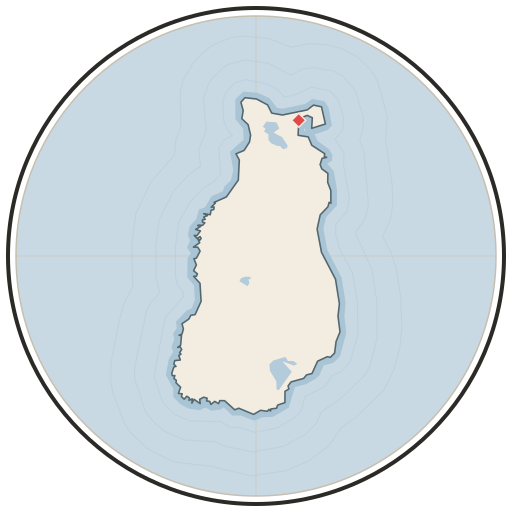
- Beaver Island archipelago
Summary
Peaine was an Odawa (Ottawa) chief in the Beaver Island archipelago, documented in accounts of the winter of 1850–51 and again in 1862–64, and the person for whom Township of Peaine is named. Two contemporary sources describe him and neither is Anishinaabe: James Jesse Strang, whom Peaine confronted at the head of a delegation of chiefs, and Elizabeth Whitney Williams, a settler who lived on Garden Island while her husband taught the government school there. Neither records a birth date, a death date, or anything of his life outside those episodes. Later sources conflict. A newspaper account of 1908 places his death before about 1858; family accounts published in the Beaver Beacon in 2002 and 2006 give him a birth year of 1805 and apply the names Peaine and Antoine Peaine to what may be one man or two. Whether they are the same person is not settled by the sources held here.
History
The township of 1847
Strang’s 1854 history records the township twice: “in 1847 the Beaver Islands were erected into the township of Peaine,”1 and, in his account of Emmet County, “In 1847 the Beaver Islands were erected into a township, by the name of Peaine. In the course of that year three meetings were held to elect township officers, but did not succeed in affecting a regular organization.”2 Milo Quaife’s 1930 narrative repeats the date.3
Neither passage says why the township carried the name, or links it to a chief. That link is made first by Williams in 1905, and afterwards by island sources of the twentieth and twenty-first centuries.
The confrontation of 1850–51, as Strang told it
Under the heading “Indian Hostilities,” Strang writes that during the winter of 1850 and 1851 the traders McKinley, Cable, Ward and Dodge “engaged the Indians to assume a hostile position towards the Mormons,” and that “Kimmeoue, Peaine, Watanesa and Chenotin, influential chiefs,” came to him with thirty braves, thirteen white men and two interpreters, carrying guns and tomahawks, faces painted and following a red flag. Peaine spoke last, and “in behalf of the Ottowas and Ojibwas, denounced war and annihilation against the Mormons” if any Mormon sued a Gentile at law, warned him out to work a highway tax, attempted to arrest him, or cut steamboat wood not bought by McKinley.4
Strang then records his own explanation of what the chiefs believed: “It was evident that the Indians fully believing that the Gentiles only were citizens, and that the Mormons were merely intruders; thought they were acting in fulfillment of treaties, and in support of the authority of the United States.”4 The account continues with Strang reading the white men the statute on inciting Indians to crime, and then his reply to Peaine: “I am no child, and cannot understand you. Your voice is like a scolding woman. I will not hear you. March on.” Peaine and the others, in Strang’s telling, “sullenly followed.”4
This is the fullest account of any direct exchange between the two men held here, and Strang wrote it about himself, in a book Quaife later described as telling the controversy from the Mormon point of view. It ends with Peaine dismissed. No Odawa or Ojibwe account of the meeting has been located, and the wording throughout — including the description of the delegation and the insult to Peaine — is Strang’s own.
Garden Island, 1862–64
Williams gives the only sustained description of Peaine written from personal acquaintance. In July 1862 her husband was appointed a government schoolteacher to the Anishinaabe community on Garden Island; the school, she writes, “was a large one as there was a large band of Indians,” and it ran two years before being discontinued for several more.5 The government supplied seeds for gardens, flower seeds among them, and the teachers were expected to show families how to plant and cultivate. The flower seeds defeated the effort. “Chief Peain was a very social, intelligent man,” Williams writes; he watched the beds being made, said “Too much work for Indian,” and instead took the school’s boys and girls and some older people, cleared three or four acres, fenced it with brush, and sowed the flower seed “like grain.” The result was called “The Chief’s Garden,” and Peaine had the teachers write a letter of thanks to the Indian agent on his behalf.6
Earlier in the same book Williams writes that the island was divided into districts and townships, that the settlement at the harbour was named Saint James for the king, and that “the town at the harbor was named in honor of the Indian Chief at Garden Island, town of ‘Peain.’” She adds that he “ruled his tribe with great kindness and firmness,” was “a man of noble appearance,” that “their tribe was the Ottawas,” and that he “was always the friend of the Chemokamon (white man).”7 Williams uses “town” in the Michigan sense of a civil township: the preceding sentence has already named the harbour settlement Saint James. Read that way, hers is the earliest held statement that the township carries the chief’s name.
The same page reports, undated and without a named informant, that Strang was “trying hard to have the Chief ‘Peain’ give him one of his handsome daughters for a wife, which the Chief refused to do.”7 Williams arrived on Garden Island in 1862, six years after Strang’s death, so this cannot be her own observation. Nothing else held here corroborates it.
A civil record stands between the two accounts. Michigan’s Local and Special Acts of 1859 set Hat, Hog and Garden Islands apart as a township and directed the first township meeting to be held on Garden Island at the village of Peaine.8 A 2026 Northern Islander summary of Joan C. Vyse’s research on the archipelago’s civil reorganizations records the same event, and adds that Garden Island Township was vacated in 1861.9 Neither source states that the village and the chief were the same person, or that he lived there.
A death reported in 1908
The Charlevoix Sentinel of 3 September 1908 carried a front-page account of a child’s funeral on Garden Island, written by a “scribe” travelling with a party of about twenty-five guests of the Hotel Beaver and the priest of Saint James. Among the grave shelters at the burial ground, the writer says, was “one of which we were told contained the bones of old chief Peaine, who died more than a half century ago.”10
That is hearsay recorded by a visitor, and it is the only statement held here that bears on when Peaine died. Taken literally it places the death before about 1858, which cannot be reconciled with Williams’s account of meeting him in 1862. No location, extent or inventory of the burial ground is given here, and none should be inferred from this account; the appropriate authority on what may be said about it is the Little Traverse Bay Bands of Odawa Indians Tribal Historic Preservation Office. See Garden Island Indian Cemetery.
Antoine Peaine, and descendants
Twentieth-century island sources use a second name. In May 1961 the Beaver Beacon reported a county appropriation for improvements to Chief Antoine Park, “named for Chief Antoine Peaine, the last Indian Chief on Beaver Island — and still remembered by many of the Islanders.”11
At Peaine Township’s 155th-birthday ceremony in August 2002, the Beacon reported remarks by Tootsie Keeshik, who described herself as descended from Chief Peaine through his son Antoine, Antoine’s son James, and James’s daughter Lucy, her mother; she gave the chief’s birth year as 1805 and said his name means “cloudy day.” Her sister Amelia Compo, who opened the ceremony with a prayer, was described as a descendant of Chief Payzhickwaywedong.12 In May 2006 Keeshik and Martha Gasco presented objects held in the family to the Peaine Township board, which undertook to build a display case in the township hall “to honor the man for whom the township was named”; the Beacon’s account names the man in the presented photograph as Chief Antoine Peaine.13 The case was completed the following year.14
Whether the chief Strang met in 1850–51 and the Antoine Peaine remembered in 1961 are one person, father and son, or two unrelated bearers of the name is not resolved by anything held here, and the island sources use the two names interchangeably. Descent from Peaine is a living claim: a 2025 Northern Islander volunteer profile carries Shelby Harris’s own statement that she is “a descendant of the Kenwabikise’s, Wabanimkee’s, Cornstalk’s and Peaine’s and am very proud of that heritage.”15
Names
The sources held here spell the name three ways for this man, and the spellings track their authors. Strang and the township records write Peaine, and so does the 1908 Sentinel; Williams writes Peain; the twentieth-century island sources write Antoine Peaine.
Two further forms appear in the Treaty of Detroit of 31 July 1855, which is held here as a retrieved text. A Pe-ane signs as a headman among the treaty’s Mackinac bands, and a Pe-aine signs the assent to the Senate amendments at Little Traverse on 2 July 1856.16 The treaty attaches neither signature to the Beaver Islands, and no source held here identifies either signer with the chief of these accounts. The forms are recorded so that a search finds them, not as an identification.
The 1836 Treaty of Washington, which reserved “The Beaver islands of Lake Michigan for the use of the Beaver-island Indians” for a term of five years, names two men “of Beaver islands” in its annuity schedule: Kainwaybekis and Pazhikwaywitum. Peaine is not among them.17 The meaning “cloudy day” comes from Tootsie Keeshik’s remarks as reported in 2002 and is the only etymology in any source held here.12
Significance
Peaine is one of a very small number of Anishinaabe individuals named in the documentary record held here, and one of very few whose names the archipelago’s official geography carries; the other Anishinaabe name on the modern map, Ojibwa Island, is a nation’s rather than a person’s. He is also the clearest case of the problem set out in Anishinaabe presence in the archipelago. The most detailed account of him was written by the man he confronted, for that man’s own press, and the second-most detailed by a schoolteacher sent to instruct his community.
Open questions
- Birth and death dates. Nothing is established. The 1908 Sentinel report and Williams’s 1862–64 acquaintance cannot both be right about the same man, and the 1805 birth year rests on a single family statement reported in 2002.
- Peaine and Antoine Peaine. Whether these are one man or two is unresolved in the sources held, which use both names for the figure the township honours.
- His base. Williams ties him to Garden Island; Strang situates the confrontation generally “at Beaver” and never mentions Garden Island in connection with him.
- The treaty signatures. Whether the Pe-ane of 1855 and the Pe-aine of 1856 are this man would be settled by the annuity rolls and Indian agency correspondence for the Mackinac agency, none of which is held here.
- An Anishinaabe account. No document by Peaine, dictated by him, or written by another Anishinaabe author before the twentieth century has been located here. The nearest are the descendants’ remarks reported in the Beaver Beacon in 2002 and 2006 and in the Northern Islander in 2025, all of them at second hand through a settler-edited newspaper.
- The one obvious unread source. Volume 3 of the Journal of Beaver Island History opens with “Some Notes on the Ojibwa (Chippewa) of the Beaver Islands” (p. 7), “Beaver Island and the Indian God” (p. 13) and “Chief Peaine and the Mormons” (p. 19), per the table of contents the Beaver Island Historical Society publishes.18 The volume is not held here and none of those articles has been read for this one.
- The Little Traverse Bay Bands of Odawa Indians Tribal Historic Preservation Office is the appropriate authority on the archipelago’s cultural resources and on what may properly be said about Anishinaabe burial places here. See Little Traverse Bay Bands of Odawa Indians.
See also
Sources
Footnotes
-
James J. Strang, Ancient and Modern Michilimackinac (1854), p. 15. Two Internet Archive printings held here are set differently and their folios differ by about a page in the later chapters; folios here are read from the running heads of the copy cited. ↩
-
Ibid., p. 20 (“Emmet County”). ↩
-
Milo M. Quaife, The Kingdom of Saint James (New Haven, 1930), p. 141. ↩
-
Ibid., p. 28 (“Indian Hostilities”). Correction to an earlier revision of this article, which cited p. 31 for the election dispute over “the vote of Peaine”: that passage is on p. 28 in this copy, and p. 31 carries the Bates interview. ↩ ↩2 ↩3
-
Ibid., p. 210 (“Our Indian School at Garden Island”). ↩
-
Ibid., p. 211. ↩
-
Elizabeth Whitney Williams, A Child of the Sea; and Life among the Mormons (1905), p. 82. ↩ ↩2
-
Michigan Local and Special Acts, 1859, No. 194, §1, p. 546. The act text is not held here. ↩
-
“Over a Half Century of Changing Counties and Townships,” Northern Islander, February 2026, p. 5, summarising research published by Joan C. Vyse in 2002. ↩
-
“An Indian Funeral: The Ancient Garden Tribe and its Ancient Cemetery,” Charlevoix Sentinel, 3 September 1908, front page, reprinted in “One Hundred Years Ago,” Beaver Beacon, September 2008, p. 20. Quotation checked against the held issue scan’s own text layer as well as the OCR. ↩
-
“Chief Antoine Park,” Beaver Beacon, May 1961. ↩
-
“Happy Birthday, Peaine Township,” Beaver Beacon, October 2002. ↩ ↩2
-
“The Chief Comes Home,” Beaver Beacon, June 2006. ↩
-
“Honoring Chief Peaine,” Beaver Beacon, April 2007. ↩
-
“Volunteer Spotlight: Shelby Harris,” Northern Islander, March 2025, p. 28. ↩
-
Treaty with the Ottawa and Chippewa, 31 July 1855, 11 Stat. 621, signature schedules. ↩
-
Treaty with the Ottawa, etc., 28 March 1836, 7 Stat. 491, Article Third and annuity schedule. ↩
-
“Books and Maps,” Beaver Island Historical Society, tables of contents for The Journal of Beaver Island History vols. 1–4. The published tables give titles and page numbers only, not authors. ↩
The name, as attested
- 1854
Peainevariant
Strang names 'Kimmeoue, Peaine, Watanesa and Chenotin, influential chiefs' (p. 28), and the township of Peaine (pp. 15, 20).
attested in Ancient and Modern Michilimackinac, 1854
- 1855
Pe-anevariant
A headman signing among the Mackinac bands. The treaty does not attach the signature to the Beaver Islands and no held source identifies the signer with this man.
attested in Treaty of Detroit with the Ottawa and Chippewa, 1855
- 1856
Pe-ainevariant
Signs the assent to the Senate amendments at Little Traverse, 2 July 1856. Same caution as for Pe-ane.
attested in Treaty of Detroit with the Ottawa and Chippewa, 1855
- 1905
Peainvariant
Williams writes the name in quotation marks throughout, as 'Peain' (pp. 82, 211).
attested in A Child of the Sea; and Life among the Mormons, 1905
- 1908
Peainevariant
Charlevoix Sentinel, 3 September 1908, front page, reprinted in the Beaver Beacon, September 2008, p. 20.
- 1961
Antoine Peainevariant
Beaver Beacon, May 1961, on Chief Antoine Park. Twentieth-century island sources use this name and 'Chief Peaine' interchangeably; whether one man or two is unresolved.
Sources
- Described in this archive: Ancient and Modern Michilimackinac, 1854.Written by Strang himself, telling the story 'from the Mormon point of view' (Quaife), so its account of Strang facing down Peaine is Strang's own, self-favorable version, not an independent witness. Supports: the 1847 erection of the township of Peaine and the failure to organize that year (pp. 15, 20); the winter 1850-51 delegation of 'Kimmeoue, Peaine, Watanesa and Chenotin, influential chiefs' with thirty braves, thirteen white men and two interpreters; Peaine speaking 'in behalf of the Ottowas and Ojibwas'; Strang's own statement that the chiefs believed they were acting in fulfillment of treaties; and his recorded rebuff (p. 28). Folios read from this copy's running heads; the other Internet Archive printing held here is set differently.
- Described in this archive: A Child of the Sea; and Life among the Mormons, 1905.Settler eyewitness, partly firsthand: her husband was appointed a government schoolteacher on Garden Island in July 1862 and they stayed two years. Supports the naming statement ('the town at the harbor was named in honor of the Indian Chief at Garden Island, town of "Peain"'), the character description, 'their tribe was the Ottawas', the flower-garden episode and 'The Chief's Garden' (p. 211), and the undated, uncorroborated marriage-proposal report (p. 82). Uses period-derogatory register throughout.
- Described in this archive: The Kingdom of Saint James, Quaife, 1930.Independent 1930 narrative. Repeats the 1847 erection of Peaine Township and its judicial attachment to Mackinac (p. 141), and describes the Garden Island whiskey-selling arrest attempt (p. 124). Quaife does not discuss Peaine the man.
- Described in this archive: Treaty of Detroit with the Ottawa and Chippewa, 1855.Primary treaty text held as a retrieved capture. A 'Pe-ane, headman' signs among the Mackinac bands and a 'Pe-aine' signs the Little Traverse assent of 2 July 1856. Recorded as name forms only: the treaty attaches neither signature to the Beaver Islands, and nothing held here identifies either signer with the Peaine of the Beaver Island accounts.web · treaty_1855_detroit
- Described in this archive: Treaty of Washington with the Ottawa, etc., 1836.Primary treaty text held as a retrieved capture. Cited here for a documented absence: Article Third reserves 'The Beaver islands of Lake Michigan for the use of the Beaver-island Indians' for five years, and the schedule names Kainwaybekis and Pazhikwaywitum 'of Beaver islands'. Peaine is not named anywhere in the instrument.web · treaty_1836_washington
- "An Indian Funeral: The Ancient Garden Tribe and its Ancient Cemetery", *Charlevoix Sentinel*, 3 September 1908, front page, reprinted in "One Hundred Years Ago", *Beaver Beacon*, September 2008, p. 20.Settler newspaper account by an unnamed writer travelling with a hotel party. Reports being told that one of the grave shelters on Garden Island held 'the bones of old chief Peaine, who died more than a half century ago' - the only statement held here bearing on the death date, and hearsay. The quotation was checked against the held issue PDF's own text layer as well as against the OCR. No public copy of this file is known; the archive holds one and can provide it on request.
- Community newspaper notice of a county appropriation. Names the park for 'Chief Antoine Peaine, the last Indian Chief on Beaver Island - and still remembered by many of the Islanders.' Establishes the Antoine Peaine name in twentieth-century island usage; it does not establish the relation between that man and the chief of the 1850s.
- "Happy Birthday, Peaine Township", *Beaver Beacon*, October 2002.Report of the township's 155th-birthday ceremony. Source for Tootsie Keeshik's stated descent from Chief Peaine through Antoine, James and Lucy; for the birth year 1805; for the name meaning 'cloudy day'; and for Amelia Compo's descent from Chief Payzhickwaywedong. These are a descendant's statements reported at second hand by a settler-edited newspaper, not a documentary genealogy. No public copy of this file is known; the archive holds one and can provide it on request.
- "The Chief Comes Home", *Beaver Beacon*, June 2006.Report of a 7 May 2006 ceremony at which family members presented objects to the Peaine Township board, which undertook a display case 'to honor the man for whom the township was named'. The photograph presented is described as of Chief Antoine Peaine. Individual ceremonial objects listed in the report are deliberately not enumerated in this article. No public copy of this file is known; the archive holds one and can provide it on request.
- "Honoring Chief Peaine", *Beaver Beacon*, April 2007.Follow-up reporting the completed township display case. Supports only the completion, not any biographical claim. No public copy of this file is known; the archive holds one and can provide it on request.
- A first-person statement by a year-round island resident describing herself as 'a descendant of the Kenwabikise's, Wabanimkee's, Cornstalk's and Peaine's'. Cited as a living self-description, not as a genealogical proof.
- Modern community summary of Joan C. Vyse's 2002 research on the archipelago's civil reorganizations. Corroborates the 1859 creation of Garden Island Township from Hat, Hog and Garden Islands with its first meeting at the Village of Peaine, and records the township's vacation in 1861.
- Michigan Local and Special Acts, 1859, No. 194, §1, p. 546.Cited in an earlier revision of this article as setting Hat, Hog and Garden Islands apart and directing the first township meeting to be held on Garden Island at the village of Peaine. The act text is not held here and has not been read for this revision; the substance is independently corroborated by the February 2026 Northern Islander chronology. It is a statutory attestation of a place-name, not evidence of the chief's birth, death or identity.
- Archived table of contents. Establishes that volume 3 (1988) carries 'Some Notes on the Ojibwa (Chippewa) of the Beaver Islands' at p. 7, 'Beaver Island and the Indian God' at p. 13 and 'Chief Peaine and the Mormons' at p. 19. The published tables give titles and page numbers only, not authors; the volume itself is not held here.
Added 28 July 2026 · revised 2 August 2026. Recent changes
Cite this article
Beaver Island Archive, “Chief Peaine”, https://beaverislandarchive.org/people/chief-peaine/, accessed [date], citing James J. Strang, *Ancient and Modern Michilimackinac, Including an Account of the Controversy Between Mackinac and the Mormons* (Saint James, Beaver Island, 1854), pp. 15, 20, 28. (and 13 further sources listed on the page).
Last revised 2026-08-02. Fill in [date] with the date you read it — this page is static and cannot know that.