- Eras
- Lumbering era
- Concepts
- lumberingeconomyforestsenvironmentLumbering eraStrang eraIrish era
- Within
- Beaver Island
Summary
Beaver Island was cut over. What it had to cut was the northern hardwood forest covering almost the whole island: beech, sugar maple and hemlock, not the white pine that made Michigan’s lumbering reputation. That distinction shapes everything about the local trade. Hardwood is heavy, burns well and rafts badly, so the island’s timber went first as steamboat fuel (from the 1840s), then as hemlock tanbark, and only later as sawn lumber under an industrial operation — the Beaver Island Lumber Company — with a mill at Saint James and a narrow-gauge railway running up the west side to the camps. Its departure date is disputed: sources held here give 1915, 1916 and 1917.
The baseline
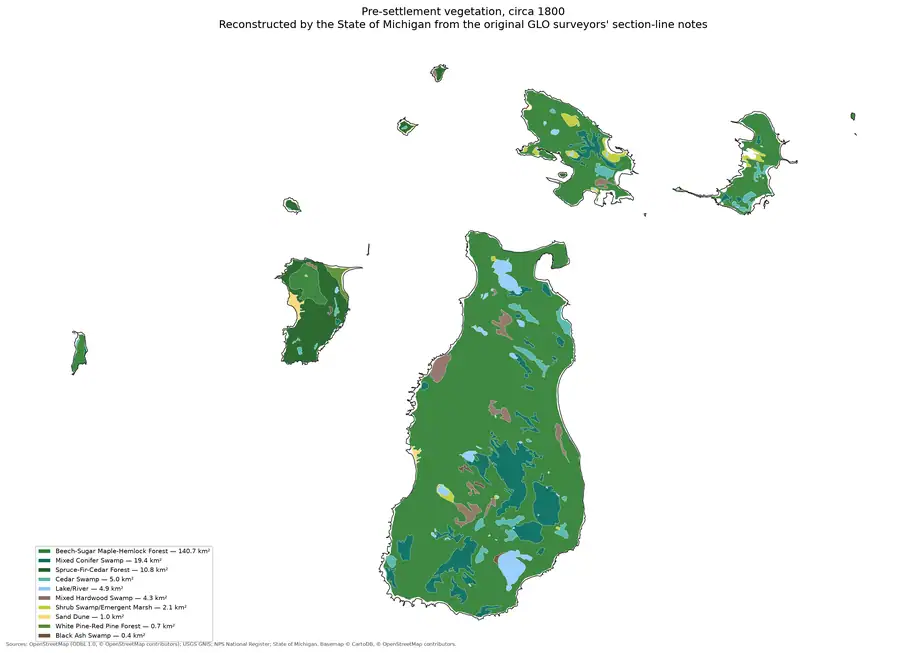
The Michigan Land Cover Circa 1800 layer reconstructs pre-settlement vegetation from the original General Land Office surveyors’ section-line notes. Within the archipelago bounding box it maps 189.2 km², distributed as follows (computed in EPSG:3078, Michigan GeoRef, metres):
| Cover type | km² |
|---|---|
| Beech–sugar maple–hemlock forest | 140.69 |
| Mixed conifer swamp | 19.36 |
| Spruce–fir–cedar forest | 10.81 |
| Cedar swamp | 4.96 |
| Lake / river | 4.92 |
| Mixed hardwood swamp | 4.29 |
| Shrub swamp / emergent marsh | 2.07 |
| Sand dune | 0.99 |
| White pine–red pine forest | 0.68 |
| Black ash swamp | 0.39 |
Beech–sugar maple–hemlock accounts for 140.69 of 189.2 km² — about 74% of everything mapped. Pine accounts for 0.68 km², roughly a third of one percent. That is the single most important fact about lumbering here: there was almost no pine to cut. The island could not participate in the Michigan pine boom, and its timber industry took the shapes it did because hardwood and hemlock were what it had.
Two cautions on the figure. The layer is a reconstruction interpolated from surveyors’ notes, not an observation, and its polygon boundaries are far more precise than the data underneath them. And the bounding box covers the whole archipelago, not Beaver Island alone — Beaver Island is 150.96 km² of it.
Strang’s 1854 description of the mainland pineries makes the contrast himself: of the Little Traverse country he writes that its timber, while valuable, “is not so abundant, as to tempt lumbermen to make lumber for export.” His account of Beaver Island mentions timber only as fuel and as an obstacle to farming.
Phase one: fuel, 1840s–1860s
Before coal, Great Lakes steamers burned wood, and Beaver Island’s harbour put it in the right place to sell it. Quaife records that when the Saints arrived, “The land could be cleared for nothing, since there was a steady demand for cordwood, which could be sold at fifty cents a cord.” Clearing and selling were the same operation.
By 1854 Strang could report at Saint James: “There is one sawmill. Three large wharves are devoted to the wood business.” The village of Galilee at the south-east end existed for the wood trade alone. The Daily Northern Islander’s market column in 1856 quotes seasoned beech and maple steamboat wood at $1.75 to $2.00 near the wharves, down from $2.25, with sales at Galilee “more than 50 cords a day”. A single advertiser offered 3,000 cords of “best body wood, beech and maple”.
The trade outlived the kingdom. A traveller’s letter reprinted in the Bismarck Tribune in 1873 asks how the post-Strangite islanders subsist and gets the answer: “Mostly by fishing, and cutting and selling cord-wood.” A pile on the dock is worth $3 a cord.
Sawn lumber, by contrast, was scarce even locally. The same 1856 paper reports “The supply of boards, plank and scantling is next to none” against the demand of buildings already projected.
Phase two: hemlock tanbark
Hemlock bark yields tannin, and the tanneries of the lower lakes bought it by the cord. The Northern Islander carried a standing advertisement:
WANTED. [quantity] CORDS of Hemlock Bark, delivered soon, for which the highest price will be paid. MARCENA THAYER. Saint James, July 8th, 1852.
The advertisement runs across many issues, and the OCR garbles the quantity differently every time it appears (the date reads 1852 most consistently), so read the figure off the page images before citing it. What is not in doubt is that the trade was new: an editorial notice in the same paper announces hemlock tanbark as a “NEW ARTICLE OF TRADE”, “to be shipped to Racine”. What tanbark cutting implies is worth spelling out. Bark is peeled from standing or freshly felled hemlock in spring, and the trunk is often left. The trade removed hemlock from the forest without producing lumber.
Phase three: the Beaver Island Lumber Company
The industrial phase is best documented by an outsider. The Rock Island Argus of 12 April 1912 describes the village:
The village contains a lighthouse, an antiquated life-saving station, and one saw-mill owned by a lumber company which is cutting timber at the head of the island and bringing it down to the mill by means of a narrow gauge railway which extends from the mill along the west side of the island to the camps.
That is a full industrial operation: mill at the harbour, rail haul, camps at the cutting face. Community sources name the operator as the Beaver Island Lumber Company and one dates its departure to 1917; a vessel chronology published in the modern Northern Islander records the schooner Nellie Johnson carrying “two miles of rails to Beaver Island Lumber Company’s narrow-gauge railroad” in 1903, which would place the railway’s construction at about that date.
That 1917 departure date rests on a single source, a 2026 community-newspaper
article, and is the weakest-sourced of the three end dates on record for the
company. A University of Notre Dame student research project gives 1915
instead, citing the primary works of Gladish (1976) and Case (1938); a
chronology attributed to the Clarke Historical
Library also reports 1915, with the company organised 1902-12-27 and
operational 1903-06-19, though that chronology has not been independently located or
verified and is reported here as a lead, not a confirmed
citation. A third source, the Beaver Island Lodge’s historical timeline (which
also gives 1901, not 1902-03, for the company’s start), gives 1916, citing
The Elders Speak by George Anthony. Two of the three end dates are academic
or archival rather than a community newspaper, and are consequently the
stronger-sourced claims even though end_date here still records 1917. That
field has deliberately not been changed to 1915 or 1916 — this is a recorded
disagreement, not a resolved one. See Open questions.
The same March 2026 account records a village called Peshawbestown established on Beaver Island below Angeline’s Bluff in 1905, “where many Native residents worked for the Beaver Island Lumber Company, until its departure in 1917” — evidence that the industry was a significant Anishinaabe employer, but not evidence that 1917 is the settled end date. See Anishinaabe presence in the archipelago.
Logging was not confined to Beaver Island. A large operation ran on High Island until 1908. Welke’s 2026 account dates the House of David’s Israelite Colony there to 1912-1932, but a 1967 local retrospective gives a c.1906-1930 chronology and a 1963 report places a House of David employee on High Island in 1936. The colony’s exact operating span remains contested. Garden Island still has an abandoned sawmill and standing structures.
The railway also has a source-qualified casualty record. A 1969 museum report says a memorial plaque was being prepared for the site where David Chase lost his life on Good Friday in 1907; a September 1960 report had already described the same location as marked by a white-painted cross. Neither account names the train or operator, gives the exact site, or establishes whether anyone else died. The event is therefore linked to the island’s lumbering context without being assigned to the Beaver Island Lumber Company.
What the forest looks like now
The 1912 Argus describes the aftermath directly, and it is a description of a cut-over forest regrowing:
The trees are small, varying in size from one to fifteen inches in diameter. A two-foot tree is unusual and the entire woods have that civilized look … From 20 to 30 different species of trees grow there. Side by side the cedar, elm, spruce, maple, beech, pine, hemlock, balm, white brier and oak twine and intertwine, while underneath grows no underbrush.
A century later the 2023 Master Plan records forest as the dominant land cover again — upland forest at roughly 55% of Beaver Island and lowland forest at another 23% in LTBB’s 2010 detailed land-use mapping — with about a third of the island in state ownership under the DNR Wildlife Division. Active management continues: the Beaver Island Wildlife Club reports funding 65 acres of aspen regeneration. The forest came back. Its composition and structure are not the 1800 forest, and nothing held here measures the difference.
Open questions
- Production figures. No board-feet, cordage or bark tonnage series for the island has been located for any phase. Michigan state forestry reports and Corps of Engineers lake-commerce returns are the obvious places to look.
- Who owned the Beaver Island Lumber Company, and where did it go? Nothing held here gives the corporate history.
- The company’s end date is disputed, and
end_date(1917) is the weakest-sourced of the three candidates. 1917 comes from a single 2026 community-newspaper article (Bobbi Welke). A Notre Dame student research project citing Gladish (1976) and Case (1938) gives 1915, as does a chronology attributed to the Clarke Historical Library — company organised 1902-12-27, operational 1903-06-19, ceased 1915 — that has not been independently verified. The Beaver Island Lodge’s historical timeline gives 1916, citing The Elders Speak (George Anthony), and also puts the company’s start in 1901 rather than 1902-03.end_datehas deliberately not been changed, to keep the disagreement visible rather than pick a winner; a future editor with direct access to Gladish 1976 or Case 1938 could resolve it. - The narrow-gauge railway’s route and fate. The 1912 Argus places it along the west side from the mill to the camps; the 1903 rail delivery gives a probable build date. Its alignment is not mapped in any dataset here, and the project records “railroads: genuinely none” for the modern island — which is true now and was not true in 1912. A trace may survive in the trail network or in aerial imagery.
- The 1908 train wreck. The later Beaver Beacon reports identify the memorial and David Chase but misdate the accident to 1907; the University of Michigan collection item and memorial inscription identify Good Friday, April 17, 1908. The available sources still do not provide a contemporary operator record, exact location, or complete casualty list.
- How much was actually cut? The 1800 baseline is on disk and a modern land cover layer exists, but no change analysis has been run, and the two are not directly comparable (one is a reconstruction from survey notes).
- The tanbark trade’s extent and end. One advertiser and one trade notice in 1852 are the whole record here.
- GLO plats and patents would date and locate the cutting parcel by parcel. They are the project’s largest outstanding retrieval gap.
See also
Sources
- A 2006 forum exchange reports a surviving boiler on the beach at the north end of Wicklow Beach Road. One participant identified it from memory as an old sawmill boiler used to make steam, but the exchange provides no photograph, mill identity, date, or independent confirmation. It is retained as a research lead rather than evidence for a specific sawmill history.forum · www.beaverislandforum.com · 00 · t000708
- Pre-settlement vegetation reconstructed from original General Land Office surveyors' section-line notes. Areas in this article computed in EPSG:3078.state · michigan · land_cover_circa_1800
- Described in this archive: Ancient and Modern Michilimackinac, 1854."There is one sawmill. Three large wharves are devoted to the wood business"; Galilee opened solely for "getting out wood for steamboats"; mill sites on the Jordan and at Lake Galilee's inlet.
- *Northern Islander* (Saint James, Beaver Island), 1850-1856, advertisements and commercial columns; *Daily Northern Islander*, 1856.Described in this archive: Northern Islander, 1850–1856.Marcena Thayer's standing advertisement for 1,000 cords of hemlock bark (Saint James, 8 July 1852); a "NEW ARTICLE OF TRADE" notice on hemlock tanbark for shipment to Racine; steamboat wood prices and the shortage of sawn lumber in 1856. No public copy of this file is known; the archive holds one and can provide it on request.
- Described in this archive: The Kingdom of Saint James, Quaife, 1930.A steam sawmill begun in 1849; land could be cleared for nothing because cordwood sold at fifty cents a cord.
- *Rock Island Argus* (Rock Island, Ill.), 12 April 1912, p. 12.Independent description of the operation at its height: "one saw-mill owned by a lumber company which is cutting timber at the head of the island and bringing it down to the mill by means of a narrow gauge railway which extends from the mill along the west side of the island to the camps." Also describes the residual forest. No public copy of this file is known; the archive holds one and can provide it on request.federal · chronicling_america · sn92053934_1912-04-12_ed1_p12
- The Bismarck Tribune (Bismarck, D.T.), 30 July 1873, p. 3, reprinting Laura Ream's letter to the Cincinnati Commercial.Post-Strang subsistence: the islanders live "mostly by fishing, and cutting and selling cord-wood", with a large pile on the dock worth $3 a cord. No public copy of this file is known; the archive holds one and can provide it on request.federal · chronicling_america · sn84022127_1873-07-30_ed1_p3
- Bobbi Welke, "A Short History of Settlements on the Beaver Island Archipelago", *Northern Islander* (Beaver Island Historical Society), March 2026, p. 4.Secondary, community-published. Source for the Beaver Island Lumber Company's departure in 1917, the large High Island logging operation to 1908, and one 1912-1932 account of the House of David Israelite Colony on High Island; the colony dates are disputed in local retrospective sources. No public copy of this file is known; the archive holds one and can provide it on request.
- Land Information Access Association, *Beaver Island Master Plan 2023* (adopted 13 November 2023), chapters 1-2.Beaver Island Lumber Co. and the House of David as the early-1900s logging economy; Garden Island's abandoned sawmill; current forest cover and DNR ownership. No public copy of this file is known; the archive holds one and can provide it on request.
- States "the logging company ceased operation in 1915," citing Gladish (1976) and Case (1938). Disagrees with the 1917 departure date given by Welke 2026, above.
- Project source article: Beaver Island Lumber Company.Described in this archive: Beaver Island Lumber Company.Entity-level synthesis keeps the company identity, industrial footprint and 1902-1915 candidate span separate from the broader lumbering theme and its 1915/1916/1917 date dispute. No public copy of this file is known; the archive holds one and can provide it on request.kb · articles · organizations · beaver-island-lumber-company
- States the company went into business in 1901 and "closed its operation and picked up its tracks in 1916," citing *The Elders Speak* by George Anthony. A third end date, distinct from both Welke 2026 (1917) and the Notre Dame project (1915).
- Reports a white-painted cross maintained by the Beaver Island Civic Association at the site where George Chase's uncle was killed 53 years earlier; the victim and exact date are not named.data1 · beaver-island-archive · beaver_beacon · 1960-09_Beaver-Beacon
- The held three-page issue scan is paired with the OCR source and confirms the published notice or report; it does not expand the source-specific identity, event, or outcome claims.data1 · beaver-island-archive · scans · beaver_beacon · issues · 1960-09_Beaver-Beacon
- Names David Chase as the person who lost his life at the train-wreck site on Good Friday, 1907, and records a planned memorial plaque. A later University of Michigan collection item and memorial inscription identify the accident as Good Friday, April 17, 1908; this Beacon report is retained as the source of the later memorial account, not the corrected date.data1 · beaver-island-archive · beaver_beacon · 1969-07_Beaver-Beacon
- The held six-page issue scan is paired with the OCR source and confirms the published notice or report; it does not expand the source-specific identity, event, or outcome claims.data1 · beaver-island-archive · scans · beaver_beacon · issues · 1969-07_Beaver-Beacon
- Beaver Island Archive, *Pre-settlement vegetation* — plate drawn for this archive. CC BY 4.0 for the drawing; underlying data under its own terms (see credit)The pre-logging forest baseline against which this article's cutting history is read: land cover circa 1800 from the State's reconstruction of the GLO surveyors' witness-tree records. It shows what stood before, not what was cut. Credit: Drawn from the archive's own data in EPSG:3078. Map data © OpenStreetMap contributors (ODbL 1.0); land cover circa 1800 from the Michigan Department of Natural Resources (public domain). No public copy of this file is known; the archive holds one and can provide it on request.output · presettlement_vegetation
- A south-end landowner sought loggers for near-mature hardwoods. This is a dated labor request and evidence that private timber work was being considered, not a harvest record, acreage report, or proof that logging occurred.forum · www.beaverislandforum.com · 01 · t001609
Added 28 July 2026 · revised 3 August 2026. Recent changes
Cite this article
Beaver Island Archive, “Lumbering”, https://beaverislandarchive.org/themes/lumbering/, accessed [date], citing Dave Dudek and Gillespie, “boiler on beach,” Beaver Island Forum, August 23–24, 2006. (and 17 further sources listed on the page).
Last revised 2026-08-03. Fill in [date] with the date you read it — this page is static and cannot know that.