- Date
- 1853-07-13
- Kind
- Crime
- Eras
- Strang era
- Concepts
- governancemormonismreligionhistoriography
- Within
- Pine River
Summary
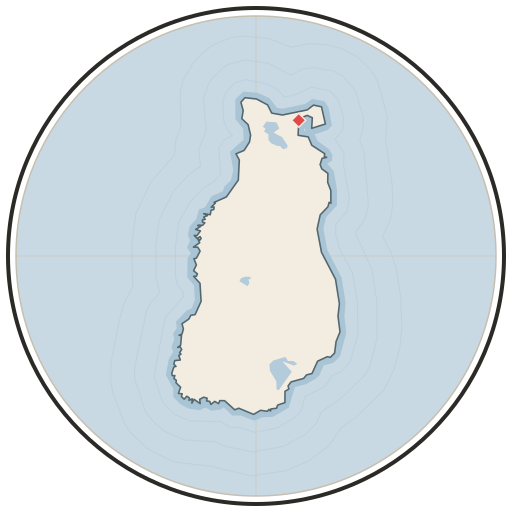
On 13 July 1853, an armed party of some fifty to eighty fishermen and settlers at the mouth of Pine River ambushed an unarmed party led by Emmet County Sheriff Joshua L. Miller as it tried to leave after serving jury summonses. Pine River was a Gentile settlement on the mainland shore of Lake Michigan, hostile to James Jesse Strang’s Mormon government of the Beaver Island archipelago, on the site of the modern city of Charlevoix, Michigan. More than two hundred shots were fired at close range; six men were wounded and none killed. The Sheriff’s party, including Alexander Wentworth (who would help assassinate Strang three years later), escaped by open boat to a passing lake vessel. No one was ever convicted. The only detailed contemporary account held here is Strang’s own newspaper’s, reprinted the next day and again in a 1920 Strangite pamphlet. No non-Mormon-authored account of the attack itself has been located, so this episode is recorded here as contested.
History
Background
Emmet County — comprising the Beaver Islands and the mainland shore around Pine River — had been the site of escalating conflict between Strang’s Mormon government and Gentile fishermen and traders since at least 1851, when Peaine Township enforced a liquor law against traders who would not post bond, a policy Quaife says “the township of Peaine enforced” over strong resentment among “the best fisheries.” In the autumn of 1852 a Mormon officer traveled to Pine River with warrants for men accused of theft; “almost the entire population” fled to the woods at his approach, and the Northern Islander dismissed the settlement as “little else than a band of vagabonds and thieves.”1 By the summer of 1853 the fishermen had reassembled “in greater numbers than before,” determined to resist the authority of Emmet County.2 Quaife also records that Mackinac county officials and citizens had, in the weeks before the attack, publicly encouraged defiance of Mormon-administered law: “For the tragic affair of Pine River which followed a few weeks later, they cannot escape a heavy measure of responsibility.”3
The ambush
Sheriff Miller’s task was narrow and, on its face, unthreatening: to summon jurors, drawn by the county clerk from lists prepared by township officers, for the circuit court sitting at Saint James the following week.4 Learning at Galilee (the settlement at the south end of Beaver Island) of fresh threats against anyone attempting to serve process at Pine River, Miller took a second boat and crew and went over unarmed, “believing that the presence of that number of witnesses would prevent any act of violence.”4 To avoid any show of hostility, the party’s four fowling guns were laid in the bottom of a boat and covered with coats, and never taken up or seen at Pine River.5
The Sheriff’s party of fourteen or fifteen men reached Pine River at two o’clock in the afternoon and completed the jury summons within twenty-five minutes. As they re-embarked, “three men had been down to the boats” and reported to their comrades “they have no guns” — after which, per the Islander’s account, a company of about sixty men opened fire from the beach and the bluff above, within thirty feet, as the boats struggled through surf to get clear.5 “More than two hundred guns were fired,” and three boats of pursuers, the leading one carrying twenty-five men, chased the Sheriff’s party some ten miles before a rising wind let them reach the bark Morgan, under Capt. Stone, and safety.6 Not one man was killed; six were wounded: Isaac Pierce (left arm, both bones broken), A. J. Porter (a ball lodged behind the hip, passing lengthwise through the thigh), Andrew Hale (shot through the shoulder, cutting the main artery, “near bleeding to death”), J. T. Pierce (a rifle ball flattened against the hip bone), and Alexander Wentworth and Lewis Briggs (each a shot through the flesh of the left arm).6 Uninjured were Sheriff Miller, Franklin Johnson, Lorenzo Tubbs, Orlando P. Briggs, L. D. Hickey, David Finch, Egbert Carpenter, Christopher Scott, and F. W. Longfield.6 The party returned to Galilee that night, and the following morning Dr. Hezekiah D. McCulloch arrived to dress their wounds.6 The Islander separately records that Indigenous residents at Pine River took no part in the attack and had in fact warned Miller beforehand that the men there intended to kill him.6
Aftermath
No one is recorded in sources held here as having been tried for the attack. Two years later, at the close of a religious conference on an island in Pine Lake (by then renamed “Lake Mormon” by the Saints), worshipers went to the mouth of Pine River and erected a gallows on which they hanged in effigy the men who had carried out the assault.7. Six months after that, correcting a report that the gallows had been cut down, the Northern Islander stated it “stands now, where it is likely to stand for fifty years to come,” marking “the deed of blood and murder there committed the thirteenth of… July, 1853.”8 The region’s permanent (non-Mormon) settlement dates from the year following the fishermen’s dispersal, and grew into the present city of Charlevoix.9
A 1967 Charlevoix Courier retrospective uses the later label “Battle of Charlevoix” for what appears to be the same episode. It likewise describes Beaver Island Mormons arriving in sailboats, the fishermen’s pursuit, the intercepting schooner Morgan, and no casualties. Because this is a much later local memory and does not replace the partisan contemporary account, it is treated as qualified corroboration only.
Significance
The Pine River ambush is the clearest instance among the sources held here of armed, organized Gentile violence against Emmet County’s Mormon-administered civil authority, three years before Strang’s assassination — and it is remembered here chiefly because one of its wounded, Alexander Wentworth, was one of Strang’s two assassins in 1856. In 1853 he was shot defending a Mormon sheriff’s lawful business; by 1856 he was shooting the Mormon prophet himself. No source held here explains this reversal, though see Alexander Wentworth for what is known of his later grievance against Strang. The episode is also a caution about sourcing: the only detailed account held here is Strang’s own paper’s, written the day after the event for a Mormon readership and reprinted 67 years later by a Strangite believer explicitly framing both this attack and Strang’s later assassination as persecution of “A MIGHTY PROPHET OF GOD.” No Gentile, Mackinac-county, or Pine River-resident account of the ambush itself has been located here to set against it.
Open questions
- No non-Mormon-authored account of the attack has been located. Everything held here about the ambush itself derives, directly or through Quaife, from Strang’s own newspaper.
- Whether anyone was ever charged or tried for the shooting is not established from sources held here; the Islander’s own account says only that “measures are being taken to bring them to justice.”
- The date’s exact rendering. Quaife’s text prints “the thirteenth of … July, 1853” with the month itself evidently a correction in the source he quotes; no unambiguous original imprint of that specific Northern Islander line has been found here to confirm it independent of Quaife’s transcription.
- The historical location is represented by Pine River; its modern coordinates and mainland GNIS join remain outside the current archipelago gazetteer.
See also
Sources
Footnotes
-
Quaife, The Kingdom of Saint James (1930), pp. 146-149. ↩
-
Ibid., p. 153. ↩
-
Ibid., p. 153 and n. ↩
-
“Murderous Assault – Attack on Sheriff Miller – Six Men Wounded!” Northern Islander extra, 14 July 1853, p. 1, reprinted in A Few Historical Facts Concerning the Murderous Assault at Pine River (1920). ↩ ↩2
-
Quaife, The Kingdom of Saint James (1930), p. 157. ↩
-
Ibid., p. 158. ↩
-
Ibid., pp. 158-159. ↩
Sources
- The primary contemporary account, from Strang's own paper, reprinted in full in this 1920 devotional tract (which also reprints the Daily Northern Islander's account of Strang's 1856 assassination -- see event/assassination-of-james-strang). Gives the fullest description of the attack, the wounded and uninjured by name, and the sequence of events, but is explicitly partisan: written the day after the event by the Mormon side, for the Mormon paper, and reprinted 67 years later by a Strangite believer framing it (and the later assassination) as evidence of persecution.
- Described in this archive: The Kingdom of Saint James, Quaife, 1930.The fullest secondary reconstruction, reprinting the same Northern Islander account as an appendix (pp. 265-275) alongside narrative background: the 1851 liquor law that the Township of Peaine enforced against Gentile traders, an 1852 incident in which a Mormon officer's visit to Pine River caused 'almost the entire population' to flee to the woods, and the Mackinac county officials' public encouragement of resistance to Mormon authority in the weeks before the attack -- for which Quaife states 'they cannot escape a heavy measure of responsibility.' Also records the Mormons' later commemorative practice of erecting a gallows in effigy at the mouth of Pine River, and the Northern Islander's own dating of the episode to 'the thirteenth of ... July, 1853.'
- Charlevoix Courier, 1967, “History of Bridge Street and Charlevoix Harbor,” Chapter IV.A later local retrospective calls the episode the “Battle of Charlevoix,” says a band of Beaver Island Mormons came in sailboats and that the fishermen pursued them until they reached the schooner Morgan, and reports no casualties. It is retained as a qualified retrospective, not independent contemporary corroboration. No public copy of this file is known; the archive holds one and can provide it on request.
Added 28 July 2026 · revised 2 August 2026. Recent changes
Cite this article
Beaver Island Archive, “Battle of Pine River”, https://beaverislandarchive.org/events/battle-of-pine-river/, accessed [date], citing 'Murderous Assault -- Attack on Sheriff Miller -- Six Men Wounded!' *Northern Islander* extra, Saint James, Thursday 14 July 1853, reprinted in *A Few Historical Facts Concerning the Murderous Assault at Pine River* (Beaver Island Strangite tract, 1920), pp. 1-6. (and 2 further sources listed on the page).
Last revised 2026-08-02. Fill in [date] with the date you read it — this page is static and cannot know that.
BibTeX for “Battle of Pine River”RIS for “Battle of Pine River”