
- Date
- 1850-07-08
- Kind
- Religious service
- Eras
- Strang era
- Concepts
- monarchygovernancemormonismreligionhistoriography
- Within
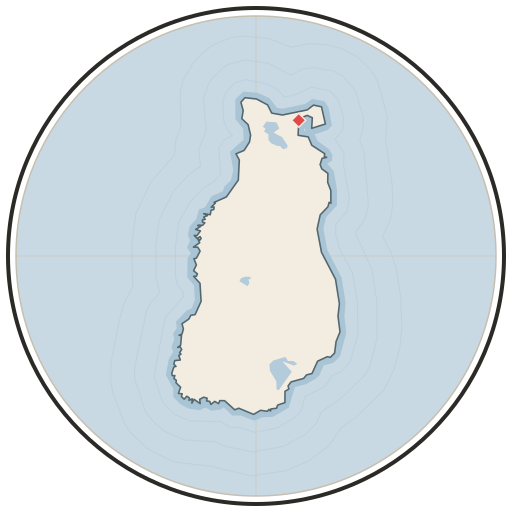
- Saint James · Beaver Island
Summary
On 8 July 1850, in the still-uncompleted tabernacle at Saint James on Beaver Island, James Jesse Strang was crowned king before an assembled congregation of his Latter Day Saint followers — an act repeatedly described in later historiography as the only self-proclaimed monarchy on United States soil. George J. Adams, then Strang’s closest lieutenant, served as master of ceremonies. The date is independently confirmed by sworn testimony at Strang’s 1851 federal trial and by newspaper notices written years apart. The number of people present, and much of the ceremony’s inner meaning, rest on sources partisan on both sides; the date and the outline of the ceremony are firm, and the details below are marked where sources disagree.
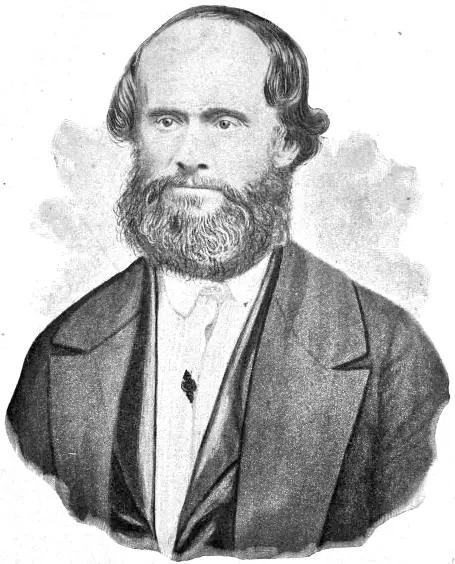
No image of the ceremony has been located. The nearest thing held here is the portrait printed in the memoir of Elizabeth Whitney Williams, who grew up on the island among the Mormons’ gentile neighbours; her plate names him “the Mormon King”.
History
The ceremony
Milo Quaife’s 1930 narrative, drawing on the manuscript “Apostolic Testimony” of Warren Post (one of Strang’s Twelve Apostles) and a decades-later eyewitness account by Mrs. Cecelia Hill, describes the event: “On July 8, in the uncompleted tabernacle, the coronation ceremony was carried out. A portion of the newly revealed Book of the Law of the Lord was read, and the four hundred spectators assembled to witness the setting up of the Kingdom of God on earth, with uplifted hands entered into a solemn covenant henceforth to be God’s people and live in accordance with His law.”1 Strang, “clad in a robe of bright red, was escorted to a platform” surrounded by his apostles, the Quorum of Seventy and minor church officials, with the common people occupying the remaining space. George J. Adams, described by Quaife as one “who performed with equal facility in the pulpit and on the stage,” acted as master of ceremonies, and the rite concluded with “placing on the brow of Strang a crown of metal with a cluster of stars in front.”2
The same day, per Quaife, Strang received a revelation appointing “the Islands of the Great Lakes” as an inheritance for the Saints and vesting in the King the power to apportion the land among them; the anniversary of the day “James the Prophet was established King” was thereafter to be kept “with sacrifices and thank offerings.”3 Quaife describes what that meant in practice: “At sunrise the King offered a heifer, while all the men presented a beast or a fowl in like fashion. The victims were slain by the priests, cooked by the deacons, and consumed by the congregation in a great public feast,” each stage marked by “appropriate declarations of sentiment on the part of the worshipers.”4 Quaife’s own framing of the ceremony is skeptical throughout — he calls the crown “tinsel” and closes the passage by asking whether Strang, “sitting with a tinsel crown upon his head,” recalled a diary entry from his youth recording “the making of a great discovery: ‘That is that I am eager and mankind are frail,’” as he “gazed into the awe-struck faces of his four hundred credulous worshipers.”5
A footnote in Quaife’s narrative, drawn from minutes of addresses given at “the conference preceding the coronation ceremony” and preserved among the Strang manuscripts, shows the gathering was held under continuing fear of attack: the Saints anticipated a gentile mob, and both Strang and Adams spoke in openly violent terms in response. Strang said he would “with his own hand execute the death sentence upon the mobbers,” and Adams called not merely for their defeat but for “a generous letting of gentile blood.”6 The coronation followed by four days the failed attempt to drive the Mormons from Whiskey Point on 3-4 July 1850 (see The Strang era, 1847-1856), and the same fear of a renewed attack that produced the armed stand at the Point was still present when the crown was placed on Strang’s head.
Independent confirmation of the date
The 8 July 1850 date does not rest on Quaife’s narrative alone. Sworn testimony given at Strang’s 1851 federal treason trial in Detroit — reprinted in the New York Herald — states plainly: “Adams reached the coronation session July 8th, 1850, when ‘James’ was crowned king,” and separately that “the occasion on which Adams spoke highly of Strang’s holiness was on the 8th of July, (coronation day).”7 The same witness states that “the Privy Council did not exist before the coronation of Strang” — evidence that the coronation marked a real change in the movement’s internal governance, not merely a ceremony.7 More than six years later, a newspaper notice written around the time of Strang’s death independently anchors the same date from the other direction: “on the anniversary of his coronation day, the 8th of July of the present year, he was to have married a fourth” wife.8 The same letter is loose about the coronation itself, placing it “some three years” rather than six before 1856 — a reminder that a source can fix one date and mistake another.
How many were there, and what it meant
Sources disagree on attendance. Quaife’s figure of four hundred spectators is roughly double the number given in a hostile contemporary account, which cites an unnamed “document” stating “upon the occasion of Strang’s self-coronation, there were two hundred persons present” — offered as evidence of the scheme’s scale, in a column headed “A Band of Outlaws” that reprints documents published by the Detroit Daily Advertiser.9 Neither figure is independently verified against a primary attendance record.
Later hostile reminiscence in the national press ties the coronation directly to Strang’s public turn toward polygamy: “Prior to that time he had been ostensibly opposed to polygamy, but upon his coronation he came out in favor of a plurality of wives… Immediately following his coronation he took two wives.”10 This sequencing is consistent with Quaife’s independent account of Strang’s earlier, secret 1849 plural marriage to Elvira Field (see George J. Adams), which suggests the coronation marked the public unveiling of an arrangement that already existed privately, rather than its beginning. No source held here fully reconciles “public unveiling” against “the coronation caused the turn to polygamy” as competing readings of the same sequence.
The master of ceremonies falls out with the King
Within months the two men had quarreled. In the winter of 1849-50, while preaching at Boston, Adams took up with a woman Quaife describes as “of indifferent fame,” passed her off in Baltimore as a wealthy widow, and brought her to the island that spring as “Mrs. Adams,” claiming his actual wife had died. She had not — she was still living, abandoned, in New Jersey. Strang disciplined Adams for the deception, removing him from the First Presidency of the church. Adams then defected to Mackinac and, on 20 October 1850, returned to Beaver Island with that county’s sheriff and a writ for Strang’s arrest on a charge of threatening the woman’s life; Strang evaded the officer and was later tried before a Mackinac justice of the peace.11 Quaife adds his own doubt about the episode as Strang told it, writing that he is “constrained to doubt whether Adams’ immoral conduct was anything more than a convenient pretext” for Strang’s move against him.12
Significance
The coronation is the defining act of Strang’s theocratic government of the Beaver Island archipelago. Later writers often call it the only instance of a monarchy proclaimed on United States soil; the sources held here neither make that claim in those words nor contradict it. It marks the formal beginning of the Kingdom of Saint James as a civil as well as religious institution (per the 1851 trial testimony, the Privy Council dates from this event) and the point at which Strang’s rule over his followers extended, by his own revelation, to a territorial claim over “the Islands of the Great Lakes.” The man who conducted the ceremony was estranged from Strang before the year was out, and became one of his most damaging outside accusers.
Open questions
- Attendance. Four hundred (Quaife, from Post’s manuscript) versus two hundred (the Lynchburg Virginian of 19 June 1851, citing an unnamed document) — not reconciled from sources held here.
- The order of public and private polygamy. Whether the coronation caused Strang’s turn to plural marriage, or merely made public an arrangement already a year old (per the Elvira Field marriage), is not settled by any source held here.
- The crown and robe themselves. No source held here states what became of the physical crown or robe, or whether either survives.
- A first-person Strangite account of the ceremony’s religious meaning, as opposed to accounts filtered through Quaife (writing 80 years later) or hostile contemporary newspapers, has not been located here.
See also
Sources
Footnotes
-
Quaife, The Kingdom of Saint James (1930), p. 94. ↩
-
Ibid., pp. 94-95. ↩
-
Ibid., p. 95. ↩
-
Ibid., p. 95. ↩
-
Ibid., p. 95. ↩
-
Ibid., p. 120, note, drawn from “minutes of addresses by Strang and others at the conference preceding the coronation ceremony, preserved among the Strang MSS.” ↩
-
Sworn trial testimony, New York Herald, 10 July 1851, p. 7, https://www.loc.gov/resource/sn83030313/1851-07-10/ed-1/?sp=7. ↩ ↩2
-
“Notes of Travel at the North and North-West: Beaver Islands and the Mormons,” The Central Presbyterian (Richmond, Va.), 25 October 1856, p. 1, https://www.loc.gov/resource/sn89053987/1856-10-25/ed-1/?sp=1. ↩
-
“A Band of Outlaws,” Lynchburg Virginian (Lynchburg, Va.), 19 June 1851, p. 2, https://www.loc.gov/resource/sn84024649/1851-06-19/ed-1/?sp=2. ↩
-
“An Island Kingdom,” Evening Star, 5 August 1893, p. 14, https://www.loc.gov/resource/sn83045462/1893-08-05/ed-1/?sp=14. ↩
-
Ibid., pp. 121-122. ↩
-
Ibid., p. 121, note. ↩
Sources
- The fullest narrative account, drawing on Warren Post's manuscript "Apostolic Testimony" and an eyewitness account by Mrs. Cecelia Hill recorded decades later. States the ceremony took place "On July 8, in the uncompleted tabernacle"; that "a portion of the newly revealed Book of the Law of the Lord was read, and the four hundred spectators assembled... with uplifted hands entered into a solemn covenant"; that Strang, "clad in a robe of bright red," was crowned with "a crown of metal with a cluster of stars in front"; and that George J. Adams "acted as master of ceremonies." Also records a same-day revelation granting "the Islands of the Great Lakes" as an inheritance to the Saints, that thereafter the coronation anniversary was to be kept "with sacrifices and thank offerings" of a heifer and other beasts at sunrise, and, in a footnote drawn from minutes preserved among the Strang manuscripts, that the conference preceding the coronation was held under fear of a gentile mob attack. Also describes the falling-out with George J. Adams that followed within months: Adams's fraudulent "Mrs. Adams," his discipline and defection, and his return with a Mackinac County sheriff's writ for Strang's arrest on 20 October 1850. Quaife's narrative voice is openly skeptical of Strang throughout this material.
- Sworn testimony (by a Mormon township clerk, unnamed in this extract) at Strang's 1851 trial, independently confirming both the date and Adams' role: "Adams reached the coronation session July 8th, 1850, when 'James' was crowned king. Adams administered the covenant to me in May previous." The same testimony states "the occasion on which Adams spoke highly of Strang's holiness was on the 8th of July, (coronation day)," and that "the Privy Council did not exist before the coronation of Strang."federal · chronicling_america · sn83030313_1851-07-10_ed1_p7
- A hostile contemporary account citing an unnamed "document": "upon the occasion of Strang's self-coronation, there were two hundred persons present" -- half of Quaife's later figure of four hundred, and evidence that even the attendance figure is not settled between sources. The paper was identified from the page's own masthead; an earlier draft of this article attributed the item to an unnamed Rochester, N.Y., paper.federal · chronicling_america · sn84024649_1851-06-19_ed1_p2
- A later hostile reminiscence: "in front of the castle he had built and was formally crowned king of the Mormons. Prior to that time he had been ostensibly opposed to polygamy, but upon his coronation he came out in favor of a plurality of wives... Immediately following his coronation he took two wives."federal · chronicling_america · sn83045462_1893-08-05_ed1_p14
- A signed traveller's letter, gathered largely from the sheriff of Mackinac county, who was the writer's fellow passenger. Independent corroboration of the 8 July date, written the year of Strang's death: "on the anniversary of his coronation day, the 8th of July of the present year, he was to have married a fourth" [wife]. The same account misdates the coronation itself, saying his followers had crowned him king "some three years ago." The paper was identified from the page's own masthead; an earlier draft of this article attributed the item to *Frank Leslie's Illustrated Newspaper*.federal · chronicling_america · sn89053987_1856-10-25_ed1_p1
- Source of the portrait shown above. Williams was a child on the island during the Mormon years and writes from the gentile side; the plate is used here for the likeness and its caption, not for her judgement of the ceremony, which she does not describe.
Added 28 July 2026 · revised 2 August 2026. Recent changes
Cite this article
Beaver Island Archive, “Coronation of James Strang”, https://beaverislandarchive.org/events/coronation-of-james-strang/, accessed [date], citing Milo M. Quaife, *The Kingdom of Saint James, A Narrative of the Mormons* (New Haven, Yale University Press, 1930), pp. 94-95, 119-122. (and 5 further sources listed on the page).
Last revised 2026-08-02. Fill in [date] with the date you read it — this page is static and cannot know that.
BibTeX for “Coronation of James Strang”RIS for “Coronation of James Strang”