- Date
- 1856
- Kind
- Migration
- Eras
- Irish era
- Concepts
- migrationIrish eracatholicismfishing
- Within
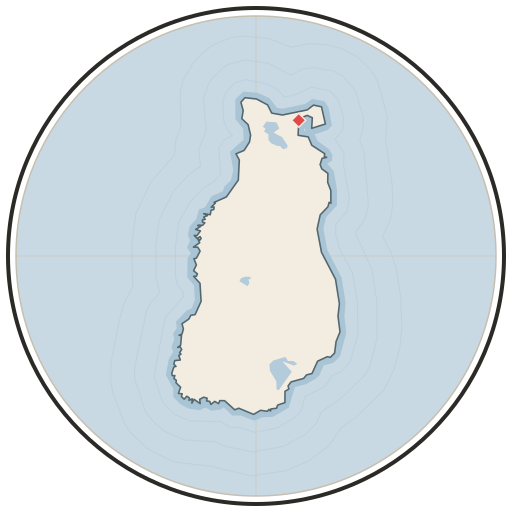
- Beaver Island
- Media
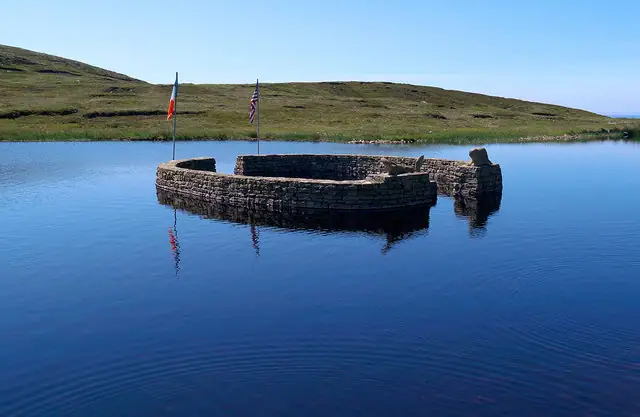
- The Beaver Island memorial at Lough Thoir, Arranmore, County Donegal
Summary
After James Jesse Strang’s assassination in June 1856 and the expulsion of his followers, Beaver Island was resettled predominantly by Irish immigrants and their Mackinac-area Irish-American neighbours, many of them from Arranmore Island, County Donegal. The newcomers built the island’s fishing economy, founded Holy Cross Catholic Church, and gave Donegal Bay its present name. The island is still locally and promotionally known as “America’s Emerald Isle,” and the connection to Arranmore is maintained today through family “clans” and an annual Irish heritage festival.
History
Strang was mortally wounded on 16 June 1856 and died 23 days later; in the disorder that followed, a mob from the mainland drove the remaining Strangite Mormons from the island.1 Among the returning and newly arriving settlers were Irish families who had been living on Mackinac Island, drawn by the island’s now-vacated, productive fishing grounds.1 Elizabeth Whitney Williams – who had lived through the Strang period and returned to the island herself (see Elizabeth Whitney Williams) – names one of these arrivals directly in her 1905 memoir: “our genial friend Capt. Roddy, so well known all over Northern Michigan,” who “bought the land and made [himself a] home.”2 Her book also names William Gallagher as “the pioneer pound-net fisherman of the island” and William Boyle as an established island businessman by the time of her writing – both surnames that remain prominent among Beaver Island’s Irish-descended families today.2
A large share of the new arrivals came specifically from Arranmore Island, County Donegal, in the north-west of Ireland; the modern Northern Islander states that “in one wave alone, 40 Arranmore families settled on Beaver Island.”1 Irish settlers “farmed, fished, built boats, and logged,” and “taught school, provided medical care, ran stores, operated transportation services, and served in religious, community, and government roles.”1 Holy Cross Catholic Church (see Holy Cross Catholic Church) became the parish home of this community; its Gaelic-language liturgies, continuing until the 1890s, are direct evidence of the settlers’ Irish-speaking origin.3 Donegal Bay, on the island’s east side, carries the settlers’ County Donegal origin in its name; it had previously been called Mount Pisgah Bay, one of Strang’s biblical toponyms.4
A later family account gives a more detailed, but explicitly source-bounded, version of one arrival chain. Clementine McCauley wrote that her grandparents Conal McCauley and Mary Gallagher left Arranmore for Canada during the famine era, married in Toronto, and later joined a group that chartered a vessel for the Beavers, with Conal as pilot.5 She remembers the group as either five or seven families and names a McDonough couple, a Boyle family, and Connaghans, while treating the possible Bonner identification as uncertain. The account says the newcomers arrived about three months after the Mormons’ departure, used abandoned houses until they could take homesteads, and combined lumber-mill work, fishing, and farming. It also describes relatives sending for family members in later decades, including the McDonough chain that brought Mary to the island in 1884.5 These details enrich the migration record but do not establish a complete passenger list, homestead sequence, or the claimed first “gentile” birth on the island.
The same family correspondence continued in August and September 1972. The August reprint described James Napper Tandy Gallagher as an ancestor who had come to Beaver Island and connected him to the Gaelic song; McCauley’s September correction says he never crossed to Beaver Island, drowned off Arranmore before the family’s departure, and was the husband of the song’s “Granny.”6 The correction also changes the claim that McCauley was the only clan member to visit Arranmore to a claim that she was the first known visitor, naming other possible visitors without asserting their descent.6 These records are kept separate so the Beaver Island settlement event does not absorb an ancestor who never arrived.
The island’s Irish identity, and its specific tie to Arranmore, are still being renewed. Since 2019 the Beaver Island Irish Heritage Group has run an annual Emerald Isle Irish Féile, drawing performers and visitors directly from Arranmore, and the island promotes itself as “America’s Emerald Isle.”78 Modern descendant “clans” (Gallagher, McCafferty, Martin, McNamara, Boyle, Gillespie, Connaghan and others) are recognized annually at the festival’s “Calling of the Clans” event. The most recent island-Arranmore exchange recorded here is a 2024 gift of a handcrafted baton from a sixth-generation islander to an Arranmore musician.9
A contemporary Irish-side record of the migration mechanism was found in the Freeman’s Journal (Dublin) of Thursday, June 9, 1881, p. 3 (“The Position at Arranmore Island”, from the paper’s Arranmore correspondent): “On one part of the island in particular—I believe in the townland known amongst them as Aphort—Mr. Charley paid the passages of the families who at one time inhabited a part of it to Beaver Island, in America, and took up the land into his own hands.” John Stoupe Charley became Arranmore’s landlord in 1849, per the same article. This documents landlord-assisted passage from a named Árainn Mhór townland (Aphort, on the island’s south side) directly to Beaver Island, alongside the family-chain migration recorded in the McCauley account (Beaver Beacon, March 1972, held). This 1881 Freeman’s Journal report is held as a citation-copy screenshot only, under its Newspapers.com/ British Library Board rights restriction, not for reproduction. Three further period matches (Liverpool Mercury 26 Jul 1884; Southern Cross (Adelaide) 26 Oct 1917; Escanaba Daily Press 7 Jun 1918) remain unexamined leads.
Significance
The migration replaced Strang’s theocratic settlement with the community that has defined Beaver Island’s demographic and cultural character for the century and a half since, and it is the direct ancestor of the island’s present-day population, institutions (Holy Cross Catholic Church) and named places (Donegal Bay). The tie it created runs to a single origin community – Arranmore Island, County Donegal – rather than to Ireland generally. Arranmore commemorates that tie with a memorial standing in Lough Thoir, flying an Irish tricolour and a U.S. flag side by side, erected around the 2000 twinning of the two islands (see Beaver Island–Arranmore twinning celebration).
Open questions
- No source held here gives a start-of-migration date more precise than
“after” Strang’s June 1856 death, nor an end date for the main settlement wave;
the process shades into ongoing 20th- and 21st-century visiting and return
migration, so
end_dateis left blank rather than guessed. - The claim that “40 Arranmore families settled on Beaver Island in one wave” is reported by the modern community newspaper without a cited primary source or precise date; it should be treated as probable, not established, until a primary source (e.g. a passenger list, land patent record, or a Journal of Beaver Island History article) is obtained. The Society’s Journal of Beaver Island History almost certainly holds this detail with sourcing (see Beaver Island Historical Society) but no volume is held here.
- This article does not address the relationship between the Irish settlement and the continuous Anishinaabe (Odawa/Ojibwe) presence in the archipelago – a distinct, ongoing history that warns against treating Anishinaabe presence as a closed “era.” That subject needs its own article or theme treatment, which has not yet been written. Garden Island’s significant Odawa/Ojibwe history (referenced in passing via Elizabeth Whitney Williams’ husband’s 1862-1864 government teaching post there) is out of scope here; Garden Island is a separate, currently unresearched stub.
- The exact date Donegal Bay’s name changed from Mount Pisgah Bay, and who effected the change, is not established from GNIS or any other source held here.
- The BLM GLO land patent records that would name the first Irish purchasers of island land are a known, unresolved gap here, and bear directly on this migration.
- The March 1972 McCauley account is a valuable family source but has no held passenger list or civil corroboration for the five-or-seven-family count, individual homesteads, or the “first gentile child” claim.
See also
- Holy Cross Catholic Church
- Holy Cross Cemetery
- Beaver Island Historical Society
- Elizabeth Whitney Williams
- Feodor Protar
- Donegal Bay
- Notre Dame Irish Stories technical report, 2010–2011 field seasons
- Notre Dame Irish Stories Boyle Farm technical report, 2012 excavation
- Notre Dame Gallagher homestead archaeological field seasons, 2010–2011
- Notre Dame Boyle Farm archaeological excavation, 2012
Sources
Full citations, matching the sources: block above.
Footnotes
-
Elizabeth Whitney Williams, A Child of the Sea; and Life among the Mormons (1905). ↩ ↩2
-
Michigan Historical Marker “Holy Cross Catholic Church,” marker ID L2251. ↩
-
USGS GNIS variant names. ↩
-
Clementine McCauley, “How the Irish Came to Settle on Beaver Island,” Beaver Beacon, March 1972. ↩ ↩2
-
“Beaver Tales Correction,” Beaver Beacon, September 1972,
/data1/beaver-island-archive/ocr/beaver_beacon/markdown/1972-09_Beaver-Beacon.md. ↩ ↩2 -
Northern Islander, January 2024, pp. 23-25. ↩
-
Beaver Island Master Plan (2023). ↩
-
Northern Islander, October 2024. ↩
Sources
- Described in this archive: A Child of the Sea; and Life among the Mormons, 1905.Eyewitness primary source. Names early post-1856 arrivals directly: "Among those that came was our genial friend Capt. Roddy ..."; also names "the pioneer pound-net fisherman" William Gallagher and businessman William Boyle as established islanders by the time of writing (1905).
- States that after Strang's 16 June 1856 assassination and the expulsion of the Mormons, "many who returned included Irish families from Mackinac Island, eager to claim the rich fishing grounds," and that "a large share of the new arrivals came from Arranmore Island in Ireland; in one wave alone, 40 Arranmore families settled on Beaver Island."
- Refers to the island's heritage celebrations as "celebrating ... Odawa and Irish cultural traditions, both historically and presently," and elsewhere describes the community as "America's Emerald Isle."
- Documents the modern Emerald Isle Irish Féile (started 2019) and the island's self-description as "America's Emerald Isle," and its stated "connection to Arranmore Island, County Donegal, Ireland."
- States that "after the expulsion of the Mormons in 1856, many Irish families settled on the island," and that parish liturgies were given in Gaelic until the 1890s.state · michigan · historical_markers
- Records Donegal Bay's superseded name, Mount Pisgah Bay -- the Strang-era biblical toponym the bay carried before its present name, which memorializes County Donegal, Ireland.federal · gnis · gnis_variant_names
- Research-design source for 19th-century Irish immigrant homesteads, oral histories, and the interaction of Irish, Native American, Mormon, and other communities. It is cited for the project's scope and framing, not as a substitute for completed excavation reports.documents · rotman_2012_ethnogenesis_nd
- Described in this archive: Notre Dame Irish Stories technical report, 2010–2011 field seasons.The held report documents a later investigation of Irish diaspora and identity, including fieldwork, documentary research, and oral histories. It is used for the existence and scope of that research program, not as primary evidence for every nineteenth-century migration claim.documents · nd_irishstories · 2011
- Described in this archive: Notre Dame Irish Stories Boyle Farm technical report, 2012 excavation.Documents a completed 2012 archaeological investigation at a publicly named Boyle Farm Site in the later Irish Stories research program. It is evidence of the research activity and site context, not a complete nineteenth-century migration account or family tree.documents · nd_irishstories · 2012 · 2012-Front-pages
- Described in this archive: “The Position at Arranmore Island”, Freeman’s Journal, 1881.Contemporaneous Irish-side report that Mr. Charley paid passage for families from part of Aphort, Arranmore, to Beaver Island, where the families took up land. It does not identify families, ship, dates, or a complete migrant count; the held screenshot is citation-only under its stated rights restriction.web · freemans_journal_1881-06-09_p3_arranmore_beaver_island
- Family account says Conal McCauley piloted a vessel carrying an uncertain five or seven families from the Canadian/Arranmore migration chain; names the McCauleys, a Boyle family, Connaghans, and possibly Bonners, and describes work, homesteading, and later family-chain migration. It is explicitly oral history and preserves uncertainty rather than a complete passenger list.data1 · beaver-island-archive · beaver_beacon · 1972-03_Beaver-Beacon
- The held eleven-page issue scan is paired with the OCR source and confirms the published notice or report; it does not expand the source-specific identity, event, or outcome claims.data1 · beaver-island-archive · scans · beaver_beacon · issues · 1972-03_Beaver-Beacon
- Publishes a Gaelic poem attributed to Catherine Gallagher of Arranmore, translated by her grandson Owen C. McCauley, and says she left Arranmore in 1867 and died on Beaver Island in 1905; it is a family publication and does not independently establish the dates, translation, or complete genealogy.data1 · beaver-island-archive · beaver_beacon · 1972-04_Beaver-Beacon
- The held eight-page issue scan is paired with the canonical OCR source and confirms the published family poem and contextual note.data1 · beaver-island-archive · scans · beaver_beacon · issues · 1972-04_Beaver-Beacon
- Publishes Fred Zalusky's family correction and added account of the Dominican Sisters' 1899 arrival, the convent and school history, early medical and mail service, and her family’s Beaver Island connections; it is a family letter and retrospective, not a complete institutional or civil record.data1 · beaver-island-archive · beaver_beacon · 1972-06_Beaver-Beacon
- The held eight-page combined June–July issue scan is paired with the canonical OCR source and confirms the published family account.data1 · beaver-island-archive · scans · beaver_beacon · issues · 1972-06_Beaver-Beacon
- Reprints a Donegal Democrat account based on Clementine McCauley's letter about the Gallagher family's Arranmore origin, the family song, James Napper Tandy Gallagher, and McCauley's 1959 visit to Arranmore.data1 · beaver-island-archive · beaver_beacon · 1972-08_Beaver-Beacon
- The held eight-page issue scan is paired with the OCR source and confirms the published notice or report; it does not expand the source-specific identity, event, or outcome claims.data1 · beaver-island-archive · scans · beaver_beacon · issues · 1972-08_Beaver-Beacon
- McCauley corrects the August account: James Napper Tandy Gallagher never came to Beaver Island, drowned off Arranmore, and was the husband of the song's Granny; she also changes the claim from the only clan visitor to the first known visitor.data1 · beaver-island-archive · beaver_beacon · 1972-09_Beaver-Beacon
- The held seven-page issue scan is paired with the OCR source and confirms the published notice or report; it does not expand the source-specific identity, event, or outcome claims.data1 · beaver-island-archive · scans · beaver_beacon · issues · 1972-09_Beaver-Beacon
Added 28 July 2026 · revised 3 August 2026. Recent changes
Cite this article
Beaver Island Archive, “Irish settlement of Beaver Island”, https://beaverislandarchive.org/events/irish-settlement-of-beaver-island/, accessed [date], citing Elizabeth Whitney Williams, *A Child of the Sea; and Life among the Mormons* (Harbor Springs, Mich., 1905). (and 19 further sources listed on the page).
Last revised 2026-08-03. Fill in [date] with the date you read it — this page is static and cannot know that.
BibTeX for “Irish settlement of Beaver Island”RIS for “Irish settlement of Beaver Island”