- Founded
- 1899
- Dissolved
- 1991
- Eras
- Irish eraModern era
- Concepts
- catholicismheritagecommunity
- Within
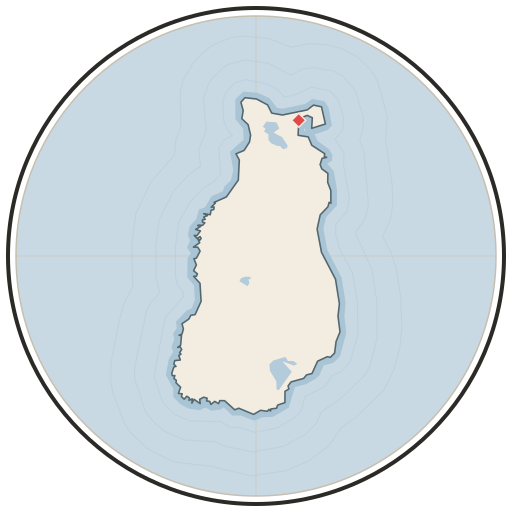
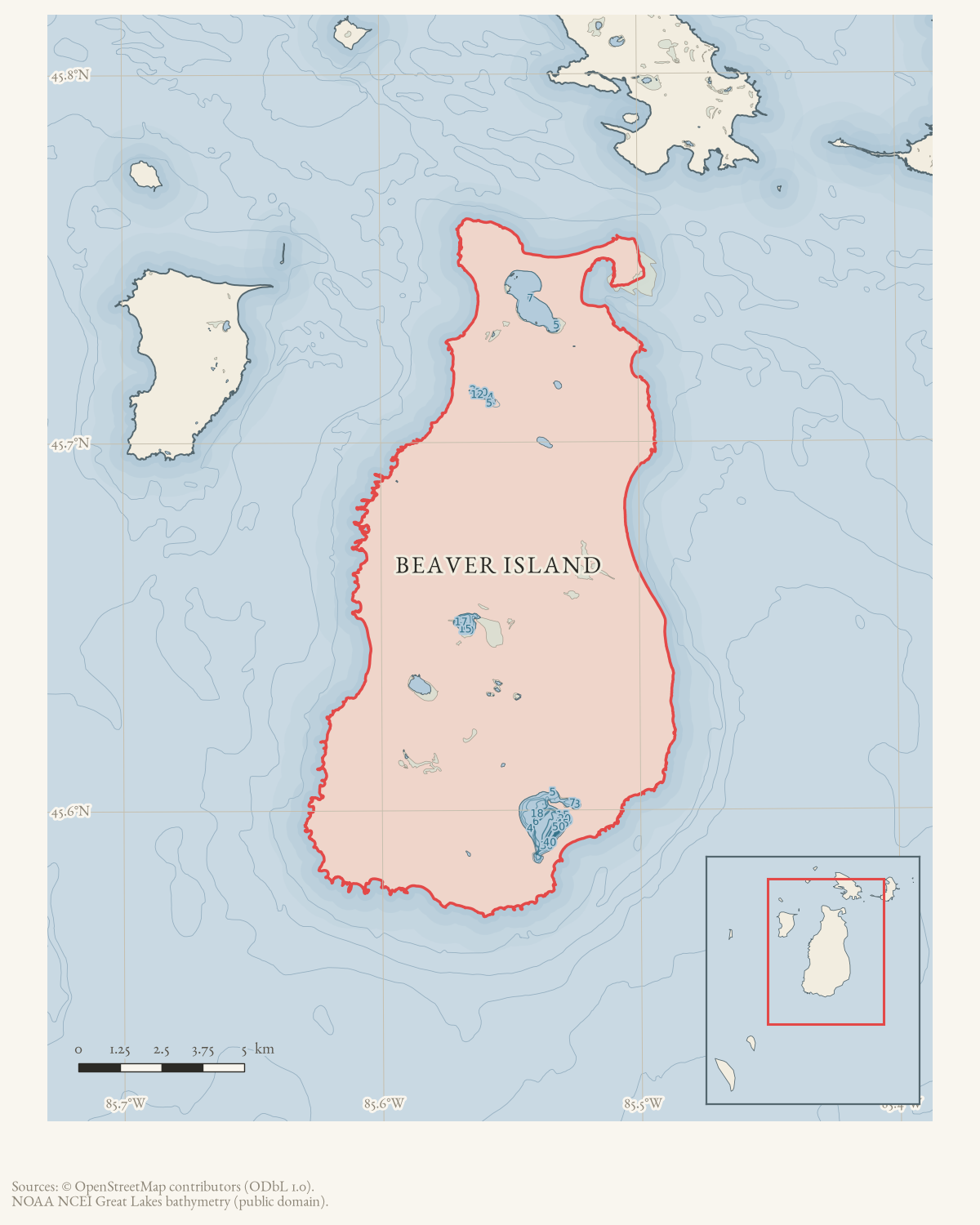
- Beaver Island
Summary
Dominican Sisters from Grand Rapids staffed Beaver Island schools beginning in 1899, according to the Michigan historical marker and local retrospective accounts. The sources explain their arrival through the island’s isolation and the difficulty of recruiting qualified teachers. They taught public-school children, including at a two-room country school, and remained part of the island’s educational history until the last two Sisters left Beaver Island in mid-July 1991, after 92 years and, by the parish’s own count, 84 Sisters in all.
History
The March 1972 Beaver Beacon correction says the Sisters had staffed island schools since 1899, rather than only for the preceding thirty years. It recalls two Sisters traveling by snowshoes to a country school in winter, while older boys cleared their path and carried their books.1 The same correction explicitly rejects a simpler poverty explanation: qualified individual teachers were hard to obtain because Beaver Island was genuinely isolated, while a group living together could withstand that isolation.1
Three accounts preserve different details about the beginning, none silently resolved into a single roster. Clementine McCauley’s March 1972 account says Bishop Richter met the county school commissioner on the boat to the island and that Sisters Clementine, Genevieve, and Eleanor came; it places their first teaching in the jail and says islanders then built the school.2 Mrs. Fred Zalusky’s June 1972 letter instead credits Father Zugelder’s 1899 committee and correspondence with Bishop Richter, names the first three as Clementine, Genevieve, and Gabriel, and says they initially lived in the house beside the present Hall. She dates the convent’s construction to 1901 and recalls horse-and-buggy travel to downtown schools before the first automobile in 1924.3 A third account, published in the parish’s own August 1991 departure report, names four arrivals with full surnames – Sisters Clementine Coyle, Genevieve Gauthier, Hildegard Gauthier, and Gabriel O’Malley – agreeing with Zalusky on “Gabriel” but adding a fourth Sister neither 1972 account mentions.4 A house-history feature published in August 1988 adds a fourth version of the earliest lodging: the Sisters “first come to Beaver Island, they stayed up stairs and built a chapel for daily Mass” in the 1858 Gallagher/Duffy House, then a boarding house – a detail not reconciled with the jail or Hall accounts above.5
McCauley herself returned to the story in a September 1991 letter, writing in the same voice as her 1972 account and identifying herself as named for Sister Clementine. She repeats Clementine, Genevieve, and Eleanor as the first three – Eleanor taught music – and adds that her own family’s house, built in 1903, supplied a rent-free music room once the Sisters had moved out of the jail and into the newly built school; in return, she and her siblings received free piano or violin lessons. She dates the island’s first two 12th-grade graduates to 1918.6
The Michigan marker gives the institutional boundary held here: Dominican Sisters taught on the island from 1899 through 1991.7 Between those dates, named individuals recur in the record without a complete personnel list: Sister Nancy Malburg served as principal from about 1973 until 1976, when she was appointed the Dominican Sisters’ Director of Personnel Services in Grand Rapids and was succeeded by Sister Dennis Marie Kirt.8 In October 1977 Holy Cross Parish marked the Dominican Sisters’ centennial of ministry across Michigan (not specific to the island) with a Mass of Thanksgiving, inviting every Sister who had served Beaver Island to attend.9 Administrative leadership passed to a layperson well before teaching did: Miss Rakowski became “the first lay principal in the 92 years since the Dominican Sisters of Grand Rapids have been teaching here” in 1979, twelve years before Sisters stopped teaching in the classroom entirely.10 A November 1974 obituary for Sister M. Aquino Boyce, O.P., who died in Grand Rapids at 57, lists Beaver Island among her several Michigan teaching assignments without dating her time on the island.11
Departure, 1991
The Dominican Sisters left Beaver Island in mid-July 1991, the Beacon reported that August, ending 92 years of service; the parish’s own count puts 84 Sisters through the school in that time, with Sisters Marie Eugene Charbonneau and Mary Alvesteffer the last to leave.4 A June 1991 tribute anticipated the departure, thanking the Sisters for “nearly a century” of teaching and community service.12 Roughly 200 people attended a farewell potluck at the parish hall; Deacon Mike McGinnity was master of ceremonies, and speakers included Mrs. JoAnn Cashman, Mr. Joseph Moore, Fr. Leonard Jocys, and Mrs. Helen Pike, who read a poem written for the occasion by Mrs. Eleanor LaFreniere.4 The report states that for the first time, the Beaver Island Community School would be taught entirely by lay teachers – twelve years after the school’s administration had already passed to a lay principal.4
Significance
The Sisters connected the post-1856 Irish-Catholic community to a public-school system that otherwise struggled to staff an isolated island. Their history is therefore related to both Holy Cross parish and the broader Irish settlement, without making the parish itself identical with the teaching community. Across 92 years and, by the parish’s count, 84 individual Sisters, they were also, in the 1991 tribute’s own words, “members of the Island family for births, christenings, weddings, illness, death” – a role the held sources describe but this article does not independently verify beyond what the tribute itself states.
Open questions
- Which Dominican community records identify the Sisters named in the 1899 accounts, and can they resolve Eleanor, Gabriel, and Hildegard across the three conflicting 1972 and 1991 rosters?
- Can school-board minutes, contracts, or building records establish the precise sequence of the Gallagher/Duffy House, jail, country-school, downtown-school, convent, and present-school locations?
- Is a complete roster of the 84 Sisters who served the island, referenced but not enumerated in the 1991 departure report, held by the Dominican Sisters of Marywood or the Grand Rapids diocese?
See also
Footnotes
-
Clementine McCauley, “How the Irish Came to Settle on Beaver Island,” Beaver Beacon, March 1972. ↩
-
Mrs. Fred Zalusky, letter, Beaver Beacon, June 1972. ↩
-
“William J. Gallagher, Jr. and Mary Duffy House,” Beaver Beacon, August 1988. ↩
-
“How the Dominican Sisters came to teach,” Beaver Beacon, September 1991. ↩
-
Michigan Historical Marker “Holy Cross Catholic Church,” marker ID L2251. ↩
-
Beaver Beacon, September 1976, principal transition notice. ↩
-
“Dominican Sisters’ Centennial,” Beaver Beacon, August 1977. ↩
-
Beaver Beacon, June 1979, “School News.” ↩
-
Obituary, Sister M. Aquino Boyce, O.P., Beaver Beacon, November 1974. ↩
-
Farewell tribute, Beaver Beacon, June 1991. ↩
The dated record
Sources
- The marker says Dominican Sisters taught on Beaver Island from 1899 to 1991.state · michigan · historical_markers
- Correction says Dominican Sisters from Grand Rapids had staffed the schools since 1899 and came because the island was isolated and qualified teachers were difficult to obtain; it also recalls a two-room country school and winter travel.data1 · beaver-island-archive · beaver_beacon · 1972-03_Beaver-Beacon
- The held eleven-page issue scan is paired with the OCR source and confirms the published notice or report; it does not expand the source-specific identity, event, or outcome claims.data1 · beaver-island-archive · scans · beaver_beacon · issues · 1972-03_Beaver-Beacon
- Reprints the March correction and preserves its explanation of the Sisters' recruitment as an isolation and teacher-supply problem, not simply an inability to pay public-school salaries.data1 · beaver-island-archive · beaver_beacon · 1972-04_Beaver-Beacon
- The held eight-page issue scan is paired with the OCR source and confirms the published notice or report; it does not expand the source-specific identity, event, or outcome claims.data1 · beaver-island-archive · scans · beaver_beacon · issues · 1972-04_Beaver-Beacon
- Family correction names Father Zugelder, Bishop Richter, and three first Sisters as Clementine, Genevieve, and Gabriel; it places their first home beside the Hall, dates the convent to 1901, and records horse-and-buggy travel before a first automobile in 1924. The individual names conflict with Clementine McCauley's Eleanor variant and are retained as an unresolved source disagreement.data1 · beaver-island-archive · beaver_beacon · 1972-06_Beaver-Beacon
- The held eight-page issue scan is paired with the OCR source and confirms the published notice or report; it does not expand the source-specific identity, event, or outcome claims.data1 · beaver-island-archive · scans · beaver_beacon · issues · 1972-06_Beaver-Beacon
- Lists five Sisters staffing Beaver Island School in 1973–74 and identifies their roles and prior locations; it is a school-year roster, not a complete congregation record.data1 · beaver-island-archive · beaver_beacon · 1973-09_Beaver-Beacon
- The held eleven-page issue scan is paired with the OCR source and confirms the combined September–October publication; it does not expand the published source-specific identity, event, or outcome claims.data1 · beaver-island-archive · scans · beaver_beacon · issues · 1973-09_Beaver-Beacon
- Reports the Grand Rapids Education Committee warning that the Sisters might be removed within two years because too few Sisters were available; it records concern but no final withdrawal or replacement plan.data1 · beaver-island-archive · beaver_beacon · 1974-04_Beaver-Beacon
- The held seven-page issue scan is paired with the OCR source and confirms the published notice or report; it does not expand the source-specific identity, event, or outcome claims.data1 · beaver-island-archive · scans · beaver_beacon · issues · 1974-04_Beaver-Beacon
- Reports a May 3 pantry shower at the convent attended by 35 women, including five nuns, with gifts and a buffet luncheon. It does not identify the individual Sisters or provide a congregation event record.data1 · beaver-island-archive · beaver_beacon · 1962-05_Beaver-Beacon
- The held six-page issue scan is paired with the OCR source and confirms the published notice or report; it does not expand the source-specific identity, event, or outcome claims.data1 · beaver-island-archive · scans · beaver_beacon · issues · 1962-05_Beaver-Beacon
- Reports Sister Nancy Malburg, principal for the preceding three years, accepting appointment as Director of Personnel Services for the Dominican Sisters in Grand Rapids, and Sister Dennis Marie Kirt succeeding her as principal, with her prior teaching assignments listed. The holding institution's portal restricts automated access; the archive holds a copy of this issue and can provide it on request.data1 · beaver-island-archive · beaver_beacon · 1976-09_Beaver-Beacon
- Announces the Dominican Sisters of Grand Rapids' centennial of ministry in Michigan (not specific to the island, where they had then taught since 1899) and a October 1, 1977 Mass of Thanksgiving at Holy Cross Parish, to which all Sisters who had served Beaver Island were invited. The holding institution's portal restricts automated access; the archive holds a copy of this issue and can provide it on request.data1 · beaver-island-archive · beaver_beacon · 1977-08_Beaver-Beacon
- Reports Miss Rakowski as "the first lay principal in the 92 years since the Dominican Sisters of Grand Rapids have been teaching here" -- an administrative transition to lay leadership twelve years before the Sisters' 1991 departure from teaching itself. The holding institution's portal restricts automated access; the archive holds a copy of this issue and can provide it on request.data1 · beaver-island-archive · beaver_beacon · 1979-06_Beaver-Beacon
- A house-history feature reports that "when the Dominican Sisters first come to Beaver Island, they stayed up stairs and built a chapel for daily Mass" in the 1858 Gallagher/Duffy House, then used as a boarding house -- evidence for the Sisters' first lodging, distinct from and not reconciled with the jail or Hall locations named in the 1972 and 1991 oral accounts below. The holding institution's portal restricts automated access; the archive holds a copy of this issue and can provide it on request.data1 · beaver-island-archive · beaver_beacon · 1988-08_Beaver-Beacon
- Obituary of Sister M. Aquino Boyce, O.P., aged 57, who died October 7, 1974, in Grand Rapids; lists Beaver Island among her many Michigan teaching assignments (undated within her career) alongside Sacred Heart Academy, Carson City, Saginaw, and Alpena postings.data1 · beaver-island-archive · beaver_beacon · 1974-11_Beaver-Beacon
- A published tribute bids the Dominican Sisters "a fond farewell" after "nearly a century" of teaching and community service, published shortly before their departure. The holding institution's portal restricts automated access; the archive holds a copy of this issue and can provide it on request.data1 · beaver-island-archive · beaver_beacon · 1991-06_Beaver-Beacon
- Reports the Dominican Sisters' departure from Beaver Island in mid-July 1991 after 92 years of service; names the first arrivals in 1899 as Sisters Clementine Coyle, Genevieve Gauthier, Hildegard Gauthier, and Gabriel O'Malley (four Sisters, full surnames, conflicting with both 1972 oral accounts above); states 84 Dominican Sisters served the island in all; names the last two, Sisters Marie Eugene Charbonneau and Mary Alvesteffer; and describes a roughly 200-person farewell potluck at the parish hall with named speakers and a poem by Mrs. Eleanor LaFreniere. States the Beaver Island Community School would for the first time be taught entirely by lay teachers. The holding institution's portal restricts automated access; the archive holds a copy of this issue and can provide it on request.data1 · beaver-island-archive · beaver_beacon · 1991-08_Beaver-Beacon
- A first-person letter, internally identified as by the same writer as the March 1972 "Clementine McCauley" account (she states she was named for Sister Clementine), gives a fuller version of the founding story consistent with her 1972 account -- Sisters Clementine, Genevieve, and Eleanor, taught first in the jail, then in the school Islanders built, with a room in the writer's own family home (built 1903) used rent-free for music lessons. Also records that 1918 produced the school's first two 12th-grade graduates. The holding institution's portal restricts automated access; the archive holds a copy of this issue and can provide it on request.data1 · beaver-island-archive · beaver_beacon · 1991-09_Beaver-Beacon
Added 1 August 2026 · revised 3 August 2026. Recent changes
Cite this article
Beaver Island Archive, “Dominican Sisters of Beaver Island schools”, https://beaverislandarchive.org/organizations/dominican-sisters-beaver-island-school/, accessed [date], citing Michigan Historical Marker "Holy Cross Catholic Church," marker ID L2251. (and 20 further sources listed on the page).
Last revised 2026-08-03. Fill in [date] with the date you read it — this page is static and cannot know that.
BibTeX for “Dominican Sisters of Beaver Island schools”RIS for “Dominican Sisters of Beaver Island schools”