- Dates
- 2010 – 2017
- Eras
- Modern era
- Concepts
- environmentconservationforestswetlandsgeologyheritage
- Within
- Whiskey Island · Beaver Island archipelago
What this adds
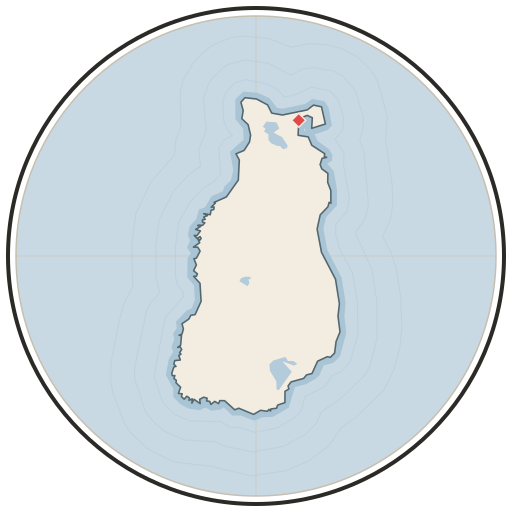
Whiskey Island is now represented by a connected but explicitly limited ecology record. The 2017 Michigan Department of Natural Resources plan describes the smallest island in its management frame as approximately 100 acres, entirely state owned and undeveloped, acquired in 2012 through a land exchange. Its broad cover types are mixed conifer, balsam fir, and some aspen. The plan also says that no natural-heritage surveys had been conducted there, although earlier visits noted several threatened and endangered plant species.
That survey-gap statement matters: the cover-type list is a baseline, not a complete forest or plant inventory. The plan identifies a nearshore colonial waterbird site and bald-eagle nesting territories as management concerns.
2010 cormorant colony
Van Guilder and Seefelt provide the strongest direct ecological evidence now held for Whiskey Island. They studied a cormorant colony during the 2010 breeding season, with early and late whole-colony counts on June 7 and July 21. Whiskey had both ground and tree nests, and the focal sites were selected for nest visibility in complex vegetation. The island was not subjected to control until young birds were fledging.
The early count found 332 nests—184 on the ground and 148 in trees—with 737 chicks modeled. The late count found 107 nests—12 on the ground and 95 in trees—with 221 chicks modeled, or 2.07 modeled chicks per nest. The study estimated that 238 chicks, 32 percent of the estimated maximum hatched, survived to fledging. These are single-season study results and modeled quantities, not a current colony trend.
Fish-community connection
The article analyzed 61 regurgitate samples containing 236 whole fish. Across the Hat and Whiskey colonies, round goby made up 67 percent of prey biomass and alewife 29 percent. White sucker and crayfish occurred only in Whiskey samples, at 4 percent and less than 0.1 percent respectively. The Whiskey chick-consumption model totaled 2,160.24 kg: 1,568.64 kg round goby, 428.69 kg alewife, 152.43 kg white sucker, and 10.48 kg crayfish. These are modeled prey consumption by chicks, not lake-wide prey biomass or a direct ecosystem-impact measurement.
The study therefore links Whiskey’s bird history to the archipelago’s changing nearshore food web: the authors describe a shift from a historically alewife- dominated diet toward lower-energy, round-goby-dominated prey. This evidence belongs alongside fish, water-quality, invasive-species, and nearshore-habitat research rather than being collapsed into a terrestrial vegetation layer.
Vegetation, predation, and distribution context
The paper notes complex vegetation structure, tree and ground nesting, and a tendency for cormorants to nest in vegetation that discouraged gull predation. Bald Eagles were observed preying on cormorants in focal areas. The authors interpret eagle and possibly owl predation as a likely influence on ground-nest abandonment and a possible contributor to colony decline, while noting that the causal effect was not experimentally measured.
The MDNR Appendix B table marks Whiskey for Eastern American toad, Common snapping turtle, Painted turtle, Common garter snake, Northern water snake, Northern red-bellied snake, Eastern milk snake, and Bald Eagle. These marks are distribution-table context with mixed underlying dates and sources—not Whiskey-specific coordinates, abundance estimates, or a complete inventory. The same plan’s 2017 status language said current information suggested no deer on Whiskey; that is a dated management statement, not proof of present absence.
Map and KB limits
Neither held source prints a Whiskey-specific occurrence coordinate for the colony or the distribution-table taxa. The generated index therefore emits no inferred centroid or study-site point. Whiskey can still be shown as a reference island geography, while the ecological evidence remains attached as non-coordinate records. A future parcel, natural-heritage, or survey dataset can add geometry without conflating it with the 2010 study.
The current GBIF snapshot retains no Whiskey records, but that is a public-data coverage result, not evidence that Whiskey lacks wildlife. The next useful search is the underlying MDNR/MNFI records and any public-safe survey or colonial-waterbird monitoring data, especially for the plant species noted in the plan.
Sources
- Official management baseline: approximate area, ownership, cover types, survey gap, management concerns, dated deer statement, and table-level island distribution marks.research · island_farming · sources · mdnr_northern_lake_michigan_islands_plan_2017
- Peer-reviewed 2010 field study of Hat and Whiskey colonies; the held PDF is a public copy and the DOI is the canonical publication link.research · wildlife · sources · whiskey_island_cormorant_bioenergetics_2013
- Generated Whiskey Island ecology index and provenance sidecar.Separates management-plan context, distribution-table marks, direct field-study results, modeled values, and evidence limits. No public copy of this file is known; the archive holds one and can provide it on request.research · wildlife · indices · whiskey_island_ecology_2010_2017
Added 3 August 2026. Recent changes
Cite this article
Beaver Island Archive, “Whiskey Island ecology, wildlife context, and cormorant study evidence”, https://beaverislandarchive.org/documents/whiskey-island-ecology-and-cormorant-study-2010-2017/, accessed [date], citing Michigan Department of Natural Resources, Management Plan for State-owned Lands on Northern Lake Michigan Islands (2017), pp. 10, 15, and Appendix B. (and 2 further sources listed on the page).
Last revised 2026-08-03. Fill in [date] with the date you read it — this page is static and cannot know that.
BibTeX for “Whiskey Island ecology, wildlife context, and cormorant study evidence”RIS for “Whiskey Island ecology, wildlife context, and cormorant study evidence”