- Eras
- Modern era
- Concepts
- transportationmaritimecommunitycommunicationtourism
- Media
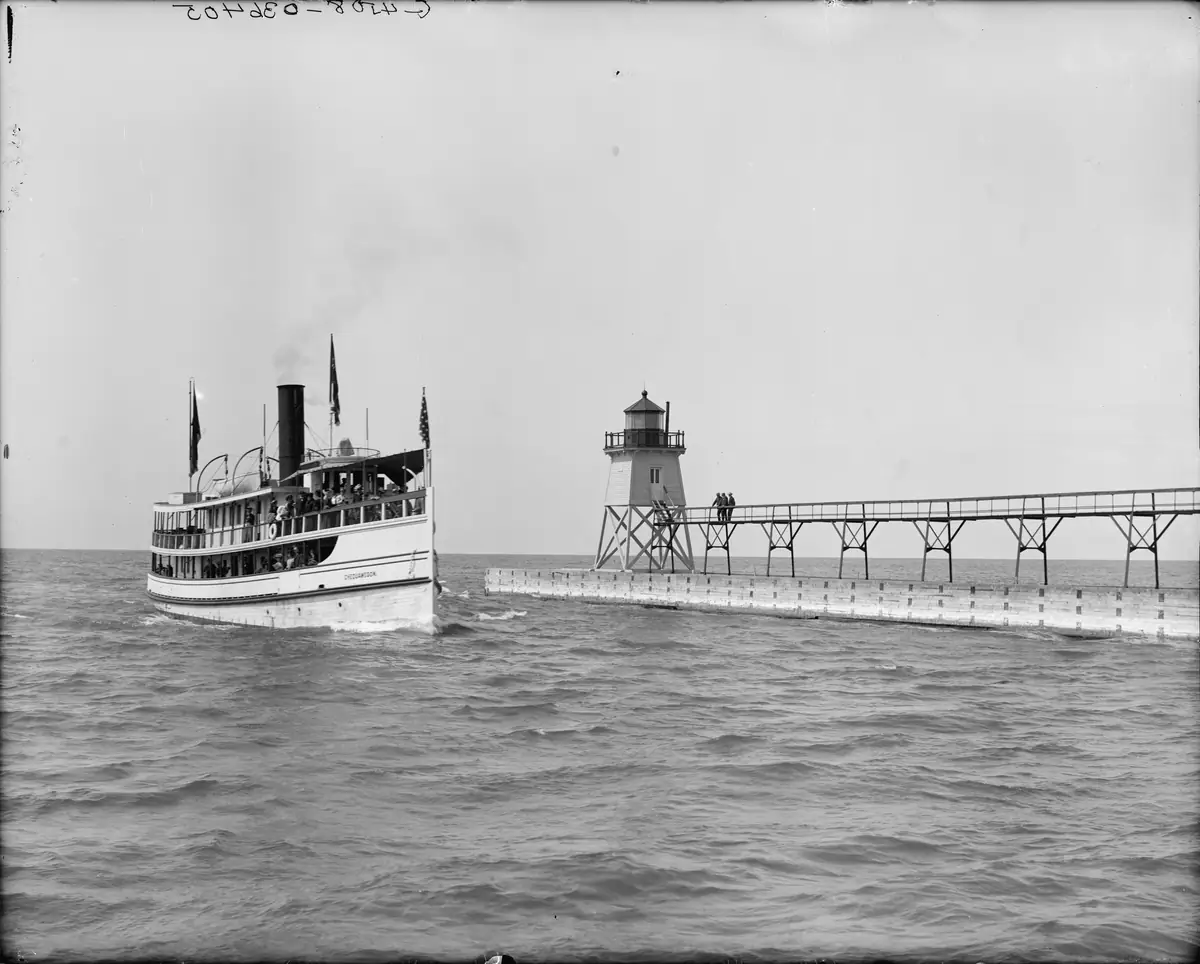
- Charlevoix light and harbour entrance, with the steamer Chequamegon (c. 1900-1910)
Summary
Beaver Island is, as the Beaver Beacon once put it, “the most remote inhabited community in the contiguous United States,” and everything about that condition turns on one boat. Since about 1890 a scheduled vessel has carried the island’s mail, passengers, freight and winter supplies across the thirty-two miles from Charlevoix to Saint James Harbor. Roughly twenty vessels have held the run. Two hold it now: the Emerald Isle of 1997 and the Beaver Islander of 1962, the latter still working at more than sixty years old.
This is a survey of that succession. The vessels themselves have their own records; the Boat Company has its own; and the wider maritime context — lights, charts, reefs and wrecks — is treated separately.
The roster
Dates are years on the Beaver Island run, not the vessels’ whole careers. Where the operator’s published history and the contemporaneous record disagree, the disagreement is set out in the next section rather than averaged away here.
| Vessel | On the run | Notes |
|---|---|---|
| Nellie | from c. 1890–95 | 60-foot steam-powered wooden hull; the first scheduled boat |
| Erie L. Hackley | c. 1896–1907 | Capt. Peter D. Campbell; 79 ft, 90 gross tons |
| Beaver | c. 1902–1915 | Campbell again; burned at the dock |
| City of Boyne | c. 1915 | Wooden steamer built at Grand Haven in 1883 as May Blossom; 87.8 ft |
| Columbia | c. 1916–17 | Burned and sank at a Charlevoix dock |
| Bruce | 1917–1920 | Earlier named A. J. Yattaw and Ogontz; 78.7 ft |
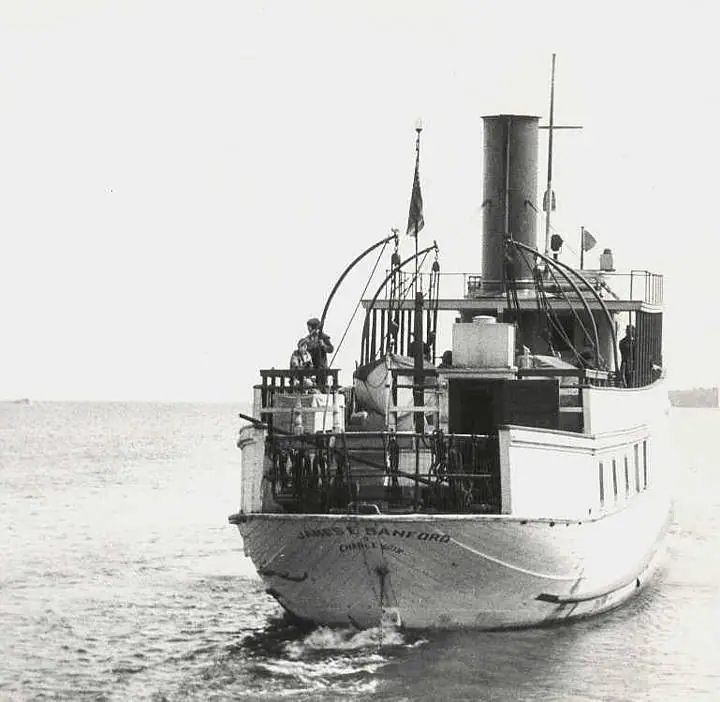
| James E. Sanford | 1920–1930 | 100 ft; reported as the first vessel to carry cars |
| Ossian Bedell | 1931–1933 | Left for the Chicago River excursion trade and the 1933 world’s fair |
| Ramblar | 1933 | A coaster, briefly |
| Marold II | 1933–1937 | A 1911 steel yacht built for Alexander Winton; destroyed by explosion, 1 January 1937 |
| Mary Margaret | from 1936 | 64-foot steel hull |
| North Shore | from c. 1946 | 64-foot wooden hull; the Lyons brothers’, later sold to the Boat Company |
| Emerald Isle | 1955–1962 | The first vessel built for the run; Christy Corporation, Sturgeon Bay |
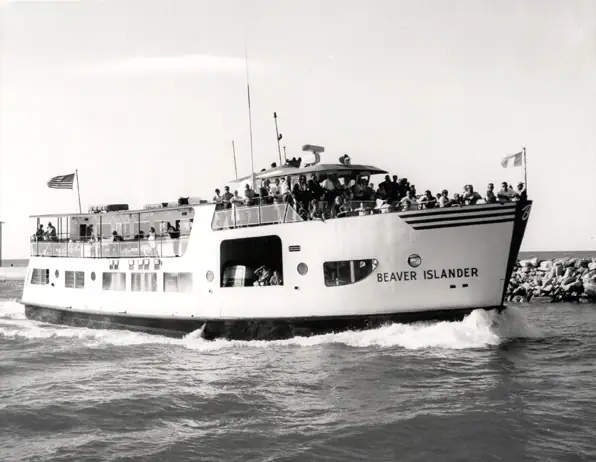
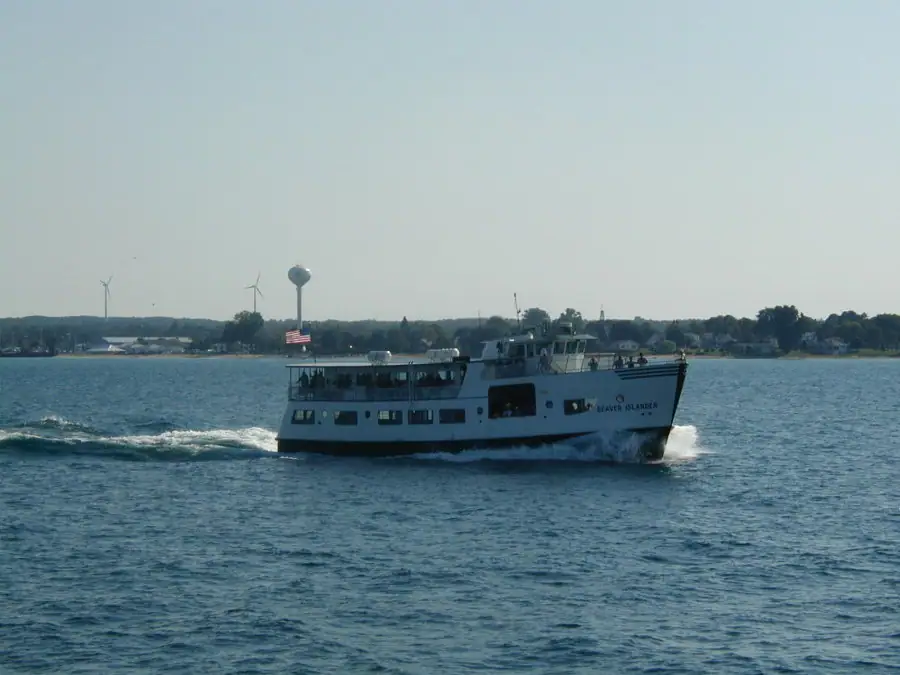
| Beaver Islander | 1962–present | Sturgeon Bay Shipbuilding; 95 ft; 172 passengers, 10 vehicles |
| South Shore | from c. 1971 | 5 vehicles, 120 passengers |
| Emerald Isle | 1997–present | Washburn & Doughty, East Boothbay, Maine; 130 ft; the largest ever on the route |
The bridge at Charlevoix
The mainland end of the run is not a dock but a drawbridge. The US-31 bascule spans over the Pine River Channel have to be raised for the ferry, stopping the highway through Charlevoix each time she passes — the crossing the January 1998 Beacon describes on the present Emerald Isle’s maiden voyage, when “as we went under the bridge, a chorus of hearty cheers went up.”
The US-31 bridge raised for the Beaver Island ferry, 15 July 2011
and lowered again once she is through
Both clips name the vessel only as “the Beaver Island ferry.”
Two boats called Emerald Isle
The name appears twice, a generation apart, and the two vessels never met on the route. The first Emerald Isle was built at Sturgeon Bay and reached Saint James on 21 April 1955; she was christened there two days later by Margaret “Aunt Maggie” Boyle, and left the run in 1962 when the larger Beaver Islander arrived. The second was floated at Boothbay Harbor, Maine, on 6 June 1997 — thirty-five years after the first had gone — and is the boat on the run today.
Anyone searching the record for “Emerald Isle” gets both. Dates, not names, separate them. The same caution applies to the Beaver, an entirely different and much older vessel that burned at the dock around 1915 and is not the Beaver Islander.
Where the accounts disagree
The Boat Company publishes its own history of the route. It is a valuable list and it is the only single source that attempts the whole succession — but it disagrees with the contemporaneous newspaper record at several points, and on one point it is demonstrably wrong.
| Question | Operator’s history | The record held here |
|---|---|---|
| Nellie on the run from | 1890 | 1895 |
| Erie L. Hackley | 1896–1900 | sold 1906–07 |
| Beaver | 1902 | ran until it burned, c. 1915 |
| Sanford | 1920 | on the run to 1930 |
| The 1 January explosion | the Boyd exploded, 1936 | the Marold II exploded, 1937 |
| Present Emerald Isle capacity | 294 passengers | 298 on another of the operator’s own pages |
The explosion is the one worth stating plainly. The J. Oswald Boyd was a gasoline tanker aground on Simmons Reef, not a ferry; islanders salvaged fuel from her through the winter. On New Year’s Day 1937 the mail boat Marold II was lashed alongside, transferring gasoline, when she exploded and sank almost immediately. Everett Cole, head of the newly formed Beaver Island Transit Company, died with four others; the Boyd burned on and carried two recovered bodies. The operator’s page attributes the explosion to the Boyd and dates it a year early.
What the run has meant
The pattern the roster shows is not steady improvement but repeated loss. Of the vessels before 1955, at least three burned and one exploded; the route consumed boats. It also changed character twice. The Sanford of 1920 is reported as the first to carry cars, which began the shift from a mail-and-passenger packet to a vehicle ferry; and the Emerald Isle of 1955 was the first hull built for this run rather than bought secondhand off another one — the point at which the island stopped taking whatever boat could be found.
The present pairing is the longest period of stability the route has had. The Beaver Islander has been on it for more than sixty years, longer than every pre-1955 vessel combined.
The boats that survive in photographs
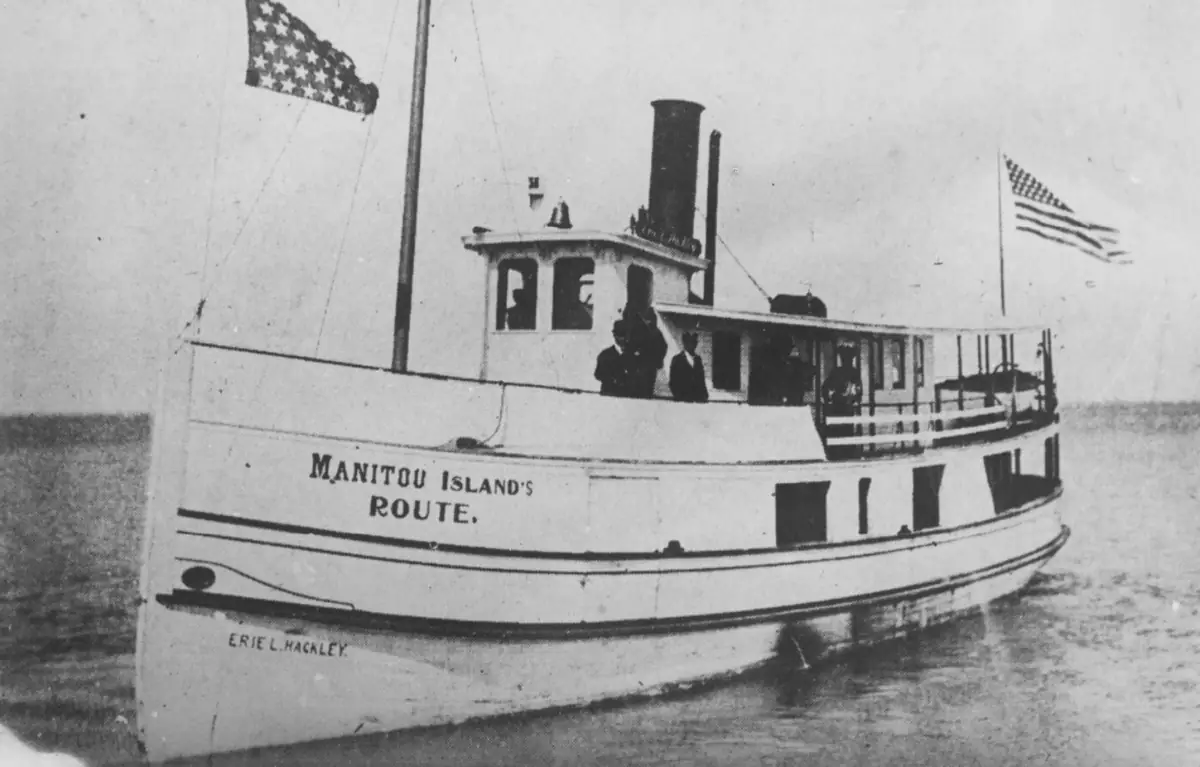
Three of the vessels on this roster can be seen. The Erie L. Hackley survives in a photograph taken before 1902, her house lettered for the Manitou Islands route she also worked; the James E. Sanford is photographed from astern with her hailing port on the transom; and the Beaver Islander appears twice, once in black and white with her upper deck packed and once in colour under way.
For the rest the record is written, not visual. Six vessel photographs in the same gallery — including an Emerald Isle, a North Shore and a South Shore — carry the watermark of the Historical Collections of the Great Lakes at Bowling Green State University, and were refused publication here in August 2026 on the ground that the Beacon cannot license a holding it does not own. That refusal is why neither Emerald Isle appears on this page.
Evidence and limits
This survey rests on two kinds of source that do not cover the same ground. The Beaver Beacon is contemporaneous from 1955 and retrospective for the earlier boats — chiefly a 1975 “Beaver Tales” series — and it stops in 2014. The Boat Company’s own history covers the whole span but is undated as to its own compilation and, as shown above, is unreliable on the 1937 explosion. No enrolment record, official number, or registry document has been consulted for any vessel here. Dates in the roster are therefore approximate wherever the two accounts diverge, and are given as such.
Open questions
- What are the enrolment records and official numbers for the pre-1955 vessels?
- When exactly did the Nellie begin, and when did the Erie L. Hackley leave?
- What became of the North Shore, the Mary Margaret and the South Shore?
- On what date did the present Emerald Isle make her first Charlevoix crossing?
- Was the Sanford really the first vehicle-carrying boat on the run?
See also
Sources
- The operator's own roster of vessels on the route from the Nellie to the present Emerald Isle, with dimensions and dates. Used as the operator's account; where it disagrees with the contemporaneous newspaper record held here, both are shown in the comparison table and neither is silently preferred.
- Beaver Beacon, March 1975 and April–June 1975, "Beaver Tales" series.A retrospective series describing the City of Boyne, the Columbia and the Bruce on the Beaver Island route, with dimensions, skippers and the circumstances of each vessel's loss or retirement.data1 · beaver-island-archive · beaver_beacon · 1975-04_Beaver-Beacon
- Beaver Beacon, January 1998, "The Maiden Voyage of the Emerald Isle."Reports the present Emerald Isle's first trip into Charlevoix with 190 islanders aboard.data1 · beaver-island-archive · beaver_beacon · 1998-01_Beaver-Beacon
- Beaver Beacon, July 1997, "She Floats!!"Reports the launch of the present Emerald Isle at Boothbay Harbor, Maine, on 6 June 1997.data1 · beaver-island-archive · beaver_beacon · 1997-07_Beaver-Beacon
Added 14 August 2026. Recent changes
Cite this article
Beaver Island Archive, “Ferry service and the mainland run”, https://beaverislandarchive.org/themes/ferry-service-and-the-mainland-run/, accessed [date], citing Beaver Island Boat Company, "Beaver Island Ferry History," retrieved 14 August 2026. (and 3 further sources listed on the page).
Last revised 2026-08-14. Fill in [date] with the date you read it — this page is static and cannot know that.
BibTeX for “Ferry service and the mainland run”RIS for “Ferry service and the mainland run”