- Rig
- Screw steamer
- Dates
- 1897 – 1903-10-03
- Official no.
- US 135615
- Owner
- Fish Creek Transportation Company
- Preceded by
- Nellie
- Eras
- Modern era
- Concepts
- maritimeshipping
- Media
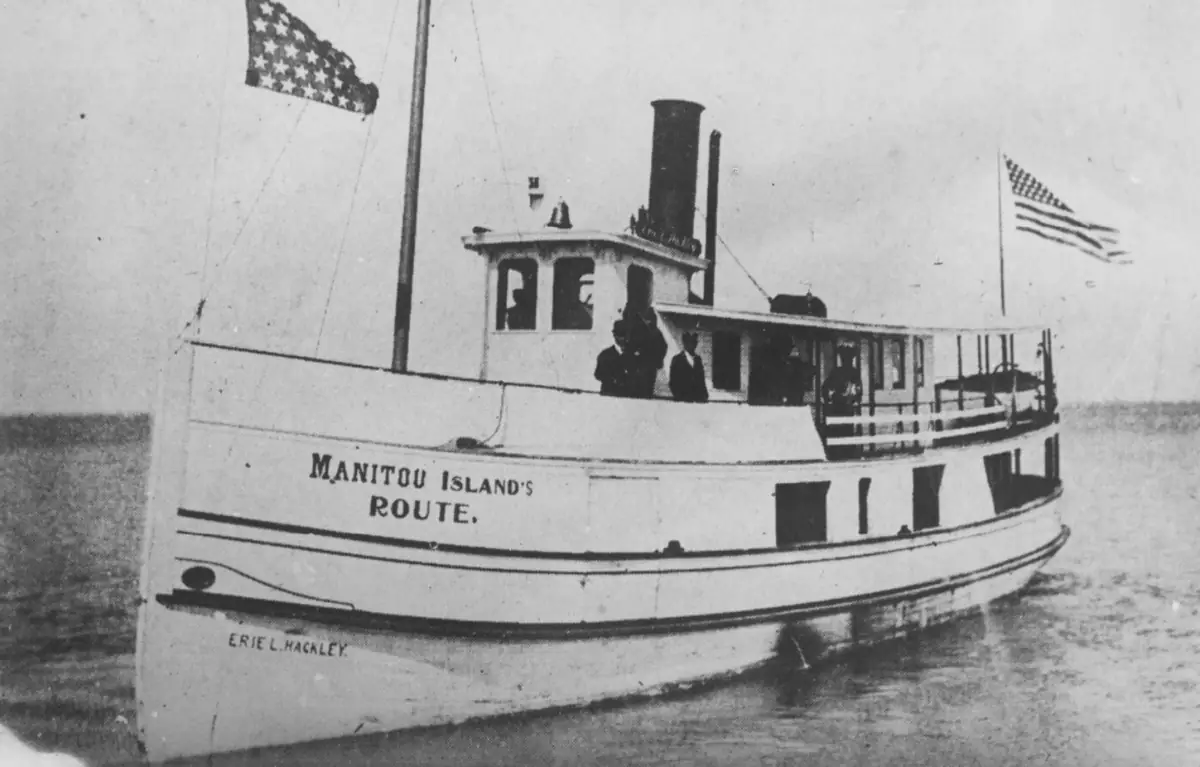
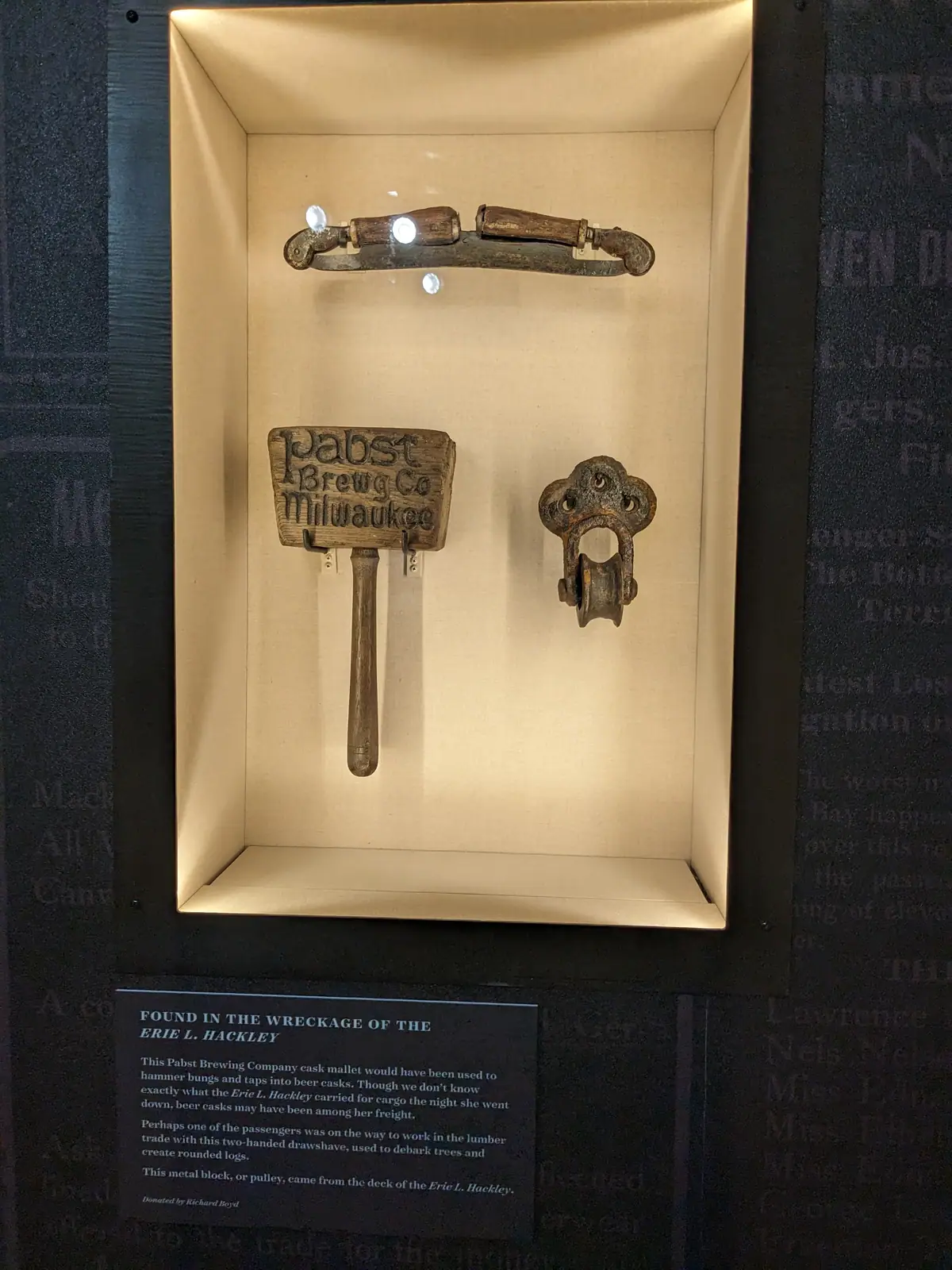
- Artifacts from the wreck of the Erie L. Hackley, museum display · The steamer Erie L. Hackley, before 1902
Summary
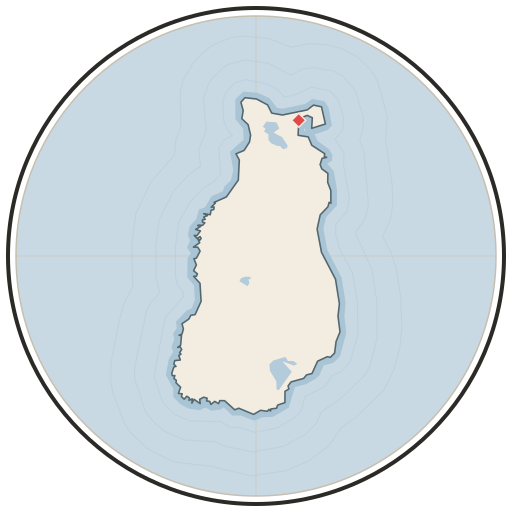
The Erie L. Hackley (also spelled Eric L. Hackley) was an 1882 Muskegon-built screw steamer that carried the Charlevoix–Beaver Island mail and passenger run for roughly a decade before passing to Green Bay service, where it sank in a squall on 3 October 1903. The October 1903 Charlevoix County Herald reports nineteen people aboard and twelve drowned; a 1973 Beaver Beacon reconstruction and a modern Wisconsin shipwreck record give eleven deaths and eight survivors, and place the wreck two miles northeast of Green Island. See Sinking of the Erie L. Hackley for the sinking itself.
The vessel identity is retained as one record because the sources agree on the name stem, 1882 Muskegon build, Beaver Island/Pine Lake service, Green Bay route, and final wreck. The service chronology conflicts: local histories place Campbell’s acquisition in 1893 or 1897, the Beaver Island mail contract in 1902 or earlier, and sale/final service in 1903 or 1906–07. The primary report gives 54 tons; the 1973 reconstruction gives 90 gross/75 net tons and 79 by 17.4 feet; another local history gives 100 feet. Dimensions and tonnage are therefore left blank, while the 1973 registry number is retained.
History
The Beaver Beacon’s “Beaver Tales” series says the Charlevoix–Beaver Island mail run’s first steam vessel was the Nellie, bought and captained by Peter D. Campbell in the 1890s; a Helen Collar subject card dates her to 1895 and gives 60 feet, with Henry Sherman as engineer. When the Nellie proved too small for the growing freight and passenger trade, Campbell replaced her with the Hackley. Two 1973 Beacon accounts disagree on the year and the vessel’s origin: one says Campbell bought her in Muskegon in 1897 and describes a 100-foot hull that had earlier spent its life towing logs into Lake Michigan sawmills; a later, more detailed account — drawing on correspondence from Mrs. Fred Floyd of Muskegon and from Janet Coe Sanborn of the Cleveland Picture Collection and Inland Seas — says the Hackley was built new in Muskegon in 1882 for Capt. Seth Lee’s Muskegon Lake Ferry Line alongside the Centennial and the Mary E. Menton, that Campbell acquired her in 1893 when Lee sold out, and that Campbell ran her between Whitehall and Muskegon until 1898 before moving to Charlevoix in 1899. The Collar card instead dates Campbell’s Hackley purchase to 1897. On the Beaver Island run, the steamer Joe, owned by “Big Neil” Gallagher, competed for passengers, but Campbell held the mail contract.
Accounts also disagree on when that contract began and ended. The 1973 reconstruction says Campbell first put the Hackley on the longer Charlevoix–Manitou Islands route in 1899, won the Beaver Island mail contract in 1902, and sold the vessel that same year to Benjamin Newhall of Chicago while staying on as captain. Two other “Beaver Tales” installments instead say Campbell held the Beaver Island mail contract on the Hackley until 1906 or 1907, when he replaced her with the steamer Beaver — one printed in 1973, the other independently in February 1975 — which matches the Collar card’s “1906 or ’07.” Contemporary Charlevoix reporting complicates both dates. The Charlevoix County Herald records the Hackley running short Lake Michigan and Pine Lake excursions out of Charlevoix during a Masonic picnic on 18 July 1902, and again carrying fair-goers alongside the steamer Rhocean on 26 September 1902 — the only two mentions of the vessel in the Herald’s run of issues between those dates and its October 1903 loss report. In early 1903 the Hackley was purchased by the Fish Creek Transportation Company of Menominee, Wisconsin, for Green Bay service, and ran that summer to Door Peninsula ports under Capt. Joseph Vorous of Fish Creek, who owned her in partnership with Henry Robertory and area stockholders. She foundered off Green Island on 3 October 1903 with Vorous still at the wheel. A June 2010 Beacon “100 Years Ago” column, quoting a Charlevoix-area item dated 30 June 1910, has Campbell — by then master of the Beaver — recalling that “since he came here with the steamer Hackley, he has made twelve hundred round trips to the Island,” which confirms Campbell brought the Hackley to the route but does not itself date her departure from it.
A cask mallet branded for the Pabst Brewing Company, a drawshave, and a deck pulley block, all recovered from the wreck site and now displayed with a placard crediting the find to Richard Boyd, are physical evidence of the 1903 loss:
Significance
The Hackley is the second vessel in the documented chain of steamers that carried Beaver Island’s mail and passenger contract from the Nellie in the 1890s through the Beaver, City of Boyne, Columbia, and Bruce into the twentieth century — the run that became, decades later, the Beaver Island Boat Company’s ferry service. Her 1903 loss on Green Bay, with a substantial fraction of those aboard drowned, is one of the deadlier known wrecks connected to a vessel that had served the island, even though the sinking itself occurred after she had left island service.
Evidence and limits
The contemporary Charlevoix reporting held here — the two 1902 Herald excursion notices and the October 1903 wreck report — places the Hackley on Pine Lake and Lake Michigan service out of Charlevoix as late as September 1902 and confirms her loss, under new Green Bay ownership, almost exactly one year later. That timeline sits closer to the reconstruction’s “sold in 1902” account than to the “held the contract until 1906 or 1907” account repeated in two separate Beaver Tales installments and the Collar card: a vessel that sank on Green Bay in October 1903 could not also have run the Beaver Island mail contract for Campbell in 1906 or 1907. This record does not resolve the discrepancy — it may reflect a later columnist’s memory error, a confusion with the Beaver’s own start date, or a garbled transcription passed between the two 1973 pieces and 1975 — but the primary 1902 and 1903 dates are treated as the more reliable anchor.
Open questions
- Which official records reconcile the 54-ton, 90-gross-ton, 79-foot, and 100-foot descriptions?
- Which mail-contract and ownership records reconcile the 1893/1897 acquisition date, and how did the “1906 or 1907” departure date printed in three separate local retrospectives arise if the vessel had already sunk, under different ownership, in October 1903?
- Can contemporary Menominee or Door County reports identify the other casualties and survivors?
- Do any Muskegon Lake Ferry Line or Fish Creek Transportation Company records settle whether the Hackley’s pre-Campbell career included towing logs, as one local history states and no other source confirms?
See also
Sources
- Local retrospective says Peter D. Campbell purchased the Eric L. Hackley in Muskegon in 1897, brought it to Charlevoix, and used it on the Beaver Island run until 1906 or 1907; it gives a length of 100 feet and a small steam engine.data1 · beaver-island-archive · beaver_beacon · 1973-03_Beaver-Beacon
- The held ten-page issue scan is paired with the OCR source and confirms the published notice or report; it does not expand the source-specific identity, event, or outcome claims.data1 · beaver-island-archive · scans · beaver_beacon · issues · 1973-03_Beaver-Beacon
- The normalized continuation repeats the 1897 Muskegon purchase and approximate 1906–07 mail-contract endpoint, and describes the Hackley’s competition with the steamer Joe; the retrospective does not resolve the vessel’s registry, dimensions, or chronology conflicts.data1 · beaver-island-archive · beaver_beacon · 1973-03_Beaver-Beacon
- The held ten-page issue scan is paired with the OCR source and confirms the published notice or report; it does not expand the source-specific identity, event, or outcome claims.data1 · beaver-island-archive · scans · beaver_beacon · issues · 1973-03_Beaver-Beacon
- Preceding installment identifies the Eric L. Hackley as the successor to the small Nellie and says it carried the established mail and passenger run between Charlevoix and Beaver Island.data1 · beaver-island-archive · beaver_beacon · 1973-02_Beaver-Beacon
- The held seven-page issue scan is paired with the OCR source and confirms the published notice or report; it does not expand the source-specific identity, event, or outcome claims.data1 · beaver-island-archive · scans · beaver_beacon · issues · 1973-02_Beaver-Beacon
- The normalized issue rendering preserves the retrospective account that the small Nellie was replaced by the Eric L. Hackley after an established Charlevoix–Beaver Island mail and passenger run had developed.data1 · beaver-island-archive · beaver_beacon · 1973-02_Beaver-Beacon
- The held seven-page issue scan is paired with the OCR source and confirms the published notice or report; it does not expand the source-specific identity, event, or outcome claims.data1 · beaver-island-archive · scans · beaver_beacon · issues · 1973-02_Beaver-Beacon
- Subject-card chronology independently places the Eric L. Hackley on the route from 1897 and says Campbell sold it in 1906 or 1907; it also notes a later loss on Green Bay, without supplying a casualty record.web · collar_subject_cards_q-z
- "Steamer Erie L. Hackley Lost," *Charlevoix County Herald*, October 10, 1903.Contemporary local report says the passenger steamer Erie L. Hackley sank in Green Bay with nineteen aboard, twelve reported drowned, and identifies it as a 54-ton screw steamer built at Muskegon in 1882. No public copy of this file is known; the archive holds one and can provide it on request.
- Detailed local reconstruction uses Erie L. Hackley, gives registry number US 135615 and 79-by-17.4-foot/90-gross-ton dimensions, dates the Green Bay loss to October 3, 1903, and reports eleven deaths. These dimensions and the chronology conflict with other held histories, so only the registry number is promoted to structured metadata.data1 · beaver-island-archive · beaver_beacon · 1973-05_Beaver-Beacon
- The held nine-page issue scan is paired with the OCR source and confirms the published notice or report; it does not expand the source-specific identity, event, or outcome claims.data1 · beaver-island-archive · scans · beaver_beacon · issues · 1973-05_Beaver-Beacon
- Shipwreck record corroborates the 1903 loss, nineteen aboard, eight survivors, eleven deaths, and wreck location; it does not resolve the Erie/Eric spelling or earlier Beaver Island service chronology.
- Clementine McCauley’s family account says the mail boat Hackley could not cross from Charlevoix until December 24 during the aftermath of the 1900 tragedy; this supports route-era context without adding vessel registry data.data1 · beaver-island-archive · beaver_beacon · 1972-01_Beaver-Beacon
- The held nine-page issue scan is paired with the OCR source and confirms the published notice or report; it does not expand the source-specific identity, event, or outcome claims.data1 · beaver-island-archive · scans · beaver_beacon · issues · 1972-01_Beaver-Beacon
- Charlevoix County Herald, July 18, 1902, local news.Reports that "the steamer Hackley run short excursions on Lake Michigan and Pine Lake" for visitors attending a Masonic picnic at Charlevoix -- contemporary confirmation that the Hackley was still Charlevoix-based in July 1902. No public copy of this file is known; the archive holds one and can provide it on request.
- Charlevoix County Herald, September 26, 1902, local news.Reports that "the steamers Hackley and Rhocean each brought in parties of excursionists to attend the Fair" -- further contemporary confirmation of Charlevoix-based service in September 1902, and the only held issue of the Herald to mention the vessel between this date and the October 1903 wreck report. No public copy of this file is known; the archive holds one and can provide it on request.
- A separate "Beaver Tales" installment repeats that the "Erie L. Hackley," "also skippered by Capt. Campbell," "operated on the run until 1906 or 07, when Capt. Campbell purchased the 'Beaver'" -- corroborating the 1906/07 chronology found elsewhere in this record, which conflicts with the vessel's documented 3 October 1903 loss on Green Bay. The holding institution's portal restricts automated access; the archive holds a copy of this issue and can provide it on request.data1 · beaver-island-archive · beaver_beacon · 1975-02_Beaver-Beacon
- Beaver Beacon, June 2010, "100 Years Ago" (quoting Charlevoix-area local news of June 30, 1910).Quotes a June 30, 1910 local news item: "Capt. Pete Campbell, of the Beaver was figuring up the other day and found that since he came here with the steamer Hackley, he has made twelve hundred round trips to the Island" -- a later republication, not an independent primary source, but it corroborates that Campbell arrived on the Charlevoix-Beaver Island run aboard the Hackley. No public copy of this file is known; the archive holds one and can provide it on request.data1 · beaver-island-archive · beaver_beacon · 2010-06_Beaver-Beacon
Added 31 July 2026 · revised 3 August 2026. Recent changes
Cite this article
Beaver Island Archive, “Erie L. Hackley”, https://beaverislandarchive.org/vessels/eric-l-hackley/, accessed [date], citing Beaver Beacon, March 1973, “Beaver Tales.” (and 14 further sources listed on the page).
Last revised 2026-08-03. Fill in [date] with the date you read it — this page is static and cannot know that.