- Founded
- circa 1953
- Operated by
- Joseph W. Christie
- Coordinates
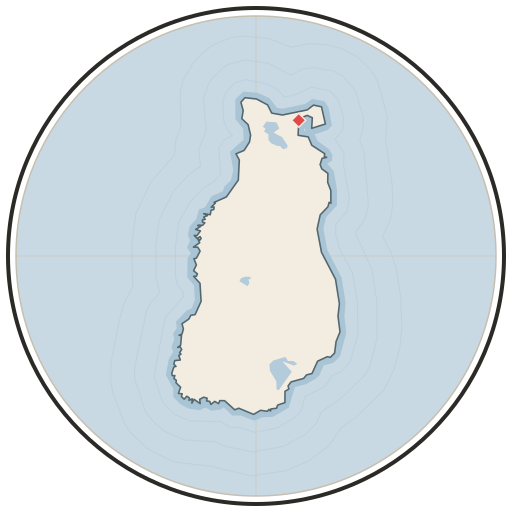
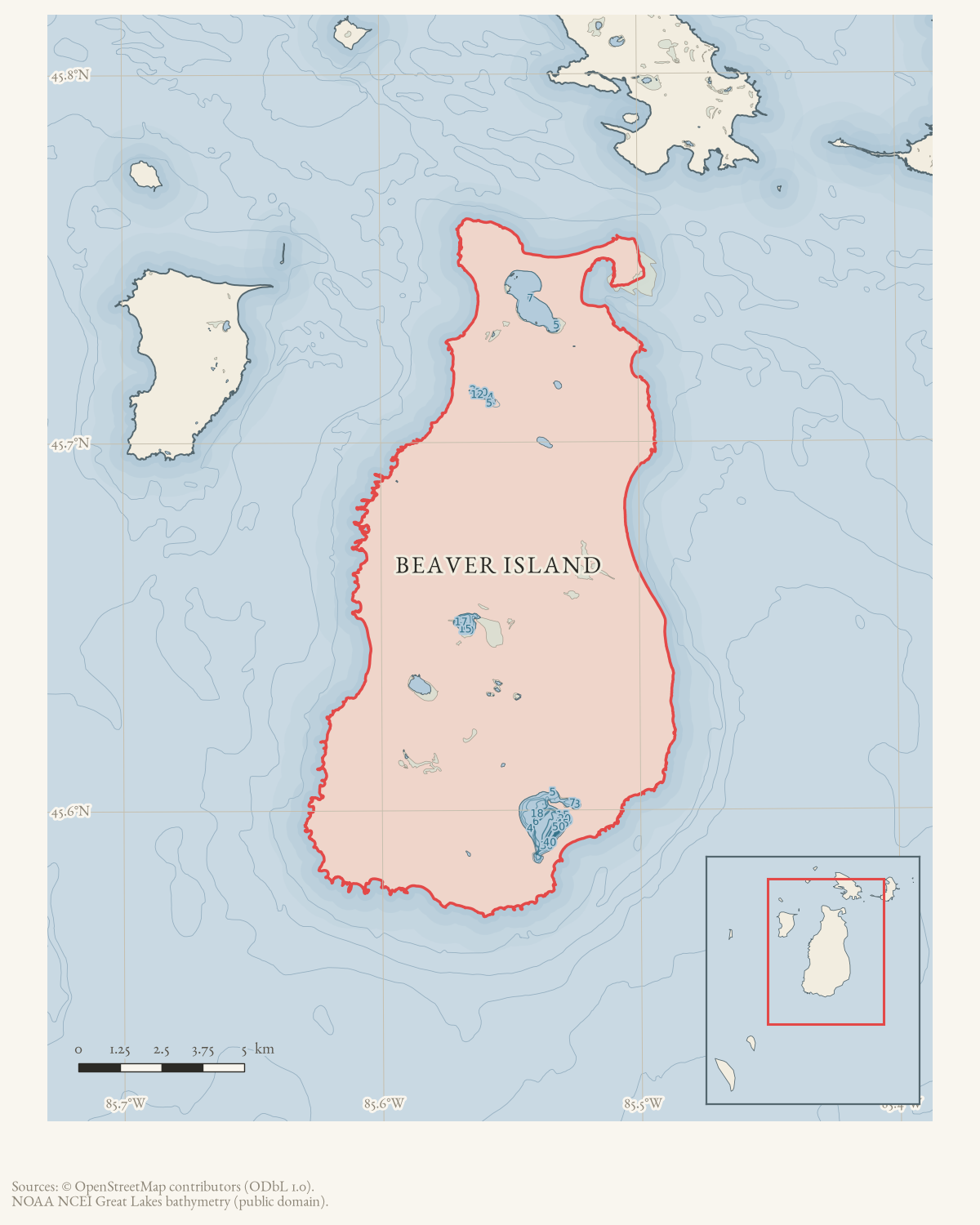
- 45.7364° N, 85.5250° WGoogle Maps: Beaver Island Medical CenterDownload KML
- Eras
- Modern era
- Concepts
- healthcarecommunitygovernanceeconomyconstructioncommunication
- Within
- Beaver Island
Summary
Beaver Island Medical Center was the archipelago’s hospital-licensed medical facility at St. James from the 1950s through the 1980s. The year in this article’s id, 1971, is neither a founding nor a closing date: it marks the fullest surviving administrative account of the Center’s operations, a signed report by its physician, Dr. Joseph W. Christie, published that November. It held a Michigan hospital and maternity license, Medicaid and Crippled Children Program certification, and Title XVIII emergency-services coverage for patients over 65. A 1953 community organizing drive, led by what became the Beaver Island Civic Association, raised funds and built the facility; sources disagree on whether it opened in 1953, 1954, or 1955. A succession of resident physicians (Vail, Luton, Schochet, Haynes, and Christie) served through 1979, when the Center reorganized as a Community Medical Center under a governing board with a full-time state-employed physician. Community fundraising, led largely by the Medical Center Auxiliary, financed equipment purchases and a 1977–78 building addition. After Dr. Leonard Siudara ended his practice privileges in 1985, staffing shifted to a nurse practitioner under supervising mainland physicians, still the model during a reported 1991 financial crisis.
History
A later local-history account, “The Beginning of the Beaver Island Medical Center,” states that residents held an island-wide meeting at the Parish Hall on January 16, 1953, after a Bay City doctor said he would come only if the island provided a modest hospital. A February 4 meeting elected officers for the Beaver Island Civic Club, soon renamed the Beaver Island Civic Association, which raised funds, chose Dr. Harry Vail as physician, and agreed on March 16, 1953 to buy the current site. The account states the Center opened in 1954; the Beacon itself described the Center in September 1973 as having opened “20 years ago,”1 implying circa 1953, and current Beaver Island Rural Health Center material instead dates the institution to 1955. No single held record reconciles these three dates.
Vail announced his departure on May 1, 1956, and left his X-ray equipment to the Center as a gift; the townships announced later that year that Center utilities would be subsidized. A search drawing 28 inquiries settled on Dr. Frank Luton, who took up permanent residence October 29, 1956, and served until his planned retirement on June 30, 1961. A recruitment campaign then selected Dr. Sidney S. Schochet of Sault Ste. Marie, who a later account says left after eight months; Dr. H. B. Haynes succeeded him. The Beacon reported Haynes’s death in November 1967 after five years of island service and credited him with helping found the Beaver Island Christian Church. Indianapolis donor D. J. Angus, who had “helped very materially with the construction of the building,” gave the Center recurring $500 Christmas gifts reported in 1960 and 1961.
By 1971 Dr. Joseph W. Christie had succeeded Haynes as physician and administrator. His signed account in the November 1971 Beacon, the fullest surviving description of the Center’s own operations, reports a hospital license and a maternity license issued yearly by the Michigan Department of Public Health, certification for care under Medicaid and the Crippled Children Program, and emergency-service coverage for patients over 65 under Title XVIII of the Social Security Act.2 The Center belonged to the North Central Michigan Comprehensive Health Planning Council. Staff included three registered nurses and two registered practical nurses; equipment included oxygen and resuscitation apparatus, an incubator, and intravenous therapy, though the Center held no blood bank. An Auxiliary formed around 1968 had furnished a Cambridge EKG machine, and increased Beaver Island Telephone Company circuits to Petoskey let the Center transmit cardiac tracings to mainland heart stations for consultation. Christie reported cooperation with the Burns Clinic’s laboratory departments, daytime air-ambulance transport, and nighttime use of the Coast Guard helicopter from Traverse City, and wrote that a drive was underway to double the Center’s capacity, with a probable completion date of July 1, 1973.
The February 1972 Beacon described the Auxiliary’s plan, under president Mrs. William Welke, to duplicate the Center’s size: a state-mandated shielded X-ray room and darkroom moved to the first floor, expanded laboratory space, and a room usable as a funeral parlor or children’s clinic. By January 1973 Christie reported that the townships had approved a Center constitution and bylaws providing for a seven-member board drawn from the townships, the Civic Association, and the Medical Center Auxiliary, with a tentative five-bed, two-emergency-room addition. That fall the license and the state physician subsidy came into doubt: the Michigan Department of Public Health, after asking in 1972 for the facility to be modernized, was now questioning the requested improvements, the license was set to expire June 1, 1974, and the State Auditor doubted continued funding of the subsidy. Islanders were asked to write legislators. On November 19, 1973, the department’s Dr. Robert S. Libke and Dr. John L. Isbister issued a news release, reprinted in the Beacon, denying any plan to withdraw the arrangement.
In November 1977 the Center broke ground on a north addition for a new X-ray room, laboratory, dental clinic, and emergency room. A fund drive followed: a New Year’s Eve party, a July benefit dance, and community donations. By September 1978 the Building Fund had passed $28,000, more than $40,000 combined with Auxiliary funds. The expanded Center was dedicated December 3, 1978; the Beacon reported a final fund total of $36,328.14 covering construction and a new $20,000 X-ray machine, and noted the dedication coincided with the Center’s twenty-fifth year and Christie’s fiftieth year in medical practice.
Effective April 16, 1979, the Center became a Community Medical Center governed by a board, with a full-time state-employed physician and a published fee schedule. Christie retired December 30, 1979, one day before his seventy-fifth birthday, and Dr. Leonard Siudara was welcomed as his successor; Christie died February 13, 1985, in Port Charlotte, Florida. Siudara announced by open letter that he would surrender his privileges to practice after June 30, 1985. Nurse practitioner Michael McGinnity then took over, beginning July 1 under the supervision of three Charlevoix physicians, with weekly physician attendance; that August the board appealed for payment of outstanding bills to keep the Center financially sound. By August 1986 the island’s Fire Department had equipped a used ambulance and licensed seven EMTs as an Emergency Medical Service division, with about $1,800 of the initial equipment paid by the Medical Center. In October 1991 the Medical Auxiliary announced a raffle, with $2,000 in prizes, to support Center operations during what the Beacon’s own headline called a financial crisis.
Significance
The Center is the clearest instance in the held record of an island institution built and sustained by subscription rather than by a public budget. It began because a mainland physician set a condition the island had to meet itself, and every subsequent expansion — the Auxiliary’s EKG machine, the 1977–78 addition, the $20,000 X-ray machine — was paid for the same way, by dances, raffles, benefit parties and door-to-door collection. That model is also the Center’s recurring vulnerability: the 1973–74 licensing and subsidy scare, the 1985 appeal for unpaid bills, and the 1991 raffle held during what the Beacon itself called a financial crisis all turn on the gap between what a state licence required and what roughly four hundred year-round residents could raise.
Its staffing history traces a change in how remote American communities were covered medically. For three decades the answer was a resident physician recruited by the island and often housed by it — Vail, Luton, Schochet, Haynes, Christie. After 1979 the answer was a state-employed physician under a governing board, and after 1985 a nurse practitioner supervised by mainland doctors at a distance, working alongside a volunteer ambulance service the Center itself helped equip. The technology followed the same path outward: cardiac tracings sent to Petoskey over added telephone circuits, laboratory work referred to the Burns Clinic, and patients moved by air ambulance or by Coast Guard helicopter at night. What the Center could do on the island mattered less over time than how quickly it could reach what it could not.
Evidence and limits
Most of this record is contemporary Beaver Beacon reporting: administrator accounts, board and Auxiliary notices, financial summaries. It is not audited accounts, licenses, or facility inspections. The founding sequence and the 1956–1971 physician succession rest chiefly on a retrospective local-history account published decades later; its reported 1954 opening conflicts with both the Beacon’s own 1973 anniversary reference and current Rural Health Center material. Reported fundraising totals are the newspaper’s presented sums, not audited ledgers.
Open questions
- Do Civic Association records, township minutes, or a state licensing file establish whether the Center opened in 1953, 1954, or 1955?
- What later record documents the Center’s relationship to the 2004 Beaver Island Rural Health Center?
- What resolved the 1973–74 licensing and subsidy questions, and what condition was the Center in after the 1991 financial crisis?
See also
- Reported Civic Association formation and Medical Center organizing drive, 1953
- Joseph W. Christie
- Beaver Island Medical Center Auxiliary
- Beaver Island Civic Association
- Beaver Island Telephone Company
- Island health, medicine, and care
- Beaver Island Medical Center license and subsidy crisis, 1973
- Beaver Island Medical Center transitions to community governance, 1979
Sources
See the sources: block above. Footnotes cite the specific claims checked
directly against the held issue text.
Footnotes
The dated record
Sources
- A first-person community discussion raised concerns about a temporary shortage of Commission on Aging in-home assistance and discussed a possible relationship between the COA and Beaver Island Rural Health Center; the original poster corrected one contract reference. This is community testimony and advocacy, not an agency statement, contract, client count, or verified staffing history.forum · www.beaverislandforum.com · 07 · t007523
- Administrator Joseph W. Christie describes a hospital license, annual maternity license, Medicaid and Crippled Children certification, emergency services for older patients, equipment and staffing, telephone-linked ECG consultation, daytime air ambulance and nighttime Coast Guard helicopter use, and a drive to double capacity; this is a contemporary administrator’s account, not a complete state licensing or facility survey.data1 · beaver-island-archive · beaver_beacon · 1971-11_Beaver-Beacon
- The held ten-page issue scan is paired with the OCR source and confirms the published notice or report; it does not expand the source-specific identity, event, or outcome claims.data1 · beaver-island-archive · scans · beaver_beacon · issues · 1971-11_Beaver-Beacon
- Reports the Auxiliary’s project to duplicate the facility’s size, move shielded X-ray and dark-room functions to the first floor, expand laboratory capacity, add storage and flexible clinic/funeral-parlor space, and keep obstetrical patients separate; it does not establish completion, permits, costs, or the final building layout.data1 · beaver-island-archive · beaver_beacon · 1972-02_Beaver-Beacon
- The held eight-page issue scan is paired with the OCR source and confirms the published notice or report; it does not expand the source-specific identity, event, or outcome claims.data1 · beaver-island-archive · scans · beaver_beacon · issues · 1972-02_Beaver-Beacon
- Reports two births at the Medical Center on May 5 and May 24 and the Auxiliary’s planned garage sale and luncheon fundraising schedule; it does not replace birth, medical, financial, or facility records.data1 · beaver-island-archive · beaver_beacon · 1972-05_Beaver-Beacon
- The held eight-page issue scan is paired with the OCR source and confirms the published notice or report; it does not expand the source-specific identity, event, or outcome claims.data1 · beaver-island-archive · scans · beaver_beacon · issues · 1972-05_Beaver-Beacon
- Reports the January 18 progress report, township approval of the constitution and bylaws, the seven-member board-selection plan, a tentative five-bed/two-emergency-room addition, and funding paperwork; it does not establish construction, permits, or final capacity.data1 · beaver-island-archive · beaver_beacon · 1973-01_Beaver-Beacon
- The held seven-page issue scan is paired with the OCR source and confirms the published notice or report; it does not expand the source-specific identity, event, or outcome claims.data1 · beaver-island-archive · scans · beaver_beacon · issues · 1973-01_Beaver-Beacon
- Reports questions about state support, requested improvements and expansion, the physician subsidy, and a June 1, 1974 license expiration; it does not establish a later policy or construction outcome.data1 · beaver-island-archive · beaver_beacon · 1973-09_Beaver-Beacon
- The held eleven-page issue scan is paired with the OCR source and confirms the combined September–October publication; it does not expand the published source-specific identity, event, or outcome claims.data1 · beaver-island-archive · scans · beaver_beacon · issues · 1973-09_Beaver-Beacon
- Reports state assurances that physician support and Medical Center approval were not being withdrawn, plus a planned early-1974 visit to discuss clinic-facility problems.data1 · beaver-island-archive · beaver_beacon · 1973-11_Beaver-Beacon
- The held ten-page issue scan is paired with the OCR source and confirms the published notice or report; it does not expand the source-specific identity, event, or outcome claims.data1 · beaver-island-archive · scans · beaver_beacon · issues · 1973-11_Beaver-Beacon
- Reports the Medical Center Auxiliary’s thanks for a $100 donation from the Beaver Island Club of Grand Rapids; it supplies no receipt, fund ledger, restrictions, or later use.data1 · beaver-island-archive · beaver_beacon · 1974-01_Beaver-Beacon
- The held six-page issue scan is paired with the OCR source and confirms the published notice or report; it does not expand the source-specific identity, event, or outcome claims.data1 · beaver-island-archive · scans · beaver_beacon · issues · 1974-01_Beaver-Beacon
- Reports D. J. Angus's $500 contribution to the Medical Center and credits earlier material help toward construction. It does not provide a receipt, donor biography, or expenditure record.data1 · beaver-island-archive · beaver_beacon · 1961-01_Beaver-Beacon
- The held five-page issue scan is paired with the OCR source and confirms the published notice or report; it does not expand the source-specific identity, event, or outcome claims.data1 · beaver-island-archive · scans · beaver_beacon · issues · 1961-01_Beaver-Beacon
- Three holiday notices announce donations to the Medical Center Building Fund instead of sending cards: LaFreniere’s Store, Beachcomber Tavern, and Loy Malloy. The issue supplies no amounts, receipts, fund ledger, or accounting of later use.data1 · beaver-island-archive · beaver_beacon · 1974-12_Beaver-Beacon
- The held nine-page issue scan is paired with the OCR source and confirms the published notice or report; it does not expand the source-specific identity, event, or outcome claims.data1 · beaver-island-archive · scans · beaver_beacon · issues · 1974-12_Beaver-Beacon
- Reports A. J. Angus of the Esterling-Angus Company sent a $500 Christmas gift for Medical Center equipment and maintenance and had earlier helped materially with construction. It does not provide a receipt, construction ledger, or later expenditure record.data1 · beaver-island-archive · beaver_beacon · 1960-01_Beaver-Beacon
- The held four-page issue scan is paired with the OCR source and confirms the published notice or report; it does not expand the source-specific identity, event, or outcome claims.data1 · beaver-island-archive · scans · beaver_beacon · issues · 1960-01_Beaver-Beacon
- Publishes the 1959 Medical Center fund figures: a $500 Angus check, $692.31 in listed expenses, and $630.57 on hand at year end. It is a newspaper report, not an audited ledger or facility account.data1 · beaver-island-archive · beaver_beacon · 1960-02_Beaver-Beacon
- The held seven-page issue scan is paired with the OCR source and confirms the published notice or report; it does not expand the source-specific identity, event, or outcome claims.data1 · beaver-island-archive · scans · beaver_beacon · issues · 1960-02_Beaver-Beacon
- Reports the November 12 operation on Kurt Van Buren at the medical center and names the visiting physicians, anesthesiologist, and surgical-ward head. It does not provide patient, operative, licensing, or staffing records.data1 · beaver-island-archive · beaver_beacon · 1960-12_Beaver-Beacon
- The held five-page issue scan is paired with the OCR source and confirms the published notice or report; it does not expand the source-specific identity, event, or outcome claims.data1 · beaver-island-archive · scans · beaver_beacon · issues · 1960-12_Beaver-Beacon
- Reports Jennifer Ann Wozan born at the Medical Center and says L. Rowena Neal was active in licensing the Center since its beginning. These notices do not replace a birth register, licensing file, or facility history. The holding institution's portal restricts automated access; the archive holds a copy of this issue and can provide it on request.data1 · beaver-island-archive · beaver_beacon · 1975-02_Beaver-Beacon
- The scan confirms the Medical Center birth and licensing references.data1 · beaver-island-archive · scans · beaver_beacon · issues · 1975-02_Beaver-Beacon
- Reports holiday notices from LaFreniere’s Store and Beachcomber Tavern announcing donations to the Medical Center Building Fund instead of sending cards. It supplies no receipts, amounts, fund ledger, or later use. The holding institution's portal restricts automated access; the archive holds a copy of this issue and can provide it on request.data1 · beaver-island-archive · beaver_beacon · 1975-12_Beaver-Beacon
- The held issue confirms the two Building Fund donation notices.data1 · beaver-island-archive · scans · beaver_beacon · issues · 1975-12_Beaver-Beacon
- Reports completion of school fluoride therapy, a well-attended Swine Flu inoculation clinic, an additional vaccine supply, and publicizing the Medical Center’s part in a rural-services Preceptor Program. It does not replace clinical, immunization, school-health, or program records. The holding institution's portal restricts automated access; the archive holds a copy of this issue and can provide it on request.data1 · beaver-island-archive · beaver_beacon · 1976-11_Beaver-Beacon
- The held issue confirms the November Medical Center report.data1 · beaver-island-archive · scans · beaver_beacon · issues · 1976-11_Beaver-Beacon
- Prints LaFreniere’s Store announcing a donation to the Medical Center Building Fund and Beachcomber Tavern announcing a donation to the Medical Center Auxiliary instead of sending cards. It supplies no amounts, receipts, fund ledger, or later use. The holding institution's portal restricts automated access; the archive holds a copy of this issue and can provide it on request.data1 · beaver-island-archive · beaver_beacon · 1976-12_Beaver-Beacon
- The held issue confirms the two Medical Center support notices.data1 · beaver-island-archive · scans · beaver_beacon · issues · 1976-12_Beaver-Beacon
- Retrospective local-history account of the reported January 16, 1953 Parish Hall meeting, the February 4 election of Civic Club/Civic Association officers, the choice of Dr. Harry Vail, and the March 16, 1953 site purchase; a later account published decades after the events, not contemporaneous minutes.
- States the Center opened in 1954, describes Dr. Vail’s tenure, and reports his May 1, 1956 departure notice; a retrospective account, not a licensing or facility record.
- States Dr. Sidney Schochet left after eight months, that Dr. H. B. Haynes then served, and that Dr. Christie succeeded Haynes; a retrospective account not corroborated here by employment or licensing records.
- Reports State Health Commissioner Albert E. Heustis’s appeal for a replacement physician after Dr. Vail’s planned September 14, 1956 departure. The holding institution's portal restricts automated access; the archive holds a copy of this issue and can provide it on request.data1 · beaver-island-archive · beaver_beacon · 1956-08_Beaver-Beacon
- Reports 28 inquiries for the physician position and a field narrowed to four candidates without a selection. The holding institution's portal restricts automated access; the archive holds a copy of this issue and can provide it on request.data1 · beaver-island-archive · beaver_beacon · 1956-09_Beaver-Beacon
- Reports that Dr. Frank Luton accepted the resident-physician position and began permanent residence on Beaver Island October 29, 1956. The holding institution's portal restricts automated access; the archive holds a copy of this issue and can provide it on request.data1 · beaver-island-archive · beaver_beacon · 1956-11_Beaver-Beacon
- Reports that St. James and Peaine Townships announced future subsidies for Medical Center utilities. The holding institution's portal restricts automated access; the archive holds a copy of this issue and can provide it on request.data1 · beaver-island-archive · beaver_beacon · 1956-11_Beaver-Beacon
- Reports that Dr. and Mrs. Vail left their entire X-ray equipment to the Medical Center after leaving the island. The holding institution's portal restricts automated access; the archive holds a copy of this issue and can provide it on request.data1 · beaver-island-archive · beaver_beacon · 1956-12_Beaver-Beacon
- Reports Mr. A. J. Angus of the Esterline-Angus Co. sending a $500 Christmas gift and recalls that Angus "helped us very materially with the construction of the building."data1 · beaver-island-archive · beaver_beacon · 1960-01_Beaver-Beacon
- Reports the Doctor Procurement Committee’s selection of Dr. Sidney S. Schochet of Sault Ste. Marie to replace the retiring Dr. Luton, with duties to begin September 1, 1961.data1 · beaver-island-archive · beaver_beacon · 1961-08_Beaver-Beacon
- Reports Dr. H. B. Haynes’s death after five years as island physician and his role in founding the Beaver Island Christian Church.data1 · beaver-island-archive · beaver_beacon · 1967-11_Beaver-Beacon
- Reports the November 5, 1977 groundbreaking for a north addition with new X-ray, laboratory, dental, and emergency-room space. The holding institution's portal restricts automated access; the archive holds a copy of this issue and can provide it on request.data1 · beaver-island-archive · beaver_beacon · 1977-10_Beaver-Beacon
- Reports the addition taking shape and $765.80 raised at a New Year’s Eve party at Holy Cross Hall. The holding institution's portal restricts automated access; the archive holds a copy of this issue and can provide it on request.data1 · beaver-island-archive · beaver_beacon · 1978-01_Beaver-Beacon
- Reports a July 22 benefit dance netting over $2,800, the Building Fund passing $28,000, and combined Building Fund/Auxiliary totals exceeding $40,000. The holding institution's portal restricts automated access; the archive holds a copy of this issue and can provide it on request.data1 · beaver-island-archive · beaver_beacon · 1978-08_Beaver-Beacon
- Reports the December 3, 1978 open house and dedication, Fr. Alvin Yard’s blessing, a $36,328.14 fund total covering construction and a $20,000 X-ray machine, and that the dedication coincided with the Center’s twenty-fifth year and Dr. Christie’s fiftieth year in practice. The holding institution's portal restricts automated access; the archive holds a copy of this issue and can provide it on request.data1 · beaver-island-archive · beaver_beacon · 1978-11_Beaver-Beacon
- Reports the April 16, 1979 change to a Community Medical Center governed by a board, with a full-time Michigan Department of Public Health physician and a new fee schedule. The holding institution's portal restricts automated access; the archive holds a copy of this issue and can provide it on request.data1 · beaver-island-archive · beaver_beacon · 1979-04_Beaver-Beacon
- Reports Dr. Christie’s December 30, 1979 retirement, one day before his seventy-fifth birthday, and the community welcome to new physician Dr. Leonard Siudara. The holding institution's portal restricts automated access; the archive holds a copy of this issue and can provide it on request.data1 · beaver-island-archive · beaver_beacon · 1979-12_Beaver-Beacon
- Reports Dr. Christie’s February 13, 1985 death in Port Charlotte, Florida, and a planned spring memorial Mass and burial at Holy Cross. The holding institution's portal restricts automated access; the archive holds a copy of this issue and can provide it on request.data1 · beaver-island-archive · beaver_beacon · 1985-03_Beaver-Beacon
- States that after June 30, 1985 Siudara would surrender his privileges to practice acute, chronic, and consultant medicine. The holding institution's portal restricts automated access; the archive holds a copy of this issue and can provide it on request.data1 · beaver-island-archive · beaver_beacon · 1985-05_Beaver-Beacon
- Reports nurse practitioner Michael McGinnity beginning July 1, 1985 under the supervision of Charlevoix physicians James Stewart, Dennis Joy, and Edward Newcombe, with weekly physician attendance. The holding institution's portal restricts automated access; the archive holds a copy of this issue and can provide it on request.data1 · beaver-island-archive · beaver_beacon · 1985-07_Beaver-Beacon
- Reports the Board’s appeal for payment of outstanding medical and dental bills to keep the Center financially sound. The holding institution's portal restricts automated access; the archive holds a copy of this issue and can provide it on request.data1 · beaver-island-archive · beaver_beacon · 1985-08_Beaver-Beacon
- Reports the Fire Department’s equipped ambulance and seven licensed EMTs by August 1986, with about $1,800 in initial equipment paid by the Medical Center. The holding institution's portal restricts automated access; the archive holds a copy of this issue and can provide it on request.data1 · beaver-island-archive · beaver_beacon · 1986-11_Beaver-Beacon
- Announces a Medical Auxiliary raffle with $2,000 in prizes, proceeds for Medical Center operations, during a stated financial crisis. The holding institution's portal restricts automated access; the archive holds a copy of this issue and can provide it on request.data1 · beaver-island-archive · beaver_beacon · 1991-10_Beaver-Beacon
- The current successor organization publishes 37304 King's Highway and an embedded map at approximately 45.7364274, -85.5250328. This is a current successor-site representative for the historical Medical Center, not proof that every 1950s–1990s facility stood on the same parcel; the article's own succession record leaves that relationship open.
Added 1 August 2026 · revised 4 August 2026. Recent changes
Cite this article
Beaver Island Archive, “Beaver Island Medical Center”, https://beaverislandarchive.org/organizations/beaver-island-medical-center-1971/, accessed [date], citing Pam Moxham and forum participants, "If not- why not?," Beaver Island Forum, June 14–16, 2014. (and 56 further sources listed on the page).
Last revised 2026-08-04. Fill in [date] with the date you read it — this page is static and cannot know that.
BibTeX for “Beaver Island Medical Center”RIS for “Beaver Island Medical Center”